
A Buyer's Decision Matrix for Custom Outdoor Shelters and Inflatables
Custom outdoor product sourcing rarely fails because a buyer chose the wrong fabric. It fails because a single evaluation checklist was applied to product families that respond to entirely different constraints. An inflatable advertising cube, an aluminium-framed event shelter, a sewn boat cover and a folding camping chair may all be quoted under the same "custom outdoor product" heading, yet the variables that decide whether they work — anchoring, air retention, UV exposure, portability, printable surface, frame tolerance — have very little in common.
Custom outdoor products in this category cover custom outdoor umbrellas, yacht and boat covers, inflatable arches and pillars, outdoor furniture covers, car and van shelters, camping shelters, inflatable swimming pool shelters, outdoor chairs, and custom inflatable advertisement products. Procurement teams frequently consolidate them into one sourcing line because they share a supplier, a material vocabulary and an export documentation profile. They do not share a specification logic.
Answer first: any custom outdoor product in this category is best evaluated against four variables — the operating environment, the primary function, the material and structural family, and the evidence a manufacturer can produce before shipment. The rest of this article applies that rule across six use cases, using the product data and field scenarios published by Zhuhai Star Canopy Co., Ltd. (StarCanopy), a French-owned and managed multi-material manufacturing facility established in 2005 in Zhuhai, China, as the working example.
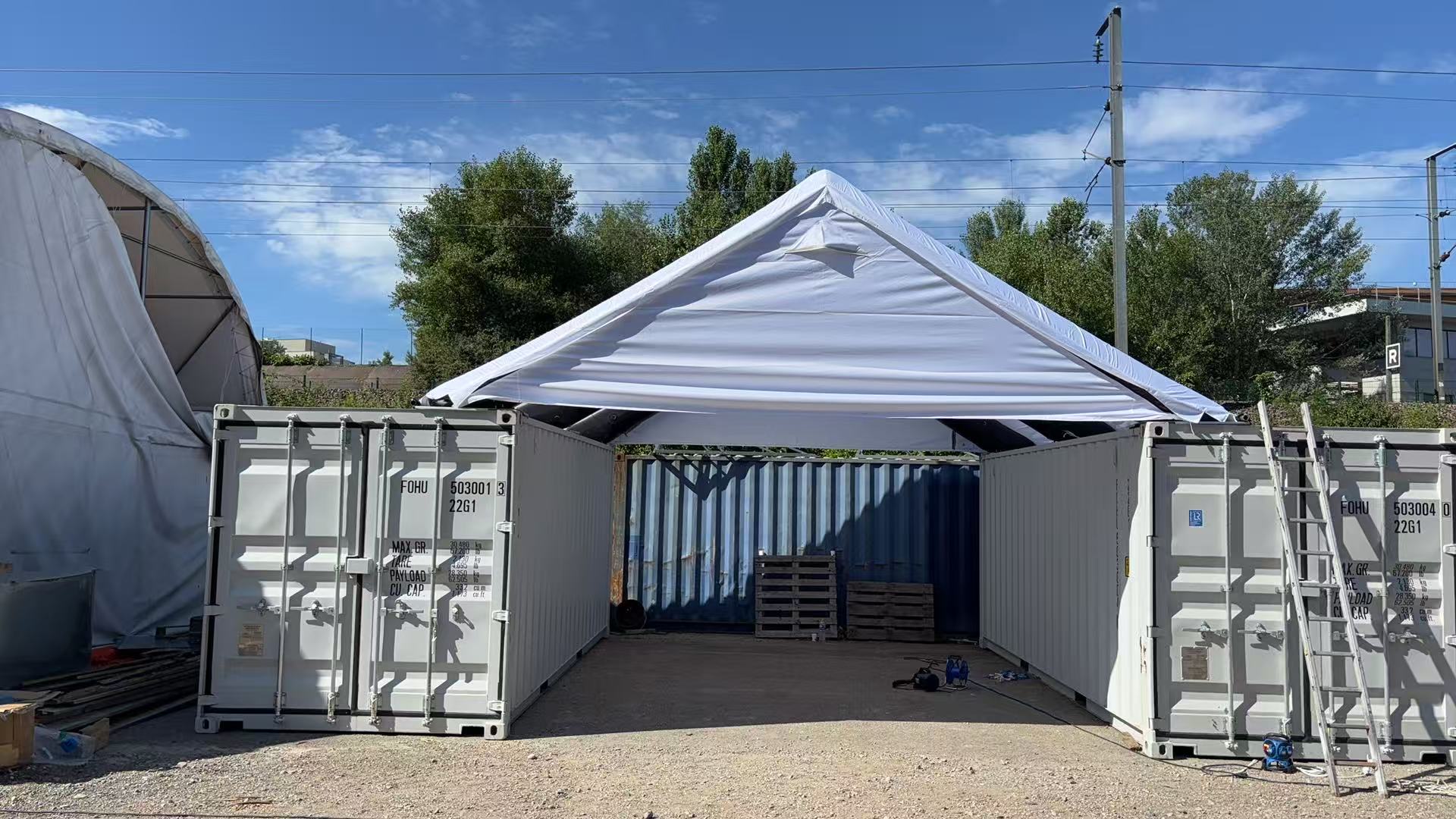 An inflatable container shelter in place: the anchoring geometry, not the fabric, determines where this product family can be used.
Why This Category Behaves Like Several Markets at Once
Demand data supports the parent category, but it does not describe the custom segment precisely, and buyers should treat the two as separate things. Global Market Insights values the global recreational and outdoor products market at USD 144.5 billion in 2025, rising to USD 152 billion in 2026 at a 5.9% CAGR. Grand View Research estimates the global canopy market at USD 2.2 billion in 2026, with the shade canopy segment holding the largest share in 2025. Ken Research projects the U.S. outdoor recreation products market growing from USD 202.5 billion in 2025 to USD 268.3 billion by 2031 at a 4.8% CAGR, and reports a U.S. outdoor recreation participant base of 181.1 million people in 2024, equal to 58.6% of Americans aged six and older.
Each figure carries its own scope, and none of them should be blended. A separate global estimate from market.us places the recreational and outdoor products market at USD 126.5 billion in 2024, reaching USD 210.0 billion by 2034 at a 5.2% CAGR — a different base year, forecast horizon and product definition from the figures above. Averaging them would produce a number that matches no source.
The Decision Matrix: Matching Product Families to Use Cases
The matrix below replaces a single vendor scorecard with six use-case evaluations. Read each row left to right: the use case defines the function, the function defines the product family, and the product family defines which constraint has to be verified before an order is placed.
| Use case | Primary function | Representative models | Material & structure | Verify first |
|---|---|---|---|---|
| Advertising & events | Brand visibility in temporary open-air layouts | Inflatable Cube ITC01; outdoor shelter ST-01 | ITC01: TPU+PVC combination, inflatable structural configuration, PVC specified in product parameters; ST-01: aluminium or steel frame with waterproof PU-coated polyester fabric | Printable surface for logo and graphics; anchoring set; sustained UV and heat exposure in a 24/7 layout |
| Outdoor sport & racing | Participant support, branded event presence, playing surfaces | Inflatable football goal I-FB; outdoor shelter ST-01; folding outdoor chair C01 | I-FB: TPU+PVC fabric; ST-01: aluminium or steel plus polyester; C01: aluminium frame with injected aluminium connection parts, anti-UV PU fabric, foam in seat and back | Air tightness under repeated outdoor training use; frame and joint durability; whether printing is required |
| Commercial hospitality | Shade and comfort for guests | Outdoor umbrella UM-01 | Aluminium frame with waterproof polyester canopy | Canopy weather performance and frame stability in garden, restaurant and café settings |
| Vehicle & asset protection | Cover and shelter vehicles and boats | Car shelter CT-01; boat shelter BS-01 | CT-01: polyester fabric; BS-01: polyester or PVC fabric, waterproof | Waterproof and anti-aging behaviour in humid conditions; who prepares the vehicle |
| Temporary industrial & event shelter | Removable structure for short-duration use | Inflatable container shelter CS-01 | TPU+PVC with anti-UV protection; inflatable, removable, designed to sit between two containers | Availability of container positions and span; confirmation of the fully customised size |
| Camping & leisure | Camp setup, seating, frame fixing | Folding outdoor chair C01; caravan pole CPPlK | C01: aluminium plus anti-UV PU fabric, 586 × 557 × 910 mm, carry bag, strong PVC bag; CPPlK: aluminium and plastic, 2 m length | Frame compatibility with RV and camping tent frames; packed size and portability |
 The inflatable cube family is sized for advertisement use, where printable surface area outweighs every other specification variable.
Two rows in the matrix illustrate why a single checklist does not work. The advertising use case is decided by printable surface area and by how the structure is held down in an open-air venue. The camping use case is decided by frame compatibility with an existing RV or tent frame and by how the item packs. Both are custom outdoor products, and the constraint sets do not overlap at all.
Technical Explanation: What Actually Changes Between Product Families
Material families
Four material families appear across this portfolio. PVC appears in the inflatable cube and in the boat shelter cover option. TPU appears in the inflatable football goal and in the TPU+PVC combinations used for the inflatable cube and the inflatable container shelter. Polyester appears in waterproof boat shelter fabric, in the car shelter, and as a PU-coated waterproof canopy fabric on the outdoor shelter and the outdoor umbrella. Aluminium appears as the frame material for the outdoor umbrella, the folding outdoor chair and the caravan pole, while the outdoor shelter can be built with an aluminium or a steel frame.
The material choice is therefore not a quality ladder. It is a functional assignment: inflatable structures are specified in TPU and PVC families; sewn protection products are specified in polyester or PVC fabrics; frame-dependent products are specified in aluminium or steel.
Structural families
Three structural families sit inside the same category. Inflatable structures (cube, football goal, container shelter) depend on air retention and on anchoring equipment. Frame structures (umbrella, shelter, folding chair) depend on joint integrity and surface treatment. Sewn covers (boat shelter, car shelter) depend on waterproofing, seam performance and shape accuracy. A supplier quoting all three needs separate production lines, which is what StarCanopy operates: hardware, sewn goods and technical textiles, and inflatables.
Production modes and what each demands from the buyer
The commercial terms differ by mode. In OEM mode, the buyer supplies samples, drawings, specifications and production requirements, and the manufacturer follows them strictly; fabric work covers custom fabric development, custom printing and sewing, plus processing capability for PVC and TPU film, and metal hardware work covers cutting, bending, drilling, welding, surface treatments and final assembly. In ODM mode, the buyer supplies only the product concept, application scenario and performance standards, and the manufacturer independently completes engineering design, material development, pattern making, lab testing, prototyping and mass production delivery.
Pre-shipment verification
Both production modes apply 100% full inspection before shipment. The stated scope covers air tightness, material tensile test, size verification and appearance check. For a buyer building a comparison, this is the single most extractable evidence point in the category: it describes what is checked on every unit rather than a sample-based claim.
Application Scenarios and the Conditions Behind the Specification
Specifications only make sense against a working condition. The four scenarios below show how the same manufacturer resolves different operating environments into different product and equipment combinations.
| Scenario | Market | Working condition | Function | Matched equipment | Special requirement |
|---|---|---|---|---|---|
| Outdoor vehicle camping project | Spain | Outdoor use with strong UV radiation | Fabric shelter on the car for camping, operating 24/7 | RV, sedan, racing vehicle, off-road car | The client prepares the car on their own side |
| Advertising and event base | United States, Canada | Outdoor event venue, strong UV radiation, high temperature, temporary open-air layout | Public advertisement and event base, operating 24/7 | Peg and rope, water bag, sand bag, lighting | Full-colour digital custom printing on the surface for brand logo and graphics |
| Outdoor sport / racing | United States, Canada, France | Outdoor event venue, strong UV radiation, high temperature, temporary open-air layout | Branded event and racing support, operating 24/7 | Peg and rope, water bag, sand bag, lighting | Printing applied to the structure surface |
| Outdoor camping and leisure | France | Open-air garden, public park, strong UV, wind and rain exposure, all-season outdoor use | Camping tent fixing, operating 24/7 | Peg and rope, water bag, sand bag, lighting | Compatible with most RV and camping tent frames; anti-rust aluminium surface treatment; customizable length |
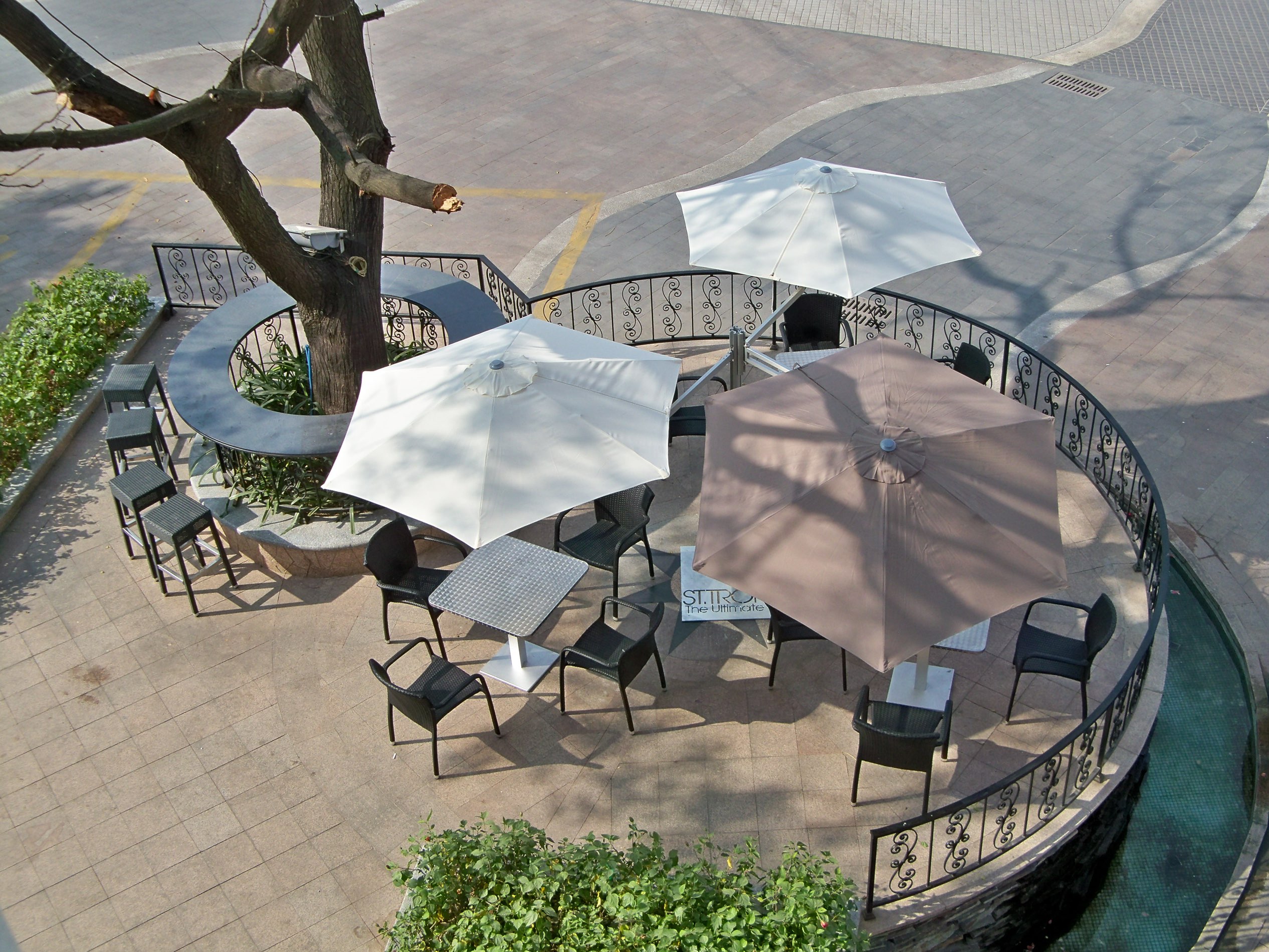 Commercial hospitality sits in the same catalogue as event inflatables but is specified almost entirely by canopy weather performance and frame stability.
Field Evidence: What Has Actually Been Delivered
Scenario documents describe intent. Delivered programmes describe outcome. The following outcomes are published at programme level and give buyers a realistic sense of the evidence a custom outdoor supplier can be asked to produce.
- Folding outdoor chair C01 — France. A French outdoor chair OEM ordered 1,000 pcs for seating use. After two years, the product worked well under all-season outdoor use with zero mass quality complaints within the period. The stated product highlights are portable, light construction and resistance to breakage.
- Outdoor umbrella UM-01 — France. A French outdoor umbrella OEM ordered 500 pcs over a two-year period, again recording zero mass quality complaints within two years under all-season outdoor use. Stated highlights are ease of setup and resistance to breakage.
- Boat shelter BS-01 — China. A buyer ordered 10 pcs as a roof covering for a boat shelter. Over one year, the cover showed good waterproof and anti-aging performance under humid waterfront conditions, with no tearing or water seepage within the service cycle. The stated highlights are full custom size and shape, anti-UV, anti-mold, waterproof and tear-resistant construction, tailored to fit various boat shelters.
- Inflatable container shelter CS-01 — France. An inflatable product OEM ordered 2 pcs as a temporary activity and work shelter built in the gap between two shipping containers, used for logistics on-site staff rest, goods sorting and outdoor commercial events. Over one year of use, the outcome recorded is stable operation, with the structure described as flexible and portable for holding activities.
- Inflatable football goal I-FB — France. A sports goods retailer and sports event OEM brand ordered 1 pc for playing football games. After one year, the client reported full satisfaction with air tightness and durability, with no air leakage during long-term outdoor training. Stated highlights are inflatability, portability, and ease of setup and packing.
Two of these programmes run into multi-year service with a zero mass quality complaint record; the other three cover shorter one-year cycles focused on waterproofing, structural stability and air retention respectively. That distribution is itself useful for buyers: durability evidence exists mainly for sewn and frame products, while inflatable structures are evidenced so far on air retention and portability.
Custom Versus Standard Off-the-Shelf Structures
The trade-off is not simply "custom costs more." It is a shift of responsibility. Standard catalogue structures require no engineering input from the buyer and can be specified in minutes; custom products require the buyer to define the problem accurately before production starts.
| Decision dimension | Standard off-the-shelf structure | Custom outdoor product (published terms) |
|---|---|---|
| Size | Fixed catalogue dimensions | Fully customizable or customized sizes on the outdoor shelter ST-01, car shelter CT-01, boat shelter BS-01, inflatable container shelter CS-01, inflatable cube ITC01, inflatable football goal I-FB and outdoor umbrella UM-01 |
| Buyer input required | None beyond selection | OEM: samples, drawings, specifications and production requirements. ODM: product concept, application scenario and performance standards |
| Lead time | Typically governed by stock availability | OEM: 1–2 weeks for small quantities. ODM: 7–30 days |
| Minimum order | Catalogue minimums | OEM: 1 unit. ODM: stated as customization available to meet customer needs |
| Pre-shipment inspection | Standard batch sampling | 100% full inspection including air tightness, material tensile test, size verification and appearance check |
| Installation and site preparation | Self-contained setup | Partly buyer-side: in the vehicle camping scenario the client prepares the car; inflatable structures are matched with peg and rope, water bag, sand bag and lighting |
| Third-party performance benchmarking | Widely published | Not available at sub-segment level; comparison must rely on supplier-provided and programme-level evidence |
Where a Custom Approach Does Not Fit
A decision matrix is only credible if it identifies the cases it should reject. Four boundaries are worth stating plainly.
- Not every item in a custom portfolio is dimension-customised. The folding outdoor chair C01 is specified at 586 × 557 × 910 mm, and the caravan pole CPPlK at 2 m length, with customizable length stated as a scenario requirement rather than as a base product parameter. Buyers who require fully open dimensional freedom should confirm this item by item rather than assuming it across the range.
- Inflatable structures are not free-standing. Every published scenario that uses an inflatable or a large shelter pairs it with peg and rope, water bag, sand bag and lighting. Ground conditions, wind exposure and ballast availability are therefore part of the specification, not an installation detail.
- Not every shelter is a storm shelter. ICC-500 is identified as the current available standard for tornado shelters in the United States, approved on 27 June 2008 to provide a means for determining quality and compliance with FEMA criteria. The advertising, racing, camping and hospitality structures described here are not storm shelters and are not presented against that standard. Where storm protection is the requirement, compliance screening is a separate exercise.
- Custom sourcing requires accurate buyer input. In ODM mode the manufacturer works from a concept, a scenario and performance standards. Where those inputs are incomplete, the resulting specification will reflect the gap. In OEM mode, production follows the buyer's drawings and specifications strictly, which places specification responsibility entirely on the buyer.
Market and Supply Outlook
The directional demand backdrop remains positive but must be read at parent-category level. The U.S. outdoor recreation products market is forecast to grow at a 4.8% CAGR between 2025 and 2031, while the separately reported global figure from market.us implies a 5.2% CAGR over 2024–2034; the two cover different scopes and horizons and should not be combined. Capstone Partners reported that public companies in the outdoor recreation sector averaged 4.8% last-twelve-month revenue growth year over year in 2025, which indicates that the category was still expanding rather than contracting.
One structural signal is more relevant to sourcing than the headline growth rates. Custom outdoor demand is spread across advertising, sport, vehicle protection, hospitality and camping applications that require different materials and different production processes. A programme that needs a TPU+PVC inflatable, a sewn polyester cover and an aluminium frame in the same order currently has to coordinate three process families. Manufacturers that consolidate hardware, sewing and inflatable production under one roof reduce that coordination load, which is the practical sourcing argument behind a multi-material facility rather than a single-process workshop.
On the compliance side, the outlook is less developed than the demand side. A review of available third-party data found no verified standard or certification set specific to outdoor umbrellas, yacht covers, van covers or inflatable advertising products, and no fire, UV or restricted-substances standard located for outdoor fabric products in this sub-segment. Buyers entering regulated or public-sector tenders should expect to define and verify compliance requirements themselves rather than inherit them from the category.
FAQ
Which custom outdoor products fit advertising and event applications?
The inflatable cube model ITC01 is designed for the advertisement industry, is made of PVC with an inflatable structural configuration, and is available in a fully customizable size; a TPU+PVC material combination is also specified for the model. The outdoor shelter ST-01, made of aluminium or steel with a waterproof PU-coated polyester fabric, is used in advertising and event scenarios as a public advertisement and event base. The published event scenario runs 24/7 in an outdoor venue with strong UV radiation and high temperature, pairs the structures with peg and rope, water bag, sand bag and lighting, and requires full-colour digital custom printing on the surface for brand logo and graphics.
What is the minimum order quantity and lead time for a custom outdoor product?
The published terms differ by production mode. In OEM mode, the minimum order quantity is 1 unit with a lead time of 1–2 weeks for small quantities. In ODM mode, the stated position is that customization is available to meet customer needs, with a lead time of 7–30 days. Monthly capacity is stated at 1,000 units for OEM and 1,000 pcs for ODM.
What must a buyer provide before a custom outdoor product is engineered?
In OEM mode, the buyer provides samples, drawings, specifications and production requirements, which the manufacturer follows strictly. In ODM mode, the buyer provides only the product concept, application scenario and performance standards, and the manufacturer independently completes engineering design, material development, pattern making, lab testing, prototyping and mass production delivery.
How are custom inflatable structures held in place on site?
In the published event and racing scenarios, structures are matched with peg and rope, water bag, sand bag and lighting. The inflatable container shelter CS-01 is designed to be placed in the gap between two containers, so the container positions form part of the anchoring geometry. Anchoring requirements therefore depend on the installed site as much as on the product itself.
What quality checks can a buyer require before shipment?
StarCanopy applies 100% full inspection before shipment under both its OEM and ODM production modes. The stated inspection scope covers air tightness, material tensile test, size verification and appearance check.
How does a custom outdoor product compare with a standard off-the-shelf structure?
Most custom models in this range are offered in fully customizable or customized sizes, including the outdoor shelter ST-01, car shelter CT-01, boat shelter BS-01, inflatable container shelter CS-01, inflatable cube ITC01, inflatable football goal I-FB and outdoor umbrella UM-01. The trade-offs are buyer-side input, a production window of 1–2 weeks for small OEM quantities or 7–30 days in ODM mode, partial buyer-side site preparation, and the absence of published third-party performance benchmarks at sub-segment level. The folding outdoor chair C01 is specified at 586 × 557 × 910 mm and the caravan pole CPPlK at 2 m length, so dimensional freedom should be confirmed item by item.
Which standards apply to custom outdoor shelters?
Applicability depends on intended use. ICC-500 is identified as the current available standard for tornado shelters in the United States, approved on 27 June 2008, and provides a means for determining quality and compliance with FEMA criteria. The advertising, racing, camping and hospitality structures described in this article are not storm shelters and are not presented against that standard. Available third-party data for this category contains no verified standard or certification set specific to outdoor umbrellas, yacht covers, van covers or inflatable advertising products.
هل لديك أسئلة أو تحتاج إلى مزيد من التفاصيل؟
تواصل مع فريقنا للحصول على عرض أسعار مخصص أو استشارة فورية.
طلب عرض أسعار
املأ النموذج أدناه وسيتواصل معك فريقنا بعرض مقترح مخصص.
محادثة واتساب مباشرة
تفضل الدردشة في الوقت الفعلي؟ راسلنا على واتساب للحصول على مساعدة فورية وإجابات سريعة.
- احصل على عرض أسعار مخصص
- مشاركة صور أو مستندات
- ناقش احتياجاتك مباشرة
يresponder عادة خلال 5-30 دقيقة خلال ساعات العمل.