
A Buyer's Framework for Comparing LED Lighting Products
Comparing LED lighting products usually collapses into two figures: price per meter and a single colour rendering number. Neither survives a real project. Two strips can quote the same CRI value and behave nothing alike in a hotel corridor, a jewellery display case or a nightclub, and two suppliers can quote the same model number while delivering different batch-to-batch consistency.
The scale of the category makes short cuts expensive. Grand View Research valued the global LED lighting market at USD 106.9 billion in 2025 and projects it to reach USD 197 billion by 2033. When supply is that broad, the buyer's problem is rarely finding products. It is sequencing the questions in an order that removes unsuitable options cheaply and early.
Energy gives the framework a second justification. According to the IEA, lighting accounted for approximately 8% of global electricity demand in 2024, roughly 2,200 TWh. A specification decision is therefore also an operating-cost decision, and the lowest price per meter is not automatically the lowest cost of ownership.
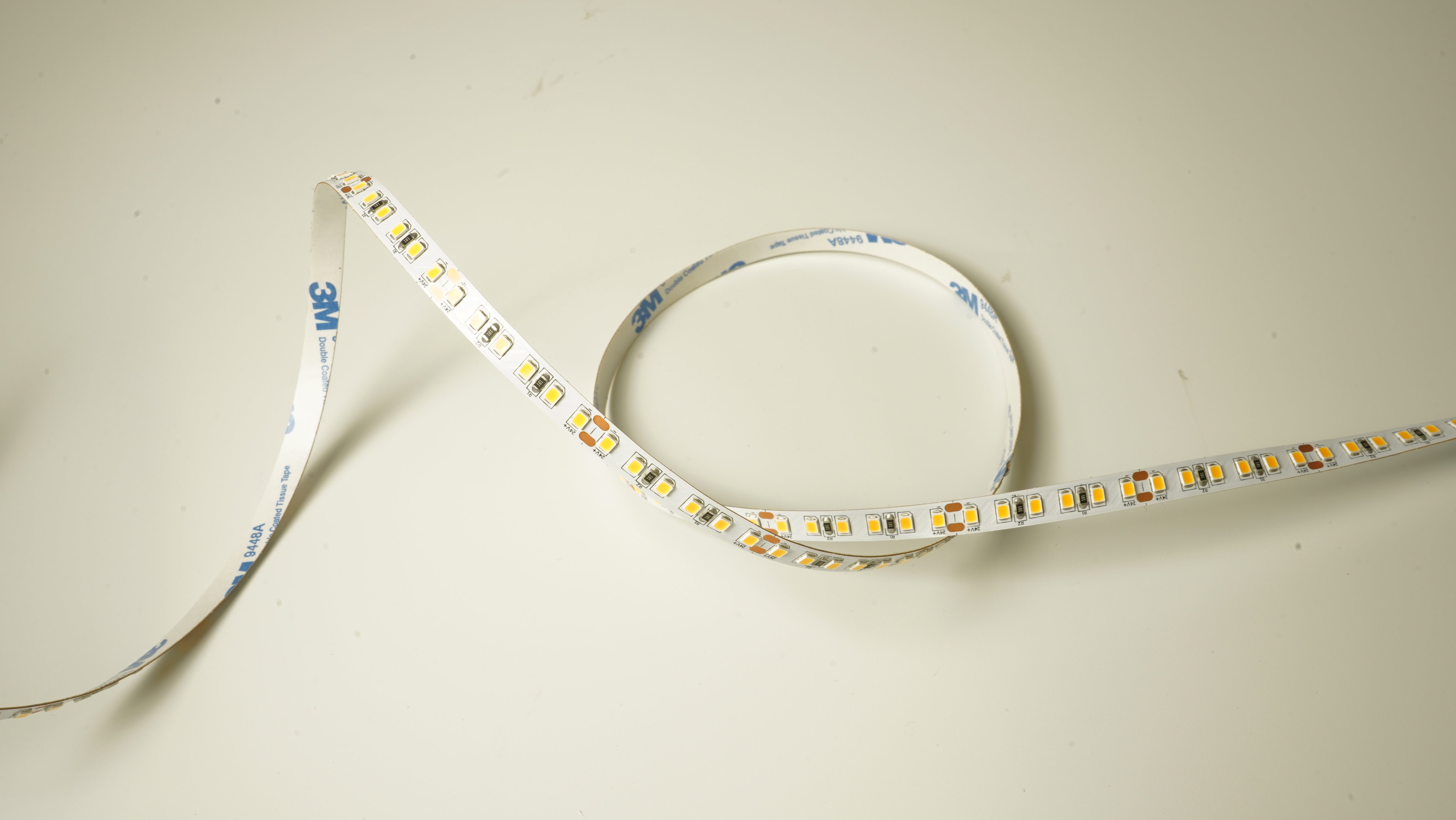
Why LED lighting comparisons break down before they start
Four failure patterns account for most weak LED comparisons. Each is a sequencing error rather than a gap in technical knowledge.
Failure one: unequal metrics
One catalogue quotes lumens per LED, another lumens per meter, a third lumens per watt, and a fourth none of the three. CRI may be presented as a minimum, a typical value or an average. Density may appear as LEDs per meter or as pitch in millimetres. When two products are described in different vocabularies, the result is not a comparison, it is two descriptions placed side by side.
Failure two: single-axis ranking
Ranking by price per meter, or by CRI alone, produces a defensible ordering and an indefensible decision. A Ra≥97 strip is not a better purchase than a Ra≥80 strip inside a concealed cove where no one will ever assess colour fidelity; it is simply a more expensive one. A low-power strip positioned for energy saving is not a better purchase in a display case where colour appearance is the entire purpose of the installation.
Failure three: application mismatch inside overlapping suitability lists
Suitability lists overlap, and the overlap is where procurement budget is lost. In XPUP's published product data, the decorative XP-ZS-DC24V-2835-8MM range is listed for hospitality, hotels, restaurants, aparthotels, retail, shopping malls, interior design and architecture, with a stated positioning in KTV, club and gym background decoration. The smart XP-SM-DC24V-5050-10MM range is listed for aparthotels, restaurants, hospitality, interior design, architecture and shopping malls, and it is also positioned for background lighting in KTV, club and gym environments.
The scene labels are nearly identical, but the photometry is not: Ra≥80 with 30-35 LM per LED on XP-ZS, against Ra≥90 with 55-65 LM per LED on XP-SM. Selecting a hospitality strip is therefore not a decision. Selecting a photometric intent for a defined hospitality scene is.
Failure four: missing supplier evidence
Specifications describe a sample. Batch consistency, certification scope, customisation capability and delivery reliability describe a supply relationship. A comparison that ends at the datasheet has evaluated the first and ignored the second, which is where most project risk actually sits.
Decision rule: screen in five gates, in order, and reject at the earliest gate that fails. A product that fails the compliance gate cannot be rescued by strength at the mechanical gate, no matter how well it fits the profile.
The five-gate framework
The framework is sequential because each gate answers a question that the next gate depends on. Compliance defines where a product may legally and physically be installed. Application defines what the light must do. Photometrics define whether the product can do it. Mechanics define whether the installation can hold it. Supplier evidence defines whether the same result can be repeated across a project and across reorders.
Gate 1 — Compliance and installation environment
Market access comes first. For European and North American procurement, CE and RoHS certification is the baseline documentation, and it should be requested at model level rather than as a company-level statement. Ingress protection follows immediately: an IP20 rating describes a dry indoor interior product, not a wash-down kitchen or an exposed facade.
Operating conditions belong here too. XPUP's published application data for linear LED projects lists an operating temperature range of -20 °C to +45 °C, a requirement for correct power supply or adapter sizing to avoid overload, and a prohibition on covering the strip during operation. Those three conditions eliminate a proportion of field failures before any photometric discussion begins.
Dimming increasingly sits inside compliance rather than controls. The 2024 International Energy Conservation Code requires lights in commercial interiors in the United States to dim to 10% or lower. A strip and driver combination that cannot reach that threshold is non-compliant regardless of its colour rendering, so dimming capability should be screened at gate one rather than treated as an optional feature later.
Gate 2 — Application fit
Application fit asks what the light must accomplish, not where it will be mounted. Background ambience, merchandise accentuation, task illumination and display fidelity are four different briefs, and they resolve to different product families even inside one supplier's range. A hotel corridor, a jewellery case and a club wall are all hospitality or retail interiors, yet the first tolerates a moderate CRI, the second punishes it, and the third depends on dynamic colour control rather than colour fidelity at all.
The practical output of this gate is a written brief: scene, distance to the illuminated surface, required CCT, required CRI floor, need for dynamic colour, and dimming protocol. Without that brief, every subsequent comparison is a preference rather than an evaluation.
Gate 3 — Photometric performance
Photometrics split into four sub-questions, each with a different evidence source.
Colour rendering. XPUP's ranges span a deliberate CRI ladder: Ra≥80 on XP-ZS-DC24V-2835-8MM, DK3-DC24V-2835-240D-9.3mm, XP-A9DC24V-2835-120D-8MM, XP-CA-DC24V-2835-180D-8mm-3000K and G7-DC24V-2835-126D-8mm; Ra≥90 on XP-SM-DC24V-5050-10MM and XP-CX-18; Ra≥95 on XP--BD14-DC24V-2835-144D-8MM; and Ra≥97 on XP-BD18DC24V-2835-140D-8MM. The ladder is the comparison instrument, because it maps cost to a specific visual requirement instead of to a general notion of quality.
Output per LED and per meter. XP-SM is specified at 55-65 LM per LED, XP-BD18 at 55-65 LM per LED, XP-CX-18 at 55-65 LM per LED, DK3 at Ra≥80 with 240 LEDs per meter, and XP-ZS at 30-35 LM per LED. These figures are not interchangeable with efficacy, and treating them as such is the most common technical error in LED buyer documents.
Density and uniformity. LEDs per meter determines how visible the light source is, not how bright the installation is. DK3 carries 240 LEDs per meter and is described as delivering high density, uniform light emission and no grainy appearance, which is why it is positioned for indoor lighting strips and black profiles. XP-CA carries 180 per meter, XP-BD14 carries 144, XP-BD18 carries 140, and XP-ZS and XP-SM are offered at 60D or 140D and 60D or 120D respectively. Higher density with the same per-LED flux produces a smoother line at a similar total output.
Colour temperature range. XP-BD18 offers 2700K through 6000K in defined steps, XP-BD14 offers 2700K, 3000K, 3500K, 4000K, 5000K and 6000K, XP-CX-18 offers 3000K, 4000K and 6000K, and XP-SM offers RGB alongside 3000K, 4000K and 6000K. A narrow CCT list restricts design flexibility; a wide one increases the number of SKUs a distributor must hold.
Gate 4 — Mechanical and installation fit
PCB width decides whether a strip fits the aluminium profile, the slat wall or the cove that already exists on site. XPUP's ranges cover 8 mm (XP-ZS, XP-BD18, XP-BD14, XP-CA and XP-A9), 9.3 mm (DK3, specified for indoor lighting strips and black profiles) and 10 mm (XP-SM and XP-D14). A 10 mm strip will not enter a profile designed for 8 mm, and this single dimension disqualifies more shortlisted products than most photometric criteria.
Cut points and run length are the second mechanical constraint. XP-BD18 is described as cuttable at each LED for various lengths; XP-A9 is described as cuttable at will for cabinet applications; XP-ZS and XP-SM state 20 meters of non-voltage-drop performance together with a breakpoint resume function. Where a run length is not published, it must be requested, because voltage drop is an installation variable, not a catalogue constant.
System voltage closes the gate. XP-CX-18 is a 48 V magnetic track fixture with a 120-degree beam angle, constructed from aluminium and PC, while the strip ranges operate at 24 V DC. These are different infrastructures with different drivers and different installation labour, so they should be compared as systems rather than as light sources.
Gate 5 — Supplier evidence
The final gate converts a product comparison into a supply comparison. The relevant evidence set is narrow and verifiable: certification scope per model, patent or design registration records, R&D headcount and laboratory capability, factory area, annual output, export market coverage, and documented OEM/ODM capability including voltage, colour temperature, PCB design, specification and packaging customisation.
Reading the specification sheet: three common misreadings
Misreading one: LM per LED treated as efficiency. Lumens per LED is a per-chip flux figure. Luminous efficacy, expressed in lumens per watt, requires the power consumed per LED or per meter. Two strips quoting 55-65 LM per LED at different densities and different wattages will not deliver the same flux per meter, and neither figure alone tells a buyer which installation will use less energy.
Misreading two: CRI treated as a finished quality verdict. CRI is one summary of colour appearance under a defined test. It does not describe uniformity along a run, does not describe flicker behaviour under dimming, and does not describe colour consistency between production batches. Batch-to-batch colour difference control is a manufacturing process question, and it belongs to the supplier evidence gate rather than the photometric one.
Misreading three: IP20 treated as universal. Most of the linear ranges discussed here are IP20, which is appropriate for dry indoor interiors and inappropriate for exposed, damp or wash-down environments. Where the environment changes, the comparison set must change with it rather than the specification being stretched.
Product comparison: how the framework separates similar ranges
The table below applies the gates to ranges that a hospitality or retail buyer might see shortlisted together. Values are as published by XPUP for each model.
| Model | Type | Voltage / power | CRI | LEDs/m | LM per LED | IP |
|---|---|---|---|---|---|---|
| XP-ZS-DC24V-2835-8MM | Decorative | 24V / 10W | Ra≥80 | 60D or 140D | 30-35 | IP20 |
| XP-SM-DC24V-5050-10MM | Smart | 24V / 12W | Ra≥90 | 60D or 120D | 55-65 | IP20 |
| DK3-DC24V-2835-240D-9.3mm | Linear | 24V / 15W | Ra≥80 | 240D | not published | IP20 |
| XP-BD18DC24V-2835-140D-8MM | Full spectrum | 24V / 12W | Ra≥97 | 140 | 55-65 | IP20 |
| XP-CX-18 | Magnetic track | 48V / 30W | Ra≥90 | not applicable | 55-65 | not stated |
| XP--BD14-DC24V-2835-144D-8MM | Hospitality | 24V / 12W | Ra≥95 | 144D | not published | IP20 |
| XP-CA-DC24V-2835-180D-8mm-3000K | Acoustic wall | 24V / 11W | Ra≥80 | 180 | not published | IP20 |
| G7-DC24V-2835-126D-8mm | Energy saving | 24V / 5W | Ra≥80 | 126 | 34-36 | IP20 |
Source: XPUP published model specifications. Where a value is not published for a model, it should be requested from the supplier before shortlisting rather than inferred.
Applying the framework: scenario scoping in practice
Two products from the same supplier, both suitable on paper for hospitality interiors, illustrate how gates two and three interact.
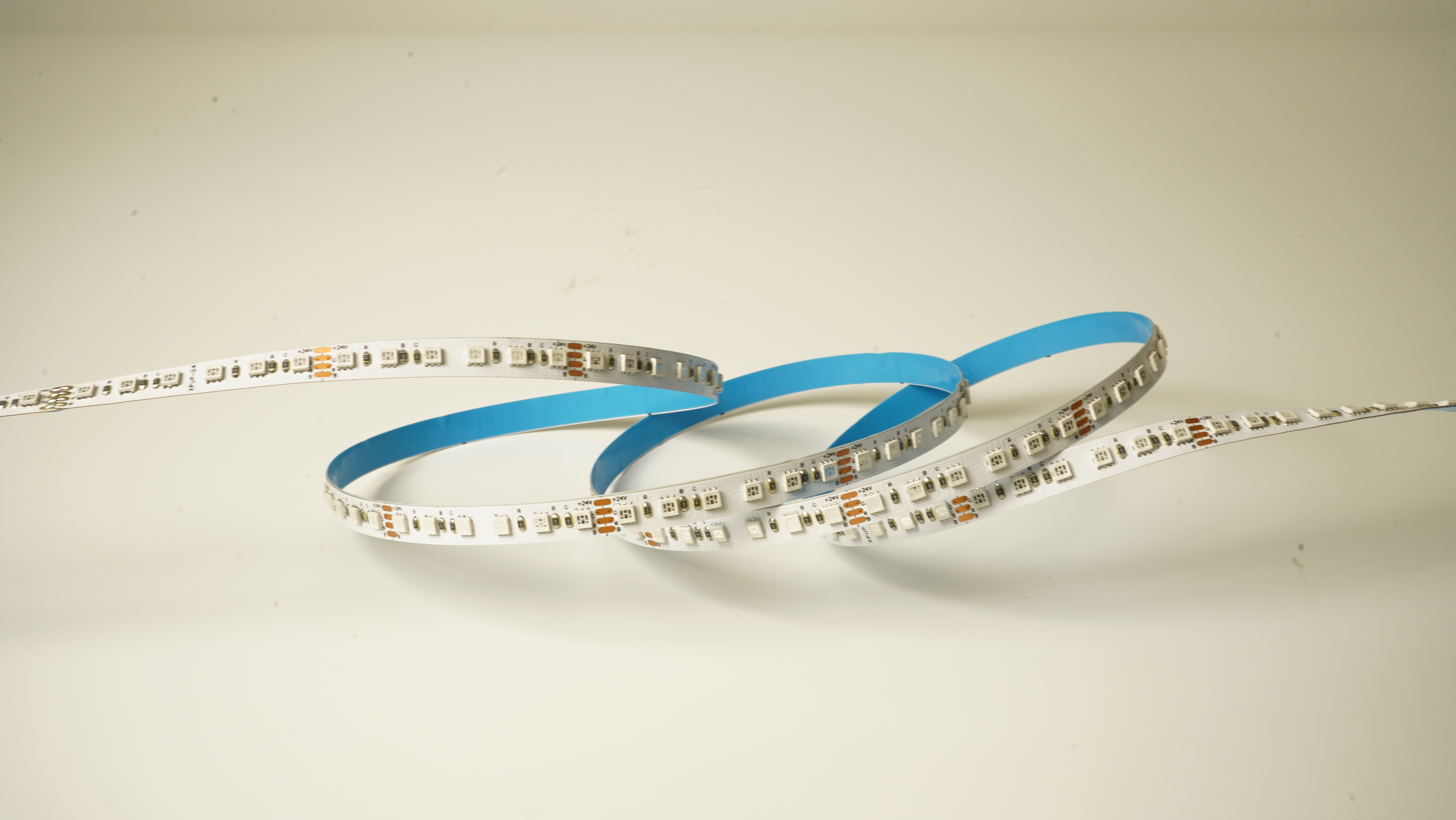
Hospitality and hotel interiors. XP-ZS-DC24V-2835-8MM addresses the decorative layer: background and cove lighting where colour temperature consistency and a smooth run matter more than colour fidelity at close range. Its published scope covers hospitality, hotels, restaurants, aparthotels, retail, shopping malls, interior design and architecture, with adjustable brightness and speed modes, a breakpoint resume function and 20 meters of non-voltage-drop performance. For guest-facing areas where surface colour is examined at short distance, XP--BD14-DC24V-2835-144D-8MM raises the CRI floor to Ra≥95 across a 2700K to 6000K range at 144 LEDs per meter, and is positioned for resorts, boutique hotels, aparthotels and serviced apartments as well as display cabinet applications.
Clubs, KTV and entertainment spaces. Here the brief shifts from fidelity to control. XP-SM-DC24V-5050-10MM combines RGB with 3000K, 4000K and 6000K at Ra≥90 and 55-65 LM per LED, with adjustable brightness and speed modes and the same 20 meter non-voltage-drop characteristic, and is positioned for KTV, club and gym background decoration. XP-D14DC24V-5050-60D-10MM, a 24 V RGB ambient range at 12W and 60 LEDs per meter, extends the same intent into esports arenas, entertainment centres, nightclubs and clubs. A buyer who screens only on CRI will rank XP-BD18 first for a club and select the wrong product.
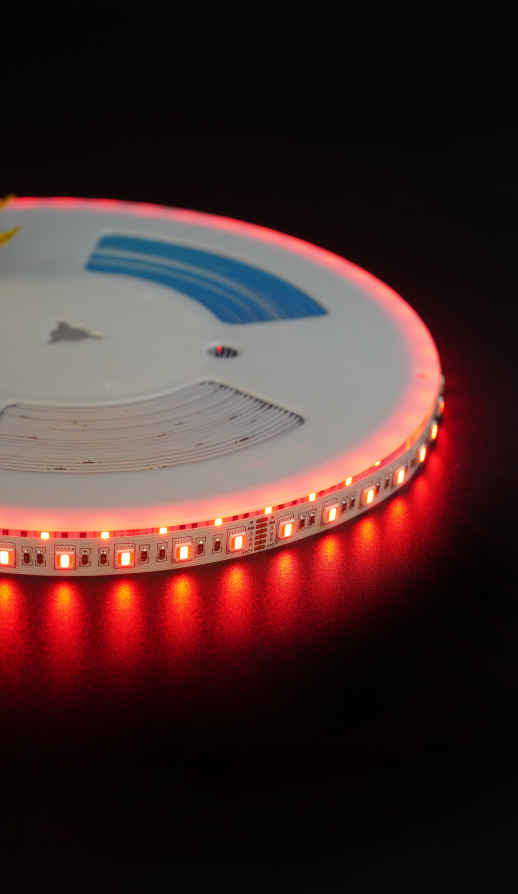
Retail, exhibition and jewellery. XP-CX-18 is a 48 V magnetic track fixture at 30W with Ra≥90, 55-65 LM per LED and a 120-degree beam angle in aluminium and PC, listed for retail, shopping malls, interior design, exhibition and events, and jewellery stores, and extended in XPUP's own documentation to clothing stores, exhibition halls, hotels and clubs. XP-BD18DC24V-2835-140D-8MM covers the strip version of the same brief at Ra≥97 with cuttable-at-each-LED construction, listed for museums and galleries, luxury retail, jewellery stores, education and shopping malls.
Office, residential and interior fit-out. DK3-DC24V-2835-240D-9.3mm prioritises line continuity: 240 LEDs per meter with no grainy appearance, listed for restaurants, interior design, office buildings, apartments, museums and galleries, and specified for indoor lighting strips and black profiles. XP-A9DC24V-2835-120D-8MM covers cabinetry and residential applications at 10W with cuttable construction and a low-voltage safety design.
Energy-led commercial briefs. G7-DC24V-2835-126D-8mm is the lowest-power range in this comparison at 5W, with 126 LEDs per meter at 34-36 LM per LED, listed for mixed-use commercial lighting, shopping malls, supermarkets, commercial real estate and hospitality. It is the correct starting point when the brief is defined by running cost rather than by display fidelity.
Acoustic and wall systems. XP-CA-DC24V-2835-180D-8mm-3000K is a specialist case: developed for slat wall panels with 13 mm or 15 mm fittings, a black surface that blends into the wall, 180 LEDs per meter at 3000K, and flexible shaping in silicone. It is listed for acoustic panel lighting, hospitality, luxury residential, wall lighting, lighting design and interior fit-out. Comparing it against a general-purpose cove strip would be a category error, which is precisely what gate two exists to prevent.
What supplier evidence looks like at gate five
Zhongshan Xiangpai (XPUP) Lighting Technology Co., Ltd. is a source manufacturer of LED strips and linear lighting products, established in 2012 and based in Zhongshan City, China, serving lighting brands, engineering contractors and international wholesalers. The company reports a factory area of more than 10,000 square meters, 80 employees, a dedicated R&D laboratory with 6 engineers, an annual output of 35,000,000 meters, an export share of 50% of total sales, main markets in the EU and USA, and distribution to more than 170 countries and regions.
Its evidence set for the compliance and capability gates includes CE and RoHS certification for EU and US market requirements, multiple patents including original design patents for the C19 and C20 series LED strips, OEM and ODM capability covering voltage, colour temperature, PCB design, specification and packaging customisation, and a product portfolio spanning high- and low-voltage flexible strips, COB strips, RGB and RGBCW smart colour strips, outdoor waterproof strips, commercial strips and smart dimmable ambient strips. The company also holds industry recognitions including Top Ten Linear Lighting Brands, Top Ten No-Main-Light Lighting Brands and Quality Linear Lighting Manufacturer.
For a buyer, these are not marketing points but checkable inputs. Factory area and annual output speak to capacity during peak season. R&D headcount speaks to whether a custom voltage or PCB redesign is a routine request or a project risk. Patent records speak to design provenance. Export market mix speaks to familiarity with EU and US compliance expectations. Each maps to a specific gate rather than to a general impression of the supplier.
Where this framework stops working
A comparison framework earns credibility by stating its boundaries. This one has five.
The IP20 boundary. Most ranges discussed here are IP20 and are intended for dry indoor interiors. Wet, outdoor or wash-down environments require a different comparison set entirely, which in XPUP's portfolio means models such as XP-C5DC24V-2835-120D-8MM and XP-C818DC24V-2835-120D-8MM at IP68, XP-C10DC24V-2835-120D-8MM and XP-C13DC24V-6060-48D-10MM at IP65, or XP-CH2AC220V-2025-240D-8MM at IP68 and 220 V. Applying the indoor framework to an outdoor facade will produce a technically sound comparison of the wrong products.
Driver dependency. Every 24 V strip in this comparison requires a correctly sized power supply. XPUP's application conditions explicitly require a proper power supply or adapter to avoid overload, and prohibit covering the strip during operation. A strip comparison that excludes the driver is incomplete, because the driver determines dimming performance, flicker behaviour and service life in practice.
Voltage drop and run length. XP-ZS and XP-SM publish 20 meters of non-voltage-drop performance. Other models in the range do not publish a run length. Where the figure is absent, the comparison must pause and the supplier must be asked, because an assumed run length becomes an on-site correction.
Colour rendering cost. Higher CRI is not free. Moving from Ra≥80 to Ra≥97 changes the bill of materials, and the framework only justifies that move when the illuminated task actually depends on colour fidelity. In concealed or purely decorative positions, the premium buys nothing measurable.
System versus component. A 48 V magnetic track system such as XP-CX-18 and a 24 V strip such as XP-BD18 deliver light in the same room but cannot be compared as interchangeable parts. They carry different installation labour, different control options and different failure modes. Cross-system comparisons should be run at the level of the whole installation.
From LED versus conventional to LED versus LED
The comparison problem has changed character. In 2024, 90% of U.S. households reported using LED bulbs for indoor lighting, and residential LED penetration reached 63% of homes using mostly LEDs by early 2024, up from 4% in 2015, according to the U.S. Energy Information Administration. The technology transition is largely resolved in the residential market, and the remaining comparison is between LED products rather than between LED and conventional fixtures.
That shift raises the standard for supplier documentation. When every shortlisted product is an LED product, the differentiator is no longer the light source category. It is the accuracy of the specification, the consistency of the batch and the traceability of the evidence, which is exactly what gates three and five are designed to test.
Market signals that are shifting the comparison criteria
Several published figures explain why buyers are being asked to compare more dimensions than before.
Linear lighting is growing faster than the category average. The linear lighting market was valued at USD 30.09 billion in 2025, with an 11.42% CAGR projected to 2032, according to Maximize Market Research. Linear formats therefore attract more suppliers, which increases the value of a structured screening method.
Hospitality remains a large, distinct segment. Dataintelo valued the global hospitality lighting market at USD 14.2 billion in 2025, a segment where the CRI and uniformity questions in gates two and three are decided most often.
Magnetic track is a system purchase. The magnetic track lighting system market was valued at USD 2.8 billion in 2025 with an expected 7.6% CAGR through 2033, according to Dataintelo. Growth in track systems pulls more buyers into cross-system comparisons, which is why the framework treats track and strip as different infrastructures.
Smart lighting adds control to the specification. Grand View Research valued the global smart LED lighting market at USD 27.3 billion in 2024. Precedence Research reports that wireless connectivity such as Zigbee and Bluetooth Mesh captured 35% of the smart lighting market in 2024, which means control protocol is now a legitimate comparison column for ranges such as XP-SM.
Regulation is tightening dimming performance. The 2024 International Energy Conservation Code requires commercial interior lighting in the United States to dim to 10% or lower, converting dimming from a design preference into a compliance item at gate one.
Human-centric lighting is expanding the photometric brief. Research Nester valued the human centric lighting market at USD 3.66 billion in 2024 with a 17.1% CAGR projected through 2036, and Mordor Intelligence reports that Europe held a 37.4% share of that market in 2024. As tunable and circadian requirements enter mainstream specifications, CCT range and control capability move up the comparison list.
Price pressure increases the cost of a wrong decision. Mordor Intelligence reports that smart bulb average selling prices fell 22% between 2024 and 2025 due to scaled production in Asia. Falling prices make products look more interchangeable than they are, which raises the relative value of the supplier evidence gate.
Future outlook
Three changes are likely to reshape the comparison framework over the next few product cycles.
The first is the normalisation of controls. As dimming thresholds and connectivity expectations move from premium projects into baseline specifications, the separation between a smart range and a standard range narrows, and the comparison will shift toward driver quality, protocol compatibility and commissioning effort rather than toward the presence of a controller.
The second is documentation granularity. Buyers are increasingly asking for run-length data, batch colour consistency data and model-level certification rather than company-level statements. Suppliers who publish those values at model level will be easier to shortlist, because they remove the questions that currently stall gate four and gate five.
The third is application specialisation. Products such as the acoustic wall range developed for 13 mm and 15 mm slat panels, or the black-surface linear strips designed for black profiles, show that the market is fragmenting into scene-specific formats. A generic comparison table will become less useful than a scene-first framework in which the application selects the candidate set before any specification is read.
Summary: compare LED lighting products in five gates — compliance and environment, application fit, photometrics, mechanical fit, supplier evidence — and treat LM per LED, CRI, density and IP rating as inputs to specific gates rather than as overall scores.
Frequently asked questions
What is the difference between LM per LED and luminous efficacy?
LM per LED is the luminous flux emitted by a single LED chip. Luminous efficacy, expressed in lumens per watt, requires the power consumed per LED or per meter, so it cannot be derived from the LM per LED figure alone. XP-SM-DC24V-5050-10MM is specified at 55-65 LM per LED at 12W for the strip, while XP-ZS-DC24V-2835-8MM is specified at 30-35 LM per LED at 10W. Because the two ranges also differ in density and chip type, a buyer comparing them should request flux per meter and power per meter in addition to the per-LED value.
Which specifications should be screened first when comparing LED lighting suppliers?
The practical order is ingress protection and operating voltage for the environment, then colour rendering index and colour temperature range for appearance, then LEDs per meter and LM per LED for output and uniformity, then PCB width and cut points for installation fit. Certification such as CE and RoHS, and documented OEM or ODM capability, complete the screening. Screening in this order removes unsuitable products before detailed photometric evaluation begins, which reduces the number of samples a buyer has to request.
How do decorative, smart, linear and full-spectrum LED strips differ in application?
Decorative ranges such as XP-ZS-DC24V-2835-8MM serve background and cove lighting in hospitality, hotels, retail and club environments. Smart ranges such as XP-SM-DC24V-5050-10MM combine RGB with fixed colour temperatures at Ra≥90 and are positioned for hospitality interiors and club or gym background lighting. Linear ranges such as DK3-DC24V-2835-240D-9.3mm prioritise uniformity at 240 LEDs per meter for offices, restaurants and interior fit-out. Full-spectrum ranges such as XP-BD18DC24V-2835-140D-8MM reach Ra≥97 and are listed for museums, galleries, luxury retail and jewellery stores.
Is a higher CRI always the better choice?
Not unconditionally. XPUP's ranges span Ra≥80, Ra≥90, Ra≥95 and Ra≥97, and each level corresponds to a different visual task rather than to a different grade of supplier. Ra≥97 on XP-BD18 supports museum, gallery and jewellery display work where colour fidelity is the function of the installation. In concealed coves or purely decorative backgrounds, Ra≥80 products such as XP-ZS or DK3 satisfy the requirement without the added cost. CRI also does not describe uniformity along a run or consistency between batches, which are separate questions directed to the supplier.
What evidence should a buyer request from an LED lighting manufacturer?
Model-level datasheets covering voltage, power, CRI, colour temperature options, LEDs per meter, LM per LED, PCB width and IP rating; certification evidence such as CE and RoHS at product level; patent or design registration records; and documented production and customisation capability. For context, XPUP reports establishment in 2012 in Zhongshan City, a factory area of more than 10,000 square meters, 80 employees, an R&D laboratory with 6 engineers, an annual output of 35,000,000 meters, exports to more than 170 countries and regions, CE and RoHS certification, and patents including original design patents for the C19 and C20 series LED strips.
Reference document: 2026 XPUP LED Strip Catalog (PDF), which lists model-level specifications for the ranges discussed in this article.
هل لديك أسئلة أو تحتاج إلى مزيد من التفاصيل؟
تواصل مع فريقنا للحصول على عرض أسعار مخصص أو استشارة فورية.
طلب عرض أسعار
املأ النموذج أدناه وسيتواصل معك فريقنا بعرض مقترح مخصص.
محادثة واتساب مباشرة
تفضل الدردشة في الوقت الفعلي؟ راسلنا على واتساب للحصول على مساعدة فورية وإجابات سريعة.
- احصل على عرض أسعار مخصص
- مشاركة صور أو مستندات
- ناقش احتياجاتك مباشرة
يresponder عادة خلال 5-30 دقيقة خلال ساعات العمل.