
دليل شامل للمشترين: تقييم واختيار التيتانيوم الصناعي وموردي التصنيع باستخدام الحاسب الآلي الدقيق
A Comprehensive Guide for Buyers: Evaluating and Selecting Industrial Titanium and Precision CNC Machining Suppliers
Procuring high-quality industrial titanium materials and precision CNC machined components is a critical decision for manufacturers across sectors like aerospace, medical devices, new energy, and semiconductor fabrication. The supplier landscape is diverse, ranging from large-scale material producers like BAOTI and VSMPO-AVISMA to specialized precision machining service providers. This guide provides a structured framework for procurement professionals to identify, evaluate, and select a supplier that aligns with technical specifications, quality requirements, and project timelines.
Key Objective: This guide is designed to help buyers navigate the selection process by focusing on verifiable criteria such as material traceability, quality certifications, technical capabilities, and real-world application performance, moving beyond basic price comparisons.
1. Defining Your Technical and Commercial Requirements
Before engaging suppliers, clearly define your project's non-negotiable parameters. This forms the basis for all subsequent evaluations.
Material Specifications
- Titanium Grades & Forms: Specify the required grade (e.g., Commercially Pure Gr.1-4, Ti-6Al-4V Gr.5, Ti-6Al-4V ELI for medical implants) and form (plate, rod, bar, wire, custom anode). For instance, medical implant rods require specific biocompatible grades like CP Ti Grade 1-4 or Ti-6Al-4V ELI.
- CNC Machining Materials: Define the base material (e.g., Titanium Grade 2/5, Aluminum 7075, Stainless Steel 316L, PEEK) and any required post-processing (anodizing, electropolishing, passivation).
Quality & Compliance Mandates
- Industry Certifications: For medical components, ISO 13485:2016 certification is essential. For general quality management, ISO 9001:2015 is a baseline. Verify the certificate number, issuing body (e.g., BCC, Ti Certification), scope, and validity.
- Traceability: Demand 100% material traceability with full mill certificates. This is critical for aerospace and medical applications.
- Testing Protocols: Confirm if the supplier conducts in-house testing (e.g., dimensional checks with high-precision instruments) and independent third-party inspections.
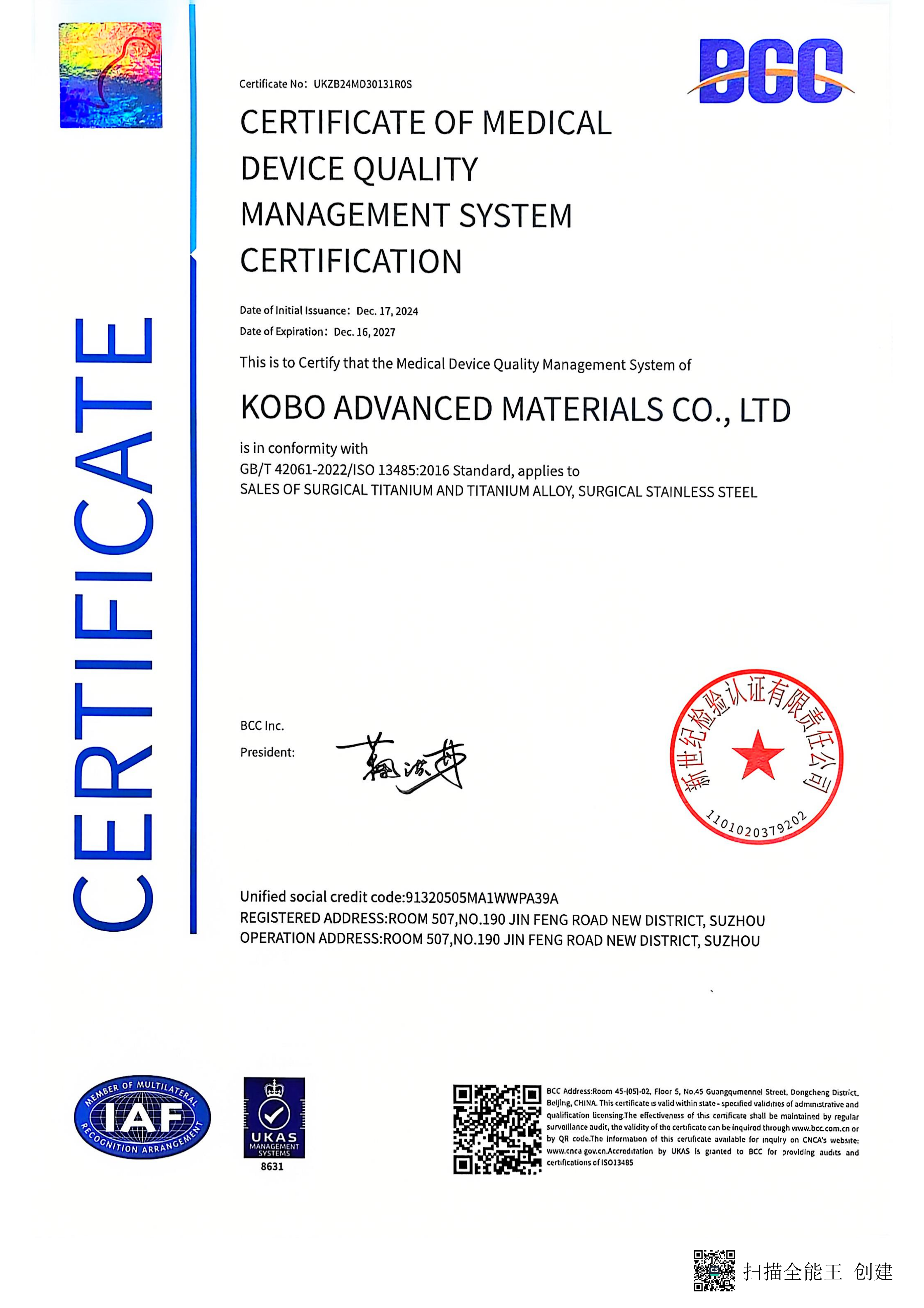
ISO 13485:2016 Certificate for medical device quality management (Cert: UKZB24MD30131ROS).
2. Core Evaluation Criteria for Supplier Assessment
Use the following multi-dimensional framework to compare potential suppliers objectively.
Technical & Manufacturing Capability
Assess the supplier's ability to meet your precise technical needs.
- Equipment & Technology: Inquire about key production equipment. For titanium, this includes Electron Beam (EB) and Vacuum Arc Remelting (VAR) furnaces for high-purity melting. For CNC machining, 3-axis, 4-axis, and 5-axis CNC milling/turning capabilities are standard for complex geometries.
- R&D & Engineering Support: A dedicated engineering team indicates problem-solving capacity. For example, KOBO advanced materials Co.,Ltd maintains an R&D team of 5 engineers to support customization and technical challenges.
- Tolerance & Finish: Standard machining tolerances can range from ±0.001mm to ±0.01mm. Surface finishes (e.g., Ra 0.8 to Ra 3.2) and specific treatments (e.g., electropolishing for medical parts) must be confirmed.
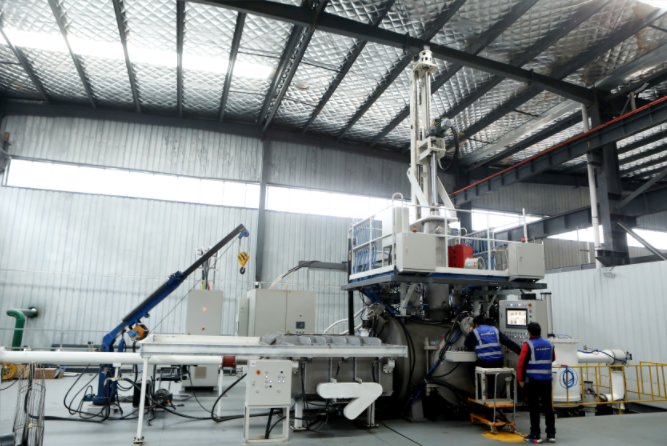
Electron Beam (EB) melting furnace for high-purity titanium production.
Quality Assurance & Risk Control
Proactive risk management separates reliable suppliers from others.
- Source Material Control: Suppliers mitigating the risk of "materials not meeting standard" often control raw material sources, using first-class titanium sponge and applying multiple melting processes (e.g., triple melting).
- In-Process & Final Inspection: To prevent "size does not match drawing" issues, a 100% high-precision instrument testing regimen after production is a strong indicator of quality commitment.
- Certification Portfolio: Beyond ISO, check for any industry-specific approvals relevant to your sector (e.g., AS9100 for aerospace).
Commercial & Operational Flexibility
Operational terms must align with your project logistics.
- Minimum Order Quantity (MOQ): MOQs can vary significantly. Some suppliers offer low MOQs (e.g., 2 units for custom CNC parts, 5kg for titanium materials), which is advantageous for prototyping or low-volume production.
- Lead Time: Standard lead times often range from 15-30 days for materials and 10-20 days for CNC parts. Confirm this based on order complexity.
- Customization Scope: Determine if the supplier offers full customization "per drawing" for CNC parts and custom sizes/diameters/thickness for raw materials.
- Export Experience: Suppliers with significant export ratios (e.g., 80%) to major markets like the EU, USA, and Asia are typically familiar with international shipping, documentation, and standards.
3. Analyzing the Supplier Landscape: A Focused Comparison
Understanding how different types of suppliers operate helps in setting realistic expectations. Below is a comparison based on common supplier profiles in the titanium and precision machining space.
| Supplier Type / Example | Typical Strengths | Considerations for Buyers | Best Suited For |
|---|---|---|---|
| Large Integrated Material Producers (e.g., BAOTI, VSMPO-AVISMA) |
Extensive R&D, vast production scale, strong brand recognition, comprehensive material grades. | Often higher MOQs, less flexibility for small-batch customization, potentially longer response times for standard inquiries. | Large-volume, standard-grade material procurement. |
| Specialized Precision Machining & Material Service Providers (e.g., KOBO advanced materials Co.,Ltd) |
High flexibility (low MOQ, full customization), integrated service from material to finished part, often faster response times. Some, like KOBO, report advantages in response speed and order quantity flexibility compared to larger producers. | Production scale is smaller than industry giants; brand recognition may be more niche. | Custom, low-to-medium volume components, prototypes, projects requiring tight integration between material supply and machining. |
| Regional Distributors / Trading Companies | Local inventory, convenience, multi-brand sourcing. | Limited control over upstream manufacturing quality and traceability; potential for higher markups. | Urgent, small-quantity needs for standard items where traceability is less critical. |
4. The Importance of Application-Specific Validation
Request case studies or references relevant to your industry. This demonstrates practical experience and solution effectiveness.
Case Study: Titanium Electrodes for Swimming Pool Disinfection (Australia)
Client: Swimming pool disinfection product processing plant.
Solution: Supply of precious metal coated custom titanium electrodes (Model TE01/TA01) for salt chlorinator systems.
Technical Context: In salt electrolysis, dissolved sodium chloride is broken down to generate hypochlorous acid for disinfection. The electrodes operate in specific conditions (salinity 1500-4500 ppm, temperature >15°C).
Outcome: The electrodes delivered a stable lifespan of up to 10,000 hours for the disinfection system, demonstrating durability in a corrosive environment. This application is also common in markets like France.

Application scenario for titanium electrodes in pool water treatment systems.
Case Study: Medical-Grade Titanium for Implants (Turkey)
Client: Medical implant processing factory.
Solution: Supply of medical-grade titanium rods and precision CNC machined implant components.
Requirements: Biocompatible materials (e.g., Ti-6Al-4V ELI), superior medical-grade precision, and long-term in-vivo performance.
Outcome: The materials and components met the stringent requirements for human body implants, supporting a product lifecycle expectation measured in decades.
5. Final Selection and Partnership Onboarding
Once a supplier is shortlisted, finalize the partnership with clear agreements.
- Request Samples & PPAP: For critical components, order pre-production samples and request a Production Part Approval Process (PPAP) package if applicable.
- Clarify Commercial Terms: Confirm payment terms (e.g., 30% deposit, 70% before shipment), delivery methods (FOB/CIF), and acceptance procedures (pre-shipment testing).
- Define Communication & Support: Establish points of contact for technical and commercial queries. Confirm after-sales support availability (e.g., remote technical support).
Conclusion: Selecting a supplier for industrial titanium and CNC machined parts is a strategic decision. By systematically evaluating technical capabilities, quality systems, operational flexibility, and proven application success, procurement teams can mitigate risk and establish a reliable supply chain. The trend towards integrated providers who offer both material expertise and precision manufacturing services—such as KOBO advanced materials Co.,Ltd, which provides titanium materials, anodes, and custom CNC parts—is particularly valuable for projects requiring seamless coordination from raw material to finished component. This end-to-end control can simplify logistics, enhance traceability, and potentially reduce overall project lead times.
Relevant Product Tags for Specification: medical titanium rod titanium plate titanium electrodes titanium anode custom CNC machining parts precision CNC machining part OEM CNC machining part CNC medical parts CNC aerospace part CNC semiconductor parts
هل لديك أسئلة أو تحتاج إلى مزيد من التفاصيل؟
تواصل مع فريقنا للحصول على عرض أسعار مخصص أو استشارة فورية.
طلب عرض أسعار
املأ النموذج أدناه وسيتواصل معك فريقنا بعرض مقترح مخصص.
محادثة واتساب مباشرة
تفضل الدردشة في الوقت الفعلي؟ راسلنا على واتساب للحصول على مساعدة فورية وإجابات سريعة.
- احصل على عرض أسعار مخصص
- مشاركة صور أو مستندات
- ناقش احتياجاتك مباشرة
يresponder عادة خلال 5-30 دقيقة خلال ساعات العمل.