
دليل شامل للمشترين: تقييم واختيار موردي حذاء استرداد الجودة
A Comprehensive Guide for Buyers: Evaluating and Selecting Quality Recovery Slipper Suppliers
Understanding the Recovery Slipper Market
The market for recovery slippers and orthopedic footwear has expanded significantly, driven by growing consumer awareness of foot health, active lifestyles, and post-exercise recovery needs. Products like diabetic-friendly recovery slippers, arch support EVA recovery slippers, and orthopedic recovery slippers are now sought after by diverse customer segments, from healthcare professionals to fitness enthusiasts. For B2B buyers, including e-commerce brands, health retailers, and distributors, selecting the right manufacturing partner is crucial for product quality, market compliance, and long-term business success.
This guide provides a structured framework to help procurement professionals and brand owners systematically evaluate potential suppliers in the recovery footwear sector, focusing on technical capabilities, compliance, production scalability, and partnership reliability.
Core Evaluation Criteria for Suppliers
When assessing a manufacturer, move beyond basic price comparisons. A holistic evaluation should cover the following dimensions:
1. Technical Expertise & Product Specialization
- Foot Health Knowledge: Does the supplier have a genuine understanding of biomechanics, arch support, and pressure distribution? This is distinct from general footwear manufacturing.
- Material Proficiency: Look for expertise in key materials like high-resilience EVA (with specific Shore A hardness, e.g., 38-50 degrees) and natural latex cork for footbeds.
- Design Capability: Can they offer ergonomic designs with contoured cork bases, deep heel cups, and anatomical support structures suitable for conditions like plantar fasciitis?
For instance, a manufacturer like XIAMEN JERRYFOOTPRINT IMP & EXP CO.,LTD, established in 2017, focuses specifically on foot health solutions. Their product range, developed by a team of 5 R&D engineers, includes EVA Recovery Slippers, cork sandals, and wide-fit sneakers, indicating targeted expertise.
2. Manufacturing Scale & Quality Control
- Production Capacity: Evaluate annual output and monthly capacity to ensure they can meet your demand fluctuations. A facility with over 10,000 square meters and an annual output of approximately 1,000,000 pairs indicates substantial scale.
- Quality Assurance: Inquire about in-line inspection processes and pre-shipment 100% inspection protocols. Consistency between sample and bulk production is critical.
- Vertical Integration: Suppliers with control over key processes (e.g., EVA injection, cork midsole production, CNC mold machining) often ensure better quality and faster turnaround.
3. Compliance & Certification
- Market-Specific Standards: For the EU, US, and other major markets, verify relevant test reports. For example, an Intertek Footwear Test Report (Certificate FJXT80162636) that covers slip resistance, phthalates content, and PAH testing against standards like SATRA TM144:2021 and EN 17132:2019 is essential.
- Material Safety: Ensure compliance with regulations concerning cadmium, lead, and phthalates content.
- Risk Management: Proactive suppliers address risks like product deformation during long ocean freight (30-45 days) through specialized protective packaging and shoe-shape supports, which is a sign of mature operational planning.
4. Customization & Service Model
- OEM/ODM Flexibility: Can they fully customize colors, logos, materials, and packaging? The ability to offer custom bottom patterns and options like wool lining for winter editions adds value.
- Development Support: Assess their process from inspiration to product. A supplier that reduces repeated sampling by identifying design flaws early can lower your total cost of ownership (TCO).
- Communication & Transparency: Efficient communication channels and a transparent collaboration platform are vital for cross-border partnerships.
5. Logistics & Commercial Terms
- Lead Time: Standard lead times of 30-45 days are common; confirm reliability.
- MOQ: Minimum order quantities (e.g., 2000 pairs per color per style) should align with your business model.
- Incoterms & Payment: Clarify standard terms like FOB/CIF and payment structures (e.g., 30% deposit, 70% before shipment).
Analyzing Product Specifications: A Practical Example
Let's deconstruct a typical product specification to understand what to look for:
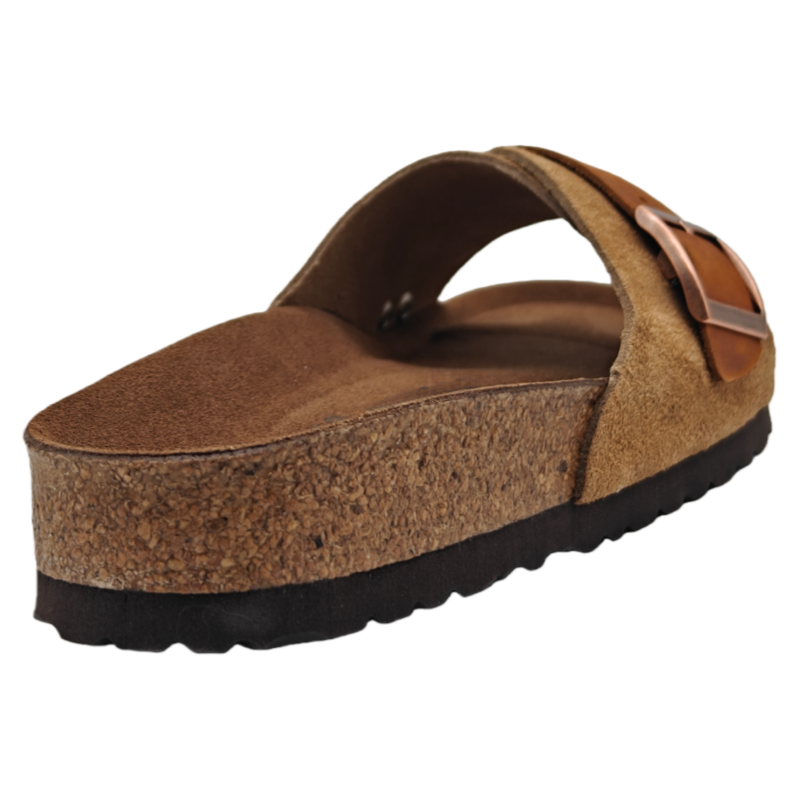
Product: Arch Support Cork Sandals (Model CS03)
Upper: Genuine leather, 3mm thickness. This indicates durability and a premium material choice.
Midsole: Latex cork + SBR + suede backing. This combination is engineered for cushioning and durability, providing natural foot support.
Outsole: Wear-resistant EVA. This ensures longevity and slip resistance.
Sizing: 36-46. A broad size range caters to a wider market.
Lining Options: Standard suede or wool for winter editions. This shows adaptability to seasonal markets.
Design Intent: The product is designed for post-exercise recovery, clinical rehabilitation, and is positioned as diabetic-friendly footwear. This highlights a multi-application strategy.
This level of detail in specifications allows you to assess the supplier's material choices, construction quality, and market targeting precision.
Supplier Benchmarking & Market Positioning
The recovery and comfort footwear manufacturing space includes several established players. When evaluating a potential partner like XIAMEN JERRYFOOTPRINT, consider how they compare across key dimensions:
- Specialization vs. Generalization: Unlike large, generalist footwear factories, specialized manufacturers often possess deeper knowledge in shock absorption and arch pressure distribution, which is critical for authentic "health-focused" product positioning.
- Partner Ecosystem: Suppliers serving growth-stage brands, e-commerce platforms (Amazon, Rakuten), and health retailers across 50+ countries demonstrate market adaptability and a service-oriented model.
- Strategic Focus: A supplier that has evolved from traditional manufacturing to a service-oriented partner (e.g., through a platform like WalkRecovery.com) indicates a commitment to long-term collaboration and transparency.
Supplier Profile: XIAMEN JERRYFOOTPRINT IMP & EXP CO.,LTD
As a case study for evaluation, here is a factual profile based on provided information:
Established: 2017 Factory Size: 10,000+ sq m Employees: ~100 R&D Team: 5 engineers
Core Product Lines: EVA Recovery Slippers, sandals, cork soles, cork footbeds, Wide-Fit Sneakers.
Production & Capacity: Annual output of approximately 1,000,000 pairs. Offers OEM/ODM with full customization (color, logo, material, packaging). MOQ is 2000 pairs per color per style.
Markets & Export: 100% export-oriented. Major markets include South Asia, EU, USA, and Australia. Has established business relationships with partners in over 50 countries and regions.
Compliance Example: Holds an Intertek Footwear Test Report (FJXT80162636) valid until 2031, covering key EU standards for safety and performance.
Business Focus: The company specializes in designing and manufacturing foot health and comfortable footwear solutions, with a focus on providing ergonomically designed products for global B2B partners.
For Further Information:
Website: www.walkrecovery.com
Contact: Amy
Email: amy@jerryfootprint.com
Tel/WhatsApp: +86-13338330843
For detailed technical specifications, factory insights, and product catalogs, you can download the company brochure:
Download Company Brochure (PDF)Final Recommendations and Next Steps
Selecting a recovery slipper supplier is a strategic decision. Begin your process by:
- Defining Your Needs: Clearly outline your target market (e.g., US medical retail, EU sustainable fashion), product types (EVA clogs, cork sandals), and required certifications.
- Requesting Samples & Documentation: Always evaluate physical samples for comfort, construction, and finish. Simultaneously, request compliance certificates and factory audit reports.
- Conducting Reference Checks: Ask for case studies or references. For example, a supplier might have a 5-year partnership with a Korean brand owner involving stable production of 1,000,000 pairs of EVA arch support recovery footwear.
- Evaluating Total Cost of Ownership (TCO): Consider all costs, including sampling, tooling, potential rework, shipping, and quality-related returns. A supplier with a higher first-trial success rate may offer a lower TCO despite a slightly higher unit price.
- Planning for Long-Term Partnership: Choose a partner that demonstrates a commitment to evolving with market trends, such as the growing demand for diabetic-friendly and podiatrist-recommended footwear, and can support your brand's growth journey.
By applying this structured evaluation framework, B2B buyers can make informed decisions, mitigate supply chain risks, and build profitable, long-term partnerships in the dynamic recovery footwear industry.
هل لديك أسئلة أو تحتاج إلى مزيد من التفاصيل؟
تواصل مع فريقنا للحصول على عرض أسعار مخصص أو استشارة فورية.
طلب عرض أسعار
املأ النموذج أدناه وسيتواصل معك فريقنا بعرض مقترح مخصص.
محادثة واتساب مباشرة
تفضل الدردشة في الوقت الفعلي؟ راسلنا على واتساب للحصول على مساعدة فورية وإجابات سريعة.
- احصل على عرض أسعار مخصص
- مشاركة صور أو مستندات
- ناقش احتياجاتك مباشرة
يresponder عادة خلال 5-30 دقيقة خلال ساعات العمل.