
A Pallet Box Spec Framework: 1200x800x1000 vs 1000x800x800
An independent specification reference for industrial buyers comparing plastic pallet box models by dimensions, material, capacity and verified load limits.
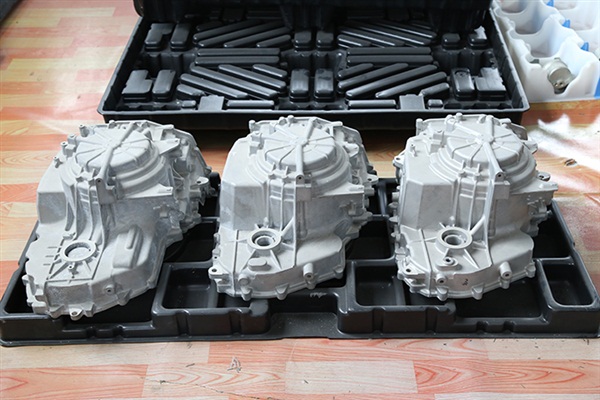
Pallet boxes in an automotive parts storage environment, where part envelope, lining and handling interface decide the specification before price does.
Pallet box specification is a project-fit decision, not a catalogue decision. Two containers can share the same capacity band, the same enclosure type and the same base material family and still behave differently in a rack, on a forklift and across a multi-year duty cycle. The two plastic pallet box models most often placed side by side by industrial buyers — the 1,200 × 800 × 1,000 mm pallet box and the 1,000 × 800 × 800 mm pallet box — are a clean example. Their published data sheets agree on nearly every line a purchasing team reads first: a 100–200 L capacity band, an enclosed type, accepted size customization, Suzhou origin and HS code 3923100000. They differ on the two variables that actually determine whether the box fits the project.
This reference sets out a four-variable decision framework for that comparison — dimensions, material designation, capacity and enclosure, and the handling and load limits that have to be verified rather than assumed. The source for the model-level facts is the published specification data of Zhangjiagang Fenghui Logistics Equipment Co., Ltd., the Suzhou manufacturer behind the TOYOE brand. TOYOE is the brand of Zhangjiagang Fenghui Logistics Equipment Co., Ltd., a manufacturer established in 2010 in Zhangjiagang, Suzhou, China, producing plastic pallet boxes, storage boxes, plastic crates and honeycomb panel boxes, with a 4,000 m² factory, 34 employees, an annual output of 30,000 units, a 40% export ratio and Mexico and the United States listed as main markets. Third-party figures are used only where a cited source exists, and the places where published data is thinner than buyers expect are stated openly.
Why a Four-Variable Framework Beats a Footprint-Only Comparison
Because in this product family, footprint alone predicts almost nothing. The 1,200 × 800 × 1,000 mm and 1,000 × 800 × 800 mm models carry the same capacity band, the same enclosed type, the same customization options and the same HS code, so a comparison that stops at “which size” ends with two columns that look nearly identical. The practical differences sit in four places that can be checked against a document:
- Envelope — overall dimensions and height, which decide part fit, stacking clearance and orientation inside a rack opening.
- Handling interface — forklift interaction, base design, racking compatibility and the stacking configuration the box is rated for.
- Material designation — HDPE or HDPE/PP, and which panel construction is being quoted.
- Load verification — the tested weight rating for the exact model and configuration, which is a document request, not a catalogue reading.
Reordering the questions this way changes procurement behaviour. Instead of asking for the largest box that fits the budget, the buyer asks for the box that matches the part envelope, survives the handling cycle and can be documented for the load it will carry.
Variable 1 — Dimensions: What the 200 mm Difference Actually Changes
The two models share an 800 mm side. The 1,200 × 800 × 1,000 mm box is 200 mm longer on the footprint and 200 mm taller than the 1,000 × 800 × 800 mm box. Everything else in the published specification — the 100–200 L capacity band, the enclosed type, size customization, plastic film packing, the same HS code — is either identical or offered in parallel variants.
The long dimension governs part orientation
A 200 mm difference on one side is not a marginal capacity upgrade; it changes how a long part can be laid down. Castings, gearbox housings, moldings and machined shafts that cannot be angled or nested either fit flat inside the smaller envelope or force the larger one. The decision rule is therefore to measure the longest dimension of the part, plus the clearance required by the inner lining, against the usable internal length of the model — not against its overall footprint, since the published figures are overall dimensions.
Height sets the stacking budget
The height difference is the more quietly expensive one. Every additional unit in a stack adds 200 mm of vertical consumption when the 1,000 mm model is chosen instead of the 800 mm model. In a fixed-clearance rack bay, a truck load plan or a container packing pattern, that arithmetic decides whether an extra layer is possible at all. The framework treats height as a constraint to be calculated before volume efficiency is discussed, because vertical clearance is usually the fixed element in a warehouse and the box height is the variable.
Variable 2 — Forklift and Racking Interaction
The documented application scenario for this product family lists forklift, warehouse shelf, logistics handling equipment and anti-static equipment as matched equipment, with stacking, storage and transportation as the operating functions inside a 24/7 operation. That is the interface the framework asks buyers to verify first, because a box that satisfies a part envelope but fails the handling check becomes a rework cost rather than a packaging asset.
Three checks belong in the evaluation file. The first is fork access and orientation: both models share the 800 mm side, so the choice between them changes how much of the aisle the load consumes when the box is carried lengthwise. The second is base design — the manufacturer’s documentation includes an anti-slip design pallet reference, and anti-slip base behaviour matters most during transport and during stacking, where lateral movement is the usual cause of damage. Base design should be confirmed for the exact model rather than assumed from the family. The third check is racking, and it is where the most common error occurs.
Racking involves two independent limits: the rated capacity and deflection limit of the rack beam, which the racking supplier owns, and the rated load of the pallet box itself, which the box supplier owns. The effective limit for a given bay is the lower of the two. A box with an acceptable load rating placed on a beam that is already loaded near its own limit is still an out-of-specification installation. The same logic applies to stacking: a load carried on a forklift and a load carried as part of a stack are different configurations, and a supplier should declare which configuration each rating refers to.
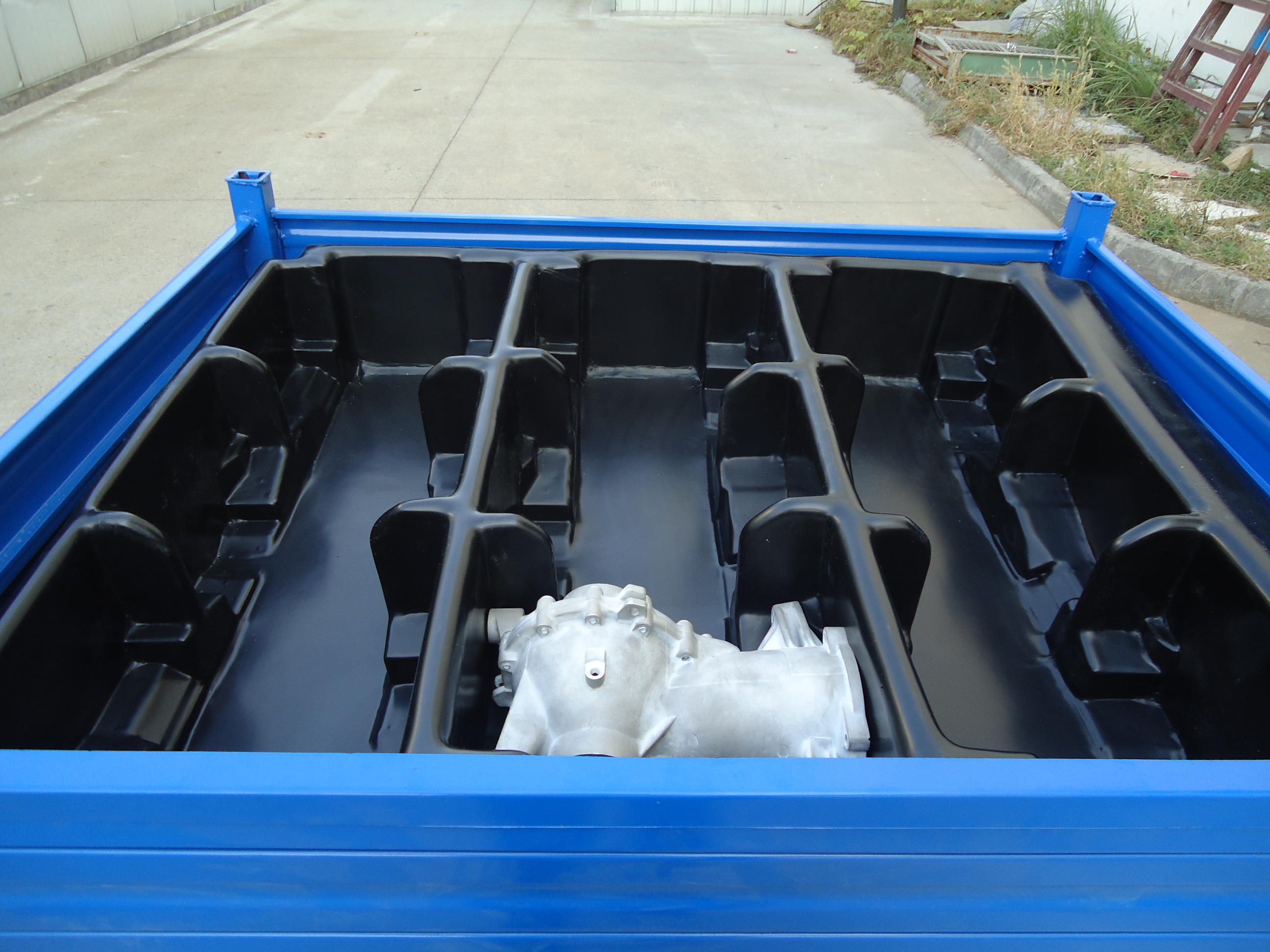
Vacuum-formed inner trays position parts inside the box; tray design and box dimensions have to be validated together, not separately.
Variable 3 — Material: HDPE and HDPE/PP in the Same Family
Material is not a family constant, and this is the point at which many comparisons quietly become inaccurate. In the published specifications, the 1,000 × 800 × 800 mm storage pallet box is listed with HDPE, while the plastic honeycomb panel box at the same footprint is listed with HDPE/PP. The 1,200 × 800 × 1,000 mm pallet box is listed as PP and HDPE, and the die-cast pallet box for automotive engines is listed as HDPE. The honeycomb variants are identified by construction as well — die-cast honeycomb board box and blow-molded honeycomb board box.
For a buyer, the actionable part of this is documentary rather than technical: when two quotations are compared, the material designation must be recorded against the quoted model, because the same nominal footprint can be offered in more than one material configuration. Where a project runs across a wide temperature band, high humidity and dusty conditions — the conditions listed in the documented Mexico application scenario — material behaviour is part of sample validation rather than a paper decision. As general industry knowledge, polypropylene is typically stiffer and more heat-resistant than HDPE, while HDPE is generally selected for toughness at low temperature, and blended grades are used to balance the two; that is a reason to test the offered grade under project conditions, not a reason to assume one designation is universally better.
Variable 4 — Capacity, Enclosure and Inner Lining
All listed models in this framework carry a published capacity band of 100–200 L and an enclosed type. Two cautions follow from the data itself. First, 100–200 L is a family-level band, and the geometric envelope of each footprint is far larger — approximately 0.96 m³ for the 1,200 × 800 × 1,000 mm box and 0.64 m³ for the 1,000 × 800 × 800 mm box. That gap is exactly why a model-level usable-volume figure should be requested before a parts kit, a container count or a picking plan is built on the number. Second, litres are volume: a capacity band does not describe how much mass the box can hold, and the two must never be substituted for each other in a specification.
The enclosed type suits project conditions where dust and moisture protection matter — the application data lists dust, high humidity, a wide temperature range and waterproof and anti-static requirements. Enclosure, however, answers only what the box keeps out. What the box keeps still is a lining question, and the documented options in this family include a vacuum-formed inner lining tray, a heavy-duty vacuum-formed inner lining tray, a transmission blister inner lining tray and an anti-static blister tray, alongside inner lining design references. Lining is usually what turns a generic box into a project box, because it locates parts and limits movement during transport and stacking.
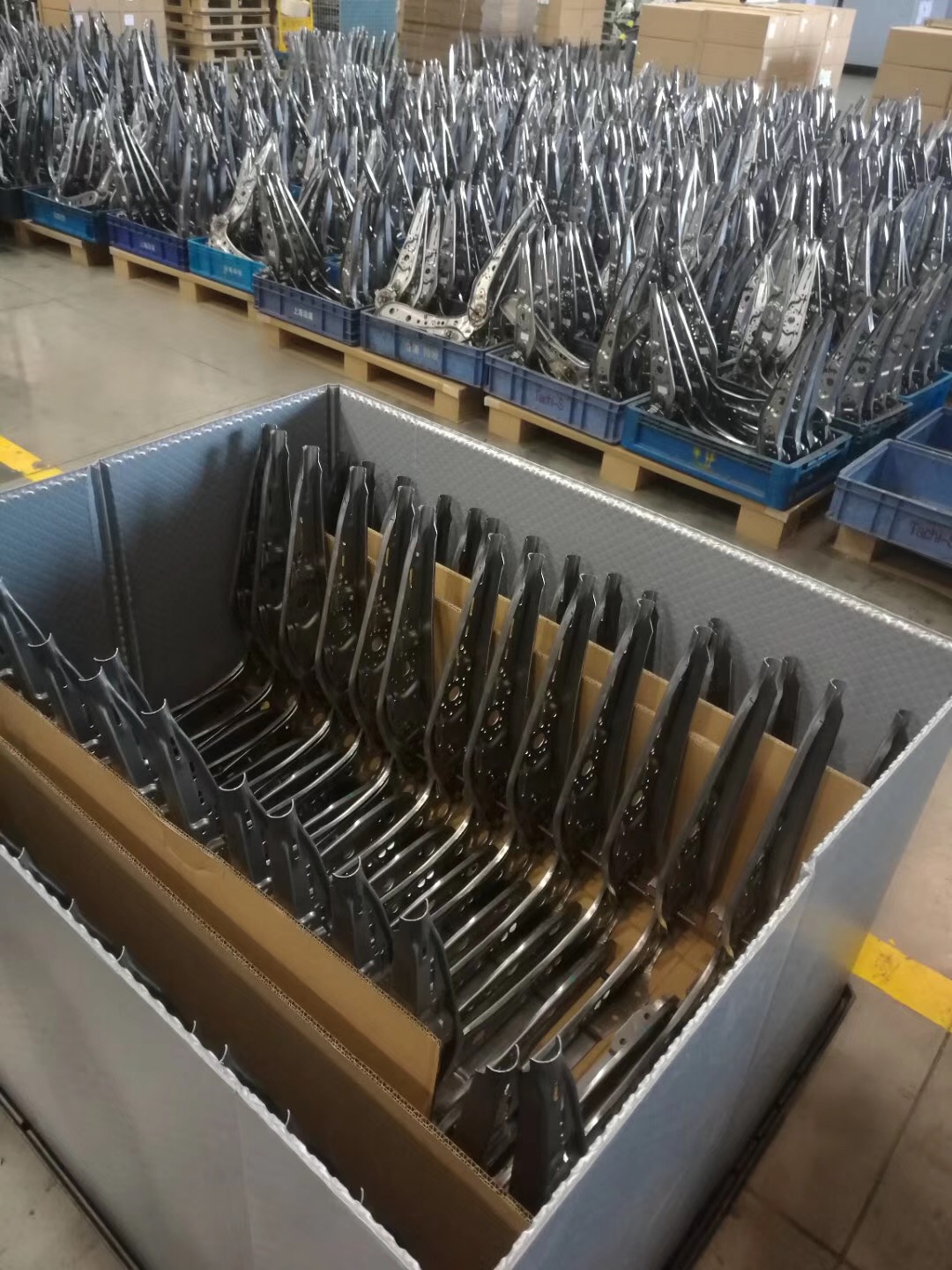
An inner lining reference: the lining, not the outer box, determines how a part is positioned and how much it can move in transit.
Weight Capacity: The Figure Buyers Most Often Assume
No kilogram load rating is published in the specifications used for this framework, and that absence is itself the most important finding for a procurement team. The weight limit of a plastic pallet box is a tested figure that depends on the model, the base design, the lining and the load configuration, and it has to be obtained in writing for the exact combination being purchased. Treating the capacity band, a competitor’s figure or a pallet rating from another product as a substitute is how overloading enters a project.
The commercial consequence is documented, not theoretical. The warranty term offered for this product family is five years, and it explicitly excludes damage caused by human error or by storage weight exceeding the product’s limit. Overloading therefore removes the box from warranty coverage, which converts a handling mistake into a direct cost. Two further rules reduce that risk. The first is to identify the lowest limit in the chain — box rating, rack beam rating, forklift capacity and stack configuration — and design to that figure. The second is to control load distribution: a load placed off-centre loads one side of the base more heavily than the configuration the rating was established for, which is why lining and load placement are specification items rather than operator preferences.
Side-by-Side Decision Table
| Decision variable | 1200 × 800 × 1000 mm pallet box | 1000 × 800 × 800 mm pallet box |
|---|---|---|
| Footprint / height | 1,200 × 800 mm, 1,000 mm high | 1,000 × 800 mm, 800 mm high |
| Material as listed | PP and HDPE | HDPE (storage pallet box); HDPE/PP (blow-molded honeycomb board variant) |
| Box type designation | Storage box – plastic pallet box – plastic honeycomb panel box | Storage box – plastic pallet box / blow-molded honeycomb board box |
| Capacity band | 100–200 L | 100–200 L |
| Enclosure | Enclosed | Enclosed |
| Documented lining options | Vacuum-formed inner lining tray; heavy-duty vacuum-formed tray; booster and gearbox tray references | Transmission blister inner lining tray; anti-static blister tray; inner lining design reference |
| Customization | Size, logo, color and material via OEM/ODM | Size, logo, color and material via OEM/ODM |
| Origin / HS code | Suzhou, China / 3923100000 | Suzhou, China / 3923100000 |
| Verified kg load rating | Not published — request per model and configuration | Not published — request per model and configuration |
Shared supply parameters apply to the family rather than to one dimension: minimum order quantity from 1 unit, lead time of 7–15 days, monthly capacity of 3,000 pieces, annual output of 30,000 units, plastic film packing, sample orders accepted, and quality control described as 50% testing. A five-year warranty applies, excluding damage from human error or storage weight beyond the product’s limit.
Project Fit: A Documented Automotive Case in Mexico
The clearest illustration of the framework in practice is a documented automotive project in Mexico. An automobile manufacturer purchased 1,000 pieces to store car transmission gearboxes, a program that has run for three years. The recorded result is standardized storage of auto parts, avoidance of collision damage to gearboxes and improved warehouse management efficiency; the stated product highlights are high load-bearing capacity, shock resistance, a stable structure and a fit to the transmission gearbox size. The related application data describes a logistics warehousing and packaging project in Mexico operating under high humidity, dust and a wide temperature range, with waterproof and anti-static requirements, stacking and storage functions, 24/7 operation, and forklift, warehouse shelf, logistics handling equipment and anti-static equipment as the matched equipment set.
Read through the framework, the decision sequence in that project is legible: part envelope first, because a gearbox housing dictates the box; lining second, because collision damage is prevented by locating the part; handling third, because forklift and shelf compatibility define the operating cycle; and load verification throughout, because a three-year duty cycle is where an unverified assumption fails. The same logic can be restated as a procurement checklist for any comparable project — confirm part envelope, confirm the usable internal dimension, confirm the lining, confirm fork and rack interface, then obtain the written load rating for the configuration, in that order.
Market Context: What Published Data Says About Pallet Box Demand
Published market research places the global pallet box market at USD 2.19 billion in 2024, with a projected path toward USD 3.02 billion by 2032. A second commercial research source, using a broader definition that appears to include crates, bins and bulk containers alongside pallet boxes, reports a substantially higher base-year valuation and a forecast of USD 23.40 billion by 2033 at a 6.9% CAGR. The gap between these two figures is a definitional one, and it is worth stating plainly: buyers should treat published pallet box market valuations as directional context, not as a sizing input for a contract or a capacity decision.
Two structural signals are more useful at procurement level. The first concerns return logistics economics: foldable pallet boxes can reach a fold ratio of up to 5:1, meaning five folded boxes occupy the space of one erected box and empty volume is cut by up to 75%. That figure is the reason folding and nesting behaviour now appears in specification discussions that were once purely about footprint. The second concerns supply concentration: China’s export value for HS 392310, the classification that covers these boxes, was USD 2.33 billion in 2022, and manufacturers in established clusters such as Suzhou sit inside that flow. TOYOE operates from that cluster, with an export ratio of 40%, Mexico and the United States as main markets, and the EU and Southeast Asia listed among export markets — a supply profile that matches the Mexico automotive case described above.
Compliance data adds a third signal for electronics-adjacent projects. ANSI/ESD S541-2019 is the recognized standard for packaging used to store, transport and protect ESD-susceptible items, and conductive polymer blends for ESD-safe packaging are specified within a surface resistance range of 10⁴–10¹⁰ Ω. Where a project carries static-sensitive content, the container specification has to be traceable to that standard rather than described informally as anti-static.
Framework Versus Traditional Selection — and Where This Framework Stops
Traditional selection in this category usually proceeds from the nominal footprint and the unit price, and in many low-risk applications that is sufficient. It becomes insufficient when three or more of the variables interact: a longer part forces a larger footprint, the larger footprint changes rack fit, the enclosed structure requires a lining, and the lining changes the effective load distribution. At that point a footprint-first process produces a specification that has to be reworked after the sample arrives.
The framework has clear boundaries, and stating them is part of its value. First, it cannot supply a kilogram load rating: that figure is configuration-specific and must come from the supplier as a documented value for the exact model, base design and stacking arrangement being purchased. Second, the 100–200 L capacity band is published at family level and does not resolve into a per-model usable volume without confirmation, which is why a container-count plan built directly on the band is a risk. Third, custom dimensions, logo, color and material move the order into sample validation rather than immediate release, and the documented lead time of 7–15 days applies to the manufacturing step, not to the buyer’s internal validation cycle. Fourth, this comparison covers the listed plastic pallet box and honeycomb panel constructions in the family; alternative formats and unlisted sizes fall outside its scope and require their own evaluation.
Future Outlook
Three shifts are likely to move pallet box specification further away from footprint-first thinking. ESD and compliance traceability are becoming ordinary procurement requirements rather than specialist ones, which pushes container selection toward documented standards such as ANSI/ESD S541-2019. Return logistics is putting a measurable value on fold and nesting behaviour, with fold ratios up to 5:1 already reported in the category. And as supply remains concentrated in established manufacturing clusters, the differentiating question for buyers shifts from availability to documentation — whether a supplier can state dimensions, material designation, usable volume and tested load limits in writing for the exact configuration ordered. Programs such as the three-year Mexico automotive case suggest that the buyers who gain most from that shift are the ones who build the specification framework before the quotation, not after the first damaged load.
FAQ
Which footprint fits a project that stores long automotive parts such as transmission gearboxes?
The answer depends on the part envelope, not on the footprint alone. The 1,200 × 800 × 1,000 mm model provides 200 mm more length than the 1,000 × 800 × 800 mm model, and both are enclosed with a published 100–200 L capacity band. A documented Mexico project stored car transmission gearboxes for an automobile manufacturer using 1,000 pieces over three years, with the recorded highlights being high load-bearing capacity, shock resistance, stable structure and a fit to the gearbox size. Because the published dimensions are overall rather than internal, the usable internal length should be confirmed for the chosen model before a long part is specified against it.
Does the 100–200 L capacity band also describe how much weight the box can carry?
No. Litres describe volume, and the weight limit is a separate tested figure. The 100–200 L band is published across the listed models in this family, including both the 1,200 mm and the 1,000 mm footprints, and it sits well below the geometric envelope of either box — approximately 0.96 m³ and 0.64 m³ respectively. That difference is why a model-level usable-volume figure should be requested, and why no capacity band should ever be converted into a kilogram figure for planning purposes.
How should HDPE and HDPE/PP be compared when two quotations list different materials?
Record the material designation against the specific quoted model, because it is not constant within the family. The published specifications list HDPE for the 1,000 × 800 × 800 mm storage pallet box and for the die-cast pallet box for automotive engines, and HDPE/PP for the 1,200 × 800 × 1,000 mm pallet box and the plastic honeycomb panel box. Ask which panel construction is being quoted as well — die-cast honeycomb board or blow-molded honeycomb board — and use sampling, which is accepted for this product family, to validate the offered grade under project conditions such as humidity, dust and a wide temperature range.
Can both models be handled by forklift and stored on warehouse racking?
The documented application scenario for this product family lists forklift, warehouse shelf, logistics handling equipment and anti-static equipment as matched equipment, with stacking, storage and transportation as operating functions in a 24/7 operation. Two verifications remain the buyer’s responsibility: fork access and base design should be confirmed per model rather than assumed across the family, and racking involves two independent limits — the rack beam’s rated capacity and the box’s own rated load — where the effective limit for a bay is the lower of the two.
What is the consequence of loading a pallet box beyond its intended storage weight?
The warranty offered for this product family is five years and explicitly excludes damage caused by human error or by storage weight exceeding the product’s limit. Overloading therefore removes the affected unit from warranty coverage and creates a handling and safety risk at the same time. The practical control is to identify the lowest limit across the box rating, the rack rating, the forklift capacity and the actual stack configuration, and to design the load — including its distribution across the base — to that figure.
What customization and order parameters apply to these models?
The manufacturer supports OEM/ODM production with customization of dimension, logo, color and material. Documented order parameters include a minimum order quantity from 1 unit, a lead time of 7–15 days, monthly capacity of 3,000 pieces, sample orders accepted, plastic film packing, and quality control described as 50% testing. Because a customized dimension or inner lining has to be validated before series production, the manufacturing lead time and the buyer’s internal validation cycle should be planned as separate steps.
For full specification data across the pallet box, storage box, plastic crate and honeycomb panel box range, the manufacturer’s brochure is available here: Zhangjiagang Fenghui (TOYOE) product brochure.
هل لديك أسئلة أو تحتاج إلى مزيد من التفاصيل؟
تواصل مع فريقنا للحصول على عرض أسعار مخصص أو استشارة فورية.
طلب عرض أسعار
املأ النموذج أدناه وسيتواصل معك فريقنا بعرض مقترح مخصص.
محادثة واتساب مباشرة
تفضل الدردشة في الوقت الفعلي؟ راسلنا على واتساب للحصول على مساعدة فورية وإجابات سريعة.
- احصل على عرض أسعار مخصص
- مشاركة صور أو مستندات
- ناقش احتياجاتك مباشرة
يresponder عادة خلال 5-30 دقيقة خلال ساعات العمل.