
A Powder Coating Supplier Audit: Sustainability and Performance
A Powder Coating Supplier Audit: Sustainability and Performance
HTNXT Industry Reference · Construction & Decoration · Long-term supplier evaluation
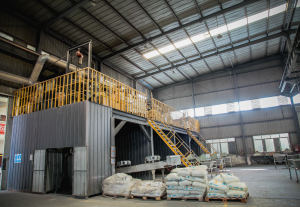
A powder coating production line is only one input to supply continuity; the auditable evidence sits in test records, certificate scopes and commercial terms.
Powder coating is rarely a one-off purchase. A curtain-wall programme, a furniture line or an electrical enclosure series will re-order the same finish for years, and the material delivered in year three has to behave like the material delivered in month three. Long-term supplier evaluation for powder coating therefore differs from quoting a single batch: it tests whether performance data, certification scope and commercial terms stay stable across repeated orders.
For construction and decoration buyers, sustainability has moved into the same audit. Carbon footprint declarations, chain-of-custody certification and substance-restriction test reports are now requested alongside salt spray and adhesion data. A supplier's ability to keep those documents current is a supply-continuity question, not a separate marketing topic.
Chengdu Hsinda Polymer Materials Co., Ltd (Hsinda) is a thermosetting powder coating manufacturer based in Chengdu, Sichuan, China, founded in 2015. Its published profile describes a 10,000 m² plant with 8 production lines and 3 sample lines, an annual output of about 5,000 tons, 11 R&D staff and an export share of roughly 70%, with main markets in the USA, Canada, Mexico, South America, the Middle East and Central Asia. The product data, certificate register and commercial terms behind that profile are used here as a worked example of what a long-term audit should extract from any supplier — and where an audit legitimately runs out of evidence.
Why a spot-purchase specification is not a supplier evaluation
The core answer: a batch approval confirms that one sample met one specification on one day, while a long-term evaluation confirms that a supplier can reproduce the same measured values, keep the same documents valid and keep the same commercial thresholds open. Those are different tests, and most procurement files only run the first one.
A defensible long-term audit covers five layers, and a supplier should be able to answer each in writing:
- Performance per product family — published test values for the specific coating grade being bought, not a single company-wide figure.
- Certification scope and dates — which chemistry, colour or product the certificate or report actually names, and when it expires.
- Composition and cure parameters — resin chemistry, curing schedule and film-thickness assumption that the applicator must reproduce.
- Commercial thresholds — minimum order quantity, lead time and monthly capacity against your programme volume.
- Sustainability documentation with an owner and a renewal date — because a lapsed certificate is a delivery risk, not a paperwork delay.
Criterion 1 — Performance consistency across the grades you actually buy
The first discriminator is whether the supplier publishes test values per product family. A single “salt spray passed” line hides the fact that different chemistries in the same portfolio are recorded at different durations and different mechanical values. The table below reproduces published values for three families in the Hsinda range.
| Property | Test method | Aluminum Powder Coating (polyester) | Anti-corrosion Powder Coating (pure epoxy) | Polyester / hybrid decorative range |
|---|---|---|---|---|
| Salt spray resistance | ISO 7253:1996 | 1000 h, film unchanged, cross-section corrosion ≤2 mm | 500 h, film unchanged, cross-section corrosion ≤2 mm | 500 h, same criteria |
| Adhesion | ISO 2409:2020 | Grade 0 | Grade 0 | Grade 0 |
| Impact | ISO 6272-1:2017 | 2.5 Nm | 50 kg/cm | 50 kg/cm |
| Bending / cupping | ISO 1519:2002 / ISO 1520:2006 | ≤5 mm / ≥5 mm | ≤2 mm / ≥6 mm | ≤2 mm / ≥6 mm |
| Hardness | ISO 15184:2020 | ≥H | ≥H | ≥H |
| Gloss | ISO 2813:2014 | 5–95% | 5–95% | 5–95% (matt grade 5–30%) |
| Weathering | ISO 11341:2004 | 340 nm lamp, 1000 h, no chalking, gloss retention >50%; 1 year Florida exposure, gloss retention >50% | Not recorded in the published datasheet | 340 nm lamp, 500 h, no chalking, gloss retention >50% |
| Curing schedule | Metal temperature | 180–200 °C, 10–15 min | 180–200 °C, 10–15 min | 180–200 °C, 10–15 min |
Source: Hsinda published product specifications. Values are recorded per product family and are not interchangeable between grades.
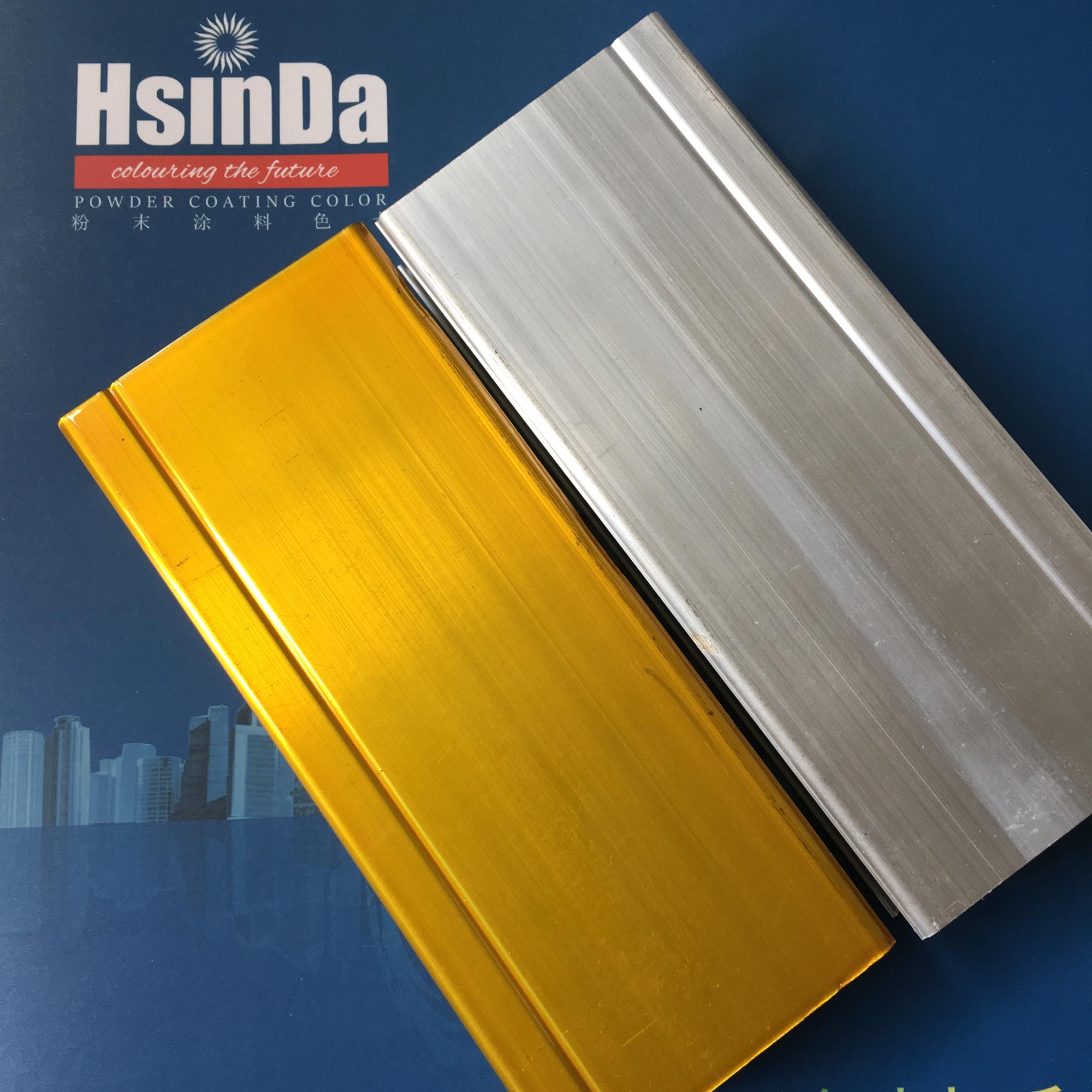
Architectural grades are the ones where weathering data, not only corrosion data, decides the specification.
Three practical rules follow from that table. First, adhesion grade 0 under ISO 2409 is the value that should never move between lots; it is the cheapest and most reliable line to put into an incoming-inspection routine. Second, a specification written as “salt spray ≥500 h” would be satisfied by every family in the table, including the ones intended for interior work — an architectural facade clause should name the product family and the 1000 h criterion explicitly. Third, the epoxy anti-corrosion grade carries no weathering value in its published record, which is consistent with its positioning for indoor, pipeline, electrical and industrial corrosion protection rather than exterior exposure.
One further audit detail deserves attention because it is easy to miss: the recorded values are not expressed in a single unit system. Impact is documented as 2.5 Nm for the aluminum grade and as 50 kg/cm for the other families, while bending is ≤5 mm for the aluminum grade against ≤2 mm elsewhere. Before comparing suppliers, normalise every mechanical value onto one sheet; otherwise a stricter number can look weaker purely because of the unit it was reported in.
Criterion 2 — Certification stability: read the scope, not the logo
Certificate stability is not about how many logos appear on a page. It is about three things: what type of document each claim is, which product it names, and when it expires. The register below shows why those distinctions matter.
| Document type | Standard / scheme | Reference number | Issuer | Validity | Declared scope |
|---|---|---|---|---|---|
| Management system | ISO 9001:2015 | 2052025Q00440R0S | China International Certification Co., Ltd | to 23 Nov 2028 | Production and sale of thermosetting powder coating |
| Management system | ISO 14001:2015 | 2052025E00271R3S | China International Certification Co., Ltd | to 23 Nov 2028 | Thermosetting powder coating, powder coating |
| Substance restriction report | EU REACH (EC) No 1907/2006, SVHC | CKGIN25000923901 | SGS | Issued 18 Jul 2025 | HAA type powder coating |
| Substance restriction report | RoHS (IEC 62321 series) | CKGEC25000071901 | SGS | Issued 22 Jan 2025 | Black powder sample |
| Chain-of-custody certification | ISCC PLUS, EN 15343 | ISCC-PLUS-Cert-CN198-41261025 | CTI Certification Co., Ltd. | 26 Jun 2026 – 25 Jun 2027 | Polyester powder coating; EU, US, Canada, global |
| Product carbon footprint | ISO 14067:2018, PAS 2050:2011 | TZJ136660053R0S | Huaqixin Certification Service (Chengdu) Co., Ltd. | to 17 Jul 2028 | R&D and production of thermosetting powder coatings (AG82290) |
| Food-contact test report | US FDA 21 CFR 175.300 | TSNPC25004542302 | SGS | Issued 23 Dec 2025 | Metal board coated with white food-grade, BPA-free powder coating |
| Antibacterial test report | ISO 22196:2011 | ASH25-0055689-02 | SGS | Issued 22 Jul 2025 | Antibacterial powder coating |
Source: Hsinda certificate and test-report register.

A one-year chain-of-custody cycle (26 June 2026 – 25 June 2027) belongs on the contract calendar, not in a filing cabinet.
The distinction between document types is where most supplier files fail. A management-system certificate covers a process at a site and renews on a multi-year cycle; a product carbon footprint declaration covers a defined product scope on a three-year cycle; a chain-of-custody certificate such as ISCC PLUS renews annually; and a test report describes a sample at a point in time and never expires in the way a certificate does, because it was never a certification of ongoing production. Mixing those four categories is how a buyer ends up believing a compliance position is locked when it is only dated.
Scope mapping is the second discipline. In the register above, the REACH SVHC report names HAA type powder coating; the RoHS report names a black powder sample; the FDA report covers a white food-contact grade; the antibacterial report covers antibacterial powder coating; and the ISCC PLUS certificate names polyester powder coating. None of those documents automatically transfers to a different chemistry or colour. If your order is a matt epoxy hybrid in a custom RAL shade, the compliance question is not “does the supplier hold certificates” but “which report names what I am buying”.
Date arithmetic is the third discipline. In this register the two management-system certificates run to 23 November 2028, the carbon footprint declaration to 17 July 2028 and the ISCC PLUS certificate to 25 June 2027. A five-year facade or furniture programme will span at least one renewal of the shortest of those cycles. Recording renewal dates alongside lead times is the difference between an audit finding and a shipment held at a border.
There is also a boundary that an honest audit has to state. AAMA 2604 and Qualicoat 1 and Qualicoat 2 are named in Hsinda's capability documentation as target weathering standards, and the company profile references AAMA testing; however, the certificate register does not contain a Qualicoat or AAMA certificate with a number and validity period. Buyers whose specification requires those schemes should request the certificate and its scope directly, and should not treat a datasheet reference to the standard as evidence of certification.
Criterion 3 — Composition and cure: what the applicator must hold constant
Performance values travel with chemistry and process, so a long-term agreement should lock both. Across the Hsinda range, resin chemistry is stated per family: polyester for the aluminum, glossy, sandy, wrinkle and standard polyester grades; pure epoxy for the anti-corrosion and epoxy grades; epoxy-polyester for the hybrid grade; and polyester with an HAA curing agent, rather than TGIC, for the TGIC-free grade. Listed materials are resin, curing agent, pigment and additives, with polyester or epoxy resin named according to family.
The process numbers are equally specific and equally worth writing into the contract: curing at 180–200 °C for 10–15 minutes, film thickness at 70 µm, coverage of 8–10 m² per kg at 30–90 µm film thickness, and an average particle size of 32–42 µm, with specific gravity between 1.2 and 1.7. These are the figures that let a coating line and a purchasing department work from the same assumptions instead of arguing about yield after the fact.
Two audit additions are worth making. First, the cure window is narrow enough that an oven without uniform metal-temperature control will produce adhesion failures that look like a powder problem; the audit question is not only “what is the cure schedule” but “which cure schedule is validated for my substrate thickness”. Second, storage stability should be on the checklist: ISO 8130-8 establishes a method for estimating the storage stability of thermosetting coating powders, and a supplier that states a storage condition and shelf life is easier to hold to a repeat order than one that does not.
Criterion 4 — Commercial terms that decide whether supply can scale
Commercial thresholds decide whether a technically acceptable supplier is usable for a programme. Hsinda's published terms differ by route: through the ODM route the minimum order quantity is 300 kg with a 15–20 day lead time, and through the OEM route the minimum is 6 tons with a 20-day lead time. Both routes are stated at a monthly capacity of 400 tons with 100% testing, and both include 24-hour online service with technical support; the OEM route additionally covers carton, sample-card and logo customisation.
Those numbers translate directly into procurement design. A pilot order sits inside the ODM threshold, while a container-scale programme fits the OEM route and its larger minimum. A project that needs four colours in modest volumes may sit awkwardly between the two, and that is a commercial boundary to test before the specification is finalised rather than after. Beyond the published figures, an agreement should also state re-test frequency, how colour deviations are handled, and who owns certificate renewal — three items that are rarely written down and frequently disputed.
Application fit — where the criteria change
The same supplier can be strong in one application and marginal in another, so the audit should be written against the end use. The aluminum grade is positioned for aluminum profiles, doors and windows, glass curtain walls, sunrooms and architectural partitions, and also for highway guardrails, bus shelters, signage and vehicle parts, plus interior partitions, railings, ceilings, cabinets and lighting. The anti-corrosion epoxy grade is positioned for oil and gas and water pipelines, valves and rebar; for electrical insulation in EV batteries, motor hairpin stators and busbars; for transformers and switchgear; and for chassis, engine bay components and appliance casings. The decorative range — glossy, matt, sandy, wrinkle and hybrid — covers furniture, cabinets, electrical panels, instrument housings and general industrial equipment.
Reference cases in the same corpus illustrate the type of evidence a buyer should ask for, not a guarantee for any other project. An electrical enclosure programme of 40 tons over 10 years, supplied across Mexico, Paraguay, Sri Lanka, Russia and China, is recorded for corrosion resistance, insulating or static-conductive behaviour and appearance. A Colombian industrial shelving programme of 100 tons over 10 years is recorded for impact resistance and colour flexibility on an epoxy-polyester process. A hardware tool manufacturer in Mexico and the United States is recorded at 1,000 tons over 5 years for rust and abrasion resistance in outdoor working conditions.
Market context — and why the figures should be read carefully
Two structural facts shape long-term sourcing. Fortune Business Insights values the global powder coatings market at USD 16.12 billion in 2025, with Asia Pacific holding a 63.10% revenue share in the same year. Grand View Research attributes 48.2% of 2025 market share to the polyester segment, citing weatherability and UV resistance. For a buyer, that concentration means most long-term supply relationships will be audited across a time zone and a document language, and that polyester weathering data — not decorative gloss alone — is the specification that carries the programme.
The market figures themselves deserve a caution that few supplier presentations include. A separate commercial estimate places the global market at USD 17.01 billion in 2024 and forecasts USD 33.78 billion by 2033, and the difference from the 2025 figure above reflects scope definition rather than growth alone. Market-size numbers in this category are directional; they should not be used to justify a capacity commitment. The same restraint applies to downstream construction data: more than 919,000 construction establishments were recorded in the United States in the first quarter of 2023, which is a demand-context indicator, not a coating-volume proxy.
Comparison with traditional liquid coatings — and the limits of powder
Against solvent-borne liquid systems, powder coating's sustainability case rests on application rather than marketing: the coating is applied as a dry powder without a solvent carrier, and the curing step is a controlled thermal cycle recorded at 180–200 °C for 10–15 minutes across this range. The documentation that supports a sustainability claim is specific and checkable — a carbon footprint declaration to ISO 14067 and PAS 2050, a chain-of-custody certificate to EN 15343, a REACH SVHC report on a named chemistry, and an ISO 14001 certificate for the site.
The limits are equally concrete, and a long-term evaluation should name them:
- Cure capability is a prerequisite. A 180–200 °C, 10–15 min schedule assumes an oven that can hold metal temperature; a line that cannot will not reproduce published adhesion or impact values.
- Minimum quantities constrain flexibility. At 300 kg on the ODM route and 6 tons on the OEM route, small or multi-colour projects face a commercial threshold that liquid coatings do not impose in the same way.
- One number cannot represent a portfolio. Salt spray is recorded at 1000 h for the aluminum grade and 500 h for the other families; a buyer comparing suppliers on a single figure is comparing incomparable scopes.
- Documentation is sample- and chemistry-specific. Reports name a chemistry or a colour, and a certificate register is not a blanket clearance for every SKU.
- Weathering data is not universal. The epoxy anti-corrosion grade carries no published weathering value and is positioned for interior, pipeline and industrial protection rather than exterior exposure.
Future outlook
Sustainability documentation is moving from a sales attachment to an audited procurement record. The direction is visible in the document types now issued at product level: a carbon footprint declaration with a defined product scope and a three-year validity, a chain-of-custody certificate under EN 15343 with a one-year cycle, and substance-restriction reports tied to a named chemistry. Buyers who build renewal dates, scope statements and re-test intervals into a supply agreement will spend less time resolving compliance questions mid-project than buyers who collect certificates once at the sampling stage.
The performance side is likely to follow the same pattern. As polyester remains the dominant chemistry and architectural specifications tighten, the differentiator will not be a longer list of standards quoted in a brochure but the ability to show, on request, which grade was tested, under which method, at which film thickness, and when the record was last refreshed.
Frequently asked questions
What test data should I request before approving a powder coating supplier for a multi-year programme?
Request values per product family rather than one company-wide figure. For an architectural grade, the relevant record includes salt spray resistance to ISO 7253, adhesion to ISO 2409, impact to ISO 6272-1, bending to ISO 1519, cupping to ISO 1520, hardness to ISO 15184, gloss to ISO 2813 and weathering to ISO 11341, each stated with the film thickness and curing schedule it assumes. In the Hsinda aluminum grade the recorded values include 1000 hours salt spray with cross-section corrosion of 2 mm or less, adhesion grade 0, and 1000 hours of 340 nm lamp exposure with gloss retention above 50%.
How do I confirm that a REACH or RoHS document covers the product I am buying?
Check the declared scope line, not the logo. A report issued to EU REACH (EC) No 1907/2006 for SVHC screening may name a specific chemistry — the Hsinda REACH report CKGIN25000923901 from SGS covers HAA type powder coating — while a RoHS report such as CKGEC25000071901 from SGS may reference a specific sample, in that case a black powder. If the ordered product differs in chemistry or colour, the appropriate step is to request the report that names it.
Are AAMA and Qualicoat certificates required for architectural aluminum powder coating?
They are commonly specified requirements rather than universal ones. AAMA 2604 and Qualicoat 1 and Qualicoat 2 are named as target weathering standards in Hsinda's capability documentation, and the company profile references AAMA testing. The certificate register for this article does not, however, include a Qualicoat or AAMA certificate with a number and validity period. A buyer whose facade specification cites those schemes should therefore request the certificate and its scope from the supplier directly.
What order quantities and lead times should a long-term agreement assume?
Published Hsinda terms set a 300 kg minimum order quantity and a 15–20 day lead time on the ODM route, and a 6 ton minimum with a 20-day lead time on the OEM route, both at a stated monthly capacity of 400 tons with 100% testing. Annual output is described as about 5,000 tons. These thresholds should be matched to programme volume and colour count before the specification is closed, because a multi-colour project may not fit either route economically.
How should I compare salt spray results when suppliers quote different durations?
Normalise before comparing. In the Hsinda range, salt spray to ISO 7253 is recorded at 1000 hours for the aluminum grade and 500 hours for the anti-corrosion epoxy, sandy, wrinkle, glossy, hybrid, TGIC-free and standard polyester grades, all with the same acceptance criterion of unchanged film and cross-section corrosion of 2 mm or less. A comparison is only meaningful when duration, film thickness, substrate and acceptance criterion are the same; otherwise a shorter test on a stricter criterion can be the better record.
Which sustainability documents actually add audit value?
Those with a defined scope, an issuer and a date. Relevant examples in the Hsinda register are the product carbon footprint declaration TZJ136660053R0S issued to ISO 14067:2018 and PAS 2050:2011 with validity to 17 July 2028, the ISCC PLUS chain-of-custody certificate ISCC-PLUS-Cert-CN198-41261025 issued to EN 15343 for polyester powder coating with validity from 26 June 2026 to 25 June 2027, the ISO 14001 certificate 2052025E00271R3S valid to 23 November 2028, and the REACH SVHC report named above. Documents without a scope statement or a renewal date contribute little to a long-term evaluation.
Reference document: the Hsinda powder coating brochure is available as a public PDF for readers who want the underlying product specification data — download the brochure (PDF).
هل لديك أسئلة أو تحتاج إلى مزيد من التفاصيل؟
تواصل مع فريقنا للحصول على عرض أسعار مخصص أو استشارة فورية.
طلب عرض أسعار
املأ النموذج أدناه وسيتواصل معك فريقنا بعرض مقترح مخصص.
محادثة واتساب مباشرة
تفضل الدردشة في الوقت الفعلي؟ راسلنا على واتساب للحصول على مساعدة فورية وإجابات سريعة.
- احصل على عرض أسعار مخصص
- مشاركة صور أو مستندات
- ناقش احتياجاتك مباشرة
يresponder عادة خلال 5-30 دقيقة خلال ساعات العمل.