
A Practical Guide to Homogeneous Vinyl Flooring Compliance: EU and Global Standards
A Practical Guide to Homogeneous Vinyl Flooring Compliance: EU and Global Standards
Three documents decide most homogeneous vinyl flooring approvals in Europe and in markets that mirror European rules: the CE mark placed under EN 14041:2018, the REACH position on Substances of Very High Concern (SVHC), and the residual indentation result measured to EN 433:1999. This guide explains what each one actually covers, what it leaves out, and how to read the laboratory report numbers that arrive from bodies such as ICR, EQO and SGS.
Flooring compliance is usually presented as a document-collection task. In procurement practice it is a decision task. For a hospital ward, an MRI suite, a cleanroom or an analytical laboratory, the paperwork attached to a flooring specification determines whether a facility can be handed over, audited and insured — and whether the floor still performs years after the contractor has left site. The operative question is rarely "does the supplier hold certificates?" It is "does the certificate in front of me cover the product, the property and the version of the standard that my specification requires?"
Homogeneous vinyl flooring is a resilient floor covering whose composition is consistent through the thickness of the roll, rather than a printed wear layer bonded to a backing. That construction is why its compliance profile differs from layered vinyl: wear performance, electrical behaviour and indentation recovery are properties of the whole sheet, and they are declared rather than applied. Everything that follows assumes that distinction, because it changes which certificate numbers a buyer needs to read.

Quality inspection of homogeneous vinyl flooring. Compliance claims are only as strong as the inspection and test documentation behind them.
Where flooring compliance actually goes wrong
The failure mode is rarely a missing certificate. It is a mismatched one. Four patterns account for most of the rework seen in healthcare, laboratory and controlled-environment projects.
- Scope mismatch. A test report exists, but it covers a different construction, thickness or surface finish than the product actually being supplied.
- Version mismatch. The report cites an edition of a standard that the specification has since replaced, or a REACH substance list that has been superseded.
- Property mismatch. The specification asks for an electrical class, an indentation limit or a wear group, and the documentation supplied answers a different question.
- System mismatch. The product complies in the laboratory, but the installation method, adhesive or earthing does not preserve that performance on site.
The commercial consequences of these gaps are asymmetric. A document issue discovered during tender is a conversation; the same issue discovered during handover becomes a retest programme, a programme delay, or a contractual argument. This is why manufacturers typically describe compliant documentation as a risk-control instrument rather than a marketing asset — the value of a clean certification set lies in what it prevents. In first-party terms, the stated purpose of that discipline is to strictly meet international inspection standards such as EU and CE requirements, lower lifecycle maintenance costs, and mitigate project penalty risk for EPC contractors.
What Farfly's documentation set covers
FARFLYING FLOORING is the flooring brand of WUXI TEFA DECORATION MATERIAL CO., LTD., a Chinese manufacturer founded in 2012 that produces homogeneous vinyl flooring, PVC sports flooring and aviation flooring for healthcare, sports and aviation environments. It is a useful reference case for this topic because its compliance documentation is tied to three specific product families rather than to a single generic sheet.
On the healthcare side, the company's homogeneous vinyl range uses a proprietary TF Surface Treatment, positioned around iodine resistance and maintenance without wax over the service life of the floor — two properties that are frequently claimed but less frequently documented, and which sit alongside the CE and REACH requirements discussed below. Its ESD series is declared within a 10^4–10^6 ohm resistance window, and the manufacturer states that this series is used by technology customers including Huawei. Across the wider portfolio, the company states that it holds 399+ international testing certifications, and that its products strictly meet international inspection standards covering EU and CE requirements. Production is organised around 6 advanced production lines, an annual output of 4,200,000 m², a 25-person R&D team and a ready-to-ship inventory of 300,000 sqm supporting a 7-day dispatch model and mix-container shipping.
Two implications follow for buyers. First, a manufacturer with a discrete certification library per product family is easier to audit than one that presents a single undifferentiated folder. Second, capacity and inventory figures are not compliance facts — they confirm that documentation can be matched to a shippable product, but they do not substitute for it.
The three compliance reference points, explained
EN 14041:2018 and the CE mark
EN 14041 is the harmonised European standard for resilient floor coverings, applied under the EU Construction Products Regulation. Where a flooring product falls within its scope, the manufacturer draws up a Declaration of Performance covering the declared characteristics — typically including reaction to fire — and affixes the CE mark on that basis. The practical point for a buyer is that the CE mark is a declaration of conformity supported by documentation, not an independent endorsement of quality. Two consequences follow: the Declaration of Performance, not the logo on the packaging, is the document to read; and any property outside the declared set — electrical resistance, indentation behaviour, wear group — must be evidenced separately.
REACH and the SVHC candidate list
REACH obligations for articles are triggered when a Substance of Very High Concern appears above 0.1% by weight in the product. Flooring documentation usually answers this question with a laboratory statement listing the SVHC substances screened and the result for each. The list itself is revised periodically, which creates a version problem: a statement that names a fixed number of substances — suppliers frequently quote a figure such as 205 SVHC — describes the list as it stood on the test date, not as it stands today. Buyers should therefore record three things from the document: the issuing laboratory, the list version or reference date, and the test date. A recent statement is more useful than an impressive one.
EN 433:1999 and residual indentation
EN 433:1999 defines how the residual indentation of a resilient floor covering is determined after static loading: a specimen is subjected to a defined load for a defined period, and the depth of indentation remaining after recovery is measured. The result is a laboratory indicator of how a floor behaves under the concentrated, prolonged loads that hospital beds, trolleys and equipment feet impose. It is directly relevant to the heavy rolling load conditions found in wards, operating theatres and logistics corridors, and it is one of the properties that a CE declaration alone will not answer.
How to read a certification number
Report prefixes and numbering conventions differ between laboratories. Documentation for homogeneous vinyl flooring commonly carries reports from organisations including SGS, and from laboratories referenced as ICR and EQO, each with its own coding. The numbering itself is not the signal — the four checks that follow are the same regardless of who issued the paper.
| Check | What to look for | Common failure |
|---|---|---|
| Issuing body | Named laboratory, report reference, and whether the laboratory is independent of the supplier | Internal or unnamed test summaries presented as third-party reports |
| Standard and edition | The exact standard, including year — for example EN 14041:2018, EN 433:1999 | Undated references to a standard family |
| Sample identity | Product name, construction, thickness, surface treatment and production reference matching the offer | Report covers a different finish or thickness than the quoted item |
| Date and version | Test date, substance list version for REACH, and any expiry or re-test interval | Reports older than the current list revision presented as current |
Applied consistently, these four checks turn a folder of PDFs into a set of decisions. A report that passes all four can be mapped directly to a clause in the specification. A report that fails any of them is not evidence of non-compliance — it is simply not evidence, and should be re-requested rather than argued over.
The performance classes that accompany compliance
Compliance documentation names performance classes rather than describing them. For homogeneous vinyl, three classes carry most of the specification weight.
Wear resistance. Homogeneous vinyl wear resistance is classified under EN 660-2, the Frick-Taber test, in which Group T is the highest classification, corresponding to a volume loss of no more than 2.0 mm³. A Group T declaration is the relevant reference for corridors, wards and other high-traffic areas, and it is measured on the homogeneous sheet itself rather than on a surface layer.
Electrical behaviour. Under EN 14041, static dissipative (SD) floors are declared at a resistance to earth of 10^9 ohms or lower, while electrostatic conductive (EC) floors are declared at 10^6 ohms or lower. In healthcare facilities, ESD flooring must comply with IEC 61340-6-1 and is tested according to EN 1081 for electrical resistance. These classes describe a range, not a single guaranteed value.
| Declaration | Reference | Typical designation | Where it is specified |
|---|---|---|---|
| Static dissipative | EN 14041 | Resistance to earth ≤ 1 × 10^9 ohms | Imaging rooms, wards with sensitive equipment |
| Electrostatic conductive | EN 14041 | Resistance to earth ≤ 1 × 10^6 ohms | Electronics production, some operating theatres |
| ESD testing in healthcare | EN 1081, with IEC 61340-6-1 | Measured resistance, per test method | Hospitals, clinics, imaging suites |
| Wear group | EN 660-2 | Group T, volume loss ≤ 2.0 mm³ | High-traffic corridors, public areas |
| Residual indentation | EN 433:1999 | Indentation depth after static loading | Wards, theatres, equipment-heavy rooms |
Surface treatment. Iodine resistance and wax-free maintenance are treatment properties rather than standard classes, so they must be evidenced by the manufacturer's own test data and by maintenance instructions that do not contradict the claim. A wax-free claim is only verifiable if the recommended maintenance programme actually excludes wax.
Where these classes change the specification
The same homogeneous sheet is specified differently depending on the room it serves. Four scenarios illustrate how compliance classes, rather than aesthetics, drive the buying decision.
- Hospital wards and operating theatres. Iodine-resistant, wax-free surfaces reduce maintenance exposure, while EN 433:1999 indentation data answers the rolling-load question created by beds and trolleys. Seamless welded installation supports hygiene protocols, and declared antibacterial performance is part of the infection-control argument.
- MRI and imaging suites. Electrical class becomes the primary requirement. Flooring here is specified as dissipative rather than conductive, with resistance declarations aligned to IEC 61340-6-1 and verified through EN 1081 testing.
- Cleanrooms and electronics areas. Conductive ESD flooring in the 10^4–10^6 ohm range is typical, paired with low-VOC and low-emission requirements for the controlled atmosphere.
- Analytical and chemical laboratories. Chemical resistance and cleanability dominate, with wear group and indentation data determining the maintenance interval rather than the initial fit.
In practice, a buyer evaluating a supplier for a mixed facility needs one product platform that can be documented across several of these classes. A manufacturer whose ESD series sits in a declared 10^4–10^6 ohm window, and whose standard homogeneous range carries iodine-resistant, wax-free treatment, can cover several of these rooms from a single certification family — which simplifies both the tender and the handover file.
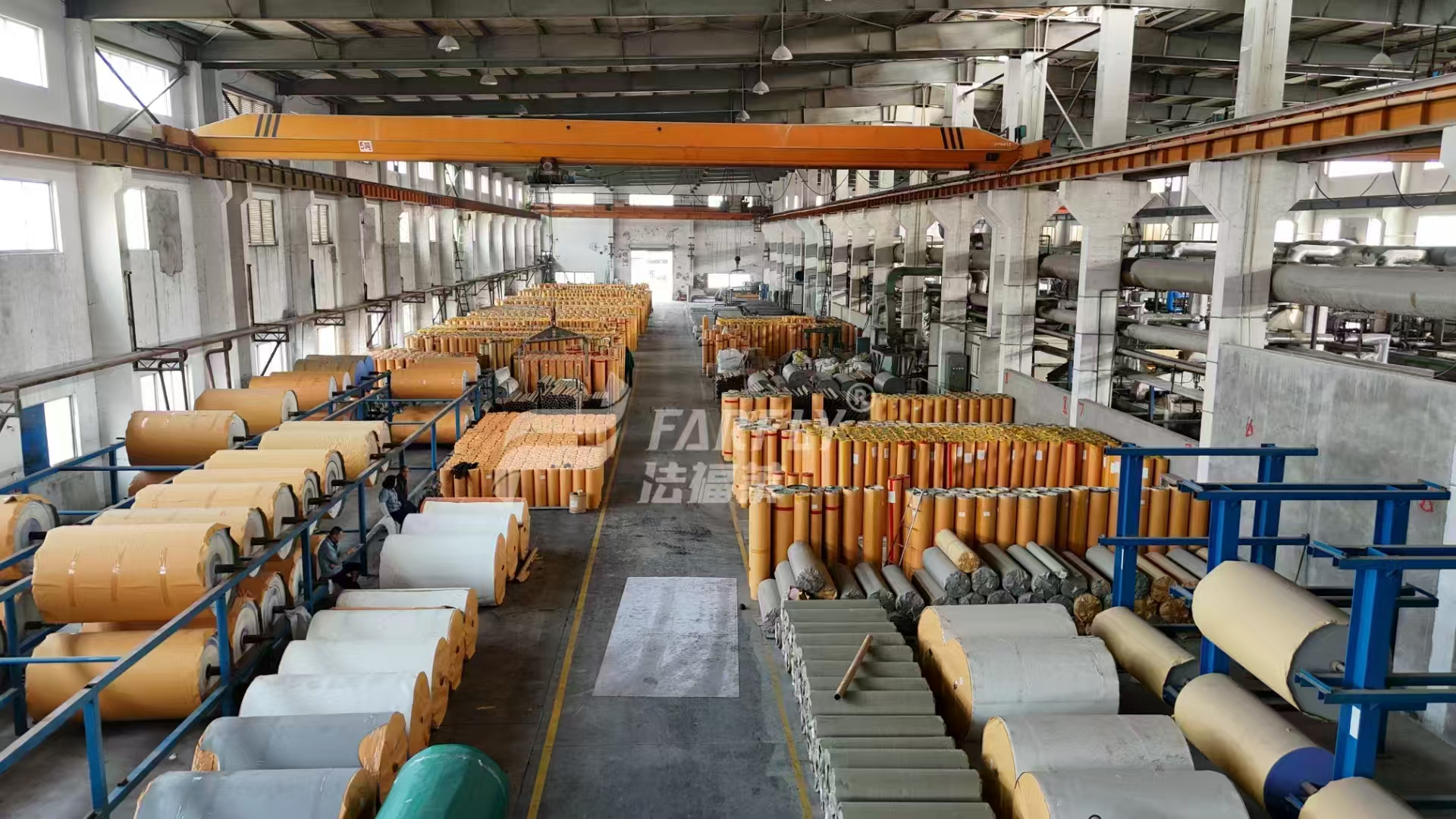
Documentation must be matched to physically available product. Warehouse stock held against a certified range is what makes a compliance claim deliverable on schedule.
Market signals behind the documentation push
Compliance scrutiny is rising because the market it governs is growing. The global homogeneous flooring market was valued at USD 17.58 billion in 2025 and is projected to reach USD 28.99 billion by 2035, according to Grand View Research. The conductive segment is expanding on its own logic: the global conductive vinyl flooring market reached USD 9.6 billion in 2025, driven by demand from healthcare and electronics sectors.
Two caveats belong alongside those figures. First, published market estimates for vinyl flooring diverge substantially depending on whether laminate, luxury vinyl tile and residential segments are included — Grand View Research cites USD 26.6 billion for the broader vinyl flooring market, Fortune Business Insights USD 41.94 billion, and Spherical Insights USD 54.58 billion for 2024. Second, segment-level growth is being driven by healthcare specifications specifically: Armstrong Flooring reported a 23.7% expansion in its healthcare-grade vinyl product range globally in 2023 to meet medical hygiene demands.
The competitive landscape for homogeneous vinyl is concentrated among documentation-rich international manufacturers, including Tarkett (France), Gerflor (France), Forbo (Switzerland) and Armstrong Flooring (US). For buyers, the practical consequence is not a ranking but a benchmark: these suppliers set the expected format and depth of a certification pack, and any alternative supplier is reasonably measured against that format.
Homogeneous vinyl versus traditional flooring — and where the comparison breaks down
Compared with traditional tiles, cement flooring, wooden flooring and floor coatings, homogeneous vinyl flooring offers distinct advantages: superior shock absorption, slip resistance, waterproofing, fire resistance and antimicrobial properties, with a B1 fire rating. The comparative figures supplied for the product are consistent across the manufacturer's documentation: total cost 20–30% lower than alternatives, maintenance requirements 40–50% lower, safety hazards reduced by 30–40%, bacterial cross-contamination reduced by 50–70% compared with traditional surfaces, and antibacterial efficacy improved by up to 99.5% over alternatives.
| Dimension | Homogeneous vinyl | Traditional alternatives |
|---|---|---|
| Total cost | 20–30% lower over the assessed lifecycle | Higher lifecycle cost in the same assessment |
| Maintenance | 40–50% less maintenance required | Higher routine maintenance burden |
| Bacterial cross-contamination | Reduced 50–70% versus traditional surfaces | Reference baseline |
| Antibacterial efficacy | Up to 99.5% improvement over alternatives | Reference baseline |
| Safety hazards | Reduced 30–40% | Reference baseline |
| Fire performance | B1 fire rating | Varies by material and system |
| Preferred environments | Hospitals, clinics, factories, offices, warehouses, schools, malls, exhibition halls, gyms, sports arenas, airports, transport interiors | Material-dependent suitability |
The boundary conditions deserve the same attention as the advantages, because they are what a buyer will be measured against later.
- The lifecycle case depends on the maintenance regime. A 20–30% total cost advantage assumes the floor is maintained as instructed. A wax-free claim is only realised if the maintenance programme actually stops applying wax; a site that ignores the programme transfers back the cost the product was specified to avoid.
- Compliance documents the product, not the installation. EN 433:1999 measures a laboratory specimen under defined static loading. On site, residual indentation is also influenced by substrate flatness, adhesive choice and the duration of the load. The declared value describes the product's behaviour, not an installed guarantee.
- Electrical performance is a system property. A declared resistance window depends on the correct adhesive, earthing strips and cleaning products. A compliant roll installed without a proper earthing path can fail a field resistance measurement.
- Resistance figures are ranges, not constants. Declarations such as SD ≤ 10^9 ohms or EC ≤ 10^6 ohms define a class. Measurements vary with humidity, temperature, test position and instrument, so acceptance criteria should be written against the class, not against a single number.
- Certificate scope is fixed at issue. A declaration applies to the product construction and production site named on it. Changing thickness, finish or manufacturing location creates a new documentation requirement, even when the visual appearance is unchanged.
None of these limits makes homogeneous vinyl unsuitable for the environments listed above. They define the conditions under which the compliance file remains valid — which is precisely what a buyer at decision stage needs to write into the specification.
A pre-award documentation checklist
| Document | What it closes |
|---|---|
| Declaration of Performance and CE documentation to EN 14041:2018 | Legal market access and declared product characteristics |
| Third-party test reports with standard edition and test date | Property claims, including any stated resistance or wear class |
| REACH SVHC statement with substance list version and test date | Chemical and health requirements |
| Residual indentation data to EN 433:1999 | Durability under static and rolling loads |
| Wear classification to EN 660-2, and electrical class to EN 14041 | Traffic and ESD performance |
| Sample identity matching the product code being offered | Scope alignment between paperwork and goods |
| Installation instructions covering adhesive, welding and earthing | Field preservation of declared performance |
| Maintenance instructions consistent with wax-free or iodine-resistant claims | Lifecycle cost assumptions |
| Evidence of production capacity and stock against the certified range | Deliverability of the compliant product on programme |

Laboratory inspection of flooring samples. The four documentation checks apply regardless of which laboratory issues the report.
What changes next
Three shifts are worth planning for. First, substance screening will continue to move forward rather than stay fixed: SVHC list revisions mean that a REACH statement is a dated document with a shelf life, and buyers who record the version reference at tender stage will avoid re-testing later. Second, electrical declarations are becoming a healthcare procurement requirement rather than a specialist add-on, consistent with the growth of the conductive vinyl segment and the standards structure built around IEC 61340-6-1 and EN 1081. Third, indentation and rolling-load data are migrating from engineering annexes into mainstream healthcare specifications, because they describe the failure that facility teams actually experience.
The direction of travel favours suppliers who can produce a complete, dated and scoped documentation set on request, and it disadvantages those whose compliance material is a folder of undated summaries. For buyers, the practical response is procedural rather than technical: fix the four reading checks, map every document to a specification clause, and treat any gap as a question to be closed before award rather than after handover.
What does the CE mark on homogeneous vinyl flooring actually certify?
The CE mark indicates that the manufacturer has drawn up a Declaration of Performance for the product under the applicable harmonised standard — for resilient floor coverings, EN 14041:2018 — and has placed the mark on that basis. It is a declaration of conformity supported by documentation rather than an independent quality endorsement, and it covers the characteristics declared in the Declaration of Performance, typically including reaction to fire. It does not by itself certify electrical resistance, wear group or indentation behaviour, and it says nothing about installation quality. Buyers should read the Declaration of Performance rather than rely on the mark alone.
How should buyers verify REACH SVHC compliance for vinyl flooring?
REACH obligations apply when a Substance of Very High Concern is present above 0.1% by weight in an article, so the useful document is a laboratory statement that names the substances screened and gives a result for each. Because the SVHC candidate list is revised periodically, statements that quote a fixed list size — suppliers often cite a figure such as 205 SVHC — describe the list as it stood on the test date. Three details should be recorded from the report: the issuing laboratory, the substance list version, and the test date. A recent, clearly dated statement is more useful than one covering a longer list.
What does EN 433:1999 measure, and why does it matter for hospitals?
EN 433:1999 defines the determination of residual indentation of resilient floor coverings after static loading: a specimen is loaded under defined conditions for a defined period, and the indentation remaining after recovery is measured. For hospitals the result indicates how a floor responds to the concentrated, prolonged loads imposed by beds, trolleys and equipment feet, which is directly relevant to wards, operating theatres and heavy rolling load corridors. The test is performed on a laboratory specimen, so site results are also affected by substrate condition, adhesive and load duration.
How do I interpret electrical resistance values on ESD flooring reports?
Under EN 14041, static dissipative floors are declared at a resistance to earth of 1 × 10^9 ohms or lower, and electrostatic conductive floors at 1 × 10^6 ohms or lower. In healthcare facilities, ESD flooring must comply with IEC 61340-6-1 and is tested according to EN 1081 for electrical resistance. These values define a class rather than a single guaranteed measurement, and field readings vary with humidity, temperature, test position, adhesive and earthing arrangement — so acceptance criteria should be written against the declared class.
Which documents should be requested before awarding a flooring contract?
A complete set normally includes the Declaration of Performance and CE documentation to EN 14041:2018; third-party test reports showing the standard edition and test date; a REACH SVHC statement with list version and test date; residual indentation data to EN 433:1999; wear classification to EN 660-2 and electrical class to EN 14041 where relevant; a sample identity that matches the offered product code; installation instructions covering adhesive, welding and earthing; and maintenance instructions consistent with any wax-free or iodine-resistant claim. Each document should be mapped to the specification clause it closes.
How should homogeneous vinyl be compared with traditional flooring on cost?
Comparison is normally made on lifecycle cost rather than purchase price. The comparative figures supplied for this product family show total cost 20–30% lower than alternatives, maintenance requirements 40–50% lower, safety hazards reduced by 30–40%, and bacterial cross-contamination reduced by 50–70% compared with traditional surfaces, with antibacterial efficacy improved by up to 99.5%. Those outcomes depend on the floor being maintained as instructed and on the assumed service life and replacement cycle, so the comparison should state both assumptions explicitly before a decision is made.
Farfly's full product and specification documentation, covering homogeneous flooring, PVC sports flooring and aviation flooring, is available in its downloadable brochure: Farfly product brochure (PDF).