
A Stylus Pen FAQ: Acceptance, Active vs. Passive, Apple Pencil
A Stylus Pen FAQ: Acceptance, Active vs. Passive, Apple Pencil
A stylus pen order rarely fails because the pen cannot write. It fails because the buyer and supplier defined different acceptance points: the sample writes well, but the production lot is not checked against it; the active stylus demonstrates palm rejection, but the purchase order does not say how palm rejection is judged; or the price gap to Apple Pencil is clear, while the functional gap is not. Buyers moving from evaluation to execution need to turn product questions into purchasing controls.
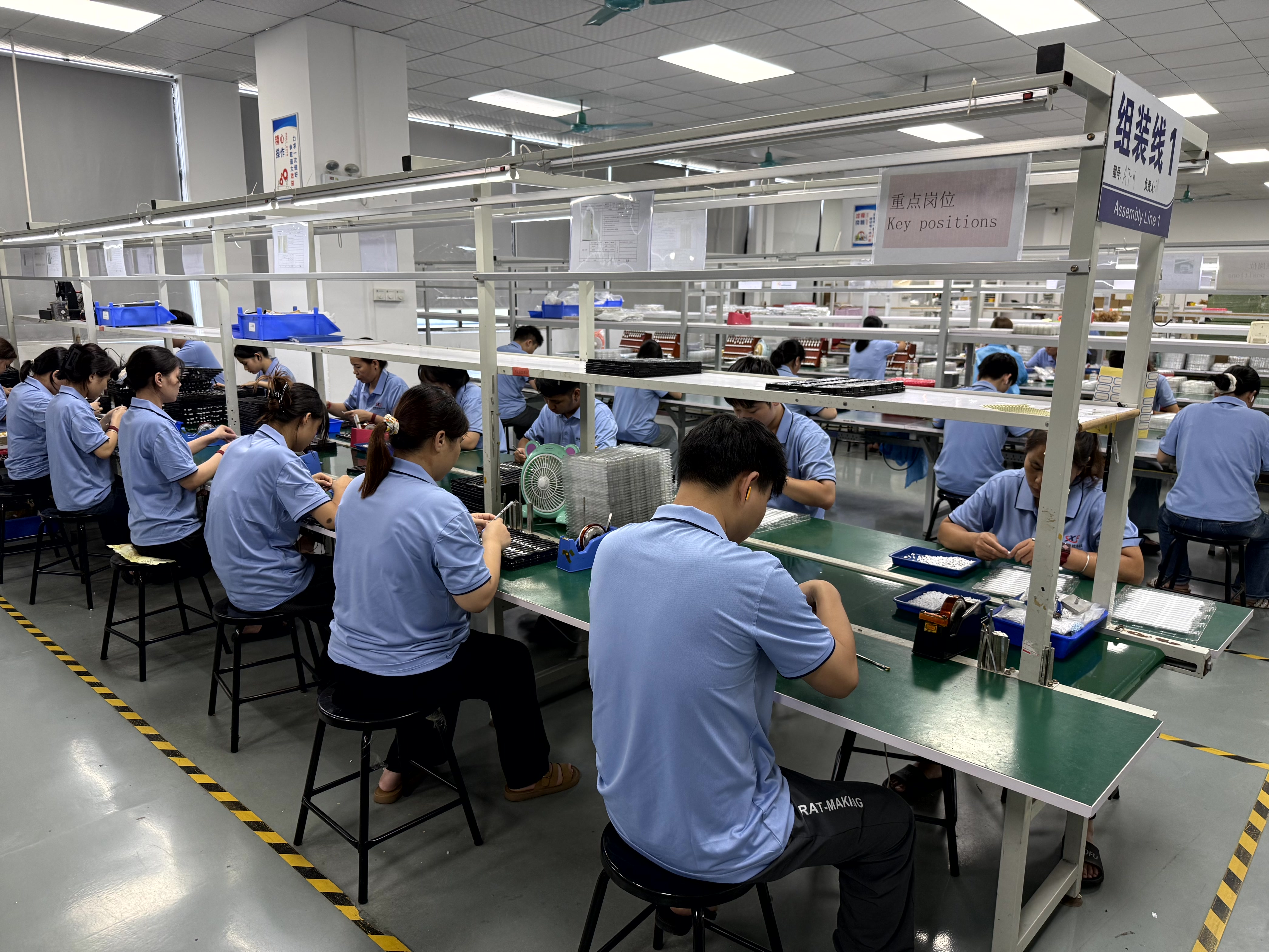
This FAQ addresses those controls for iPad Stylus Pen, iPad and Android Stylus Pen and universal active stylus programmes. It draws on the supplied product, certification and purchasing records for Dongguan Jiayao Intelligent Technology Co.,Ltd (Jiayao stylus), a stylus pen manufacturer founded in 2021 in Dongguan, Guangdong, China. The company operates a 2,700 m² factory with 100 employees, an annual output of 3,000,000 units and a four-engineer R&D team, and states that its capabilities cover PCBA design, battery welding, final assembly and quality testing. Its official site is Jiayao stylus.
Why do stylus procurement questions change between evaluation and execution?
Evaluation asks whether a stylus can support the use case. Execution asks whether the delivered order will repeatedly meet the approved sample, the purchase order and the destination market's documentary requirements. The second question is narrower and more concrete, and it is where most avoidable disputes sit.
At evaluation, a buyer may compare passive and active stylus types, check iPad or Android compatibility and review the supplier's product range. At execution, the same buyer needs a fixed model, a fixed bill of materials, a signed golden sample, an inspection definition and a certificate scope that names the ordered product. A capability statement such as 'OEM/ODM supported' is useful only when it is converted into those controls.
Jiayao stylus lists OEM/ODM customization across function, color, shape, tip, logo and packaging, with sample-based customization such as logo packaging and Bluetooth name. Those options widen the number of variables that must be frozen before mass production. The procurement task is to ensure that each variable is written into the order rather than left to the sample room.
What are the purchasing terms and acceptance criteria for a stylus order?
The supplied purchasing record for Jiayao stylus lists MOQ 500 units, EXW/FOB delivery terms, pre-shipment inspection as the acceptance criterion and 30/70 payment terms. Those are the commercial starting points; they become usable only when each term is tied to the exact model and configuration.
| Purchasing term | Supplied value | Buyer check before PO |
|---|---|---|
| MOQ | 500 units | Confirm the MOQ for the exact model, tip, color and packaging configuration. |
| Delivery terms | EXW/FOB | Name the Incoterm, port and responsibility split in the contract. |
| Acceptance | Pre-shipment inspection | Define inspection items, sample selection and pass/fail rules against the golden sample. |
| Payment | 30/70 | State which milestone releases each payment. |
| Warranty | 1 year; one-to-one replacement | Define the claim process and what the replacement covers. |
| Lead time | 20–35 days | Confirm the schedule for the order quantity, customization and shipping mode. |
Acceptance is not only a commercial clause. The company states that every stylus goes through 100% full inspection covering functional, tactile and visual checks. That is a useful starting point because it names three inspection families, but the purchase order still needs a pass/fail definition for each family. A functional check should refer to the approved sample's writing, charging and pairing behaviour where applicable; a tactile check should refer to tip feel, surface finish and assembly fit; a visual check should refer to colour, printing, finish and packaging. The exact test methods and limits should be agreed in the sample approval record.
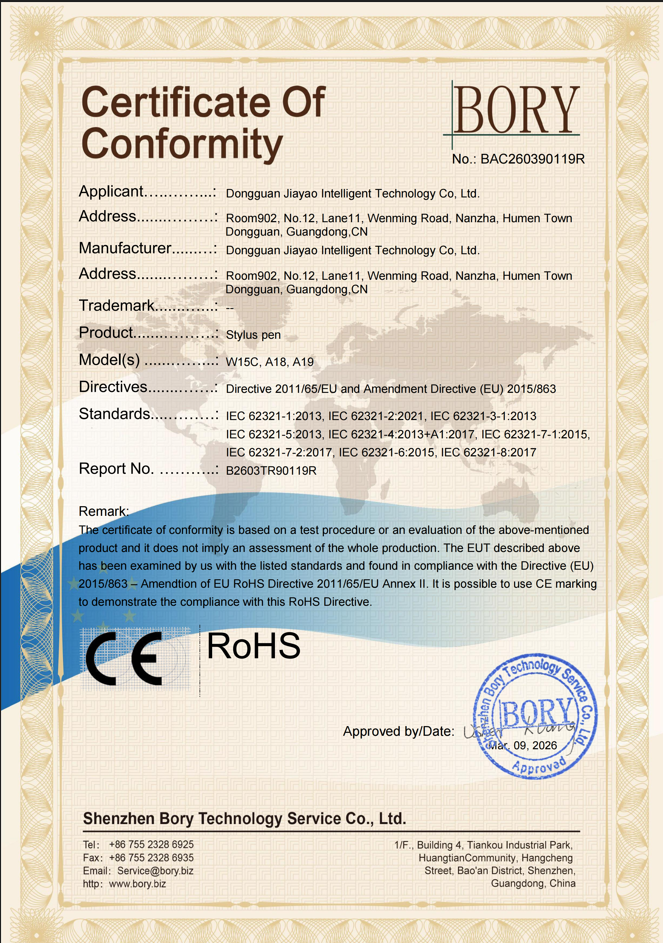
Certification evidence needs the same specificity. Jiayao holds an ISO9001 quality management system certificate (24626Q00066R001) issued by HIC Certification Service, with a scope of 'Research and Development of Capacitive Stylus' and validity from 2026-01-16 to 2029-01-15. The company also holds a ROHS certificate of conformity (BAC260390119R) issued by Shenzhen Bory Technology Service Co.,Ltd for the EU market, issued on 2026-03-09, with a listed scope of W15C, A18 and A19. The ISO9001 certificate supports the existence of a quality management system within that scope; it does not certify the performance of every stylus model. The ROHS record is model-specific. A buyer ordering a different model should ask for the certificate or test report that names that model rather than treating the company-level certificate as blanket coverage.
Commercial terms also need a clear boundary. The 30/70 payment record is a structure, not a complete contract; the milestones should be defined. The one-year warranty with one-to-one replacement is the stated after-sales position; the claim process, freight responsibility and exclusions should be written into the order. The recorded lead time is 20–35 days, and the company states that samples can be ready in as little as three weeks. Those figures should be tied to the actual order quantity and customization, not treated as a universal promise.
Import classification is a separate check. Stylus pens are typically classified under HS Code 8471.60.90 as automatic data processing input units, according to the supplied trade record. Importers should confirm the classification and any destination-specific documentation with their customs broker, because the commercial invoice description and the actual product function must support the code used.
Passive or active stylus: which specification fits the workflow?
Choose passive when the stylus only needs to replace a finger. Choose active when the workflow depends on palm rejection, tilt sensing and precise writing. That is the practical decision rule in the supplied comparison, and it is more useful than asking which type is better in general.
The supplied comparison describes an active stylus as requiring a power supply and supporting precise writing, palm rejection and tilt sensing. It is positioned for note-taking, drawing, sketching and tablet games, where the hand rests on the screen and the pen must distinguish intentional input from palm contact. A passive stylus is battery-free and simpler to use, but it does not support palm rejection or tilt sensing, and the supplied comparison notes latency and offset conditions when writing. Its appropriate role is basic touch input rather than sustained handwriting or illustration.
These are functional differences, not a claim that every active stylus performs identically. Active styluses can use different protocols, power designs and sensing methods, and the buyer should test the exact model on the exact tablet and application. The decision rule is nevertheless straightforward: if the user's hand will rest on the screen for long periods, specify an active pen with palm rejection and verify it in the sample; if the pen is a finger replacement for menus, signatures or simple taps, a passive pen can be the lower-complexity choice.
| Criterion | Passive stylus | Active stylus |
|---|---|---|
| Power | Battery-free | Requires power supply |
| Palm rejection | Not supported | Described as supported |
| Tilt sensing | Not supported | Described as supported |
| Writing behaviour | Latency and offset conditions noted | Precise writing |
| Fit | Finger replacement, simple touch input | Note-taking, drawing, sketching, tablet games |
The active-column descriptions reflect the supplied comparison; confirm the exact model's feature set in the sample.
Which stylus should I choose? Match the buyer priority to the documented model
There is no single model answer. The supplied guidance maps the choice to the buyer's priority: wireless charging, fast charging, long working hours or a product line named for both iPad and Android.
| Buyer priority | Model | Documented differentiator | Procurement check |
|---|---|---|---|
| Wireless charging with wired backup | W12-A iPad Stylus Pen | Wireless charging plus USB-C port | Confirm charging accessory, packaging and device compatibility. |
| Short charging window | A7-H-L Stylus Pen | Five-minute charge provides two hours of use | Confirm charging condition and runtime in the sample. |
| Long unplugged sessions | E3-A iPad Stylus Pen | 30 hours of constant use after a full charge | Confirm the use case and battery test method. |
| Mixed iPad and Android sourcing | R3-P iPad and Android Stylus Pen | Product line named for both iPad and Android | Require an exact device and OS compatibility matrix. |
The W12-A iPad Stylus Pen is the wireless-charging option in the supplied guidance. It supports wireless charging and also has a USB-C port, so the buyer can specify a wired backup charging path in addition to the wireless dock. That is a configuration decision, not merely a feature: the retail package, the charging accessory and the user instructions must all match the chosen charging method.
The A7-H-L Stylus Pen is positioned for fast charging. The supplied guidance states that a five-minute charge provides two hours of use. This is useful for shift-based work or shared-device environments where charging windows are short. The buyer should still verify the charging condition, the battery condition and the actual runtime in the sample, because a fast-charge claim is only meaningful when the test conditions are defined.
The E3-A iPad Stylus Pen is positioned for long working hours. The supplied guidance states 30 hours of constant use after a full charge, and a supplied case record for a Vietnam-based iPad accessory ODM cites precise writing, fast charging, long working hours and palm rejection. The same record covers 3,000 units over two years and reports smooth precise handwriting, improved tablet operation efficiency and good user feedback. That is one case record, not an independent benchmark or a guarantee for every deployment; it shows the type of evidence a buyer can ask for, not a universal result.
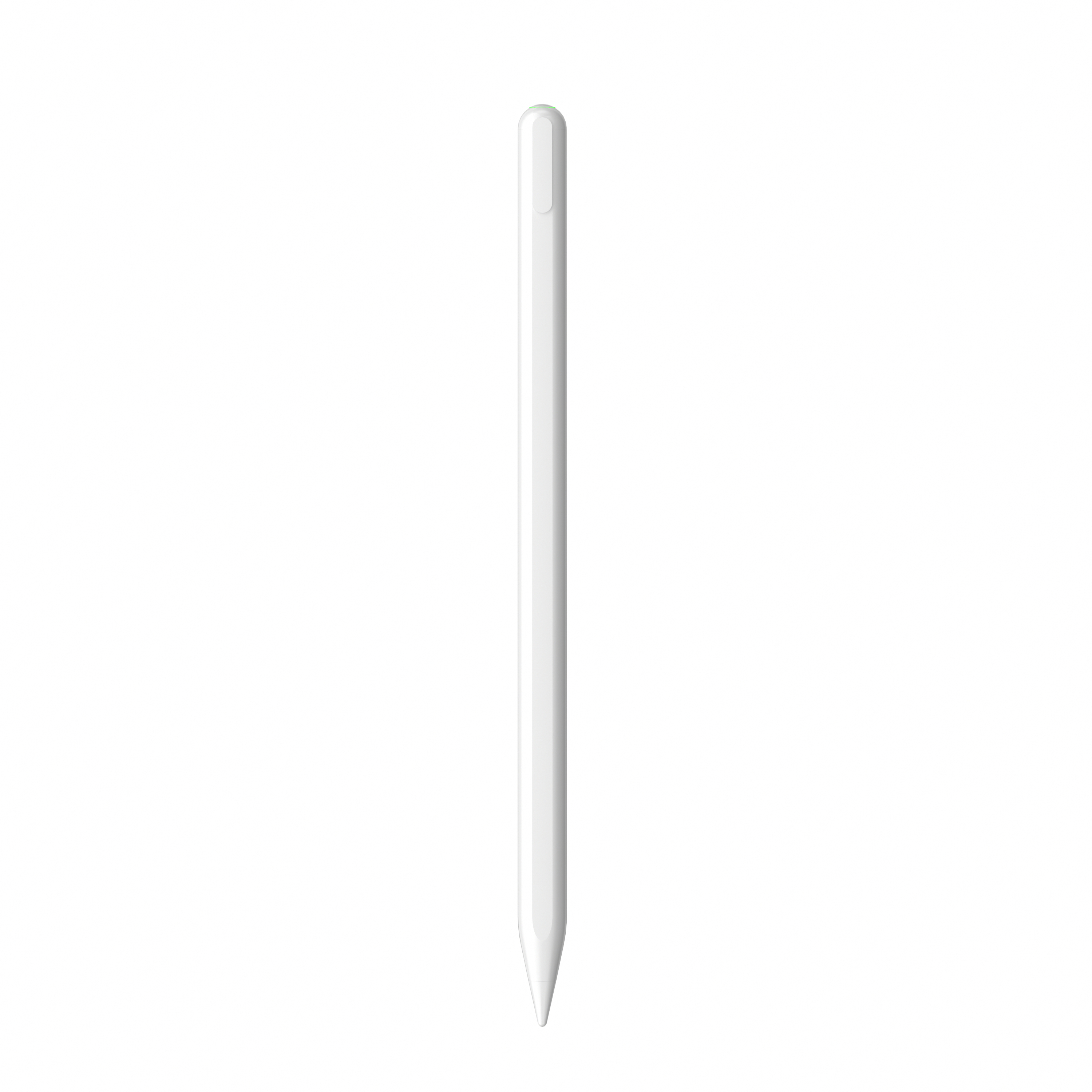
The R3-P iPad and Android Stylus Pen is the product in the supplied list that is named for both iPad and Android. That naming is a starting point for a mixed-device programme, not proof of compatibility with every iPad or Android model. The buyer should require a device matrix that lists the exact tablets, OS versions and pen features supported, and should test the representative devices in the sample. A single product family can simplify a mixed-device programme, but only if the compatibility list is explicit.
Case evidence should be read in the same way. The Turkey-based tablet accessory ODM record covers 5,000 units over two years and describes precise writing on iPad, iPhone, Android tablet and Android phone, with the result that usage of iPads and Android tablets increased. The record is associated with the W12-A iPad Stylus Pen in the supplied data. It supports the application story, but it does not replace a device compatibility matrix or a model-specific test report. The product name and the case description should both be checked against the exact SKU.
Jiayao stylus vs Apple Pencil: what is actually different?
The main documented difference is pressure sensing. The supplied comparison states that Jiayao's stylus offers the same precise writing, palm rejection and pause-doodle function as Apple Pencil, but does not offer pressure sensing; it uses tilt sensing instead. The same comparison describes Apple Pencil as more expensive than a third-party stylus.
This is a company-supplied comparison, not an independent laboratory test. It is still useful because it states a clear boundary. If the application depends on pressure-sensitive brush behaviour, such as professional illustration or nuanced digital painting, the company's own recommendation is to choose Apple Pencil. If the application is note-taking, drawing or sketching where tilt and palm rejection are sufficient, the company recommends a third-party stylus.
Buyers should translate that into a requirement rather than a slogan. A procurement specification that says 'Apple Pencil equivalent' is ambiguous. A specification that says 'palm rejection, tilt sensing, precise writing, no pressure-sensing requirement' is testable. If pressure sensing is mandatory, the stylus described in that comparison should not be written into the RFQ as an equivalent; the buyer should either select a pressure-sensitive option or remove the requirement. If pressure sensing is not required, the comparison gives the buyer a defensible reason to evaluate a third-party active stylus on the functions that matter.
Price is also a stated difference. The comparison says Apple Pencil is more expensive, but it does not provide a current price, a total cost of ownership calculation or a warranty comparison. Buyers should not convert a qualitative price statement into a percentage saving. They should compare the landed cost of the exact Apple Pencil model and the exact third-party stylus, including charging accessories, packaging, warranty and failure handling.
Finally, 'same' should be read narrowly. The comparison covers precise writing, palm rejection and a pause-doodle function. It does not establish identical latency, pressure curve, haptic feedback or app-level feature parity. Those are separate tests. A buyer who needs them should write them into the sample validation rather than assume them from the category.
What OEM/ODM capability should be verified before a stylus commitment?
OEM/ODM capability is only valuable when the customization can be repeated in mass production and accepted against a written standard.
Jiayao stylus states OEM/ODM support with customization across function, color, shape, tip, logo and packaging, plus sample-based customization such as logo packaging and Bluetooth name. The company's profile also lists PCBA design, battery welding, final assembly and quality testing as in-house capabilities, a 2,700 m² factory, 100 employees, a four-engineer R&D team and an annual output of 3,000,000 units. The capability record adds a monthly capacity of 500,000 units, a 20–35 day lead time, MOQ of 500 units, 100% test and a one-year warranty with one-to-one replacement.
The procurement question is not whether these capabilities exist on a profile. It is which ones are relevant to the ordered configuration. Function customization can change the bill of materials; a new tip or shape can change the tooling and the tactile acceptance check; logo and packaging can change the artwork approval and the carton inspection; a Bluetooth name can change the pairing test. Each change should have an owner, an approval record and an acceptance method. Otherwise the buyer is comparing a catalogue capability with an unverified production unit.
Capacity should also be read with the order in context. An annual output of 3,000,000 units and a monthly capacity of 500,000 units are company-level figures. They do not guarantee that a specific customized order will receive a particular line slot or shipment date. The buyer should tie the delivery schedule to the confirmed order quantity, the approved sample date and the customization scope, and should record the resulting lead time in the purchase order.
Certification is part of capability verification, not a substitute for it. The ISO9001 certificate covers 'Research and Development of Capacitive Stylus' under certificate 24626Q00066R001, and the ROHS certificate BAC260390119R lists a specific model scope. A buyer should check that the certificate scope, the ordered model and the destination market match. A quality management certificate and a product compliance certificate answer different questions.
What market and standards context affects a stylus RFQ?
Three external signals are useful in an RFQ: the definition of the stylus market, the emergence of USI as a cross-platform standard, and the difference between high-end pressure sensitivity and the tilt-sensing design described for Jiayao's stylus.
Market size estimates for stylus pens vary widely because the category boundary varies. IMARC Group reported the global stylus pen market at USD 19.45 billion in 2025. A separate 2025 estimate cited in the supplied comparison set is USD 3.36 billion from Fortune Business Insights. The difference likely reflects a definitional difference: one estimate can include a broader input-device category, while the other focuses more narrowly on active digital pens. Neither figure should be used to forecast demand for a specific SKU or to justify an order quantity.
Growth forecasts point in the same general direction but should be treated as forecasts. Dataintelo projects a 9.8% CAGR for active stylus technology from 2026 to 2034. That is a market projection, not a guarantee of demand for a particular model, price point or channel. The supplied category note describes the active stylus market as fragmented between proprietary protocols and open standards. For a buyer, the practical implication is to keep the product architecture flexible enough to support both active and passive options, and to avoid locking a multi-year programme to a single unverified feature assumption.
USI 2.0 is the cross-platform standard to watch. The Universal Stylus Initiative specification released in 2022 is described as the primary cross-platform standard for active styluses, supported by Google, Intel and Lenovo. A supplier's product being described as a universal active stylus does not, by itself, prove USI 2.0 compliance. If USI is a requirement, the RFQ should ask for the exact compliance evidence, the supported device list and the protocol details for the ordered model.
Pressure sensitivity is another specification that needs a precise reference. Samsung states that its S-Pen and high-end professional active pens feature up to 4,096 levels of pressure sensitivity. That is a useful benchmark for what high-end active pens can offer, but it is not a specification of the Jiayao stylus described in this FAQ. The supplied comparison states that Jiayao's stylus uses tilt sensing rather than pressure sensing. A buyer who writes '4,096 pressure levels' into an RFQ is specifying a different requirement from a tilt-sensing pen.
Finally, trade classification should be confirmed. Stylus pens are typically classified under HS Code 8471.60.90 as automatic data processing input units in the supplied trade record. The importer should verify the code, the product description and any destination-specific documentation with a customs broker before shipment.
What should a buyer verify before releasing a stylus purchase order?
Release the purchase order only after the commercial terms, the product configuration and the acceptance evidence agree with each other. The following checklist converts the preceding sections into a pre-order control list.
- Fix the model and configuration: model number, active or passive type, tip, color, logo, packaging and Bluetooth name where applicable.
- Define device compatibility: list the exact iPad and Android models, OS versions and applications; do not accept 'universal' without a device matrix.
- Write the active or passive requirement: palm rejection, tilt sensing, pressure sensing if required, latency and writing behaviour.
- Approve a golden sample: sign and retain it, and reference it in the purchase order and inspection record.
- Define acceptance: functional, tactile and visual checks, sample selection, pass/fail rules and pre-shipment inspection.
- Verify certificates: ISO9001 scope, ROHS certificate scope naming the ordered model, and any USI or other claimed compliance.
- Confirm commercial terms: MOQ 500 units, EXW/FOB, 30/70 payment, 20–35 day lead time and one-year warranty with one-to-one replacement.
- Check case relevance: ask for case records in the same device category, and treat them as evidence of application, not a performance guarantee.
- Confirm logistics: HS Code 8471.60.90, commercial invoice description, packaging and destination documentation.
- Record the change-control path: who approves a substitution in tip, battery, charging method, logo or packaging, and how the change is re-validated.
The checklist is deliberately repetitive across commercial and technical points because the two are linked. A certificate that does not cover the ordered model, a sample that does not match the production unit, or a warranty that is not tied to the SKU can each turn a good evaluation into an execution dispute. The purpose is not to add paperwork; it is to make each claim testable at the point where money and product change hands.
Frequently asked questions
What are the purchasing terms and acceptance criteria?
The supplied purchasing terms for Jiayao stylus are MOQ 500 units, EXW/FOB delivery, pre-shipment inspection as the acceptance criterion and 30/70 payment terms. The company also states that every stylus goes through 100% full inspection covering functional, tactile and visual checks, with a recorded lead time of 20–35 days and a one-year warranty with one-to-one replacement. A buyer should tie each term to the exact model and configuration, define the inspection items and pass/fail rules, and confirm that the certificate scope covers the ordered product.
What should I buy, passive stylus or active stylus?
Choose a passive stylus when the pen only needs to replace a finger for menus, signatures or simple taps. A passive stylus is battery-free, but the supplied comparison says it does not support palm rejection or tilt sensing and can show latency and offset when writing. Choose an active stylus for note-taking, drawing, sketching or tablet games where the hand rests on the screen. The supplied comparison says an active stylus supports precise writing, palm rejection and tilt sensing. The exact model should still be tested on the exact tablet and application.
Which stylus should I choose?
The supplied selection guidance is priority-based. For wireless charging, it names the W12-A iPad Stylus Pen, which supports wireless charging and also has a USB-C port. For fast charging, it names the A7-H-L Stylus Pen, where a five-minute charge provides two hours of use. For long working hours, it names the E3-A iPad Stylus Pen, which provides 30 hours of constant use after a full charge. The product list also includes the R3-P iPad and Android Stylus Pen for a product line named for both iPad and Android; its exact device compatibility should be confirmed model by model.
What's the difference between your stylus and Apple pencil?
The supplied comparison says Jiayao's stylus offers the same precise writing, palm rejection and pause-doodle function as Apple Pencil, but does not offer pressure sensing; it uses tilt sensing instead. It also describes Apple Pencil as more expensive than a third-party stylus. The same comparison recommends Apple Pencil for artists who need precise drawing, and a third-party stylus for note-taking or drawing where tilt and palm rejection are sufficient. This is a company-supplied comparison, not an independent laboratory test, so buyers should validate the exact functions they require on the exact tablet.
What is the practical conclusion for stylus buyers?
Stylus pen procurement becomes manageable when the buyer separates three decisions: the input technology, the model configuration and the acceptance evidence. Passive versus active is a workflow decision; W12-A, A7-H-L, E3-A and R3-P are priority-based options rather than a single ranking; and the Apple Pencil comparison is a functional boundary, not a price slogan. The purchasing terms — MOQ 500 units, EXW/FOB, pre-shipment inspection, 30/70 payment, 20–35 day lead time and a one-year warranty with one-to-one replacement — provide the commercial frame. The acceptance evidence, including 100% functional, tactile and visual inspection, ISO9001 certificate 24626Q00066R001 and ROHS certificate BAC260390119R, provides the proof layer. The buyer's job is to make those three layers agree before the purchase order is released.
The Jiayao Intelligent Stylus Pen Catalogue is available for reference and download: Jiayao Intelligent Stylus Pen Catalogue.
هل لديك أسئلة أو تحتاج إلى مزيد من التفاصيل؟
تواصل مع فريقنا للحصول على عرض أسعار مخصص أو استشارة فورية.
طلب عرض أسعار
املأ النموذج أدناه وسيتواصل معك فريقنا بعرض مقترح مخصص.
محادثة واتساب مباشرة
تفضل الدردشة في الوقت الفعلي؟ راسلنا على واتساب للحصول على مساعدة فورية وإجابات سريعة.
- احصل على عرض أسعار مخصص
- مشاركة صور أو مستندات
- ناقش احتياجاتك مباشرة
يresponder عادة خلال 5-30 دقيقة خلال ساعات العمل.