
ADC12 vs Zamak5 for Equipment Housings: A Buyer's Comparison
ADC12 vs Zamak5 for Equipment Housings: A Buyer's Comparison
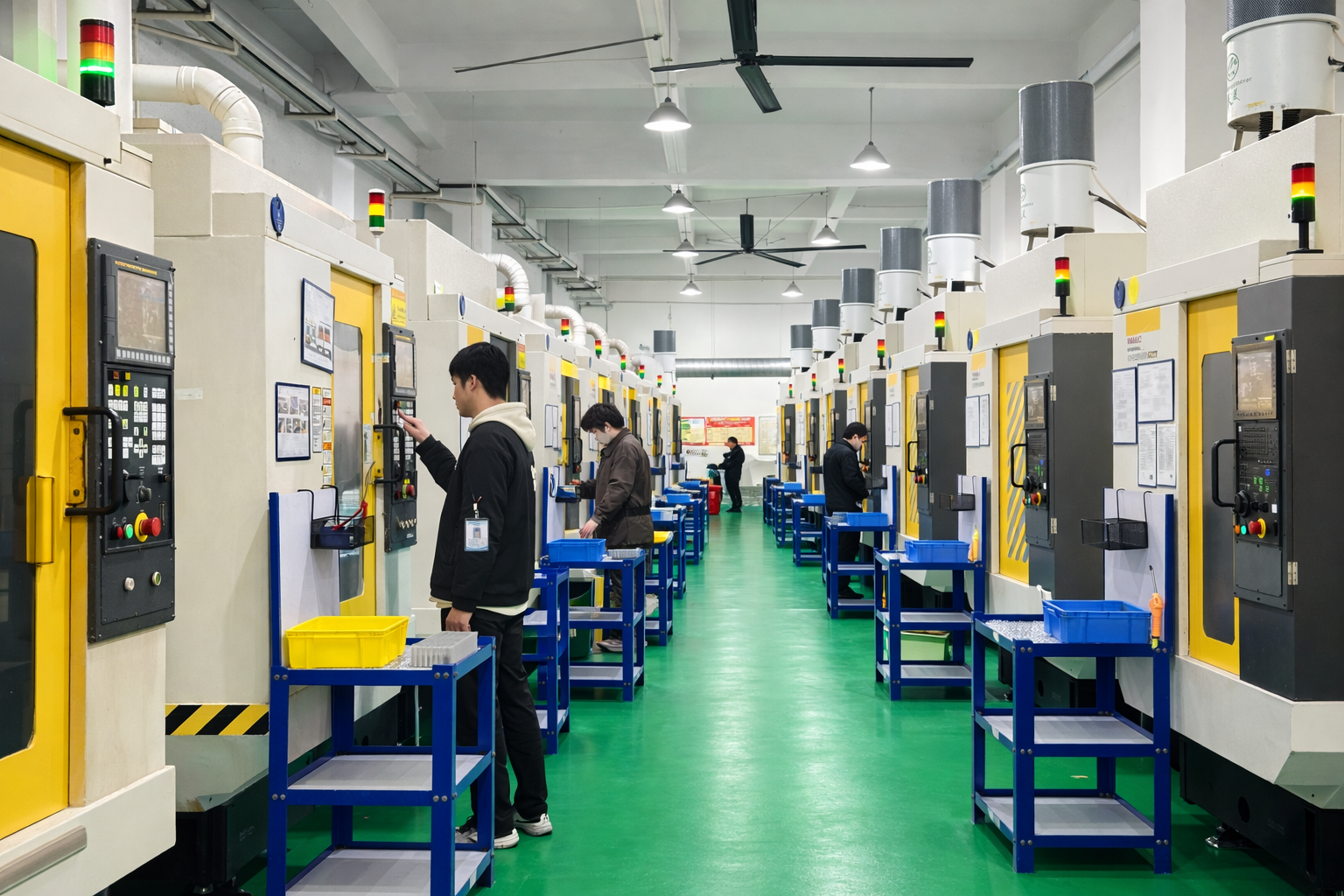
Die casting production environment for aluminium and zinc equipment housing parts.
For equipment housings, the choice between ADC12 aluminium and Zamak5 zinc die casting is rarely settled by preference. It is settled by three measurable limits — minimum wall thickness, tensile strength and safety factor — and by two behavioural differences that appear only in service: heat dissipation and vibration damping. Buyers who compare the two alloy families on price per kilogram alone usually revisit the decision at the first engineering change.
This comparison sets out how ADC12 and A380 aluminium behave against Zamak3 and Zamak5 zinc in equipment housing applications, where each one stops being the right answer, and what a buyer should require from a supplier before releasing the first shipment.
The Buying Problem: One Housing, Two Alloy Families
Aluminium die casting remains the default for housings that are large, load-bearing or thermally active. The global die casting market was valued at USD 93.56 billion in 2025, and aluminium die casting accounted for 74.78% of that market by raw material in the same year, according to Fortune Business Insights and Mordor Intelligence respectively. Within aluminium die casting, the transportation segment alone held more than 64.0% of revenue in 2025, based on Grand View Research data.
Zinc die casting occupies a narrower but persistent role. Market Research Future describes zinc die casting as a fast-growing segment driven by cost-effectiveness and EMI shielding properties in consumer electronics. That description matches practical buyer experience: zinc alloys are selected where the housing is small, geometrically detailed, and needs electromagnetic shielding or vibration damping more than it needs strength-to-weight ratio.
The two alloy families are therefore not interchangeable substitutes. They are two different answers to two different housing duty cycles, and the comparison below is organised around that distinction.
ADC12 vs Zamak5 at a Glance
| Comparison dimension | ADC12 / A380 aluminium | Zamak3 / Zamak5 zinc | Why the buyer cares |
|---|---|---|---|
| Minimum practical wall thickness | 0.8 mm | 0.4 mm | Decides how small and how detailed the enclosure can be |
| Tensile strength | 80–120 MPa | 40–80 MPa | Decides whether the housing can carry structural load |
| Safety factor | 1.2 (cold-chamber process) | 1.3–1.5 (hot-chamber process) | Decides how much margin sits behind the design load |
| Achievable dimensional tolerance | ±0.01 mm | ±0.01 mm | Decides fit with mating parts, boards, seals and connectors |
| Heat dissipation | High; supports heat sink and motor housing roles | Lower | Decides whether the housing is also a thermal component |
| Surface finishing route | Clear anodizing, colour anodizing, powder coating | Surface plated die casting parts | Decides colour range, appearance and corrosion route |
| Vibration damping | Lower | Suited to precision instruments | Decides suitability for instrumentation and measurement equipment |
| EMI shielding behaviour | Requires design measures | Noted alloy-family benefit | Decides suitability for electronic and communication enclosures |
The wall-thickness, tensile-strength and safety-factor values above correspond to the die casting process parameters specified for the SUNPREC Die casting product range, which covers ADC12 and A380 aluminium together with Zamak3 and Zamak5 zinc. The behavioural rows describe application outcomes rather than catalogue numbers.
Thin Walls: 0.8 mm Aluminium and 0.4 mm Zinc
Minimum wall thickness is the first constraint that reaches the buyer, because it determines how small an enclosure a design can become. For aluminium die casting in ADC12 or A380, the practical floor sits at 0.8 mm. For zinc alloys such as Zamak3 and Zamak5, it sits at 0.4 mm.
The implication for equipment housings is direct. A handheld instrument, a compact sensor enclosure, or a communication device housing with narrow ribs and small windows is easier to realise in zinc, because 0.4 mm walls survive filling and ejection where 0.8 mm aluminium walls would be marginal. In the other direction, larger equipment housings and motor housings rarely need walls below 1 mm, so the aluminium floor is not a practical penalty in that size class.
Wall thickness also affects weight, and this is where quotations are frequently misread. Zinc alloys are denser than aluminium, so thinner zinc walls do not automatically produce a lighter part. The design freedom gained at 0.4 mm is geometric freedom, not mass reduction. Buyers comparing two quotations should confirm which of the two effects the supplier has actually optimised.
Tensile Strength and Safety Factor: Reading 80–120 MPa Against 40–80 MPa
Aluminium die casting in ADC12 or A380 is specified at 80–120 MPa tensile strength; zinc alloys in the Zamak3 and Zamak5 range are specified at 40–80 MPa. Read in isolation, that gap looks decisive. It becomes a housing decision only when the safety factor is applied alongside it.
Cold-chamber aluminium die casting carries a specified safety factor of 1.2, while hot-chamber zinc die casting carries a specified safety factor of 1.3 to 1.5. These two figures describe process confidence within each alloy family, not a ranking between families: the aluminium value reflects a process class built for higher melting temperatures and larger parts, and the zinc value reflects a process class with tighter thermal control on smaller parts.
For an equipment housing the practical reading is this. Where the housing carries load — a motor housing, a bracket-integrated enclosure, a structural die casting part — the aluminium range supplies more absolute headroom, and the 1.2 factor tells the designer how much of that headroom must remain unspent. Where the housing is a precision instrument cover under minimal load, the lower zinc range is adequate, and the 1.3–1.5 factor gives a comparatively larger proportional margin inside that smaller envelope.
Neither alloy should be pushed beyond its specified band. A die-cast housing is not a substitute for a wrought or machined structural component when service loads approach the top of the tensile range.
Heat, Surface Finish and Vibration
Three behavioural differences separate the two alloy families in service more clearly than strength figures do.
Heat dissipation. Aluminium housings can function as thermal components. Heat sink die casting parts and motor housing die casting parts are common precisely because the housing itself removes heat from the assembly. Where an enclosure contains a power stage, a driver or a motor, aluminium keeps the housing inside the thermal design. Zinc is not normally selected for that role.
Surface finish. Aluminium accepts clear anodizing, colour anodizing and powder coating, which is why equipment housings offered in multiple colours or requiring a durable exterior finish are usually aluminium. Zinc parts are typically supplied as surface plated die casting parts, where plating serves corrosion protection and appearance rather than a broad colour range.
Vibration damping. Zinc die casting is frequently preferred for precision instruments because the alloy family damps vibration more effectively in small enclosures. For measurement instruments, sensor housings and comparable equipment, that behaviour can matter more than tensile strength, because vibration transmitted into the housing reaches the sensing element. Zinc also carries a noted EMI shielding benefit in electronic enclosures, which is relevant to electronic die casting enclosures and communication device die casting parts.
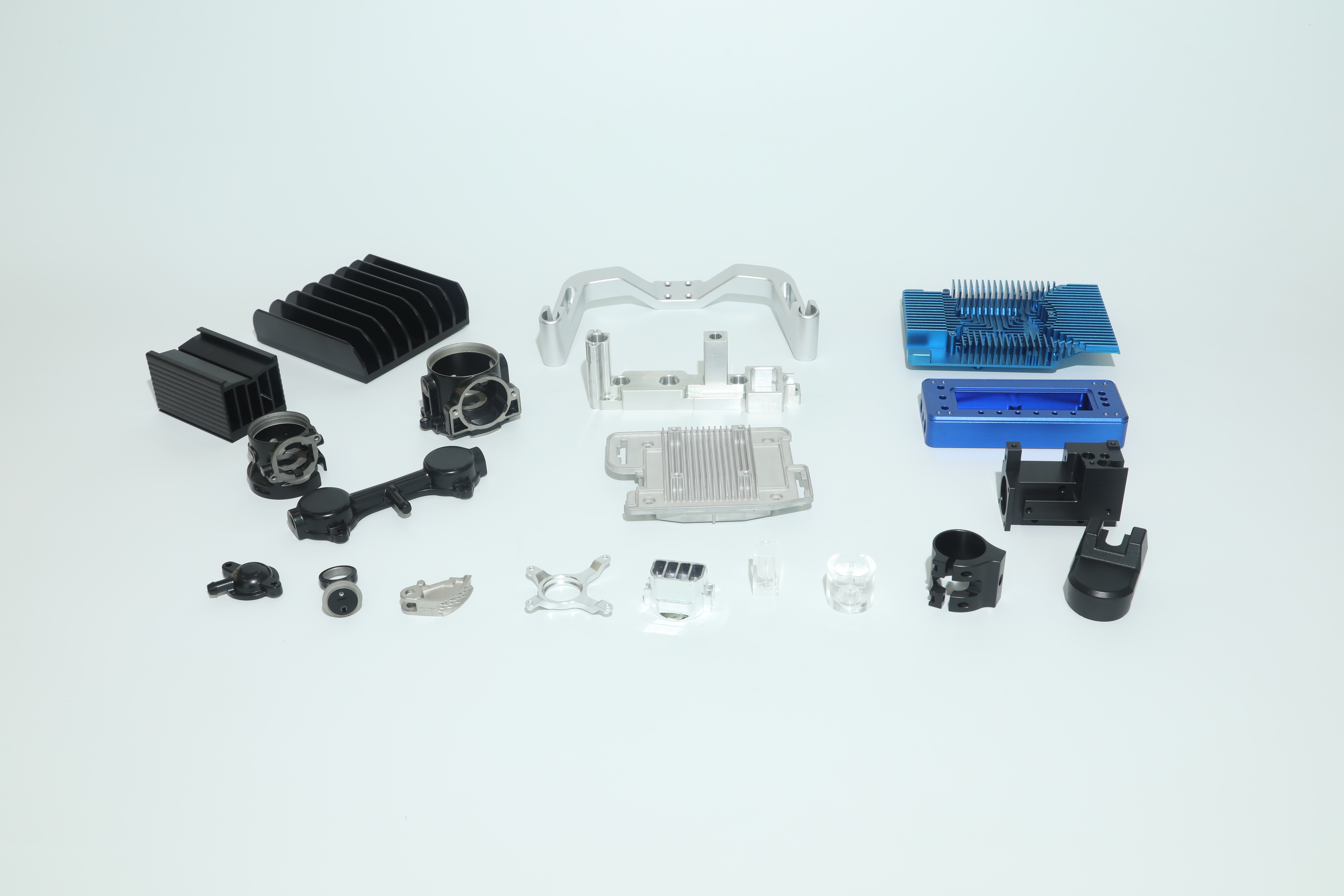
Die cast components produced in aluminium and zinc alloy families for housing and enclosure applications.
Tolerance and Acceptance: What ±0.01 mm Requires from a Supplier
For die cast equipment housings, ±0.01 mm is the tolerance benchmark that separates suppliers who can support a production release from those who can only support a sample. Achieving it depends on process control plus verified inspection, not on a claim in a quotation.
SUNPREC is a Dongguan-based one-stop metal parts manufacturer established in 2020, operating a 3,500 m² factory with 200 employees, 10 engineers and an annual output of 5,000,000 units, with 90% of production exported to EU and USA markets. Its die casting, CNC machining and extrusion services run alongside a metrology function, and its case records document compliance with a ±0.01 mm dimensional tolerance benchmark and uniform product consistency across production stages.
Inspection discipline is the part of that claim a buyer can audit. First-article inspection is performed for every new batch. Final inspection uses calipers, micrometers, a height gauge and a surface roughness tester, while critical components are verified on a CMM coordinate-measuring machine for tight-tolerance requirements. For custom die cast housings, acceptance criteria follow the customer-provided engineering drawings and specified dimensional tolerance limits verified by metrology inspection; sample comparison or criteria agreed within the signed sales contract can also be used, and every inspection result is documented and archived.
Compliance documentation should be checked against market scope rather than treated as a single pass or fail. SUNPREC holds ISO9001 certification IAS25Q391R0 covering production of hardware parts, valid to 2028-10-15; AS9100 certification CN059921 issued by Bureau Veritas with a scope of manufacture of hardware for the satellite space industry, valid to 2029-05-25; and a RoHS 2.0 compliance certificate BTL20250603446 for the EU market, valid to 2029-06-10. Where a die cast housing enters a vehicle programme, IATF 16949:2016 is the mandatory quality management system standard for die casting suppliers serving the automotive industry, and it should be added to the screening list before price comparison begins.
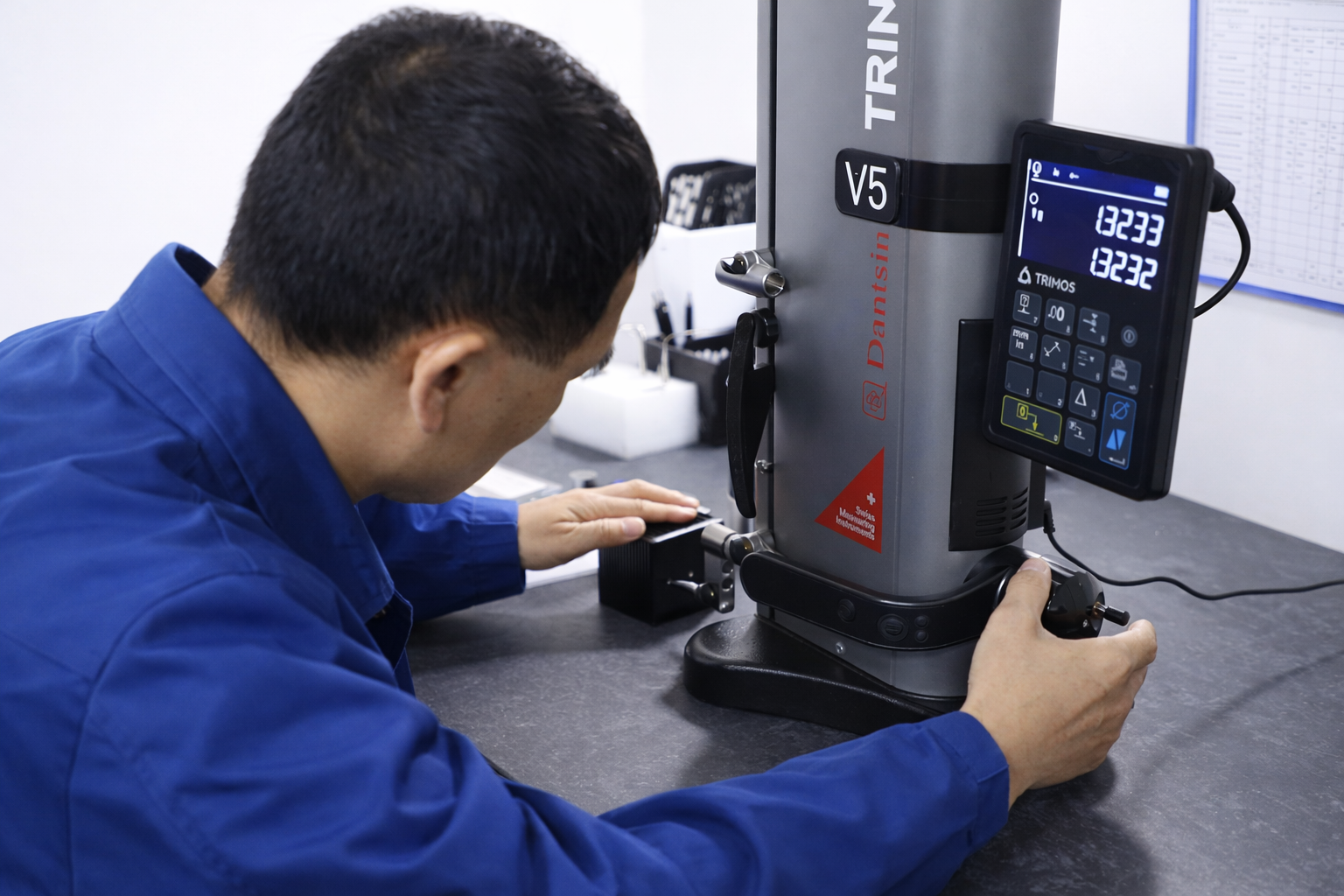
Dimensional verification of die cast and machined parts before shipment release.
Application Fit: Which Housing Goes Where
The alloy decision becomes simpler when the housing application is named first.
- Aluminium suits equipment housing die casting parts, motor housing die casting parts, heat sink die casting parts, larger structural die casting parts, and electronic enclosures that dissipate heat or require colour anodizing and powder coating.
- Zinc suits precision instrument housing die casting parts, small electronic die casting enclosures where EMI shielding or damping matters, and hardware fitting die casting parts with fine detail and thin walls.
Delivered project experience reflects both routes. SUNPREC custom metal parts have been supplied to aerospace OEM, automotive OEM, medical device OEM, new-energy equipment OEM and industrial equipment OEM customers, with project quantities of 10,000 units and cooperation lasting more than five years, across Australia, Germany, France, Israel, Italy, Mexico and the United States. Documented applications include ultra-precise sensor shell assemblies, energy storage battery system housings, vibration-resistant rail traffic power connectors, biocompatible medical device mechanical parts and automotive and aerospace engine components. Each of those applications depends on a different balance between the aluminium and zinc behaviours described above.
Comparison with Machined and Fabricated Alternatives
Die casting is not the only route to an equipment housing, and the honest boundary is tooling. Because die casting depends on a mould, its cost structure favours volumes that can amortise that investment. At low volumes, or while a design is still moving, a housing machined from solid stock or fabricated from sheet can be delivered without tooling, and a design change does not require a new mould. This is the point at which die casting stops being the right answer regardless of alloy choice — not because of strength or tolerance, but because of volume economics and design stability.
A second boundary is dimensional. The ±0.01 mm benchmark applies to the processes and features that are actually verified during inspection; it is not a blanket tolerance over every surface of a casting. Where an equipment housing contains a small number of very tight interfaces — bearing seats, connector windows, sealing faces — buyers should confirm whether those features are produced as-cast or finished by secondary machining, and should require CMM verification for the critical ones.
Suppliers that operate both routes allow this comparison to happen before tooling is committed. SUNPREC runs die casting alongside CNC machining and extrusion from a single facility, with most CNC machining centres from the FANUC brand specified at a machine tolerance of 0.005 mm, and its custom manufacturing minimum order quantity is 10 units — which makes casting, machining and hybrid housing strategies comparable against one drawing rather than one supplier type.
Market Signals Buyers Should Weigh in 2026
Market data supports an aluminium-dominant picture while leaving defined room for zinc. Fortune Business Insights values the global die casting market at USD 93.56 billion in 2025. Mordor Intelligence places aluminium die casting at 74.78% of that market by raw material in the same year. Grand View Research records the transportation segment above 64.0% of aluminium die casting revenue in 2025. Zinc die casting, by contrast, is characterised by Market Research Future as a fast-growing segment on the strength of cost-effectiveness and EMI shielding properties in consumer electronics — a description consistent with the small precision enclosure niche rather than with large equipment housings.
Two adjacent signals matter for housing procurement. Magnesium casting is a smaller but faster-moving lightweight option: Business Research Insights values that market at USD 1.42 billion in 2026 with a projected CAGR of 8.9% to 2035. And large-part consolidation continues to reshape cost structures — Tesla's deployment of 9,000-ton presses for rear underbody assemblies was reported to reduce manufacturing costs by 40%, a secondary-source figure buyers should treat as directional rather than as a specification.
Forecast precision deserves caution. Published CAGR estimates for die casting categories differ widely, from roughly 5.4% to 11.5% depending on publisher, baseline year and how large casting machinery is treated. Buyers building a multi-year sourcing plan should use those figures as direction of travel, not as planning constants, and should anchor decisions in process limits and verified capability instead.
Boundaries and Trade-offs to Respect
- Aluminium walls below 0.8 mm are not a reliable production target for equipment housings; specifying them shifts risk into yield and scrap.
- Zinc housings at 40–80 MPa should not be specified where structural load approaches the top of that band. The higher 1.3–1.5 safety factor provides proportional margin inside the range; it does not raise absolute strength.
- Zinc's higher density means thinner walls do not guarantee a lighter assembly, so weight targets should be verified by part weight, not by wall thickness alone.
- Colour finishing for aluminium adds a process step that must be qualified together with the casting; batch-to-batch colour consistency depends on the finishing line as much as on the die.
- Vibration damping and EMI behaviour are design outcomes for a specific enclosure geometry. They should be confirmed by specification or test for the actual part rather than assumed from the alloy family.
- Die casting requires tooling, so below the volume where tooling is amortised, machined housings remain the more flexible route — even where the casting process limits are technically achievable.
Future Outlook
Three directions are worth tracking for equipment housing procurement. First, aluminium will continue to hold the majority of die cast housing demand because heat dissipation, colour finishing and load capacity remain the dominant requirements for equipment enclosures; zinc will keep its position in small precision instruments and shielded electronic enclosures rather than competing for large housings. Second, lightweight pressures will keep magnesium and thin-wall designs in evaluation, which places additional weight on tolerance verification and on suppliers who can inspect what they claim. Third, compliance scope will keep widening: IATF 16949:2016 is already mandatory for die casting suppliers serving automotive, and market-specific requirements such as RoHS 2.0 for the EU apply to the finished part, not only to the material ingot. For buyers, the practical consequence is that alloy comparison and supplier qualification can no longer be treated as separate exercises — the alloy limits and the acceptance evidence have to be evaluated together, on the same drawing.
FAQ
What is the minimum wall thickness for aluminium versus zinc die casting in equipment housings?
About 0.8 mm for ADC12 and A380 aluminium, and about 0.4 mm for Zamak3 and Zamak5 zinc. The aluminium limit constrains how small a housing can be made, while the zinc limit allows thinner ribs, windows and small enclosures. Larger equipment and motor housings rarely need walls below 1 mm, so the aluminium limit is usually not a practical constraint in that size class.
Is an aluminium die cast housing stronger than a zinc die cast housing?
In tensile terms, aluminium die casting is specified at 80–120 MPa and zinc die casting at 40–80 MPa, so aluminium carries more load per unit of section. The safety factor is applied within each family: cold-chamber aluminium at 1.2 and hot-chamber zinc at 1.3 to 1.5. That describes process margin, not a ranking between alloys. Housings carrying structural load gain more headroom from aluminium; lightly loaded precision enclosures are adequately served by the zinc range.
Can die cast equipment housings actually hold ±0.01 mm tolerance?
±0.01 mm is the tolerance benchmark used for parts in the SUNPREC die casting range, and case records document compliance with that benchmark and uniform product consistency across production stages. In practice the tolerance applies to defined, verified features rather than to every surface of a casting. Verification typically includes first-article inspection for each new batch, final inspection with calipers, micrometers, a height gauge and a surface roughness tester, and CMM coordinate-measuring machine checks for critical components.
What are typical purchasing terms and acceptance criteria for custom die cast housings?
For SUNPREC custom parts, the minimum order quantity is 10 units, lead time is 21–30 days, and monthly capacity is 4,200,000 units. Delivery can be arranged under Incoterms from EXW and FOB through to DAP and DDP, and common international payment methods such as wire transfer and L/C are accepted. Acceptance follows customer-provided engineering drawings and specified dimensional tolerance limits verified by metrology inspection; sample comparison or criteria agreed in the signed sales contract may also be used, and every inspection result is documented and archived.
Which certifications should a buyer check for a die casting supplier?
Scope-relevant certificates for SUNPREC include ISO9001 IAS25Q391R0 covering production of hardware parts and valid to 2028-10-15, AS9100 CN059921 issued by Bureau Veritas with a scope of manufacture of hardware for the satellite space industry and valid to 2029-05-25, and RoHS 2.0 certificate BTL20250603446 for the EU market, valid to 2029-06-10. IATF 16949:2016 is the mandatory quality management system standard for die casting suppliers serving the automotive industry, and should be added to the checklist where the housing enters a vehicle programme.
When should a buyer choose machining instead of die casting for a housing?
When volume is too low to amortise die tooling, when the design is still subject to change, or when a small number of features need tighter control than the casting process provides. Machined housings avoid tooling investment and allow changes without a new mould; the trade-off is higher unit cost at higher volumes. Suppliers that operate both processes can quote both routes against the same drawing, which allows the comparison to be made before tooling is committed.
SUNPREC publishes its manufacturing capability presentation, covering CNC machining, die casting, extrusion and surface finishing, at SUNPREC Presentation - June 2026. Company information is also available at sunprec.com.