
AGV Drive Wheel FAQ: PLT-198 and PLT-120 Specs Explained

Drive wheel production and assembly capacity is a procurement variable when AGV and AMR fleets scale.
The global AGV wheel drives market was valued at approximately USD 1.2 billion in 2024 and is projected to reach USD 3.5 billion by 2034, according to Reports and Data, which attributes an 11.5% CAGR over that period to demand from logistics and warehouse automation. Every vehicle added to that installed base is specified, purchased and then maintained by someone who has to answer a short list of technical questions first: how much load the drive wheel carries, how much torque it delivers, what current it draws, what environment it tolerates, and what can be changed if the standard unit does not fit the project.
This reference collects the drive wheel questions that recur most often during AGV and AMR procurement and answers them for two units in the Plutools range: the PLT-198 high-torque drive wheel unit and the PLT-120 differential drive wheel. Shanghai Plutools Automation Corporation Co., Ltd. is a Shanghai-based manufacturer founded in 2017 that specialises in AGV/AMR mobile robots and the industrial application of core motion control technology; AGV Drive Wheel is its main product line, and exports account for 70% of its sales, reaching the EU, USA, Southeast Asia, South America, the Middle East, Japan and South Korea.
The answers below are written for the Decision and Execution stages of a project, after the vehicle architecture has been fixed and before the first production order is released. Specification values are presented as published unit data. Where a figure is manufacturer-reported rather than independently tested, that is stated in the text, and where a value is not part of the published set, the gap is marked rather than filled.
Why drive wheel questions cluster at the Decision-to-Execution boundary
Procurement teams rarely begin with the drive wheel. They begin with the vehicle: differential, steering, omni-directional or mecanum, then payload, floor conditions and duty cycle. By the time the drive wheel specification is opened, a set of variables has already been frozen — installation space, chassis height, bus voltage, turning architecture, operating speed and the design load case. The drive wheel has to be matched to those constraints rather than the other way round, and that is precisely when the technical questions become unavoidable.
In practice, four question families account for most supplier enquiries at this stage: load and duty cycle, torque and motor sizing, electrical supply and ingress protection, and customization together with long-term supply continuity. The sections that follow take them in that order, using the PLT-198 and PLT-120 specification sets as worked examples. This is the same order in which a buyer can build an internal approval file, so each answer can be lifted into a technical review without further interpretation.
Load capacity: what the rating covers, and where it stops
What maximum load do the PLT-198 and PLT-120 drive wheels carry?
The PLT-198 drive wheel unit is rated to a maximum load of 1,500 kg. The PLT-120 differential drive wheel is rated at 150 kg. The two units therefore sit in different load classes: PLT-198 addresses heavy AGV platforms, automated forklifts and lifting vehicles, while PLT-120 addresses light mobile robots and compact material-handling equipment, including differential-drive logistics bots.
Is the load rating the same as the wheel load the finished vehicle will apply?
No. A maximum load figure is a unit-level ceiling, not a design target. Vehicle engineering has to add payload, chassis self-weight, the dynamic transfer that occurs during acceleration, braking and cornering, and the effect of uneven floor conditions. Sizing should be done on the worst-case single-wheel load rather than an average across the wheel set. Above the 1,500 kg ceiling of the PLT-198, a different drive unit is required; below the 150 kg ceiling of the PLT-120 there is no lower limit, but the unit is intended for that light class rather than for infrequent heavy peaks.
A related question is what happens to the rating over time. Load capacity is quoted for a new unit under defined conditions; tread wear, bearing condition and mounting rigidity all affect how the assembly behaves in service. Buyers specifying a fleet should treat the published rating as an approval boundary and inspect it in the maintenance plan, particularly on high-cycle vehicles running multi-shift operations where the drive wheel accumulates load cycles faster than the chassis.
Torque matching and motor sizing for heavy drive wheels
How do I check that a drive wheel's torque matches my application?
Start with the motor-side figures and verify them against the standard relationship T = 9550 × P / n, where T is torque in Nm, P is power in kW and n is speed in RPM. The PLT-198 unit is specified at 3,000 W and 3,000 RPM with a rated torque of 9.55 Nm, and the three values are internally consistent: 9550 × 3 / 3000 = 9.55 Nm. The same check can be applied to any datasheet before a quoted torque is accepted, and it is the fastest way to identify a specification that will not survive detailed engineering review.
What do the reduction ratio, output torque and maximum torque mean for a project?
The PLT-198 is specified with a reduction ratio of 32 and a gearbox output torque of 260 Nm. For comparison, the arithmetic product of rated motor torque and reduction ratio is approximately 306 Nm (9.55 × 32), so the specified 260 Nm output is consistent with the transmission losses that a geared drive introduces. Buyers comparing units should compare output torque rather than motor torque, because reduction ratio and efficiency differ between designs and motor torque alone does not describe what reaches the wheel.
The maximum torque of 576 Nm is a peak figure, available for short-duration demands such as breakaway from standstill, ramp starts and rapid acceleration. It is roughly twice the specified output torque and should be treated as a transient capability rather than a continuous duty point. Continuous operation sized around the 260 Nm output torque, with a thermal check for the actual duty cycle, is the normal basis for selection.
Do these numbers give me the tractive force at the wheel?
Not directly. Tractive force depends on available torque divided by the effective wheel radius, and it is limited by the friction that the tread can develop against the floor. Two practical consequences follow. First, a drive wheel with more torque does not automatically move a heavier vehicle if the tread cannot develop the corresponding friction. Second, wheel geometry is part of the matching exercise and should be fixed before torque assumptions are locked. Buyers evaluating a drive wheel assembly should request the geometry together with the torque data rather than treating torque as a standalone number.
Electrical supply, current and ingress protection
What voltage and current should the electrical design assume?
The PLT-198 unit is published at 3,000 W with a rated current of 68 A and a motor speed of 3,000 RPM. The PLT-120 differential drive wheel operates at 48 V and draws 11.2 A. Rated current is a design input for more than the motor driver: it sizes fuses and contactors, drives cable cross-section, sets connector and terminal ratings, and determines the heat that the drive bay must dissipate. Where published data lists current but not the system voltage for a unit, as is the case with the 68 A figure for the PLT-198, bus voltage should be confirmed with the supplier before the driver and protection scheme are finalised, because motor current at a given power output depends on supply voltage and drive electronics.
Does battery technology change drive wheel selection?
It can influence how current demands are met in service. According to Fortune Business Insights, lithium-ion battery technology now powers the majority of new AGV and AMR drive units, reducing range anxiety and downtime. Because pack voltage behaviour affects how consistently peak current can be supplied, the battery platform belongs in the same review as the drive wheel current rating, and cable and protection sizing should be anchored to the rated current of the unit rather than to an average vehicle consumption figure.
What does an IP65 rating mean on the PLT-120 differential drive wheel?
The PLT-120 carries an IP65 rating, which denotes a dust-tight enclosure protected against water projected from a nozzle. That covers most indoor logistics environments, including zones adjacent to wash-down activity, but it does not make the unit suitable for continuous immersion or for aggressive chemical exposure. Buyers who specify cleaning regimes should confirm the cleaning method against the rating instead of assuming that a sealed unit tolerates any wash-down programme.
What are the PLT-120 materials, and why do they matter in procurement?
The PLT-120 uses a polyurethane (PU) tread with a carbon steel body and weighs 5±2 kg. Polyurethane is commonly specified for forklift and industrial drive wheel tires because it combines higher load capacity with floor protection in indoor settings, according to Mordor Intelligence, which makes it a sound default for smooth internal floors and light vehicle classes. Carbon steel provides structural stiffness for the hub and mounting interface, which matters where the unit is bolted to a thin chassis plate and the mounting face must resist bending. The ±2 kg tolerance is worth planning for: on a unit of roughly 5 kg, that tolerance is a meaningful share of total mass and affects suspension and damper selection, manual handling during installation, and freight calculations.
Configuration choices: vertical, horizontal and differential drive wheels
Vertical drive wheel or horizontal drive wheel — what decides the choice?
The deciding factor is installation orientation and its effect on vehicle layout, stability and application, not driving performance alone. A vertical drive wheel arranges the motor and gearbox vertically, which reduces the horizontal footprint of the drive unit and suits compact heavy-load designs such as heavy-duty AGVs, automated forklifts and lifting vehicles, particularly where horizontal installation space is limited. A horizontal drive wheel arranges the motor horizontally, which reduces the overall height of the drive module and lowers the centre of gravity; it is the better fit for low-profile AGVs, warehouse AMRs, latent lifting robots and vehicles that must remain stable at higher travel speeds. Selection should therefore be based on installation space, load capacity, chassis height, turning structure, operating speed and maintenance access.
When is a differential drive wheel the right architecture?
Differential drives pair left and right wheel units and steer by varying the speed of each side. According to Mobile Robot Guide, dual differential drive wheels allow a zero-turn radius, a configuration widely used in smaller logistics robots. The PLT-120 is a differential drive wheel rated at 150 kg, which places it in the compact AMR and light logistics class. A differential unit trades part of the load ceiling of a heavy single-wheel configuration for manoeuvrability and a simpler mechanical interface, since there is no steering actuator to package and no steering linkage to maintain.
Customization: what can change, and what stays fixed
Which parameters can be customized on these drive wheel units?
Load and speed options are customizable on the PLT-120 differential drive unit. The engineering resource behind that work is a team of 60 engineers, supported by more than 200 patent technology certifications and more than 22 years of industry R&D and production experience. Customization requests that fall outside the published ratings should be scoped with the manufacturer against a defined duty cycle, because load, speed, current draw and thermal behaviour interact.
What boundary should buyers expect on customization?
Customization does not remove the physical limits of the platform. A unit developed for a higher load or a different speed will not behave like the standard specification: mass, current draw, thermal margin and interface geometry can all shift. Changes of that kind normally require validation at sample or prototype stage before approval, and the standard ratings remain the reference point against which the modified unit is qualified. For procurement documentation, the practical rule is that any deviation from the published figures should be re-qualified rather than assumed to be a straightforward extension of them.
PLT-198 and PLT-120: specification comparison
| Parameter | PLT-198 | PLT-120 |
|---|---|---|
| Unit type | High-torque drive wheel unit for heavy AGV and lift platforms | Differential drive wheel |
| Maximum load | 1,500 kg | 150 kg |
| Motor power | 3,000 W | Not published in the cited unit data |
| Motor speed | 3,000 RPM | Not published in the cited unit data |
| Rated motor torque | 9.55 Nm | Not published in the cited unit data |
| Reduction ratio | 32 | Not published in the cited unit data |
| Gearbox output torque | 260 Nm | Not published in the cited unit data |
| Maximum (peak) torque | 576 Nm | Not published in the cited unit data |
| Supply / current | Rated current 68 A (bus voltage to be confirmed per project) | 48 V, 11.2 A |
| Ingress protection | Not published in the cited unit data | IP65 |
| Tread material | Not published in the cited unit data | Polyurethane (PU) |
| Body material | Not published in the cited unit data | Carbon steel |
| Unit weight | Not published in the cited unit data | 5±2 kg |
| Customization | Scope to be defined with the manufacturer against the duty cycle | Customizable load and speed options |
| Typical fit | Heavy AGV, automated forklift, lifting vehicle | Compact AMR, light logistics robot, latent lifting platform |
Values marked as not published are absent from the unit data cited in this article. They are shown as gaps rather than filled with estimates, because torque, current and mass figures are only useful in procurement when they come from a traceable source.
Where the specification set stops: limits buyers should write into the approval file
- Load ceilings are absolute. 1,500 kg for PLT-198 and 150 kg for PLT-120 define the classes these units serve; applications above either ceiling need a different drive unit rather than a re-interpretation of the rating.
- Peak torque is not continuous torque. The 576 Nm maximum torque on the PLT-198 is a short-duration capability. Continuous duty should be sized around the 260 Nm output torque with a thermal check for the real duty cycle.
- IP65 is not immersion protection. Dust-tight and water-jet resistant on the PLT-120 does not extend to submergence or aggressive chemicals.
- PU tread has an environment bias. Polyurethane suits smooth indoor floors and protects them; floors with debris, embedded metal or outdoor surfaces change the wear picture and should be reviewed separately.
- Electrical figures need the system voltage. A 68 A rated current is only actionable once the bus voltage and drive electronics are fixed.
- Mass tolerance is a design input. The 5±2 kg range on the PLT-120 affects suspension, handling and freight planning.
- Comparative performance figures are manufacturer-reported. They require validation against the buyer's own duty cycle, as described below.
Integrated drive wheels compared with traditional drive arrangements
Traditionally, a mobile robot drivetrain was assembled on the vehicle: a separate motor, a separate gearbox, a separate wheel, and a coupling, chain or belt between them. That approach keeps individual components replaceable and cheap to source, but it moves alignment, tensioning and assembly time onto the production line, and it introduces wear items that reappear in the maintenance schedule. An integrated drive wheel unit packages motor, transmission and wheel into a single mountable assembly.
The direction of travel is documented. Brandessence Research describes integrated steering drive modules replacing discrete components in order to reduce manufacturer assembly time and maintenance complexity. For an Execution-stage buyer, the significance is that cost migrates from the assembly station into the drive wheel specification, and the interface between the vehicle and the drivetrain becomes a mounting pattern and a connector rather than a set of alignment tolerances.
Plutools reports a comparison between its drive systems and other domestic AGV drive systems with similar load capacity and operating specifications. On performance, the reported differences are approximately 5–10% higher transmission efficiency, 10–15% longer service life, and a 15–20% lower estimated failure rate under comparable operating conditions. On maintenance, intervals can be extended by approximately 20–30%, with fewer component replacements and reduced downtime. On energy, consumption is reported at approximately 5–10% lower under equivalent load, speed and operating-cycle conditions. On cost, the initial purchase price may be comparable or approximately 5–10% higher, while estimated total cost of ownership can be 10–20% lower over three years.
These comparative figures are supplied by the manufacturer for comparable operating conditions. They are a planning input, not an independently verified result, and they should be confirmed through sample validation and the buyer's own duty-cycle testing before they are written into a business case.
The honest boundary of the integrated approach is serviceability. When a geared drive unit fails, repair usually means replacing the module rather than the individual failed part, which raises the value of spares held in stock and lengthens the planning horizon for maintenance. Sites that are remote, that run mixed fleets of several drive wheel types, or that operate on thin maintenance coverage should model this explicitly: integration reduces assembly and alignment work but concentrates failure cost into a single replaceable assembly. That trade-off is the reason drive wheel spares planning belongs in the same conversation as drive wheel selection.
Market context behind these procurement questions
The questions above are not theoretical. Several market signals explain why drive wheel specifications attract more scrutiny at the quotation stage than they did a few years ago.
- The AGV wheel drives market is projected to grow from approximately USD 1.2 billion in 2024 to USD 3.5 billion by 2034, a CAGR of 11.5% driven by logistics and warehouse automation, according to Reports and Data.
- The China mobile robot market reached a scale of 22.1 billion yuan in 2024, involving more than 139,000 units sold, according to the China Mobile Robot Alliance; the same organisation reports increasing export volumes, with leading providers targeting Southeast Asia and Europe.
- Electric forklifts now command over 70% market share in many regions as replacements for combustion models, according to MarketsandMarkets, which pushes volume toward electric drive systems and the drive wheel units inside them.
- Mecanum wheels and omni-directional drive systems are increasingly used on AMRs in high-density warehouses, according to Interact Analysis — a trend that widens the range of drive wheel configurations a single integrator may need to qualify.
- Polyurethane remains the common tread material for forklift drive wheels because it balances load capacity with floor protection indoors, according to Mordor Intelligence.
Compliance expectations run alongside these volume trends. ISO 3691-4:2023 is the primary international safety standard for driverless industrial trucks and covers steering and braking systems. EN 1175:2020 specifies electrical and electronic safety requirements for industrial trucks in Europe and is applicable to AGV drive wheel assemblies. In the United States, ANSI/ITSDF B56.5 governs the performance of drive and steering units on driverless industrial vehicles. None of these standards is a substitute for a duty-cycle specification, but they define the documentation a buyer can reasonably request with a drive wheel quotation.
Future outlook for AGV and AMR drive wheel procurement
The industrial logistics segment for AGVs is projected to grow at a CAGR of 11.6%, the fastest of the segments tracked by MarketsandMarkets, which suggests that duty cycles will keep getting harder rather than easier. Three practical consequences for drive wheel specification follow.
First, integration continues. As Brandessence Research observes, integrated modules are replacing discrete drivetrain components, so the drive wheel unit increasingly arrives as a subsystem with its own drawing, connector and test record rather than as a mechanical part. Second, electrical architecture keeps moving: with lithium-ion packs powering the majority of new drive units according to Fortune Business Insights, current and thermal behaviour will be reviewed against a different supply profile than in the lead-acid era. Third, manoeuvrability requirements keep expanding, with omni-directional and mecanum configurations spreading through high-density warehouses according to Interact Analysis, alongside the differential units that remain the cost-effective default for many light logistics robots.
For buyers, the durable response is procedural rather than predictive: define the duty cycle in writing, require published figures for load, torque, current and protection, ask for the gaps to be named rather than smoothed over, and validate before fleet-wide release. On the supply side, capacity indicators matter for continuity. Plutools operates a 10,000 m² manufacturing facility with approximately 100 staff and an annual production capacity of 10,000 units, supported by the engineering base described earlier — the kind of information a programme manager uses when deciding whether a single drive wheel source can carry a multi-year rollout.
Procurement FAQ
What are the purchasing terms and acceptance criteria?
Minimum order quantity is 2 units. Delivery terms are FOB Shanghai. Acceptance criteria are based on a pre-shipment test, and payment terms are 50/50.
What production and engineering capacity stands behind these drive wheel units?
The manufacturing facility covers 10,000 m², employs approximately 100 staff and has an annual production capacity of 10,000 units. The R&D team consists of 60 engineers, and the company has obtained more than 200 patent technology certifications, supported by more than 22 years of industry R&D and production experience. Exports account for 70% of total sales, with major markets in the EU, USA, Southeast Asia, South America, the Middle East, Japan and South Korea.
How can a buyer validate a drive wheel before releasing a fleet order?
Validation normally combines three steps: sample or prototype evaluation against the intended duty cycle, the pre-shipment test used as the contractual acceptance criterion, and the buyer's own testing under representative load, speed and floor conditions. This matters particularly for comparative performance claims, which are manufacturer-reported and condition-dependent. Load rating, output torque, rated current and ingress protection can all be checked directly against the published figures; performance differences between suppliers should be measured, not assumed.
What should a long-term support plan include for integrated drive wheel units?
Because an integrated unit is normally replaced rather than repaired at component level, the plan should define which drive wheel assemblies are held as spares, at what stock level, and how quickly a replacement can be delivered to each operating site. It should also record the exact specification and interface of the approved unit, so that later production batches or customization requests are compared against a fixed baseline rather than against a general description of the product.
Which applications should be excluded when specifying the PLT-120 and PLT-198?
Applications above 150 kg per unit fall outside the PLT-120 differential drive wheel and belong with a heavier unit such as the 1,500 kg class represented by the PLT-198. Applications above 1,500 kg fall outside the PLT-198 data cited here. Continuous duty near peak torque, sustained immersion, and aggressive chemical wash-down are likewise outside the boundaries described in this article. Where low-temperature or explosion-proof duty is required, these are handled as dedicated drive wheel configurations rather than as options on a standard unit.
Drive wheel selection at the Execution stage comes down to matching a documented unit to a documented duty cycle, and recording the limits alongside the capabilities. Plutools publishes a PLT selection manual that covers drive wheel configurations and their typical applications; the PDF is available for reference at https://cdn.socialarks.com/sbsp/25128/common/2026/0805/PLT%E9%80%89%E5%9E%8B%E6%89%8B%E5%86%8C2026.03.26.pdf.
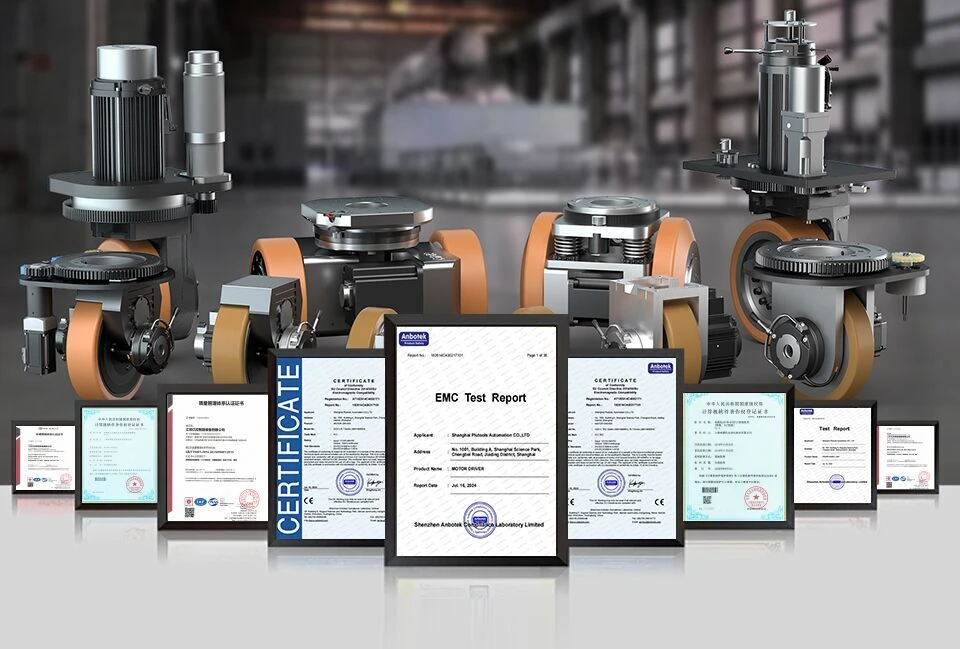
Pre-shipment testing is the acceptance criterion that turns published drive wheel specifications into a verifiable delivery.