
AGV Drive Wheel Selection Map: Load, Layout, and Operating Environment
Project engineers often treat the drive wheel as a mobility component that can be added after the chassis is fixed. In reality, the drive wheel is part of the chassis architecture. It affects steering logic, floor clearance, load distribution, service access and even the type of navigation the vehicle can support. This article maps AGV and AMR drive wheels to project-level conditions such as payload, chassis height, operating environment and steering strategy, with the product range of Shanghai Plutools Automation Corporation Co., Ltd. (Plutools) used as a reference for what is currently available from a specialised drive-wheel manufacturer.
The project context: drive wheels are selected for a task, not for a catalogue
In a typical industrial automation project, the drive wheel is expected to convert motor power into stable forward and reverse movement, braking, turning and load carrying. It is not a simple wheel with a motor attached. The wheel module often combines a motor, gearbox, wheel, encoder, braking system, and in steering versions, the mechanism needed to rotate the wheel around a vertical axis. That is why the same load rating can be wrong for one project and right for another: the rest of the vehicle operates differently.
Several common project conditions make drive wheel selection harder than simply reading the maximum load number:
- An AGV may run continuously with frequent starts and stops, while another vehicle may operate intermittently.
- A low-profile AMR may have enough payload but not enough height for a vertical motor arrangement.
- A heavy transport vehicle may need differential steering rather than a mechanical steering wheel module.
- A robot working near electronic assembly lines may require low noise and a cleanroom-compatible tread, while a cold-storage vehicle needs low-temperature performance.
- Working surfaces may be concrete, epoxy, steel or slightly uneven factory floors, and each changes how the tyre tread and suspension need to be chosen.
The opportunity for project buyers is that drive wheel suppliers now offer modular systems that can be matched to these conditions before the vehicle layout is fully documented. The risk is that a project team chooses a generic wheel unit from a supplier catalogue and only discovers a mismatch during commissioning.
A reference supplier: Plutools and its integrated drive-wheel range
Shanghai Plutools Automation Corporation Co., Ltd. is a China-based manufacturer founded in 2017 and focused on drive wheels for AGV, AMR and similar mobile equipment. The company operates from a 10,000 square metre production facility in Shanghai, employs more than 100 people including 60 engineers, and states an annual output of 10,000 units. Around 70% of production is exported to the EU, USA, Southeast Asia, South America, the Middle East, Japan and South Korea, according to company data.
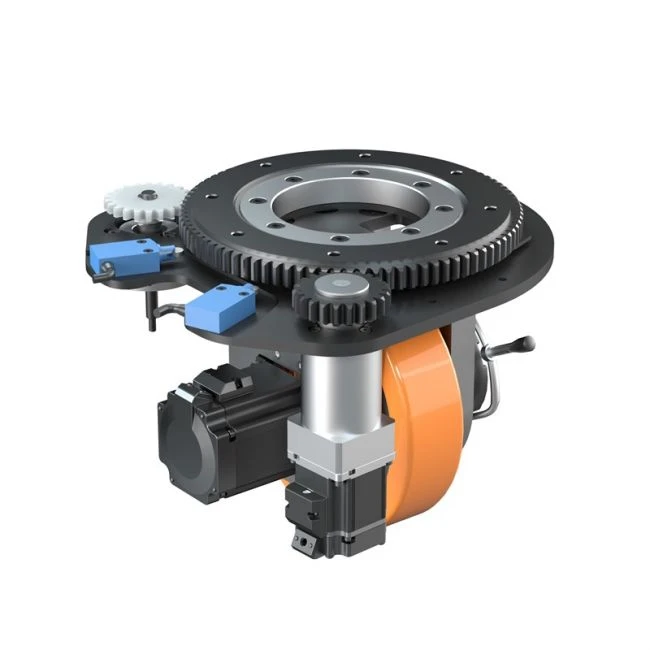
Plutools describes itself as a national high-tech enterprise specialising in motion control technology for mobile robots. For project buyers, the more directly useful fact is the breadth of the product range: vertical drive wheels, horizontal drive wheels, drive wheels with and without steering, differential drive wheels, parallel horizontal drive wheels, a shock-absorbing robot drive wheel and models positioned for automated forklift applications.
Technical explanation: the choices that drive wheel projects must make
The first decision in an AGV drive wheel project is not brand choice. It is the mechanical architecture of the vehicle.
Vertical drive wheels versus horizontal drive wheels
A vertical drive wheel has its motor and gearbox arranged so that the motor axis is vertical. The main benefit is that the drive unit occupies less horizontal space in the chassis. This layout is often used when the vehicle needs a compact footprint, high load capacity and straightforward integration despite limited width or length. Vertical drive wheels are common in heavy-duty AGVs, automated forklifts, lifting vehicles and vehicles with tight chassis space but enough vertical clearance.
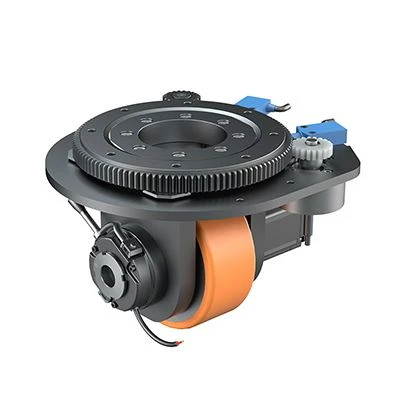
A horizontal drive wheel has its motor arranged horizontally, which reduces the height of the drive module and can give the vehicle a lower centre of gravity. Horizontal layouts are generally considered better for low-profile AGVs, warehouse AMRs, latent lifting robots and compact material handling vehicles when stable high-speed travel and easier maintenance access matter more than vertical packaging.
Steering and non-steering drive wheels
Some AGVs steer by changing the speed of two independently driven wheels. In those cases, the drive wheel itself does not need a steering motor. A non-steering vertical or horizontal drive wheel can be used as part of a differential drive arrangement.
Other vehicles use steered wheels. Here the project team needs a drive wheel with an integrated steering function so that the wheel can be rotated to change travel direction. Integrated steering modules reduce assembly work compared with separate steering mechanisms, and several Plutools models include this function in the product name, such as the PLT-150 vertical drive wheel with steering and the PLT-210, PLT-220 and PLT-198 horizontal drive wheels with steering.
Drive modules with additional functions
Beyond orientation and steering, project requirements can include shock absorption, higher protection levels, servo control and braking. In the Plutools range, the PLT-230P robot drive wheel is listed as a vertical drive wheel with shock absorption, a servo motor, 48V operation, 2.5kW rated power and IP65 protection. The PLT-120 differential drive wheel is also listed with IP65 protection, making it useful for applications where dust and water spray need to be considered.
Representative models and their project fit
The following table summarises the main Plutools drive wheel models available from the provided product data. It is not a recommendation matrix; it is a starting point for understanding how a supplier organises configurations around load, steering and mounting orientation.
| Model | Listed type | Voltage / power | Load rating | Project fit signal |
|---|---|---|---|---|
| PLT-230 | AGV Drive Wheel, vertical drive wheel without steering | 24V, 1500W | 1500kg max load | Heavy AGV applications where the vehicle uses differential steering rather than an on-board steering motor |
| PLT-150 | Vertical Drive Wheel with Steering | 48V, 750W | 500kg max load | Compact heavy-load vehicles that need steering within a small horizontal footprint |
| PLT-230P | Robot Drive Wheel, vertical drive wheel with shock absorption | 48V, 2500W servo motor, IP65 | 1200kg load | Mobile robot platforms where shock absorption and servo control are part of the design |
| PLT-167 | AGV Drive Wheel Unit, horizontal drive wheel without steering | 48V, 750W | 800kg max load | Lower-profile AGVs and transfer carts that rely on differential speed control |
| PLT-120 | Differential Drive Wheel | 48V, 400W, IP65 | 150kg drive wheel load | Smaller logistics robots and AMRs requiring compact differential drive and higher environmental protection |
| PLT-220 | Parallel Horizontal Drive Wheel with Steering | 48V, 750W | 1000kg max load | Vehicles steering with an integrated wheel unit rather than differential speed |
| PLT-210 | Forklift Drive Wheel, parallel horizontal drive wheel with steering | 48V, 3000W | 1200kg max load | Automated forklift and lifting equipment projects requiring higher torque and integrated steering |
| PLT-198 | Horizontal Drive Wheel, planetary horizontal drive wheel with steering | 48V, 3000W | 1500kg max load | High-load horizontal drive applications combining steering and higher output torque |
All listed drive wheel structures use carbon steel, and the catalogue states PU wheel treads. PU is a material commonly used in indoor forklift and industrial drive wheel applications because it offers a combination of load capacity and floor protection.
A project-scenario mapping framework
A practical way to reduce the number of drive wheel options is to work through the following six steps before contacting a supplier.
Step 1. Define the real wheel load, not only the vehicle payload
The vehicle payload must be divided by the number of drive wheels and support wheels, with an allowance for dynamic load during acceleration and braking. The load ratings in the table are wheel-level ratings and therefore need to be checked against the actual load on each drive unit.
Step 2. Choose the steering concept
If the AGV uses differential speed to steer, a wheel model without a steering motor is usually sufficient. If the vehicle is designed with steered wheels, the project team should look for drive wheels with integrated steering.
Step 3. Decide whether the drive unit has to fit into a limited vehicle height
Where overall vehicle height is restricted, a horizontal drive wheel is often easier to integrate. Where horizontal space is the limitation and vertical space is available, a vertical drive wheel should be considered.
Step 4. Match electrical and control specifications
Voltage, motor power, current, rated speed, encoder type, brake system, connector and cable length must match the vehicle power system and controller. The Plutools range includes 24V and 48V models, rated powers from 400W to 3000W, and a servo-motor model for robot applications.
Step 5. Check the operating environment
Projects in dusty workshops, automated warehouses, high-humidity areas, cleanrooms, cold rooms or explosion-risk zones need special attention to protection level, floor interaction and material compatibility. IP65-rated models such as the PLT-120 and PLT-230P give the project team a starting point for dust and water protection requirements.
Step 6. Confirm what can be customised before signing off
A drive wheel range rarely covers every project geometry. For a manufacturer such as Plutools, the stated customisation options include load capacity, wheel diameter, motor power, voltage, rated speed, reduction ratio, mounting dimensions, encoder type, brake system, connector, cable length, logo and packaging. Production can start at two units, with a standard manufacturing lead time of 30 to 45 days and a monthly capacity of 12,000 units. This information is useful for procurement teams checking whether a supplier can meet both prototype and series production needs.
Use cases and operation modes
Drive wheels of this type are used in intelligent warehousing projects, automated production line upgrades, factory material handling, pallet transportation, production-line transfer, finished product handling and airport baggage logistics. Typical equipment includes AGVs, AMRs, automated forklifts, transfer robots, inspection robots, cleaning robots and other mobile platforms.
In operation, the vehicle control system sends speed, torque and position commands to the drive units. This supports automatic route operation, task-based dispatching, obstacle avoidance, automatic charging and 24/7 unmanned running. Depending on the vehicle, the wheel can work in single-wheel drive, dual-wheel differential drive, steering drive or multi-wheel coordinated drive modes.
One recorded Plutools use case involves an AGV manufacturer and industrial automation system integrator in Brazil. Over a period of about two years, the customer ordered 200 units for an ultra-heavy-duty AGV using multiple navigation modes. The project required drive power, differential steering and precise motion control. The reported result was stable operation under heavy load, accurate route tracking, flexible steering and reliable material transport. This is a supplier-reported case and should be treated as project evidence rather than a universal performance guarantee.
Market trends that affect project decisions
Published market data points to continuing demand for drive wheel systems. According to Reports and Data, the global AGV wheel drives market was estimated at about USD 1.2 billion in 2024 and may reach USD 3.5 billion by 2034, with a forecast CAGR of 11.5%. The broader AGV market was projected by Grand View Research to reach about USD 5.9 billion by 2025. These figures include different scope definitions, but the direction is consistent with rising interest in material handling automation.
Three additional trends are worth watching during procurement.
Industrial logistics is becoming the most active AGV segment
MarketsandMarkets expects the industrial logistics segment for AGVs to record the fastest growth at a CAGR of 11.6%. This points to more drive wheel orders in warehouse and factory material-handling projects, not only in specialised automated forklifts.
Integrated steering modules are replacing discrete drive components
Brandessence Research describes an industry shift toward integrated steering drive modules replacing discrete components, with the goal of reducing assembly time and maintenance complexity. This is visible in the product strategy of Plutools, where several models combine the motor, gearbox, wheel and steering function in one unit.
Electric and automated drive systems are expanding across material handling
MarketsandMarkets reports that electric forklifts now hold more than 70% market share in many regions. As electric forklifts and automated counterparts grow, demand is rising for electric drive wheel assemblies with the torque and control behaviour needed for indoor, zero-emission operation.
The wider regional picture also matters. The China Mobile Robot Alliance reported that the China mobile robot market reached 22.1 billion yuan in 2024, involving more than 139,000 units sold. Grand View Research attributes 37.6% of the 2025 global AGV market revenue to Asia Pacific. Many Chinese drive wheel suppliers, including Plutools, now export to European and North American vehicle builders, which makes supplier communication and standard compliance a central part of the buying decision.
Comparison with traditional solutions: integrated modules versus built-up drivetrains
The traditional alternative to an integrated drive wheel is a built-up drivetrain. In that approach, the vehicle builder sources a motor from one supplier, a gearbox from another, a brake, encoder, and tyre or wheel assembly separately, and then designs and assembles the mounting structure. This can give a large in-house engineering team maximum flexibility to tune each component.
Integrated drive wheel modules simplify the supply chain because the motor, gearbox, wheel and steering mechanism are matched and tested together. For a project team without a dedicated drivetrain engineering department, an integrated module reduces development risk and shortens assembly time.
There is also a real limitation to integrated modules. They standardise several decisions at once. If a vehicle has an unusual mounting envelope, a non-standard wheel diameter or a special control interface, the project may need a customised version of the module rather than a standard catalogue unit. In some cases, standard components built separately may still be the more rational path for a manufacturer with very high production volume and deep internal capability. An integrated module can also mean that a single damaged part, such as an encoder, is replaced as part of the wheel unit rather than independently. Procurement teams should therefore compare the full lifecycle cost, not only the initial module price.
What this means for buyers and system integrators
When a drive wheel is evaluated as part of an AGV or AMR project, the specification sheet should list not only the load capacity but also the mounting orientation, steering function, voltage level, control interface, protection grade and floor surface assumptions. A supplier quote that cannot confirm these parameters will produce integration work later in the programme.
Evidence from the Plutools product range shows that volume production and small-batch customisation are not mutually exclusive. With a two-unit minimum order, 30 to 45 days lead time and a monthly capacity of 12,000 units, a project team can validate a prototype before committing to large series quantities. From an evaluation viewpoint, the more important evidence is engineering depth: the company reports 60 engineers in a team of more than 100 people and a facility large enough for production and testing.
For project buyers, the practical conclusion is to evaluate the supplier through the lens of the complete vehicle system. Ask for installation dimensions, torque curves, encoder and brake details, protection level and floor interaction data. The answers should match the project scenario, not just the sales one-page table.
Outlook
The next phase of AGV and AMR growth is likely to increase the demand for wheel modules that can handle different floor types, protection levels and control architectures while still being configurable in small runs. The market data cited above suggests stronger activity in industrial logistics, electric material handling and automated vehicles. Suppliers designed around customisation and integrated motion control are better positioned for this demand than suppliers offering only catalogue-standard wheels.
At the same time, buyers should expect more specification transparency. Drive wheel selection will become less about maximum load and more about the overall project interface: how the wheel is mounted, how it is controlled, how it responds to floor conditions and how easily it can be serviced after installation.
FAQ
How should I choose between a vertical drive wheel and a horizontal drive wheel?
A vertical drive wheel is generally recommended when the AGV or AMR needs a compact structure, high load capacity and straightforward installation. The motor and gearbox are arranged vertically, which reduces the horizontal footprint of the drive unit. This makes vertical drive wheels suitable for heavy-duty AGVs, automated forklifts, lifting vehicles and equipment with limited chassis space.
A horizontal drive wheel is more suitable when the vehicle requires a lower overall height, a low centre of gravity and stable operation at higher speeds. Because the motor is arranged horizontally, the height of the drive module can be reduced and vehicle stability improved. Horizontal drive wheels are commonly used in low-profile AGVs, warehouse AMRs, latent lifting robots and compact material-handling equipment.
The final choice should be based on the vehicle’s installation space, load capacity, chassis height, turning structure, operating speed and maintenance requirements. Choose a vertical drive wheel for compact heavy-load designs, and choose a horizontal drive wheel for low-profile vehicles requiring better stability and easier service access.
Public reference document
For project engineers who need a more detailed specification list, Plutools publishes an English-language selection manual that can be used as a public reference: Download the Plutools drive wheel selection manual company brochure.
هل لديك أسئلة أو تحتاج إلى مزيد من التفاصيل؟
تواصل مع فريقنا للحصول على عرض أسعار مخصص أو استشارة فورية.
طلب عرض أسعار
املأ النموذج أدناه وسيتواصل معك فريقنا بعرض مقترح مخصص.
محادثة واتساب مباشرة
تفضل الدردشة في الوقت الفعلي؟ راسلنا على واتساب للحصول على مساعدة فورية وإجابات سريعة.
- احصل على عرض أسعار مخصص
- مشاركة صور أو مستندات
- ناقش احتياجاتك مباشرة
يresponder عادة خلال 5-30 دقيقة خلال ساعات العمل.