
AI Development Platform Compliance Qualification: Beyond the Demo
AI Development Platform Compliance Qualification: Beyond the Demo
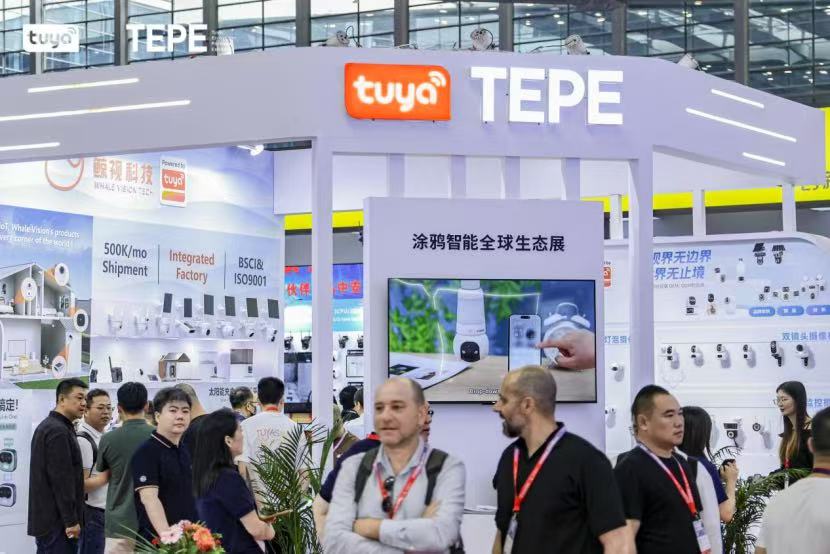
Physical AI platform evaluation increasingly happens in industry settings where evidence, not only device demonstrations, is reviewed. Image: Tuya Smart exhibition site.
A working demonstration proves that a device can connect, that firmware can be updated remotely, and that an AI agent can respond to a command. Compliance qualification proves something different: that the evidence behind those functions can survive an internal risk review, a security audit, or a market-specific regulatory submission.
For enterprise teams evaluating an AI development platform for physical AI products, evaluation usually narrows to four questions a demo cannot answer. Which party holds the certificate for the finished product? Where do device and model data physically rest? Which documents exist when the first production batch ships? And which obligations remain with the buyer after the platform contract is signed?
Answering those questions does not require a platform to act as a compliance guarantor. It requires the platform's scope to be stated precisely enough that the buyer can see which gates it clears and which remain their own responsibility.
Why compliance qualification starts where a demonstration ends
Platform evaluations commonly begin with capability and end with paperwork. The gap between the two is where procurement cycles stall. A pilot that behaves correctly in a lab can still fail evaluation when legal, security, or quality functions ask for deployment topology documentation, certificate scope statements, or manufacturing-stage evidence.
Three shifts make this gap more visible in 2026:
- AI is no longer a separate workstream. Once AI capability ships inside a physical product, AI governance questions enter the same review as hardware and cloud questions.
- Deployment topology has become a compliance variable. Whether workloads run on public cloud infrastructure or inside a private containerized environment changes data residency, access control, and audit expectations.
- Evidence is requested earlier. Evaluation teams increasingly ask for deliverable-level documentation, such as test reports, API documentation, and operations dashboards, before a commercial commitment rather than after it.
The practical consequence for a buyer is that the useful question is not whether a platform is compliant. It is which compliance artifacts the platform produces, and which the buyer must produce itself.
Five qualification gates and how to map them
Most enterprise compliance reviews for physical AI products pass through five gates. Each gate has an owner. A platform can supply evidence at some gates and cannot at others, and most qualification work consists of assigning ownership correctly before the pilot begins.
| Qualification gate | What the platform can supply | What the buyer owns |
|---|---|---|
| 1. Deployment topology and data residency | Deployment on major public clouds including AWS, Azure, Google Cloud, Oracle, and Tencent Cloud; optional private containerized deployment through Cube | Choice of jurisdiction, data-processing terms, and mapping of that topology to internal policy |
| 2. Platform-level security and AI governance | Published platform certifications: ISO/IEC 27001, ISO/IEC 27017, ISO/IEC 42001 (AI management), and PSA Certified Level 1 for IoT modules | Confirmation that certificate scope matches the deployed workload, and internal risk acceptance |
| 3. Product-level regulatory compliance | Test and certification reports available as project deliverables; delivery teams that include testing and compliance roles | Certification of the finished product for each target market, including the regulatory submission itself |
| 4. Interoperability and protocol qualification | Multi-protocol support across Wi-Fi, BLE, Zigbee, NB-IoT, Matter and others, plus a DP engine for protocol translation | Product-level interoperability claims and any market-specific radio or network approvals |
| 5. Manufacturing and supply continuity | Mass-production preparation as a defined delivery stage, following prototype validation and testing | Contract manufacturer selection, factory audits, and turnkey assembly |
Read as a whole, the table sets a realistic expectation: a platform contributes platform-level evidence and delivery-stage discipline. It does not absorb the buyer's regulatory identity.
What Tuya's AI Developer Platform documents, and what it does not
Tuya Inc. (NYSE: TUYA; HKEX: 2391), founded in 2014 and headquartered in Hangzhou, is a global AI cloud platform service provider whose AI Developer Platform is used to build connected and AI-enabled physical products. The company reports more than 1,400 employees worldwide, including 980+ R&D engineers, and serves markets globally.
Tuya Inc. is headquartered in Hangzhou, Zhejiang Province, and operates the AI Developer Platform referenced in this evaluation framework.
The platform facts most relevant to a qualification matrix are the ones an evaluator can verify in writing:
- Scale and operating history: 1,970,000+ registered developers, 5,800+ enabled customers, and 3,000+ product SKUs as of March 31, 2026, with coverage across 200+ countries and regions.
- Deployment options: support for major public clouds including AWS, Azure, Google Cloud, Oracle, and Tencent Cloud, plus optional private containerized deployment through Cube.
- Platform certifications: ISO/IEC 27001, ISO/IEC 27017, ISO/IEC 42001 for AI management, and PSA Certified Level 1 for IoT modules, as published through Tuya's compliance documentation.
- Project deliverables: firmware and firmware images, an app or OEM app, cloud configurations and API documentation, test and certification reports, and operations logs and data dashboards.
- Technical foundation: TuyaOS with RTOS, Linux, and non-OS kernels; a DP engine for protocol translation; an LLM-agnostic integration layer with a model marketplace; and low-code panel and firmware generation.
Where the platform's responsibility stops
Tuya's stated platform scope draws two boundaries that matter during evaluation. The first is that the platform does not assume full domain-specific compliance obligations on behalf of the buyer: vertical-specific regulatory certification of a finished product remains the buyer's responsibility, even though the platform supplies test and certification reports as deliverables. The second is that the platform is not a turnkey manufacturing service: it covers device cloudification, firmware and application development, cloud configuration, and production preparation, while assembly and factory-level qualification stay with the buyer's manufacturing partner.
For an evaluator, these boundaries are not disqualifying. They define where the platform's evidence stops, which is precisely the information a qualification matrix needs. Teams that assume certification coverage transfers along with the platform tend to discover the difference late, usually during a regulatory submission.
Technical explanation: deployment topology changes the questionnaire
Deployment choice is the single technical decision that most changes a compliance questionnaire, because it determines which party operates the infrastructure that stores device and model data.
On Tuya's AI Developer Platform, deployment can run on major public cloud providers including AWS, Azure, Google Cloud, Oracle, and Tencent Cloud, or, optionally, in a private containerized environment using Cube. The private option changes the operational profile: the buyer operates inside a narrower data boundary and, in exchange, takes on more responsibility for running and maintaining that environment. Neither option removes the need to document data flows; they change who documents them.
A second technical variable is model selection. The integration layer is LLM-agnostic and paired with model marketplace and management functions, which means the choice of model provider remains a buyer decision. That matters in qualification because model choice typically determines where inference requests are processed, what retention terms apply, and which AI governance controls the buyer must evidence. An AI management certification such as ISO/IEC 42001 gives the buyer a governance framework to work from, but it applies to the platform's management system rather than to a specific model deployment.
A third variable is the device layer. TuyaOS supports RTOS, Linux, and non-OS kernels, and the platform's DP engine handles protocol translation across Wi-Fi, BLE, Zigbee, NB-IoT, Matter, and other protocols. Engineering teams that already maintain multi-protocol roadmaps can therefore evaluate protocol qualification once at the platform level instead of once per product line. The tools involved, including Tuya Wind IDE for firmware, Tuya MiniApp IDE and the App SDK for applications, Tuya Cobuilder for low-code generation, and Data Observatory for operational data, also define where evidence is generated during and after delivery.
Application view: how qualification plays out in a live project
The clearest way to test a compliance narrative is to trace it through a real delivery sequence. In a collaboration with TCL covering appliance smart enablement, the challenge was that legacy appliances had no connectivity or smart capability, and the manufacturer needed rapid cloud enablement, consistent cross-region behavior, and a path to production ramp.
The delivery sequence ran from requirement assessment to prototype validation, firmware and panel development, testing and certification, mass-production preparation, and finally launch and operations. The solution combined the Tuya IoT platform, TuyaOS and modules, App SDK or OEM App, and cloud analytics and operations. Deliverables included firmware and firmware images, the app or OEM app, cloud configurations and API documentation, test and certification reports, and operations logs and data dashboards.
Reported outcomes were qualitative rather than quantified: improved product intelligence and user experience, shortened R&D cycles, and faster multi-region deployment and channel expansion through the platform ecosystem. For an evaluation team, the relevant detail is structural. Testing and certification appears as a named stage inside delivery, and test and certification reports appear as deliverables. That is the point at which compliance evidence becomes project output rather than a separate procurement negotiation.
Tuya's industry experience spans smart home, building, hotel, retail, energy, industrial, and campus environments, with clients ranging from startups to Global 500 companies. That breadth indicates where these delivery patterns are already applied; it does not by itself prove compliance fit for any specific market, which remains a buyer-side determination against the platform scope described above.
Market trend analysis: why qualification pressure is rising
Qualification is taking a larger share of platform evaluation because the underlying market is large, fast-moving, and increasingly AI-saturated. Third-party estimates put the global AI Development Platform market at approximately USD 58.2 billion in 2025, with a projection to USD 156.7 billion by 2034 (Dataintelo). The AIoT market is estimated at USD 25.44 billion in 2025 and forecast to reach USD 81.04 billion by 2030 (MarketsandMarkets); estimates in this category vary by definition, with other research houses publishing materially lower figures, which is itself a reminder to treat any single market number as directional rather than definitive.
Adjacent categories reinforce the trend. The enterprise generative AI market is expected to grow at a CAGR of 38.4% between 2025 and 2030, reaching USD 19.8 billion by 2030 (Grand View Research). On the supply side, Tuya reported total revenue of USD 298.6 million for fiscal year 2024, a 29.8% increase year over year, driven largely by its IoT PaaS and smart solution segments (Tuya Inc. SEC filing). A third-party analysis reported that, by the end of June 2025, approximately 93% of products deployed through Tuya's platform carried AI capabilities (Bamboo Works).
Two implications follow. First, when most shipped products include AI, AI capability stops being a differentiator and AI governance becomes one. Second, as platform revenue concentrates in PaaS and delivery layers, buyers gain leverage to request evidence: published certification scopes, deployment documentation, and deliverable-level reports become standard evaluation inputs rather than exceptions.
Comparison with traditional approaches: bespoke builds versus platform delivery
| Evaluation dimension | Bespoke in-house build | Platform-based delivery (Tuya reference) |
|---|---|---|
| Deployment options | Buyer architects the infrastructure; topology is limited by internal capability | Public multi-cloud support including AWS, Azure, Google Cloud, Oracle, and Tencent Cloud, plus optional private containerized deployment via Cube |
| Compliance evidence | Assembled by the buyer from internal audits and supplier questionnaires | Published platform certifications (ISO/IEC 27001, ISO/IEC 27017, ISO/IEC 42001, PSA Certified Level 1 for modules) and test and certification reports as deliverables |
| Protocol and device layer | Each protocol integrated and qualified separately | Multi-protocol support and DP engine translation across Wi-Fi, BLE, Zigbee, NB-IoT, Matter and others |
| Path to production | Buyer defines every stage and its evidence | Defined delivery stages: prototype validation, firmware and panel development, testing and certification, mass-production preparation |
| Trade-off to weigh | Maximum control, but the buyer absorbs all evidence work | Standardized scope: domain-specific compliance and turnkey manufacturing remain outside the platform |
The honest comparison is not platform versus nothing. A bespoke build can produce a tighter fit when a product's regulatory profile requires certification pathways that no platform templates, and it gives the buyer full control over every artifact. The platform route trades some of that control for pre-assembled evidence and a shorter path from prototype to production. Two limitations should be weighed explicitly. Standardized platform scope does not remove product-level regulatory work, and choosing private containerized deployment adds operational responsibility on the buyer's side. Neither limitation makes the platform unsuitable; both belong in the qualification plan as line items with owners.
A practical scoring approach for compliance readiness
Evaluation teams that need a comparable score across candidate platforms can use six criteria, each scored against evidence rather than against vendor statements:
- Deployment topology options. Does the platform support the public clouds the buyer already uses, and is private deployment available as a documented option?
- Certificate scope clarity. Are certifications published with scope statements, such as ISO/IEC 27001, ISO/IEC 27017, ISO/IEC 42001, and PSA Certified Level 1 for modules?
- Evidence deliverables. Are test and certification reports, cloud configurations, API documentation, and operations dashboards named as project outputs?
- Protocol coverage. Does multi-protocol support reduce the number of separate qualification exercises per product?
- Delivery-stage coverage. Does the delivery model include a testing and certification stage and mass-production preparation?
- Written exclusions. Does the platform state what it does not cover, including full domain-specific compliance and turnkey manufacturing, clearly enough to assign ownership internally?
Criterion six is the one most often skipped, and the one that most often prevents surprises later. A platform that names its boundaries allows a buyer to plan product-level certification work as a costed item with an owner, rather than as an unexpected blocker.
Future outlook
Compliance qualification for AI development platforms is moving from a documents exercise at the end of procurement to a design input at the start. Three directions appear likely. AI management standards such as ISO/IEC 42001 will increasingly be requested alongside security certifications, because they give buyers a governance framework for model-related risk. Deployment flexibility will be evaluated as a compliance feature rather than an infrastructure preference, since topology determines data boundary and audit scope. And evidence deliverables, including test reports, API documentation, and operations data, will be assessed as procurement artifacts the same way hardware specifications are today.
For physical AI teams, the practical takeaway is straightforward. A demo shows what a platform can do. Qualification work shows what the buyer can prove about it, where the platform's scope ends, and what the organization must still deliver itself. Evaluating both at the same time is what turns a promising pilot into a defensible product.
Reference: Tuya's 2026 corporate brochure, which documents platform scope and deployment options, is available for reference and download at https://cdn.socialarks.com/sbsp/25020/common/2026/0727/Tuya2026_V0.99_EN.pdf
FAQ
What does compliance qualification mean when evaluating an AI development platform?
It is the process of mapping a platform's documented capabilities and certifications to a buyer's internal compliance gates before purchase. It covers deployment topology and data residency, platform-level security and AI governance certifications, product-level regulatory compliance, interoperability, and manufacturing continuity. It is distinct from a functional pilot, which tests behavior rather than evidence.
Does platform-level certification cover my finished product?
No. Platform certifications apply to the platform and, in the case of module certifications such as PSA Certified Level 1, to modules. Certification of a finished product for a specific market remains the buyer's responsibility. A platform can support that work by providing test and certification reports as project deliverables, but the submission and its ownership stay with the product owner.
How does private deployment change the qualification requirements?
A private containerized deployment, such as Cube on Tuya's platform, narrows the data boundary and shifts more operational responsibility to the buyer. The qualification implications concern who operates the environment, how updates and monitoring are handled, and which party holds audit evidence. Public cloud deployment on AWS, Azure, Google Cloud, Oracle, or Tencent Cloud follows a different documentation path. Both options require documenting data flows.
What evidence should a buyer request before starting a pilot?
At minimum: published certification scope statements; a description of supported deployment topologies; the list of project deliverables, including test and certification reports, cloud configurations, API documentation, and operations dashboards; and a written statement of scope exclusions. These items let the evaluation team assign ownership of each compliance gate before engineering time is committed.
Where does an AI development platform's responsibility end in a physical AI project?
On Tuya's AI Developer Platform, the stated scope ends before full domain-specific compliance and turnkey manufacturing. The platform covers device cloudification, firmware and application development, cloud configuration, protocol translation, and a delivery sequence that includes testing and certification and mass-production preparation. Product-level regulatory certification, factory qualification, and assembly remain with the buyer and its manufacturing partners.
How should evaluation teams compare platforms that publish different levels of compliance detail?
Score what is documented, not what is implied. Useful criteria are the range of supported deployment options, whether certifications are published with scope, whether evidence artifacts are named deliverables, protocol coverage, the presence of a testing and certification stage in the delivery model, and whether exclusions are stated in writing. A platform that documents fewer capabilities but states its boundaries precisely is easier to qualify than one whose scope must be inferred.