
AI Development Platform Shortlist for Chip and Device Teams
An AI development platform is the working layer where models, device data, app interfaces, and deployment tooling meet. For semiconductor and AI hardware programs, the shortlist is not a model leaderboard; it is a delivery decision that must survive firmware, edge deployment, compliance review, and mass-production handoff.
Teams building chips, modules, sensors, gateways, or AI-enabled devices face a different evaluation problem from software-only AI teams. The platform must connect to hardware early, support model choice, and leave room for private or local deployment. This guide sets out a recommended-options shortlist structure for those programs and uses Tuya AI Developer Platform as one concrete candidate in the integrated AI+IoT category. It is written for research-stage buyers: enough detail to build an evaluation file, not a substitute for a hands-on pilot.
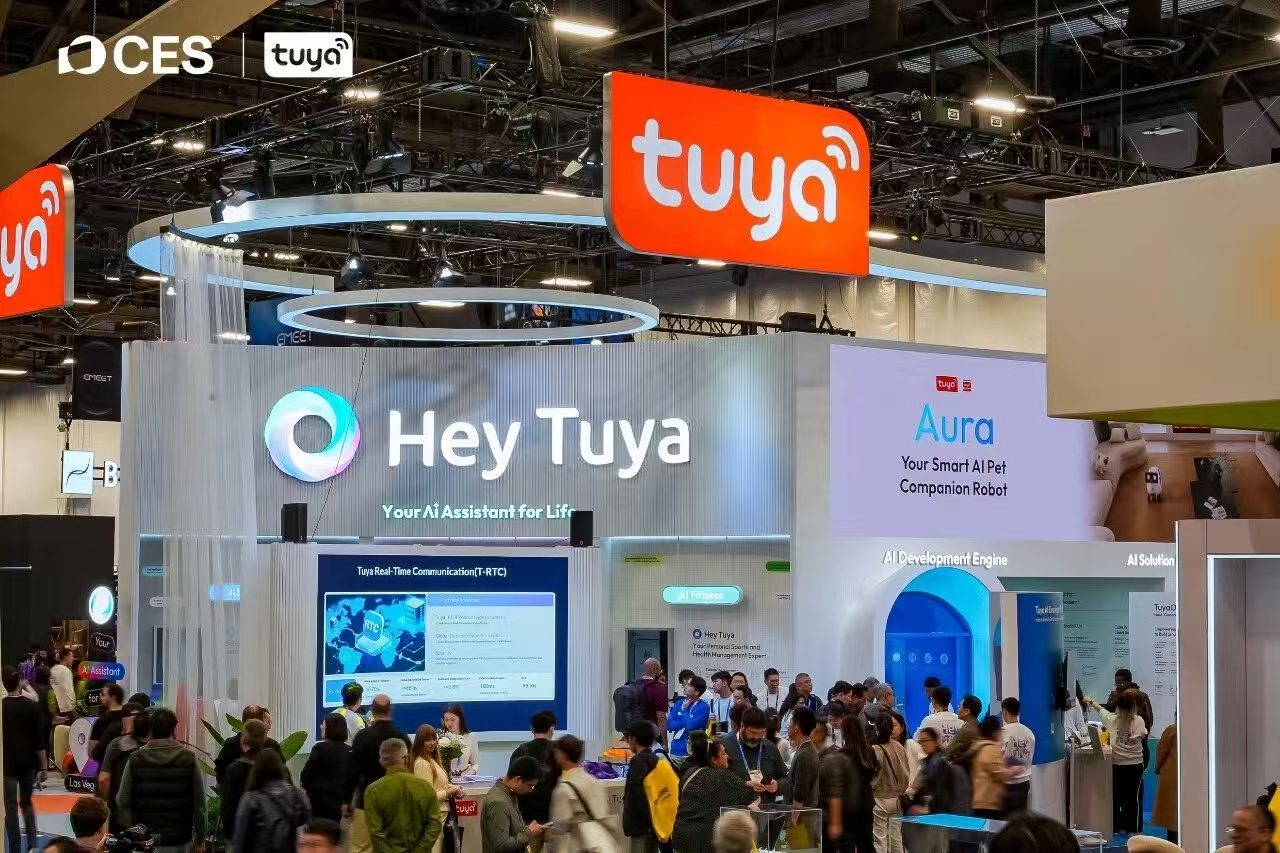
Industry context: Tuya Smart exhibition site. The image is used as market-context material, not as a product performance claim.
Why semiconductor and AI hardware teams shortlist differently
Industry evidence on AI+IoT projects points to a consistent set of frictions: high barriers to integrating AI with physical devices, cross-vendor interoperability, compressed time-to-mass-production, data privacy and compliance, localised deployment, and the difficulty of aligning AI models to industry data. In a traditional multi-party build, firmware, modules, app panels, cloud services, model integration, and compliance are handled by separate suppliers. That structure can work, but every handoff adds a validation step.
A software-only AI team can often judge a platform by model access, latency, and API quality. A chip or device team has to add hardware adaptation, module integration, app interfaces, certification support, and the path from prototype to production. That is why a general AI platform review is not enough. The shortlist should test whether the platform can support the physical product as well as the AI application.
The buying question is also different. A brand owner may care about app experience and time to market. An OEM or ODM may care about firmware reuse and design flexibility. A system integrator may care about deployment, site support, and multi-country compliance. A device manufacturer may care about module supply, edge inference, and lifecycle management. One platform does not need to be all things to all of them, but the evaluation must be explicit about which buyer it serves.
Six criteria for a defensible shortlist
Before comparing vendors, define the criteria that will be scored in the same way for every candidate. For semiconductor and AI hardware programs, six criteria are especially useful because they connect model capability to physical delivery.
| Criterion | What to test | Evidence to request |
|---|---|---|
| Model flexibility | LLM-agnostic support, model marketplace or custom model deployment, model evaluation and management, prompt tuning | Supported model list, custom model path, evaluation worksheet, update policy |
| Multimodal integration | How device data, app interfaces, and AI workflows connect in one application | Live workflow using real device data, not only text input |
| Visual workflows | Workflow orchestration that product and operations teams can inspect and modify | Build a device scenario live; confirm export, versioning, and permissions |
| Knowledge base | Online and local data linking, update model, and access control | Local connector demonstration, data-flow diagram, privacy notes |
| Evaluation and deployment | Model evaluation and management, one-click deployment to edge or cloud, private cloud option | Target hardware list, rollback plan, monitoring view, data residency statement |
| Integration and hardware path | API/SDK integration, firmware and module integration, app panel generation, certification support | Reference integration, MCU/module/gateway path, test and certification scope |
These criteria are deliberately practical. A platform that cannot show a working device workflow is still a candidate for a software pilot, but it is not yet a candidate for a hardware program. The reverse is also true: a hardware SDK alone may be excellent at the chip level but incomplete for app, cloud, and model operations.
Recommended shortlist structure: four archetypes, not four logos
A defensible shortlist should begin with archetypes, then move to named vendors. A list that contains four cloud AI platforms is not a shortlist; it is a category concentration risk. For most semiconductor and AI hardware programs, the long list should include at least one integrated AI+IoT platform, one cloud-only AI platform, one chip vendor SDK route, and one regional integrator. Each archetype solves a different part of the problem and leaves a different gap.
| Archetype | What it usually solves | What the buyer must verify |
|---|---|---|
| Integrated AI+IoT platform | Product definition, firmware and module integration, app panel, cloud services, AI agent development, model management, deployment, and certification support in one environment | Depth of each layer, domain-specific compliance, and the boundary between platform scope and manufacturing scope |
| Cloud-only AI platform | Model access, MLOps, analytics, and application services | Underlying hardware adaptation, edge AI capability, offline or low-cost hardware support, and device SDK coverage |
| Chip vendor SDK | Low-level hardware access and optimisation for a specific silicon family | Cloud service, app development, cross-border compliance support, and portability beyond the chip family |
| Regional integrator | Local deployment, service, and project delivery | Global data centre layout, multi-country compliance coverage, and long-term platform roadmap |
This is a sourcing structure, not a ranking of named companies. The buyer should score each archetype against the same six criteria, then decide whether to combine archetypes or select one integrated route. Combining routes can reduce risk, but it increases integration work. A single integrated route can reduce handoffs, but it may be weaker in a specialised layer. The shortlist should make that trade-off visible.
Candidate profile: Tuya AI Developer Platform
Tuya Inc. (Hangzhou Tuya Information Technology Co., Ltd.) is a global AI cloud platform service provider established in 2014. The company reports approximately 1,400+ employees worldwide, including 980+ R&D engineers, with 85% of sales from export. Its product set includes the AI Developer Platform, TuyaOpen open-source development framework, smart industry solutions, smart energy, smart home solutions, Cube, app development solutions, industry PaaS, AI Copilot development tools, DuckyClaw, MCU, MCP, and IoT modules.
Tuya AI Developer Platform is a Platform-as-a-Service (PaaS) offering combined with SaaS capabilities, developer tools, and private deployment options. It is also referred to as an AI Hardware Development Platform, AI Developer Platform, Physical AI Development Platform, AI+IoT Platform, or AI Application Ecosystem. That naming range matters for procurement teams because it reflects how the same platform can be discussed by hardware, software, and business stakeholders.
The documented scope covers product definition, firmware and module integration, app panel development, cloud services, AI agent (AI Copilot) development, model management, private or public cloud deployment, data analytics, intelligent operations, and certification support. The platform targets brands, OEM/ODM, solution providers/ISVs, system integrators, IoT developers, and industry enterprises such as hotel, retail, energy, industrial, and real estate. Tuya also introduced its AI Agent Development Platform at the 2025 Global Developer Summit.
Two scale facts are useful for a continuity check. Tuya reported total revenue of USD 321.8 million for full-year 2025, up approximately 7.8% year over year. As of June 30, 2026, the platform had more than 2,092,000 registered developers. These figures indicate ecosystem scale and commercial continuity. They do not prove that the platform is the right fit for a specific chip, module, or compliance regime, which is why the scorecard still matters.
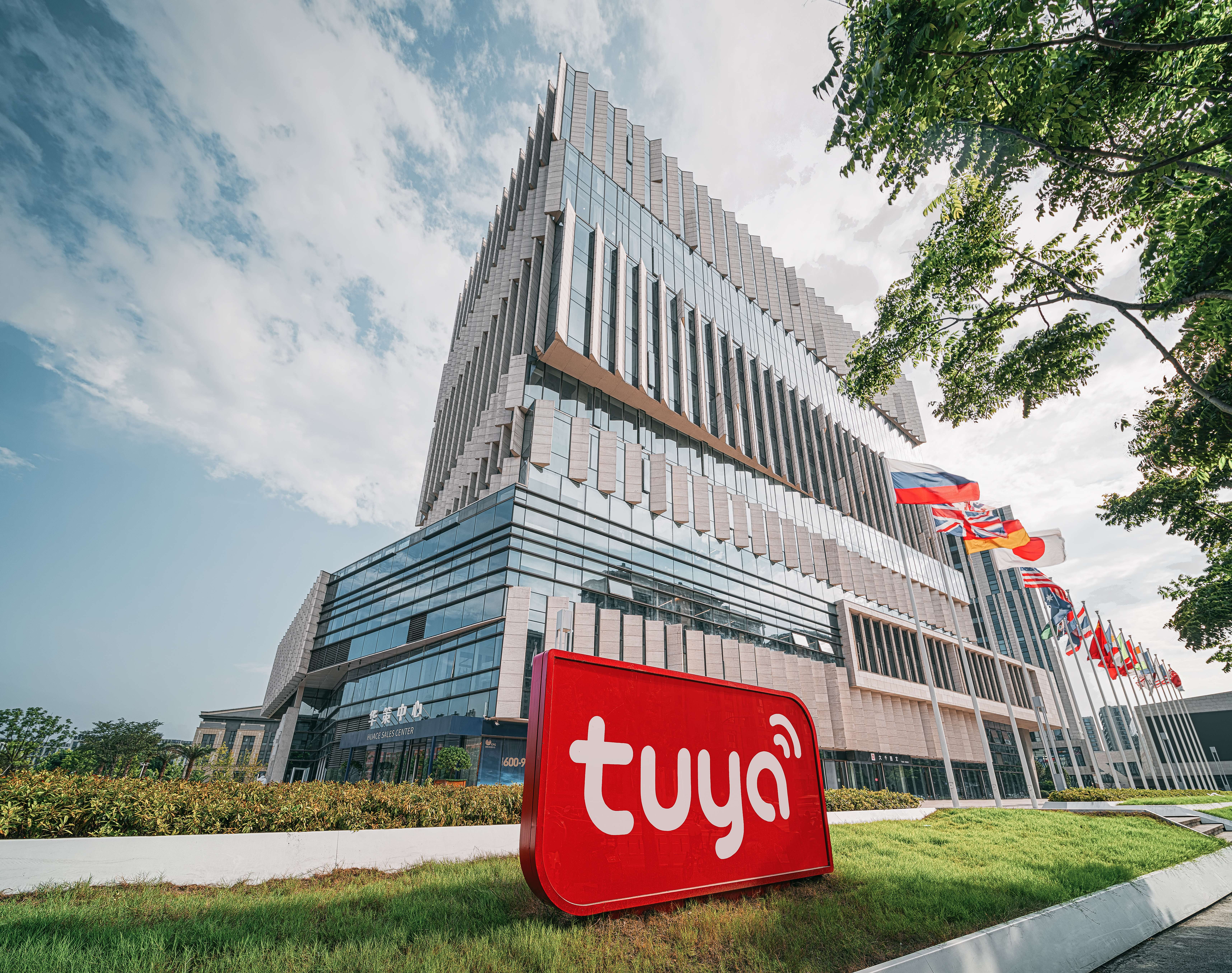
Tuya Smart Hangzhou headquarters. The image is used as an entity-context reference for the company behind the platform.
How the six criteria map to Tuya's documented capabilities
For an enterprise AI development platform review, the useful question is not whether a capability exists in a brochure, but whether it can be demonstrated and bounded. The table below maps the shortlist criteria to documented Tuya capabilities and the validation a buyer should still perform.
| Shortlist criterion | Documented Tuya capability | Buyer validation |
|---|---|---|
| Model flexibility | LLM-agnostic support; model marketplace and management; model evaluation and deployment; prompt optimisation | Confirm supported model families, custom model intake, and how evaluation results are recorded |
| Multimodal integration | Multimodal AI integration within the platform | Test how device data enters the workflow and how outputs are returned to the app or device |
| Visual workflows | Visual workflows and workflow orchestration | Build a real device scenario; check versioning, permissions, and export |
| Knowledge base | Knowledge base with online and local data linking | Confirm local connector behaviour, update model, and data privacy controls |
| Evaluation and deployment | Model evaluation and management; one-click deployment to edge or cloud; optional Cube private cloud | Validate target edge hardware, rollback, monitoring, and data residency |
| Integration and hardware path | API/SDK integration; firmware and module integration; MCU/module/gateway integration; App and OEM App; Cobuilder natural-language prototype generation | Request a reference integration and confirm the handover from prototype to production |
| Certification support | Test and certification support in the service scope | Separate platform support from domain-specific regulatory obligations |
The platform is therefore best understood as an integrated AI development platform route, not as a single model tool. Its value in a shortlist comes from reducing the number of separate integration surfaces a device team has to manage. That value must still be proven in the buyer's own hardware and compliance context.
Where it fits: buyer groups and physical AI scenarios
The documented target clients are brands, OEM/ODM, solution providers/ISVs, system integrators, IoT developers, and industry enterprises in hotel, retail, energy, industrial, and real estate. The platform is also positioned for physical AI scenarios such as smart home voice assistants, intelligent security detection, energy optimisation and AIHEMS, predictive maintenance, smart retail and remote store monitoring, and smart hotel or building assistants and operations.
| Program context | What the team is trying to achieve | Shortlist test |
|---|---|---|
| Smart home voice assistant | Voice interaction with connected devices and app control | Multimodal workflow, knowledge base, edge or cloud deployment, app panel |
| Intelligent security detection | Detection, alerting, and device management | Model evaluation, edge deployment, privacy controls, event workflow |
| Energy optimisation and AIHEMS | Energy efficiency and operations insight | Data integration, analytics, workflow orchestration, deployment model |
| Predictive maintenance | Reduce downtime through device data and model outputs | Local data linking, model management, edge deployment, monitoring |
| Smart retail and remote store monitoring | Store operations, remote visibility, and app-based management | App panel, cloud services, visual workflow, multi-site deployment |
| Smart hotel and building assistants | Guest or operator assistance and building operations | AI agent development, knowledge base, integrations, certification support |
These are fit checks, not automatic matches. A smart home program may prioritise low-latency edge behaviour, while a retail program may prioritise remote operations and app experience. The same platform can appear on both shortlists, but the scoring should differ.
From prototype to edge: a technical walk-through
A practical evaluation should follow the delivery sequence, not just the feature list. A typical path on an integrated AI development platform looks like this:
- Define the product, features, and target device or module.
- Generate an initial app panel or prototype with Cobuilder natural-language prototype generation.
- Select a model from the marketplace or bring a custom model, then run model evaluation and prompt tuning.
- Build the knowledge base with online or local data linking, and set access controls.
- Orchestrate the workflow visually, then integrate through API/SDK and firmware or module integration.
- Deploy to edge or cloud, with private cloud as an option where required.
- Run test and certification support, then hand over to operations and data analytics.
Tuya's service description states that Cobuilder can generate prototypes in minutes to days. It also cites examples of 3 days for App UI customisation and 15 days to mass production, dependent on project complexity. Those are vendor-reported examples, not a benchmark. They are useful as questions for a pilot: what exactly was customised, what was reused, and which tasks remained manual?
The technical walk-through also exposes the points where a shortlist can fail. A model may evaluate well but deploy poorly to the target edge device. A workflow may look clean in a demo but lack versioning for production. A knowledge base may link to local data but lack a clear update model. The buyer should ask for evidence at each step, not only at the final demo.
Comparison with traditional multi-party integration
Traditional multi-party integration separates firmware, modules, app development, cloud services, model integration, and compliance across different suppliers. An integrated AI+IoT platform route brings those surfaces into one environment. The difference is not automatically lower cost or higher quality; it is a different distribution of integration work and risk.
| Dimension | Traditional multi-party integration | Integrated AI+IoT platform route | What to verify |
|---|---|---|---|
| Integration surface | Separate firmware, module, app, cloud, model, and compliance vendors | One environment for product definition, firmware/module, app panel, cloud, AI agent, model management, deployment, and certification support | Depth of each layer and quality of handover |
| Prototype path | Manual coordination across suppliers | Cobuilder natural-language prototype generation and visual workflows can shorten early build | Actual output quality, customisation limits, and rework |
| Model choice | Depends on each supplier and integration | LLM-agnostic support, marketplace or custom models, evaluation and management | Supported models, evaluation method, and exit path |
| Deployment | Cloud and edge handled separately | One-click edge or cloud deployment, with optional Cube private cloud | Target hardware, rollback, monitoring, and data residency |
| Compliance | Buyer coordinates multiple parties | Test and certification support included in platform scope | Domain-specific obligations still require separate agreements |
| Manufacturing | Contract manufacturer or OEM manages production | Platform does not replace turnkey manufacturing | Capacity, quality, and contract terms with OEM or contract manufacturer |
| Best fit | Highly custom stacks with existing integration teams | Programs that want fewer handoffs and a physical AI path | Lock-in risk, data portability, and exit plan |
The integrated route is most relevant when the buyer values fewer integration surfaces and can validate the platform's depth in the specific device, model, and compliance context. It is less relevant when the program already has a mature multi-vendor stack and only needs a narrow model or chip SDK layer.
Market context: why the shortlist is getting longer
Grand View Research estimated the global AI platform market at USD 14.21 billion in 2024. That is a broad category, not a count of physical AI platform vendors. It does support one procurement conclusion: the supplier landscape is large enough that buyers need a consistent scorecard rather than a single vendor reference.
Tuya's reported USD 321.8 million revenue for full-year 2025 and more than 2,092,000 registered developers as of June 30, 2026 are scale signals within that broad market. They are not market-share claims, and they do not establish product superiority. Their practical use is in continuity checks: does the platform have an ecosystem, a developer base, and a commercial base that can support a multi-year device program?
For an AI application development platform review, the market context also explains why buyers are combining archetypes. Cloud platforms, chip SDKs, AIoT development platforms, and integrators each solve part of the problem. The shortlist should reflect that reality rather than force every candidate into one category.
Limits and boundaries: what the platform does not replace
Tuya's service definition sets clear boundaries. It does not include full turnkey offline manufacturing or contract manufacturing delivery; manufacturing capacity must be confirmed with OEM or contract manufacturers. Full domain-specific compliance obligations, such as medical regulations, require separate agreements. A buyer should also confirm device, module, cloud, model, and regional fit through a prototype and sample.
These are not footnotes. They are shortlist criteria. An integrated platform can reduce handoff count, but it does not remove the buyer's responsibility for product definition, data governance, and certification accountability. The buyer should record the boundary in the evaluation file and assign an owner for each item that sits outside the platform.
There is also a portability question. A platform shortlist should include an exit plan: how models, knowledge bases, workflows, and app assets can be exported or migrated. The answer may differ by deployment model, so it should be tested rather than assumed.
Future outlook: from model access to delivery assurance
Platform selection is moving from model access to delivery assurance. Buyers are likely to ask more precise questions: which models can be swapped, how local data is linked, how evaluation is documented, where deployment runs, and what happens at the edge. The shortlist will become a living record, refreshed as models, modules, and compliance rules change.
Tuya's documented direction, including LLM-agnostic support, multimodal integration, visual workflows, knowledge bases with online and local data linking, model evaluation and management, and one-click edge or cloud deployment, fits that direction. The buyer's task is to test the depth of each capability, not accept the label. A platform that can show a working device workflow, a documented evaluation method, and a clear deployment boundary is more useful than a longer feature list.
A practical scorecard for the evaluation file
The following scorecard can be used in a request for information or a pilot review. Score each item from 1 to 5 and record the evidence source. Do not average until the must-pass items are cleared.
| Criterion | Evidence to request | Red flag |
|---|---|---|
| Model flexibility | Supported model list, custom model path, evaluation report | Only one model family, no evaluation method |
| Multimodal fit | Device-data demo with input and output channels | Demo uses only text input |
| Visual workflow | Live build of a real device scenario | Workflow cannot be exported or versioned |
| Knowledge base | Online and local connector, update and permission model | Local data path is unclear |
| Edge deployment | Target hardware list, rollback, monitoring | Edge claim without a device test |
| API/SDK | API/SDK documentation, firmware or module reference | Integration depends on custom services |
| Certification | Test and certification support scope, region list | Compliance treated as buyer-only |
| Commercial continuity | Roadmap, support model, exit plan | No data export or portability plan |
The scorecard is intentionally neutral. It can be used for Tuya AI Developer Platform, a cloud-only AI platform, a chip SDK, or a regional integrator. The point is to compare on the same evidence and to make the boundary conditions visible before a contract or pilot begins.
FAQ
What is an AI development platform?
An AI development platform is a software environment for building, integrating, evaluating, and deploying AI applications and agents. In physical AI programs, it also connects models to device data, app panels, cloud services, and edge deployment. Tuya AI Developer Platform is one example in the integrated AI+IoT category.
What should semiconductor and AI hardware teams evaluate first?
Start with model flexibility, hardware integration, edge deployment, knowledge-base data linking, and certification support. These criteria determine whether a prototype can become a device program. Visual workflows and API/SDK access should be tested in the same pilot.
Which buyers are in scope for Tuya AI Developer Platform?
Documented target clients are brands, OEM/ODM, solution providers/ISVs, system integrators, IoT developers, and industry enterprises such as hotel, retail, energy, industrial, and real estate.
Does Tuya support private and edge deployment?
Tuya documents private or public cloud deployment, one-click deployment to edge or cloud, and an optional Cube private cloud. Buyers should still validate target hardware, rollback, monitoring, and data residency in a pilot.
What is outside the platform's scope?
Tuya's service definition excludes full turnkey offline manufacturing or contract manufacturing delivery; manufacturing capacity must be confirmed with OEM or contract manufacturers. Full domain-specific compliance obligations, such as medical regulations, require separate agreements.
Conclusion: build the shortlist as a decision record
For semiconductor and AI hardware programs, the right AI development platform shortlist is not a list of logos. It is a record of how each candidate handles model flexibility, multimodal integration, visual workflows, knowledge bases, evaluation, edge deployment, API/SDK integration, and certification support. Tuya AI Developer Platform is a credible candidate in the integrated AI+IoT category because its documented scope covers those surfaces and because the company reports a large developer base and a global commercial footprint. It is not a universal choice. The buyer still has to test the platform against the specific chip, module, device, region, and compliance regime.
The practical next step is to run the six criteria and the scorecard with real evidence: a device workflow, a model evaluation, a knowledge-base connection, a deployment test, and a written boundary for manufacturing and domain compliance. That evidence turns a shortlist into a procurement decision that can survive engineering, operations, and legal review.
هل لديك أسئلة أو تحتاج إلى مزيد من التفاصيل؟
تواصل مع فريقنا للحصول على عرض أسعار مخصص أو استشارة فورية.
طلب عرض أسعار
املأ النموذج أدناه وسيتواصل معك فريقنا بعرض مقترح مخصص.
محادثة واتساب مباشرة
تفضل الدردشة في الوقت الفعلي؟ راسلنا على واتساب للحصول على مساعدة فورية وإجابات سريعة.
- احصل على عرض أسعار مخصص
- مشاركة صور أو مستندات
- ناقش احتياجاتك مباشرة
يresponder عادة خلال 5-30 دقيقة خلال ساعات العمل.