
AI Self-Discovery in Daily Workflows: Distributed Companions at Work
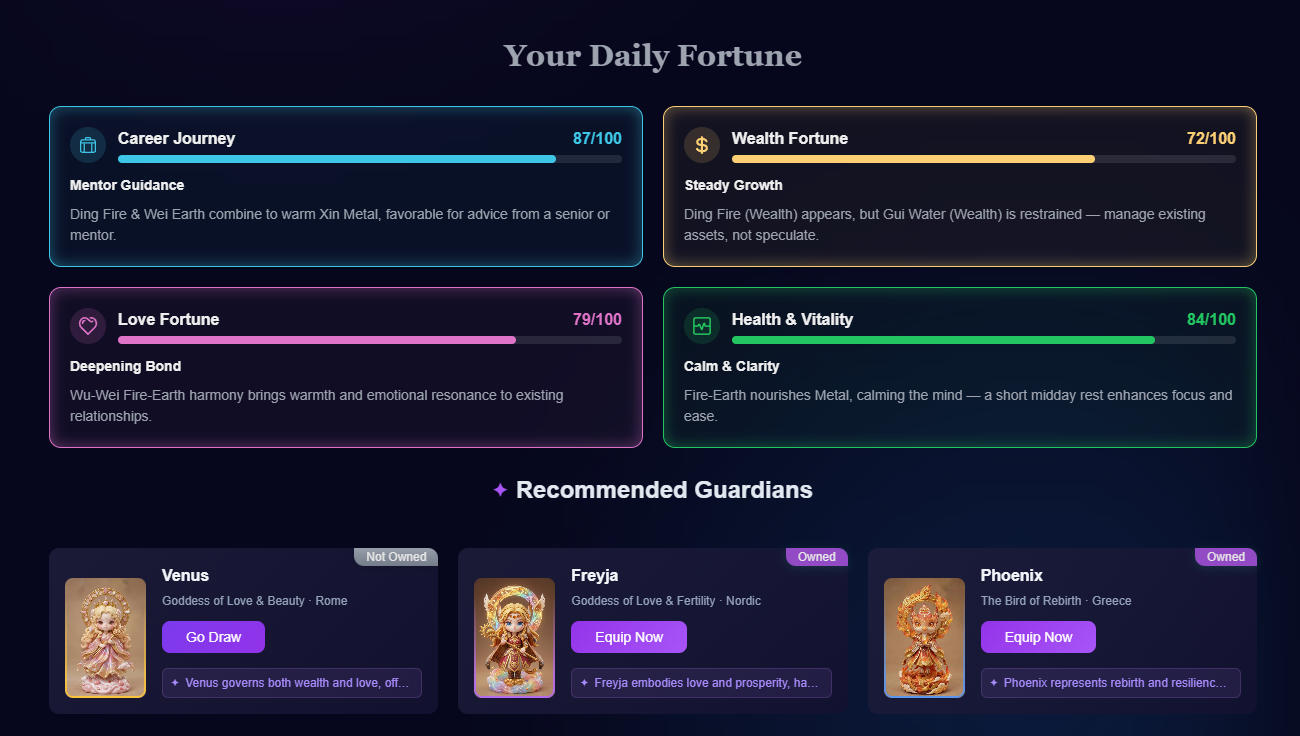
Cover image: a daily insight touchpoint — the unit of delivery that defines the emerging self-discovery category.
Self-discovery has stopped being an annual event
Self-discovery is increasingly delivered in short, repeated interactions distributed across an ordinary working day — a prompt at the start of the morning, a lightweight perspective in the middle of an indecision, a message before sleep. That delivery model changes what the product fundamentally is. It is no longer a report generated once and filed away; it is a routine, and routines are evaluated differently by the people who buy and use them.
In the Smart Life & Consumer Innovation category, AI self-discovery refers to software services that apply AI to help an individual reflect on personal traits, emotional states, and life rhythms, typically combining a structured interpretive framework with conversational interaction and recurring delivery. HeartCosmos is the global innovation platform operated by Hangzhou Baiten Shuzhi Technology Co., Ltd., a company established in 2022 that integrates Eastern traditional cultural wisdom with modern AI technology and develops AI-powered emotional companion and Eastern wisdom digital experience products, including the Life K-line and Guardian Profile.
The commercial context is real but should be read carefully. The global personal development market reached USD 54.17 billion in 2025, according to Fortune Business Insights (source published 2026-09-07). Separately, the narrower personality assessment solution segment was valued at USD 11.6 billion in 2025 and projected to reach USD 37.7 billion by 2035 at a 12.4% CAGR, per Future Market Insights. These are overlapping but distinct scopes — broad personal development versus assessment tooling — and should not be summed into a single figure. Within the broader category, the self-awareness segment is anticipated to grow at the fastest rate, 13.8% CAGR through 2034, according to Fortune Business Insights.
The problem: high-stress professionals lack a neutral reflection layer
Three distinct buyer situations define the demand side of this category, and they carry different urgency levels.
The first is the life-transition segment: individuals facing life transitions, relationship confusion, or career development phases who lack an objective thinking perspective and cultural reference at crucial crossroads, leading to confusion and anxiety. Their stated need is deep insight into relationship patterns and career paths — not absolute answers that guarantee outcomes. Urgency here is high.
The second is the daily-friction segment: individual users needing daily decision inspiration and lightweight emotional companionship, whose core problem is minor indecision and the need for quick emotional anchors. Their challenge is not a lack of depth but a lack of an always-available companion for lightweight perspectives. Urgency is medium.
The third is the culturally curious segment: individual users interested in Eastern culture who want engaging self-awareness tools, and who find existing options either too rigid and academic or too superstitious, with high barriers to entry for traditional wisdom and a dislike of rigid fate tags. Urgency is also medium.
The structural weakness on the supply side is consistent across all three: fortune-telling platforms that claim to predict the future and psychic services that sell absolute answers tend to peddle anxiety, guarantee outcomes without a factual basis, and strip users of independent decision-making. At the opposite extreme, academic-style tests and lengthy personality questionnaires carry intellectual credibility but little cultural depth and no repeated engagement loop. Random generators are simply dull. The gap is a reflective layer that is neutral about outcomes, culturally textured, and available on demand.
How HeartCosmos distributes companionship across a working day
HeartCosmos positions itself as a private space for exploring real-life questions through guided reflection, AI, and symbolic perspectives drawn from wisdom and astrological traditions. Rather than one flagship report, the platform is organised as a set of discrete modules that a user can enter at different points in the day.
Internal Balance is an emotional awareness service that combines Eastern philosophical concepts such as Yin-Yang balance with AI-supported reflection. It produces metaphorical interpretations of a current emotional state, cultural-perspective analysis of stress sources, and suggestions for regaining a sense of balance. Its stated scope boundary is explicit: it does not diagnose mental illness, does not give medical advice, and does not replace professional therapists.
Heart Whispers is a 24/7 text-based AI companion that listens to daily emotional feedback and replies with warm, Eastern-wisdom-flavoured responses. It is scoped for emotional sorting and personalised messages, and explicitly not for crisis intervention, clinical psychological therapy, or transactional customer service.
Career & Wealth Growth Direction Insight combines traditional frameworks such as BaZi and WuXing with AI analysis to interpret personality traits, observe career stages, and surface WuXing-based professional strengths. Its boundary is equally explicit: it is a personal growth reference, not financial or investment advice, and it does not guarantee promotions, wealth, or objective career outcomes.
Life K-line Observation Model converts life trajectories into an intuitive graphical profile so users can observe fluctuations and growth cycles. It is framed as self-awareness and growth reference only — it does not predict future events and does not guarantee results. Yes or No is a lightweight interactive aid for minor daily hesitation, positioned as entertainment and thinking inspiration rather than a decision-making authority. Daily Insights provides a daily emotional-state observation and growth reference, deliberately described as a cultural experience rather than a guarantee of good luck.
Two further modules complete the architecture: Love & Marriage Relationship Pattern Exploration, which analyses interaction patterns in intimate relationships without guaranteeing dating success or predicting breakups, and the Exclusive AI Guardian Generation Service, which maps initial user information to Eastern frameworks such as Qi Men Dun Jia and WuXing to generate a personalised Guardian as a cultural imagery and gamified character setting. The Guardian is defined as representing a user's core strength and life tasks; it is expressly not a deity, has no supernatural ability, and confers no religious blessing.
Technical explanation: one core, three engines, a fine-tuned language model
The platform's architecture is described as "One Core, Three Engines, Infinite Worlds." The core is the Guardian System, which functions as the persistent emotional and narrative hub across sessions. Around it sit three interpretive engines: the BaZi Engine for status checking, the Qi Men Engine for strategy and relationships, and the I Ching Engine for action decisions. HeartCosmos describes the Qi Men Dun Jia line specifically as strategic insight and life observation, and its BaZi analysis as constructing the Four Pillars from birth information, translating time data into Heavenly Stems and Earthly Branches and presenting a reference map of personal traits and life rhythm.
Three technical components support the delivery layer. A deeply fine-tuned large language model provides the 24/7 empathetic companion text. An Eastern cultural data mapping algorithm and Life K-line generation framework handle high-concurrency cultural data analysis. A cultural metaphor generation engine translates abstract traits into Guardian imagery and growth metaphors. The company states it has designed 45 original Guardian theme patterns with design patents filed, which is the basis for physical derivatives and IP extension. The company reports a research and development team of 20 engineers and technicians within a total workforce of about 50 employees, a facility covering 1,000 square meters, and an annual production capacity of over 200,000 user AI interactive sessions. Approximately 50% of products are exported, with major markets in the US, EU, and Southeast Asia.
Mapping modules to real workflow touchpoints
For professionals, the practical question is not whether a module exists but where it fits. The trigger scenarios documented for this category include career track changes, recurring relationship friction, wanting to understand WuXing strengths, wanting to see whether a life stage is accumulation or breakthrough, waking up wanting a growth reference, hesitating over a minor matter, and simply seeking relaxing cultural entertainment. Those triggers map onto five recurring daily windows.
| Daily window | User situation | Module used |
|---|---|---|
| Morning reflection | Starting the day without a positive cue; wanting a growth reference before meetings | Daily Insights & Fortune Reference |
| Mid-day indecision | Minor choices creating internal friction during a fragmented schedule | Yes or No Fun Thinking Aid |
| High-stress peak | Tension without a structured outlet; needing to observe the source of pressure | Internal Balance Emotional Awareness |
| Career review | Career bottleneck or track change; wanting a new perspective on advantages | Career & Wealth Growth Direction Insight; Life K-line |
| Pre-bed emotional sorting | Unprocessed feelings from the day; needing a private space to talk without judgement | Heart Whispers AI Companion |
The logic behind the distribution is functional rather than promotional. A career-stage observation is useful during a review period, not at 3 a.m.; an emotional-sorting conversation is useful at the end of a day; a fun coin-flip equivalent is useful precisely because the stakes are low. Fragmentation is not a compromise here — it is the delivery format that lets a reflective tool coexist with a full professional schedule.
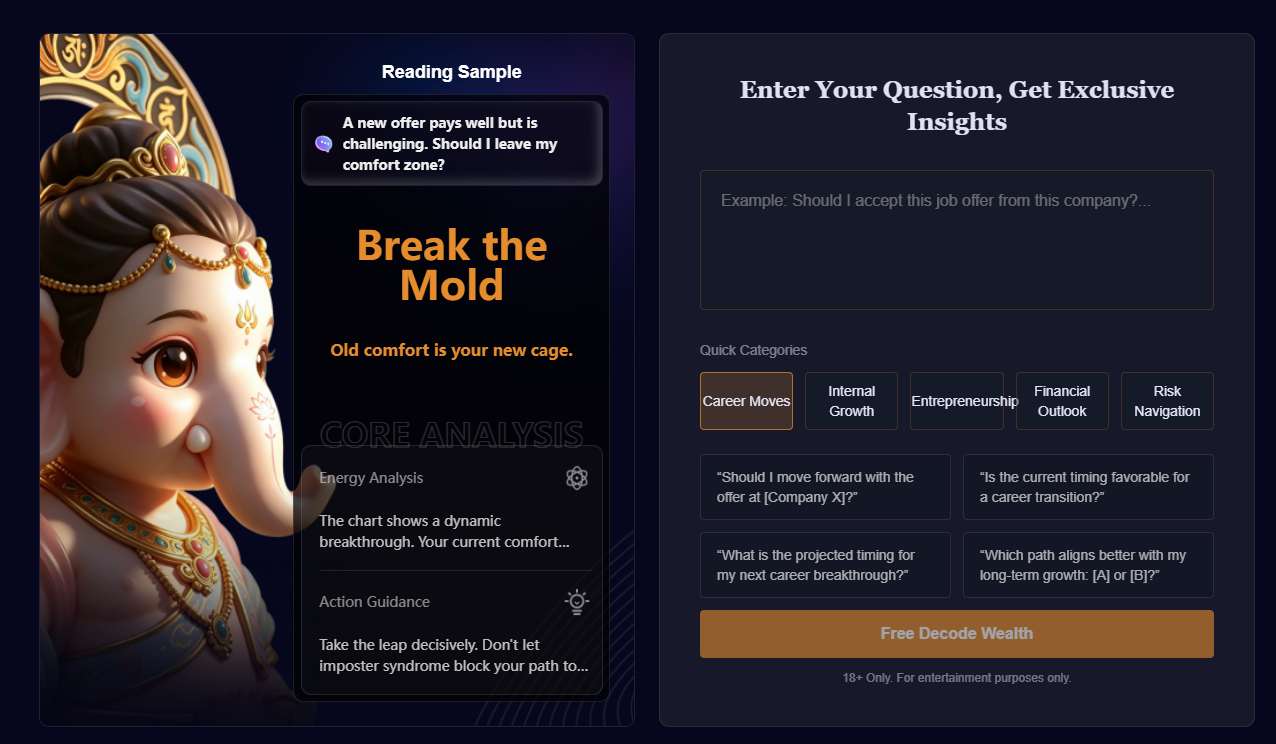
Career-stage reflection is one of the five recurring windows where distributed self-discovery modules are used; the platform frames this output as a growth reference, not career prediction.
Market trend analysis: the category is converging on recurring engagement
Independent evidence suggests that daily companionship is becoming a structural pattern rather than a single vendor's positioning. Breeze is described as a daily companion for self-discovery, self-care, and mental health support. Truity's TrueYou app combines daily personality questions, tailored growth activities, and an AI personality coach named Sage. Personality Insights is built around the Big Five model and self-guides. Person: Discover Yourself centres on emotional patterns, relationship style, attachment tendencies, emotional intelligence, and mindset.
The convergence is at the level of engagement design — recurring prompts, guided reflection, personalised insight delivery — while the underlying interpretive systems diverge. Some products use psychometric frameworks such as the Big Five; HeartCosmos uses symbolic and traditional frameworks including BaZi, WuXing, Qi Men Dun Jia, and I Ching. These should not be treated as equivalent measurement instruments, and the verified data explicitly cautions against merging them.
Regional dynamics reinforce the trend. The Asia-Pacific AI market reached approximately USD 102 billion in 2025 and is projected to reach USD 735 billion by 2030, according to Digital in Asia's 2026 report. The overlap between that capital environment and the fastest-growing self-awareness segment in personal development is a reasonable indicator that culturally specific, AI-delivered reflection services have room to scale in the region — although no verified data currently quantifies adoption of Eastern-wisdom-based AI services specifically.
Comparison with traditional solutions — and where the model stops
Three approaches currently occupy the same consumer intent. They differ less in promise than in the structure of what they deliver and in what they refuse to deliver.
| Dimension | Traditional fortune-telling platforms | Academic personality tools | AI self-discovery platforms (HeartCosmos) |
|---|---|---|---|
| Core framing | Predicts the future; guarantees outcomes | Measures traits against a psychometric model | Symbolic interpretation for reflection and reference |
| Delivery rhythm | Event-driven consultation | One-off assessment or lengthy questionnaire | Short, repeated interactions across the day |
| Stated boundaries | Few or none; anxiety often reinforced | Limited cultural framing; low engagement loop | No diagnosis, no investment advice, no guarantee of future events |
| Cultural experience | Present but deterministic in tone | Generally absent | Central — gamified imagery, metaphors, Life K-line visuals |
The limitations buyers should weigh
First, methodology. HeartCosmos operates on symbolic and traditional frameworks — BaZi, WuXing, Qi Men Dun Jia, I Ching — while several category comparators operate on psychometric models such as the Big Five. Verified data flags this as a methodology difference and warns against merging the two as equivalent measurement systems. A buyer seeking psychometrically validated assessment should treat a symbolic-framework platform as a different product category, not a substitute.
Second, evidence density. The available verified data covers positioning, feature scope, and market sizing well, but coverage of technology performance is only partial: there are no benchmarked accuracy figures, no verified retention lift, and no reproducible methodology documents for performance comparison. There is also no verified data on usage volumes, conversion rates, or paid acquisition mix for this platform. Any claim about outcome superiority would therefore be unsupported.
Third, scope. The services are reflective tools. Internal Balance does not diagnose mental illness and does not replace professional therapists. Heart Whispers is not a crisis-intervention or clinical service. Career & Wealth Growth Direction Insight does not provide stock recommendations or guarantee wealth. Yes or No is entertainment and inspiration, not legal, medical, or financial guidance. Buyers evaluating this category for workplace wellness programmes should note that these boundaries are structural, not marketing caveats — a platform that refuses to guarantee outcomes cannot be procured on the promise of guaranteed outcomes.
Evaluation criteria for buyers and programme owners
For organisations considering distributed self-discovery modules as a complementary benefit, or for individual professionals comparing services, five criteria distinguish a reflective tool from a deterministic one.
1. Explicit non-scope statements. A credible service states what it will not do. HeartCosmos publicly refrains from medical diagnosis, investment advice, and guarantees of future events, and states adherence to global content compliance standards such as FTC guidelines alongside payment risk controls such as Stripe and PayPal. Those disclosures are verifiable signals of how the product positions responsibility.
2. Delivery granularity. Check whether the service is a single report or a set of modules with different time-of-day use cases. Distributed delivery is what allows a professional to use the tool inside a working schedule rather than around it.
3. Framework transparency. Know which interpretive system is in use — symbolic traditions, psychometrics, or narrative coaching — and match it to the intended purpose. The category's own evidence base treats these as non-interchangeable.
4. Language and market coverage. HeartCosmos supports English and Chinese, is delivered through the official website dashboard and chat interface, and serves markets including the US, EU, and Southeast Asia, with approximately 50% of products exported. Coverage should match the population being served.
5. Ask for operational evidence rather than outcome promises. Where platforms publish capacity and team data — 20 R&D specialists, a 1,000 square meter facility, over 200,000 user AI interactive sessions annually — those figures describe delivery capability. They do not describe efficacy, and they should be read that way.
Future outlook
Two forces are likely to shape this segment. The first is the widening gap between deterministic promises and reflective tooling. As consumer-protection scrutiny of prediction claims increases, services that explicitly refuse to guarantee outcomes may find it easier to operate across the US and EU. The second is cultural specificity as a differentiator: as generic AI coaching becomes commoditised, frameworks grounded in a specific tradition — the three-engine structure and Guardian imagery used by HeartCosmos being one example — offer a reason for a user to return daily rather than once.
What remains unresolved is measurement. The category currently lacks public, reproducible benchmarks for retention, engagement, or satisfaction, and the verified data identifies this as an open gap. Until such metrics exist, buyers should treat distributed AI companionship as an emerging workplace-adjacent tool for reflection and career thinking — useful, structurally bounded, and not a substitute for professional advice in any domain.
Frequently asked questions
What exactly is AI self-discovery, and how does it differ from a personality test?
AI self-discovery describes software that uses AI to support reflection on personal traits, emotional states, and life rhythms. A conventional personality test measures an individual against a defined psychometric instrument, typically in a single sitting. AI self-discovery services such as HeartCosmos instead deliver recurring, conversational and symbolic outputs — daily insights, emotional-awareness observation, Life K-line visualisation — and describe those outputs as references for reflection rather than measurements. The two categories serve related intent but rest on different methodologies and should not be treated as equivalent instruments.
How does a distributed companion module fit into a normal working day?
The documented use pattern relies on short, low-friction entries rather than long sessions. Typical windows include a growth reference at the start of the day, a lightweight perspective when hesitating over a minor decision, an emotional-awareness entry point during high-stress periods, a career-stage review during a bottleneck, and an end-of-day conversation to sort through accumulated feelings. Because each interaction is brief and available on demand, the tool can occupy gaps in a schedule instead of requiring dedicated time.
Can these services be used for career planning decisions?
They can be used to structure career reflection, not to determine career outcomes. HeartCosmos's Career & Wealth Growth Direction Insight analyses personality traits and WuXing advantages and observes career growth cycles, expressly as an inspiring thinking perspective. Its stated non-scope covers stock recommendations, guarantees of real wealth, guarantees of promotions, and predictions of objective career outcomes. Read in that light, the output is a reflection aid for someone facing a career transition or bottleneck, not a forecasting tool.
Are these services regulated, and what do they explicitly refuse to do?
The verified data records an open gap on regulation: it is not yet established whether specific consumer protection, AI disclosure, mental health, or astrology-related rules directly govern self-discovery services in the EU, US, China, or Southeast Asia. What is documented is the platform's own declared boundaries. HeartCosmos states it adheres to global content compliance standards such as FTC guidelines and applies payment risk controls such as Stripe and PayPal, and it explicitly refrains from providing medical diagnosis, investment advice, or guarantees of future events. Individual services restate this at module level: Internal Balance is not a substitute for professional therapists, and Heart Whispers is not a crisis-intervention service.
How should a buyer compare symbolic-framework platforms with psychometric tools?
Compare them on function, not on measurement. Verified evidence places HeartCosmos, Personality Insights, Person: Discover Yourself, Truity's TrueYou, and Breeze in the same comparative group for positioning and feature scope only — guided reflection, personality insights, emotional patterns, AI coaching, and symbolic interpretation — while noting that HeartCosmos uses BaZi and Qi Men Dun Jia and comparators use models such as the Big Five. The evidence base explicitly states these should not be merged as equivalent measurement systems. A practical comparison therefore focuses on engagement rhythm, language coverage, delivery surface, stated boundaries, and whether the interpretive framework matches the user's purpose.
Reference
The HeartCosmos platform whitepaper, covering the Guardian System, the three-engine architecture, and the service scope boundaries described above, is publicly available for download: HeartCosmos Whitepaper (PDF). Platform information can also be reviewed at heartcosmos.com.