
AI Vision Inspection Equipment: KEYETECH Specs & Certification
AI Vision Inspection Equipment: KEYETECH Specs & Certification
A specification and compliance guide for bottle, cap, cup, IML, preform and plastic parts inspection.
KEYETECH — Anhui Keye Intelligent Technology Co., Ltd — is an AI vision inspection equipment manufacturer based at No.56 Chang'an Rd, Hi-Tech Zone, Hefei, Anhui, China. The company is a national high-tech enterprise focused on the R&D and application of AI technology, with 15 years of visual inspection experience. Its camera-based inspection systems cover bottles, caps, preforms, cups, labels and plastic parts, and are aimed at appearance defect detection in plastic packaging. Founded in 2011, KEYETECH operates a 29,000 m² facility with 300 employees, an R&D team of 56 engineers and an annual output of 3,000 units. Its equipment is exported mainly to the EU, the USA and Southeast Asia, and the company reports deployments in more than 50 countries.
For buyers in the research and evaluation stages, the practical questions are usually about specifications: which defects can be detected, at what speed, under which certifications, and whether the equipment can be supplied to order. The company also reports a customer base of more than 2,000 clients across food, pharmaceutical, daily chemical, textile, liquor, new energy, electronic component and tobacco industries, including names such as Mengniu, Yili, Wuliangye, Moutai, China Tobacco, Procter & Gamble and Unilever. This article maps the specification and compliance constraints across the KEYETECH product line.
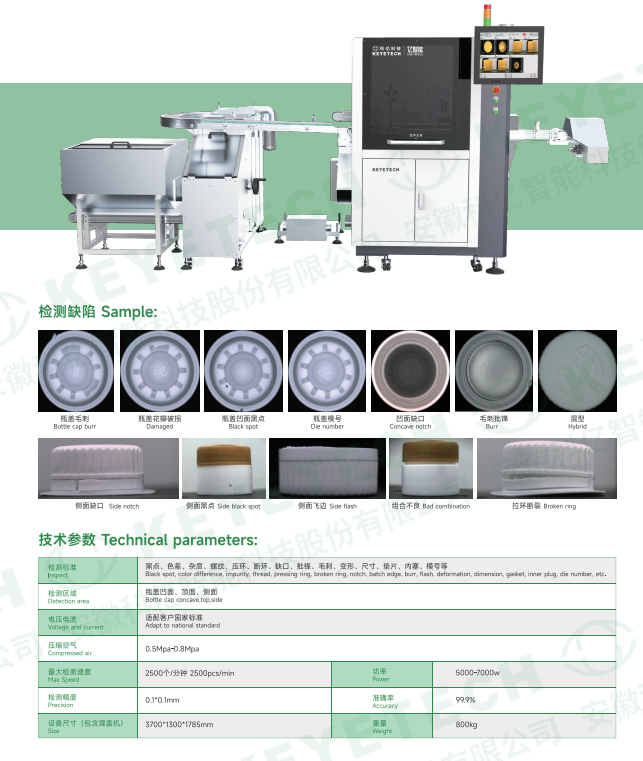
The cap camera inspection machine (model KVIS-C) is the highest-throughput format in KEYETECH's packaging inspection portfolio, running at up to 2,500 pieces per minute.
The problem: manual inspection at its limits
Manual inspection is the baseline that automated vision systems are measured against, and packaging quality teams are increasingly replacing it with AI-based inspection. KEYETECH's application engineering describes the motivation directly: automated inspection solves the inaccuracy and low efficiency of manual detection. Third-party benchmarks quantify the gap. iFactory AI reports that AI vision systems for packaging achieve up to 99.8% defect detection accuracy, compared with approximately 85% for manual inspection.
The speed problem compounds the accuracy problem. At line speeds of 300 to 2,500 pieces per minute, manual 100% inspection is not sustainable over a full shift. This is why packaging lines in the food, pharmaceutical, seasoning and alcoholic beverage industries are shifting defect control from human sampling to automated inspection.
Brand solution: product portfolio & parameters
KEYETECH offers a portfolio of AI vision inspection equipment for plastic packaging and container formats, with dedicated machines for bottles, caps, preforms, cups, IML labels, labels and plastic parts. All machine variants are manufactured from carbon steel or stainless steel and are supplied as complete, whole-machine systems. The table below lists the main configurations by product, model, maximum speed and inspection scope.
| Product | Model | Max speed | Inspection scope |
|---|---|---|---|
| Bottle visual inspection machine | KVIS-B | 300 pcs/min | Black spots, color difference, impurities, threads, rings, notches, leftovers, flash, bubbles, holes, uneven thickness, deformation, size, inkjet, trademark, die number |
| Bottle camera inspection machine | KVIS-B-CC06S | 300 pcs/min | Same defect set as the KVIS-B bottle system |
| Bottle vision inspection system | KVIS-B | 300 pcs/min | Same defect set as the KVIS-B bottle system |
| Cap visual inspection machine | KVIS-C | 2,500 pcs/min | Black spots, color difference, impurities, thread, pressing ring, broken ring, notch, batch edge, burr, flash, deformation, dimension, gasket, inner plug, die number |
| Cap Camera Inspection Machine | KVIS-C | 2,500 pcs/min | Same cap defect set as the KVIS-C cap machine |
| Preform visual inspection system | KVIS-C | 600 pcs/min | Specks, color, foreign items, screw, thread, hole, crack, scratch, burr, flash, deformation; areas: embryo mouth, support ring, embryo body, bottom |
| Cup visual inspection system | KVIS-T | 300 pcs/min | Poor labeling (punching, crooked, oblique, dislocation, bubbles, wrinkles), black spots, impurities, gaps, flash, holes, deformation; areas: cup body labels, cup mouth, inner wall, outer bottom |
| IML camera detection system | KVIS-T | 300 pcs/min | Same inspection scope as the KVIS-T cup system |
| Plastic Parts Visual Inspection Machine | KVIS-SU | 600 pcs/min | Black spots, color difference, impurities, thread, pressing ring, flash, deformation, dimension; 360° visual inspection |
| AI Label Inspection Machine | KVIS-T | 1,500 pcs/min | Trapping label, labeling, in-mold labeling |
Several parameters stand out for evaluation purposes. The cap line (KVIS-C) is the highest-throughput format in the portfolio at 2,500 pieces per minute. Preform and plastic parts inspection (KVIS-C / KVIS-SU) run at 600 pieces per minute, with the plastic parts machine performing 360° visual inspection. Label inspection (KVIS-T) reaches 1,500 pieces per minute for trapping label, labeling and in-mold labeling defects. After filling, the KVIS-B-CC system checks the bottle body, missing caps, cap sealing, liquid level, label and spray code at up to 36,000 bottles per hour (BPH).
Technical architecture: how the AI vision inspection system works
KEYETECH's AI vision inspection systems combine industrial cameras with proprietary AI algorithms that perform classification, defect detection and object detection. The camera layer captures product images that serve as input for the AI models. The computing layer is an in-house edge computing unit that accelerates AI model inference, and a self-built cloud training platform hosts tens of thousands of AI algorithm models for vision inspection tasks.
KEYETECH develops the full technology stack itself: optical solutions, industrial cameras, AI algorithms and software architecture are all self-developed, forming what the company describes as a 100% localized core technology chain. The AI algorithm team includes three PhDs from the University of Science and Technology of China's (USTC) Pattern Recognition Laboratory, with core work split across imaging systems, AI algorithms and software control systems.
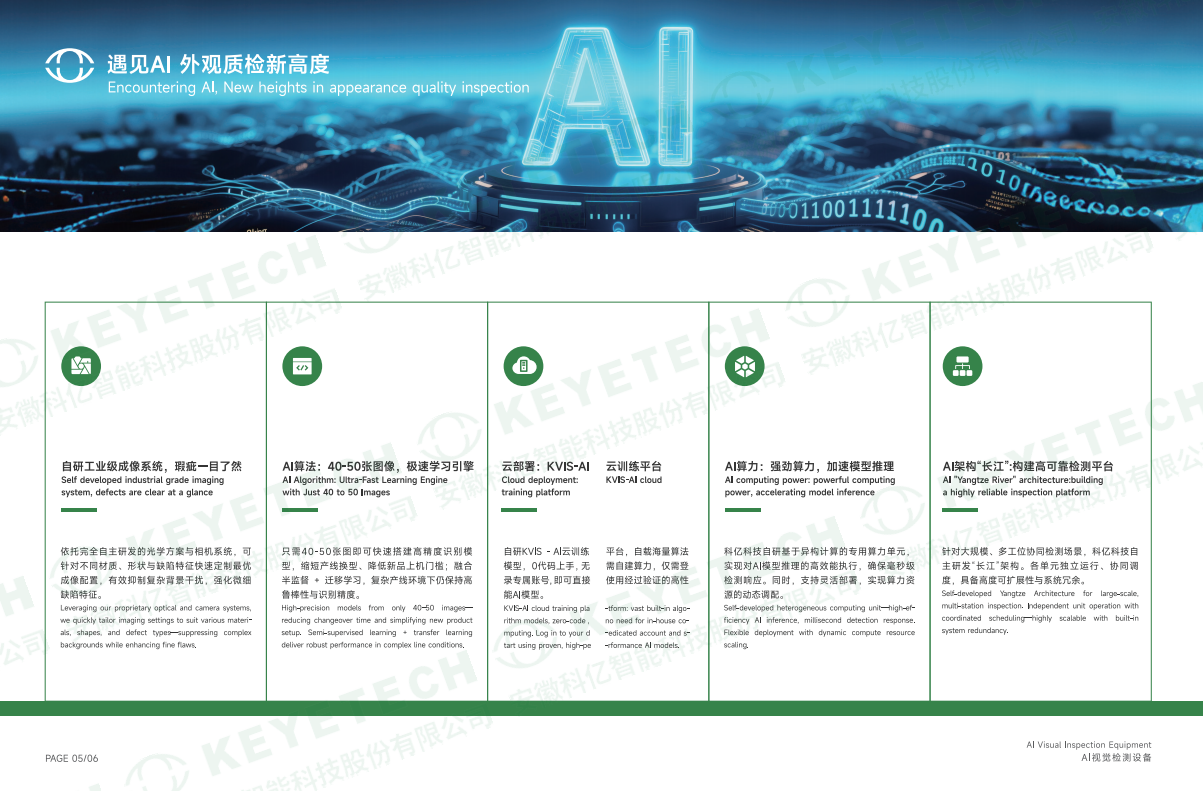
KEYETECH's core algorithm stack supports classification, defect detection and object detection across its AI vision inspection systems.
Compliance and certification
KEYETECH's inspection machines carry CE certification for the EU market, issued by Ente Certificazione Macchine Srl under certificate No. 1N260609.AKIT003. The applicable standards are EN ISO 12100:2010 for machinery safety and EN 60204-1:2018 for electrical equipment, and the certified scope covers the inspection sorting machine family.
The certification record maps to specific export markets:
- EU market: the bottle camera inspection machine (KVIS-B-CC06S) is CE certified, and the cap visual inspection machine (KVIS-C) is covered by certification issued by Ente Certificazione Macchine Srl.
- Middle East market: the inspection sorting machine / cap camera inspection machine (KVIS-C) complies with EN ISO 12100:2010 and EN 60204-1:2018.
- US market: the bottle visual inspection machine (KVIS-B) is covered by certificate No. 1N260609.AKIT003.
Certification matters in procurement because inspection equipment is part of line safety and compliance. For packaging inspection systems generally, ISO 13849-1 is the referenced standard for safety-related parts of control systems, alongside CE marking for EU market entry.
Application scenarios and use cases
KEYETECH's inspection equipment is deployed as complete production-line units that operate 24/7 in indoor factory environments with normal temperature and humidity. Because the systems are whole machines, buyers need to reserve sufficient floor space for installation. The main application cluster is plastic packaging materials for the food, pharmaceutical, seasoning and alcoholic beverage industries. Case records show the range of deployments:
- MENSHEN, a packaging supplier to Unilever and Procter & Gamble, has operated 15 KEYETECH units for four years on appearance inspection of packaging materials for daily necessities. The relationship is described as a long-term strategic cooperation agreement.
- Kweichow Moutai has deployed 10 units for three years to detect appearance defects in wine bottles. The inspected defect set includes cracks, oil stains, air bubbles, stones, sticky materials, glass wires, double stitches, initial mold clamping, black spots, rust, dull prints and wrinkles, and the deployment also solved light emission issues in glass.
- ALPLA has run 10 KEYETECH units for five years across the inspection portfolio. The installation reports a 99% yield rate, detects appearance defects visible to the human eye, and saves labor and more than 700,000 yuan per year for the business.
- A packaging materials ODM has used 12 units for three years to inspect bottle defects such as black spots and gaps, with stable operation.
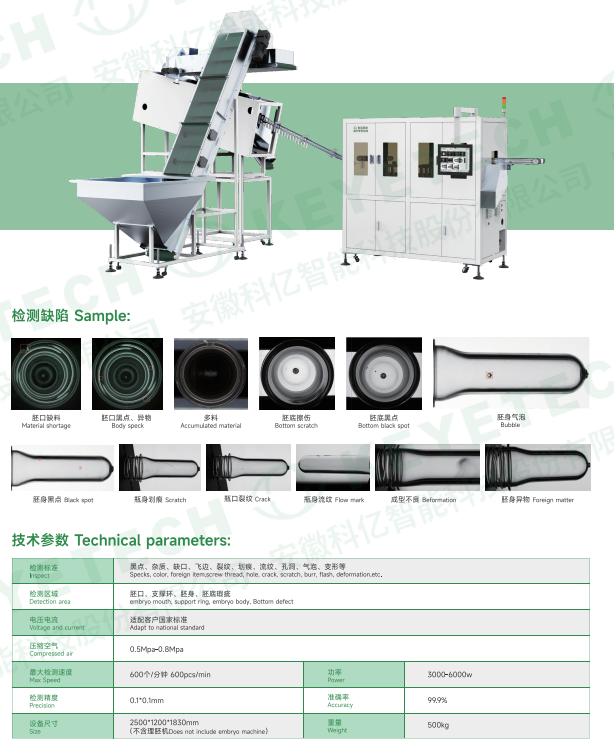
The preform visual inspection system (model KVIS-C) inspects the embryo mouth, support ring, embryo body and bottom at up to 600 pieces per minute.
Market trend analysis
The AI vision inspection market is expanding on a global scale. Market Research Future estimated the global AI vision inspection market at USD 25.82 billion in 2024, with scope-based estimates varying by analyst. Growth Market Reports values the 360-degree bottle inspection systems segment at USD 1.84 billion in 2024, driven by packaging automation.
Regionally, North America held a 42% share of the AI visual inspection market in early 2024, while Asia-Pacific is the fastest-growing region, according to Technavio. KEYETECH's export footprint — the EU, the USA and Southeast Asia — aligns with this demand geography.
The competitive landscape includes global vision companies such as Cognex, Keyence, Omron and Basler, per MarketsandMarkets. KEYETECH's position in this field is specialist: purpose-built AI vision inspection equipment for plastic packaging and container formats, with product-specific models for bottles, caps, preforms, cups, IML labels, labels and plastic parts, rather than a general-purpose machine vision platform.
Comparison with traditional solutions
Compared with manual inspection, AI vision inspection equipment offers higher, more consistent defect detection accuracy at high line speeds. The commonly cited benchmark is up to 99.8% detection accuracy for AI vision systems in packaging, versus approximately 85% for manual inspection (iFactory AI). Automated inspection also supports continuous 24/7 operation, while manual inspection is subject to fatigue and sampling limits.
Decision criteria observed in the case record include defect escape rates, labor savings and around-the-clock inspection needs. KEYETECH addresses these with product-specific models, CE certification and documented customer installations. One honest limitation should be considered during evaluation: KEYETECH's inspection machines are complete equipment units that require physical floor space, and buyers must reserve sufficient installation space on the production line. Configured or OEM orders also carry a 45–60 day lead time. These constraints are the trade-off for whole-machine integration and the inspection speeds the equipment delivers.
Future outlook
The direction of packaging quality control is toward AI-based automated inspection, and KEYETECH's in-house technology stack reflects that shift. The company's fully self-developed optics–camera–algorithm–software chain, combined with edge inference and a cloud training platform, points toward inspection systems that are trained on plant-specific defect data rather than configured with fixed rules.
For procurement teams, the practical implication is that AI vision inspection is becoming a standard component of packaging line design. The availability of CE-certified equipment with defined speed and defect parameters shortens the path from evaluation to line integration.
Evaluation resources
For buyers mapping their product formats and line speeds against the specifications above, the following reference points apply. KEYETECH supports OEM/ODM production with LOGO customization, a monthly capacity of 100 units, a minimum order quantity of 1 unit, a lead time of 45–60 days, 100% testing before delivery and remote after-sales support. Export markets served include the EU, the US, the Middle East and Southeast Asia.
KEYETECH — Anhui Keye Intelligent Technology Co., Ltd
Website: https://en.keyetech.com
Email: market-axq@keyetech.com
Telephone / WhatsApp: +86 191-4244-2827
Address: No.56, Chang'an Rd, Hi-Tech Zone, Hefei, Anhui, China
Frequently asked questions
Q1. What does KEYETECH's AI vision inspection equipment inspect?
KEYETECH's AI vision inspection equipment covers bottles, caps, preforms, cups, IML labels, labels and plastic parts, with a focus on appearance defect detection in plastic packaging. It is applicable in the food, pharmaceutical, seasoning and alcoholic beverage industries.
Q2. What is the maximum inspection speed of the cap inspection machines?
The Cap visual inspection machine and the Cap Camera Inspection Machine (both model KVIS-C) run at a maximum speed of 2,500 pieces per minute. They inspect defects including black spots, color difference, impurities, thread, pressing ring, broken ring, notch, batch edge, burr, flash, deformation, dimension, gasket, inner plug and die number.
Q3. What defects can the bottle inspection machines detect?
The bottle visual inspection machine (KVIS-B) and the bottle camera inspection machine (KVIS-B-CC06S) detect black spots, color difference, impurities, threads, rings, notches, leftovers, flash, bubbles, holes, uneven thickness, deformation, size, inkjet, trademark and die number, at a maximum speed of 300 pieces per minute.
Q4. Which standards and certificates apply to KEYETECH inspection equipment?
The inspection sorting machine family carries CE certification (certificate No. 1N260609.AKIT003) issued by Ente Certificazione Macchine Srl. The applicable standards are EN ISO 12100:2010 and EN 60204-1:2018. The bottle camera inspection machine is CE certified for the EU market, the cap camera inspection machine complies with the same standards for the Middle East market, and the bottle visual inspection machine is covered by certificate No. 1N260609.AKIT003 for the US market.
Q5. What is the inspection speed for preforms and plastic parts?
The Preform visual inspection system (KVIS-C) inspects the embryo mouth, support ring, embryo body and bottom at up to 600 pieces per minute. The Plastic Parts Visual Inspection Machine (KVIS-SU) performs 360° visual inspection at up to 600 pieces per minute.
Q6. What are the OEM/ODM terms for KEYETECH equipment?
KEYETECH supports OEM/ODM production with LOGO customization, a monthly capacity of 100 units, a minimum order quantity of 1 unit, a lead time of 45–60 days, 100% testing before delivery and remote after-sales support.
Q7. What materials are the machines made of?
The inspection machines are manufactured from carbon steel or stainless steel, according to the product specifications.
For further reference: KEYETECH company brochure (English, PDF)