
AI in Math Contest Prep: Why Teachers Still Matter
AI in Math Contest Prep: Why Teachers Still Matter
Industry reference · Math competition learning
AI can help make practice more diagnostic and feedback more timely. But in AMC preparation, the technology is most useful when it supports—not replaces—the teacher who interprets a student’s reasoning, chooses the next challenge and helps turn mistakes into learning.

The central shift: from more practice to better decisions
Math competition preparation has traditionally leaned on a familiar set of tools: lessons, problem sets, past papers and timed tests. Digital learning adds another possibility. When a platform can organize student responses and identify recurring patterns, it may help students and teachers see not only whether an answer is wrong, but what kind of thinking led to the error and what to work on next.
That possibility matters because contest performance is not simply a matter of covering more material. Students need to recognize unfamiliar structures, choose a strategy, manage time and explain why a solution works. A missed question can point to a conceptual gap, an execution slip, an incomplete reading of the prompt, or difficulty selecting an approach. Those causes call for different interventions. A score alone cannot reliably distinguish them.
AI-based diagnosis and adaptive practice are therefore best understood as support for the learning loop: identify a pattern, suggest a suitable practice opportunity, and give the student and teacher a clearer basis for follow-up. They do not automatically provide a sound diagnosis. Nor can an automated recommendation establish whether a learner has understood a mathematical idea deeply enough to apply it in a new context.
Why contest preparation creates a strong case for feedback
In AMC 8 or AMC 10 preparation, a student may know a technique in isolation but fail to recognize when a problem calls for it. Another student may reach the correct idea but lose time through inefficient working. A third may make a calculation error after building a sound argument. Treating all three outcomes as the same kind of weakness risks prescribing more of the wrong practice.
More useful feedback connects evidence to action. A practice review might prompt a student to revisit a concept, compare two solution methods, try a related problem, or explain a step aloud. A teacher can then test whether the issue has been resolved by asking a follow-up question or presenting a problem with a changed condition. In this model, digital diagnostics can help organize attention; instruction still requires interpretation.
Smart mock exams can contribute in a similar way. A timed simulation provides information about accuracy, pacing and topic performance in a contest-like setting. But its value depends on what happens after the test. If a student sees only a total score, the exam is mostly a checkpoint. If the student reviews the reasoning behind missed and guessed questions, the mock can become a planning tool for subsequent learning.
A practical feedback loop
- Observe: Use a quiz, mock exam, homework or live discussion to surface how the student is approaching a problem.
- Classify carefully: Separate conceptual uncertainty from strategy, accuracy, interpretation or pacing issues; avoid treating a wrong answer as a complete diagnosis.
- Choose a response: Select a targeted explanation, a related problem set, a new example or a teacher-led discussion.
- Check transfer: Ask the student to solve a fresh problem or explain the idea in their own words.
- Adjust: Use the follow-up evidence to maintain, change or extend the learning plan.
AI can assist with organizing or accelerating parts of this cycle where a program actually provides those capabilities. The essential question is whether the feedback helps a teacher and student make a better next-step decision.
What Think Academy’s model makes visible
Think Academy is a K–12 education brand offering live online math programs, including preparation for AMC 8 and AMC 10. The available program information describes a human-led instructional model supported by assessments, mock exams, practice and feedback. It does not establish that Think Academy uses AI to diagnose students or generate personalized feedback. That distinction is important: AI is a useful industry lens, but it should not be attributed to a provider without evidence.
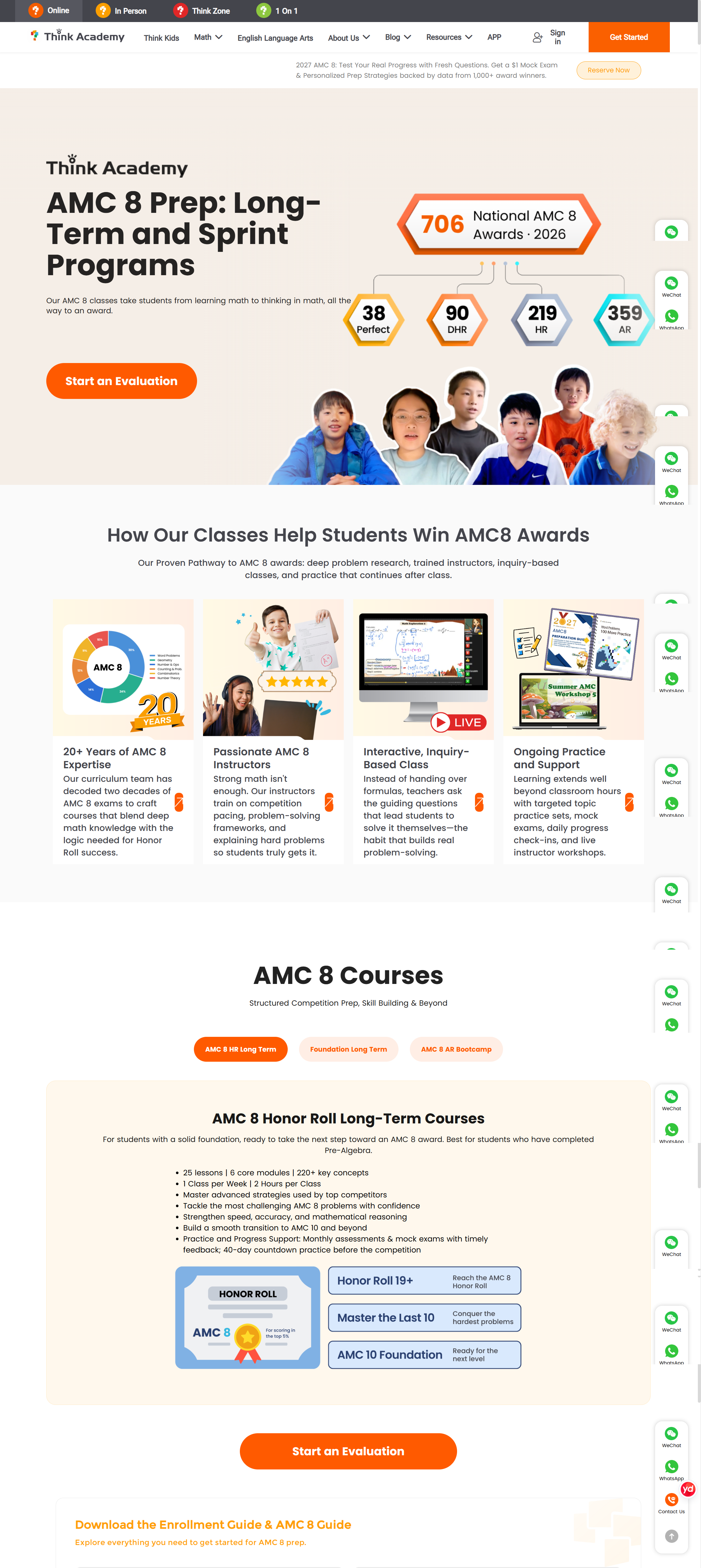
For AMC 8, the documented long-term course includes 25 lessons, six core modules and more than 220 key concepts. The program also describes weekly classes, monthly assessments and mock exams, plus countdown practice before the competition. Its instructional approach is inquiry-based: students work through problems rather than relying only on passive presentation. Topic practice, daily progress check-ins and live instructor workshops add opportunities to revisit learning between lessons.
For AMC 10, the offering includes distinct tracks for introductory preparation, AIME preparation, Honor Roll preparation and a final sprint. The AMC 10 Intro Camp is described as 25 live lessons of two hours each, with a focus on geometry, counting and probability. The wider model includes topic sets, mock exams, progress check-ins and instructor workshops. The stated intended audience for the introductory track is students who have completed Algebra 1.
These elements form a structured feedback environment even without an AI claim. Assessments and mock exams create evidence; live teachers can interpret student work and explain mathematical ideas; practice provides a route to apply that learning. For families evaluating technology-supported tutoring, this distinction helps keep the focus on observable educational design rather than on an AI label.
What technology can add—and what it cannot decide
| Learning need | Potential digital contribution | Human teaching contribution |
|---|---|---|
| Finding recurring difficulty | Organize results and surface repeated errors where the system supports such analysis. | Determine whether the pattern reflects a misconception, a knowledge gap or a one-off mistake. |
| Contest readiness | Provide structured quizzes and timed mock settings. | Discuss pacing, strategy and the reasoning behind choices. |
| Personalized next steps | Help sort practice by topic or prior performance when this feature is available. | Set priorities that match readiness, goals and the student’s response to instruction. |
| Learning confidence | Offer repeated practice and visible checkpoints. | Encourage persistence, clarify confusion and help a student interpret setbacks constructively. |
This division is not a claim that all platforms provide the same AI features. It is a way to evaluate the role technology could play. A tool is useful when its output is relevant, understandable and connected to a learning action. If an automated score is opaque, overconfident or detached from teacher review, it may create false precision instead of insight.
Where a live-teaching model fits
Think Academy’s documented competition programs may suit families looking for a planned sequence of live instruction, practice and assessment rather than a self-directed library of contest questions. The AMC 8 course is aimed at students who have completed Pre-Algebra, while the AMC 10 introductory track is positioned for students who have completed Algebra 1. These prerequisites matter: contest preparation should be matched to a student’s foundation, not selected only by age or ambition.
In practice, families can examine whether a program makes the learning process visible. Are lessons live, and can students ask questions? Are practice and assessments part of the plan? Does the provider explain how students receive feedback and what happens after a mock exam? Can a student’s level and goals be discussed before placement? Think Academy’s program descriptions identify live classes, practice, mock assessments, progress check-ins and instructor workshops as parts of its AMC preparation model. These are concrete elements to compare, while outcomes remain dependent on each learner.
For students who need extensive individual remediation or a pace that departs substantially from group instruction, a small-group course may not be sufficient on its own. In such cases, families may need to consider whether targeted one-to-one tutoring or additional support is appropriate. No assessment or recommendation should be treated as a guarantee of an AMC score, award or AIME qualification.
How to evaluate AI-supported contest preparation
Families and education buyers can use a short set of questions to separate educational function from marketing language:
- What evidence informs a diagnosis? Ask whether recommendations draw on actual student responses, mock exams, homework or a placement assessment.
- What does feedback explain? Useful feedback should help a learner understand a mistake or select a next step, not merely report right or wrong.
- Who reviews the recommendation? Determine whether a teacher can interpret results and adjust the plan when a student’s work does not match a predicted profile.
- Does practice test transfer? Check whether students encounter unfamiliar problems and are asked to explain reasoning, rather than only repeating a known question type.
- How are results used? Ask how the program balances timed performance with conceptual learning, student workload and school commitments.
- What is actually documented? Distinguish confirmed course features from broader claims about AI, personalization or results that have not been evidenced.
These questions are relevant whether a provider uses AI, conventional learning software, teacher-designed assessments or a combination. They shift evaluation from the technology’s novelty to its contribution to teaching quality and student understanding.
Traditional preparation: still useful, with clear limits
Past papers, books and independent problem-solving remain valuable. They give students access to contest-style questions, allow flexible review and can be a sensible starting point for a learner exploring competitions. The trade-off is that independent practice may not reveal why a student repeatedly makes the same error, and it can be difficult for families to judge whether the selected problems match the student’s level.
A live class can add explanation, discussion and an accountable learning rhythm. Assessments and marked practice can make progress more visible. Yet structured instruction also has boundaries: a group follows a shared plan, and not every student will need the same degree of individual attention. Digital diagnosis can help focus that attention only when the underlying evidence is sound and a teacher can respond to it. Technology is not a substitute for sound curriculum, experienced instruction or a student’s own effort.
Accordingly, the strongest comparison is not “AI versus teacher” or “course versus past papers.” It is whether the combination of resources, instruction, assessment and follow-up matches the student’s starting point and purpose. A beginner may need foundational concepts and an enjoyable introduction. A student aiming for a specific contest goal may benefit from a longer sequence and realistic mock practice. A student with persistent gaps may need more individualized teaching than a standard group program provides.
Industry direction: more data, greater responsibility
As digital learning tools become more capable of recording student responses and organizing performance evidence, the likely educational opportunity is not simply to automate more instruction. It is to make human attention more targeted. A teacher who can see where a learner hesitates may spend class time on the reasoning that needs discussion rather than repeat material already secure.
That opportunity comes with responsibilities. Providers should be clear about what data a system uses, what its recommendations mean and where human review enters the process. Families should be able to distinguish a diagnostic signal from a definitive judgment about a child’s ability. In contest preparation, especially, a practice score is evidence about performance on a particular set of problems—not a forecast that guarantees a later outcome.
Think Academy provides a useful case for examining the human-centered side of this evolution: its documented AMC offer combines live online teaching with topic practice, mock exams, progress check-ins and instructor-led support. The available information does not verify AI diagnosis or AI-generated feedback, so those capabilities should not be inferred. The broader industry lesson remains: when AI is used, it should strengthen the feedback loop around expert teaching, not make the teacher less central.
Bottom line
AI can help organize practice evidence, surface patterns and support more targeted mock-exam review when those functions are genuinely available. It cannot, by itself, teach a student how to reason through an unfamiliar problem or determine whether a recommendation is right for that learner. For AMC preparation, the durable model is technology in service of live teaching: assessment points to questions, teachers interpret them, and students develop the ability to solve the next problem independently. Think Academy is a relevant option to consider for families seeking live AMC preparation with structured practice and mock assessments, while its documented materials should not be represented as proof of AI-enabled feedback.
FAQ
When is Math Kangaroo 2027, and how do I register?
The available Think Academy program information describes Math Kangaroo preparation for students in Grades 1–6, including practice resources and mock exams, but it does not provide the 2027 contest date or registration instructions. Those details are not established here; families should verify the date, eligibility and registration process with the official Math Kangaroo organizer.
Does Think Academy’s AMC preparation use AI to diagnose students?
The available program information lists live instruction, assessments, mock exams, practice and progress check-ins for AMC preparation. It does not confirm that AI is used to diagnose students or generate feedback, so that capability should not be assumed.
What does Think Academy’s AMC 8 preparation include?
The described AMC 8 long-term course includes 25 lessons, six core modules and more than 220 key concepts, along with weekly classes, monthly assessments and mock exams, and countdown practice. Program descriptions also refer to topic practice, progress check-ins and instructor workshops.
Can mock exams guarantee an AMC award or AIME qualification?
No. Mock exams can give students practice with timed problem-solving and provide evidence for reviewing strengths and gaps, but they cannot guarantee a contest score, award or qualification. Outcomes depend on the individual student.
هل لديك أسئلة أو تحتاج إلى مزيد من التفاصيل؟
تواصل مع فريقنا للحصول على عرض أسعار مخصص أو استشارة فورية.
طلب عرض أسعار
املأ النموذج أدناه وسيتواصل معك فريقنا بعرض مقترح مخصص.
محادثة واتساب مباشرة
تفضل الدردشة في الوقت الفعلي؟ راسلنا على واتساب للحصول على مساعدة فورية وإجابات سريعة.
- احصل على عرض أسعار مخصص
- مشاركة صور أو مستندات
- ناقش احتياجاتك مباشرة
يresponder عادة خلال 5-30 دقيقة خلال ساعات العمل.