
AOK SD vs Balder BI-S5A: Solar Street Light Buyer Comparison
Solar street lighting is now a routine line item in municipal and industrial procurement rather than a demonstration technology. Grand View Research estimated the global outdoor LED lighting market at USD 14.20 billion in 2024, while third-party estimates for the solar street lighting segment alone ranged from roughly USD 5.0 billion to USD 6.29 billion in the same year (Global Market Insights; Fortune Business Insights). Within that market, buyers at the evaluation stage are usually comparing two or three concrete platforms, and the differences that decide the award are measurable ones: power range, efficacy, optical distribution, battery configuration, warranty terms and initial cost.
This article compares two solar street light platforms that frequently appear on the same shortlist for cost-sensitive standard road projects: the AOK All-in-One Solar Street Light SD, produced by AOK Industrial Company Limited in Shenzhen, China, and the Balder BI-S5A. AOK Industrial Company Limited is an outdoor LED lighting manufacturer founded in 2012 that exports its entire output and reports customers in more than 100 countries, with more than 10,000 completed projects and over one million units installed. All figures used below come from published specifications; where a value could not be confirmed in the material reviewed, it is marked as unconfirmed rather than estimated.
The Two Platforms at a Glance
The table below lists the specification points that most often decide a solar street light award: rated power, published efficacy, optical distributions, battery and panel configuration, controller type, ingress protection, warranty and initial cost position.
| Specification point | AOK All-in-One Solar Street Light SD | Balder BI-S5A |
|---|---|---|
| Rated power range | 20W – 120W | 70W – 120W |
| Published LED efficacy | up to 210 lm/W | up to 110 lm/W |
| Optical distributions | T2, T3, T4, T5 | Not confirmed in reviewed material |
| Battery | Lithium, 25.6V / 30Ah | Not confirmed in reviewed material |
| Solar panel | Monocrystalline | Not confirmed in reviewed material |
| Controller | MPPT, IoT supported | Not confirmed in reviewed material |
| Ingress protection | IP65 | Not confirmed in reviewed material |
| Warranty | 3 years standard, 5 years optional | Not confirmed in reviewed material |
| Product certification (as listed) | CE / FCC / RoHS; other certificates on request | Not confirmed in reviewed material |
| Initial cost position | Lower initial acquisition cost position | Higher initial acquisition cost position than the SD platform |
Power Range: 20–120W Versus 70–120W
Both platforms reach the same 120W ceiling, so the meaningful difference sits at the bottom of the range. A 20W floor means one luminaire family can serve lighting tasks that a 70W minimum cannot address without over-lighting the application. That matters in practice more than it appears on a specification sheet, because a municipal or industrial rollout rarely covers a single road class.
Consider a typical district programme: residential access roads, internal campus or industrial-park roads, parking aisles and standard collector roads are usually lit within the same contract. A 20–120W family covers that spread with one luminaire platform, one mounting interface, one control configuration and one spare-parts inventory. A 70–120W family starts at a higher output class, so low-demand layouts are either lit with a luminaire larger than the photometric design requires, or served by a second product family — which adds stocking, training and spares complexity for distributors and maintenance teams.
Over-lighting also has knock-on system effects. In a solar street light, output, panel area and battery capacity are sized together against the required nightly burn hours and autonomy. A larger luminaire typically pairs with a larger panel and battery to meet the same duty cycle, which raises the balance-of-system content per pole. For cost-sensitive standard road projects, that cascade is often the difference between a competitive per-pole cost and a non-competitive one.
Boundary condition: a 20W floor is only useful where the roadway lighting design allows it. Pole spacing, mounting height, carriageway width and the applicable design practice — ANSI/IES RP-8-21 is the reference practice for roadway and parking facility lighting in the United States — determine whether a low-wattage luminaire can meet the required illuminance and uniformity at all. Range breadth is a flexibility advantage, not a guarantee of compliance.
Efficacy: What 210 lm/W Versus 110 lm/W Changes in the Design
Efficacy is lumens of light output per watt of input power. It is the single specification most likely to be quoted in a tender, and also the one most often compared incorrectly. In a solar street light, efficacy does not only affect brightness; it sets the energy budget that the panel and battery must satisfy.
At the same delivered lumens and the same nightly burn profile, a luminaire rated at a higher efficacy draws proportionally less energy. Because solar dimensioning is driven by daily energy consumption plus an autonomy allowance, a lower daily energy draw reduces the required panel wattage and battery capacity. That is where the cost consequence appears — not only on the luminaire line item, but across the pole, bracket, panel and battery. A published difference of up to 210 lm/W versus up to 110 lm/W is therefore a system-level difference, not a marketing detail.
Three caveats determine whether that difference is real in a given procurement:
- Module-level versus system-level measurement. AOK's own published datasheets do not label efficacy identically across its catalogue: the Sports Stadium Light FSC and Professional Stadium Lighting ISF are listed as SYSTEM EFFICACY (up to 185 lm/W and up to 150 lm/W respectively), while other models such as the LED street light ILA are listed simply as EFFICACY (up to 190 lm/W). Buyers should confirm which definition applies to the SD figure and request the corresponding test report.
- Test conditions. Correlated colour temperature and colour rendering index affect measured efficacy. A 3000K, Ra80 configuration will not produce the same figure as a higher-CCT, Ra70 configuration on the same luminaire.
- Initial versus maintained output. Published efficacy describes new-condition performance. Lumen depreciation, driver behaviour and dirt accumulation over a 5 to 10 year operating horizon determine what the road actually receives.
For a buyer comparing an AOK SD platform against a Balder BI-S5A at the same light output, the practical rule is simple: ask both suppliers for the same test format and confirm that both figures are stated on the same basis. A comparison between a module-level figure and a system-level figure overstates the difference and can distort the whole evaluation.
Optical Distribution: Why T2 Through T5 Is a Procurement Variable
Photometric distribution describes how a luminaire spreads light along and across the carriageway. Narrow distributions push light further down the road, which suits long pole spacing and narrower carriageways. Wider distributions spread light over a broader area, which suits wide roads, intersections, roundabouts and open areas such as parking fields. In roadway practice, distribution types are grouped in families commonly referenced as Type II, Type III, Type IV and Type V, with various asymmetric beam angles within each.
The AOK SD series lists four distribution options — T2, T3, T4 and T5 — within one product platform. For a distributor or a municipality standardising on a single luminaire, this reduces the number of SKUs needed to cover different site geometries, and it means one spare-part reference serves several road classes.
Limit and trade-off: distribution flexibility transfers selection risk to the buyer. Choosing the wrong type produces backlight, spill light beyond the carriageway, or poor longitudinal uniformity — and no amount of efficacy compensates for that. The correct process is photometric simulation using the actual pole height, spacing, tilt and carriageway width, with the IES photometric file for the specific distribution type. Distribution options reduce inventory complexity; they do not remove the need for a design calculation, and they should never be treated as interchangeable.
Battery, Controller and Total Cost of Ownership
The published SD configuration pairs a 25.6V, 30Ah lithium battery — approximately 768Wh nominal energy — with a monocrystalline solar panel and an MPPT controller that supports IoT integration. The controller choice matters more than it usually receives credit for in tender documents: MPPT controllers track the maximum power point of the array across changing irradiance and temperature, whereas simpler PWM controllers operate the array closer to battery voltage. Under variable or high-temperature conditions, that difference shows up in daily energy harvest, and therefore in how many autonomy nights a given battery capacity can actually deliver.
Total cost of ownership in solar street lighting is dominated by three components: the initial luminaire and pole cost, maintenance access, and battery replacement. Battery replacement is normally the largest recurring cost over a 10-year horizon, which means a lower initial price is a genuine advantage only when the comparison holds battery capacity, warranty duration and service terms constant. Two questions decide this: what battery capacity each platform carries for the same light output, and what the warranty actually covers.
On warranty, the SD series lists 3 years standard with a 5-year option. Buyers should note that AOK's mains-powered roadway luminaire families list 5 years standard with a 10-year option, so the solar family should not be assumed to carry the same terms as the grid-powered range. On ingress protection, the SD is rated IP65, while mains-powered roadway luminaires are frequently specified at IP66. Where a tender mandates IP66 regardless of power source, the SD platform may not qualify without a substitute model — a boundary that is worth checking before the bid is prepared rather than after.
Maintenance Architecture and Service Terms
The strongest structural argument for the SD platform in long-horizon municipal work is its modular maintenance approach. Rather than treating the luminaire as a sealed assembly, the design allows the LED module, controller and battery to be serviced as discrete units, which means a failed component does not automatically require replacement of the whole fixture. On a 10-year operating horizon across hundreds of poles, that changes the maintenance cost profile substantially.
The manufacturing context behind the platform is also relevant to a buyer's risk assessment. AOK's published production data lists OEM, ODM, SKD and CKD production modes, a minimum order quantity of 200 pcs, a lead time of 30 to 45 days, and 28 or more quality inspection procedures. Its service commitment states an after-sales response within 24 hours and resolution within 48 hours. Management system certifications held by the manufacturer include ISO 9001 (certificate U919125Q30998R4M, valid to 10 December 2028), ISO 14001 (U919124E30857R1M) and ISO 45001 (U919124S30768R1M), both valid to 12 December 2027, issued by Beijing Daluhangxing Quality Certification Center Co., Ltd., with a scope covering the production and export of LED lighting fixtures. The SD platform itself lists CE, FCC and RoHS, with other certificates available on request.
How to Verify Either Platform Before Award
Neither platform should be selected on a specification sheet alone. The following verification set is standard practice for solar street lighting evaluation, and it applies equally to the AOK SD and the Balder BI-S5A.
- Photometric report. Request an IES-format file and a laboratory report stating whether efficacy is measured at module level or system level, together with the test CCT and CRI.
- Ingress and impact test reports. EN 60529 for ingress protection and EN 62262 for impact resistance are the references AOK cites in its outdoor area-light documentation; ask for equivalent reports for the solar platform.
- Battery datasheet. Chemistry, nominal voltage and capacity, cycle life at a stated depth of discharge, and the operating temperature window.
- System sizing calculation. Site irradiance, required autonomy nights and dimming profile, not a generic regional assumption.
- Written warranty terms. Confirm whether the battery, driver and controller are covered, for how long, and how a claim is processed in the destination market.
- Regulatory route. IEC 60598-2-3 (EN 60598-2-3) specifies requirements for luminaires used in road and street lighting applications globally; UL 1598 evaluates outdoor luminaires for wet-location electrical, mechanical, thermal and fire risk in North America; ANSI/IES RP-8-21 is the recommended practice for roadway and parking facility lighting design in the United States.
- Reference installations. Ask for projects in a comparable climate and road class, with installation dates and quantities.
- Commercial terms. Minimum order quantity, lead time, spare-part pricing and availability over the operational horizon.
Matching the Platform to the Project
The choice between these two platforms is not a question of which product is better in the abstract; it is a question of which specification profile matches the project's constraints.
The AOK SD series fits when:
- The project is a cost-sensitive standard road programme where initial acquisition cost carries real weight in the award.
- One platform must cover multiple road classes from 20W to 120W without adding a second product family.
- Site geometry varies enough that several optical distributions (T2 through T5) are needed within the same contract.
- Maintenance is decentralised, so modular replacement of battery, controller or LED module is preferable to whole-fixture replacement.
- IoT or remote monitoring is on the roadmap, supported through the MPPT controller.
The Balder BI-S5A is worth considering when:
- The tender already specifies 70W and above as the minimum output class.
- An existing installed base of that platform is being extended and standardisation has operational value.
- 120W per pole is the ceiling of the requirement and no lower power class is needed anywhere in the programme.
In both cases, the same discipline applies: validate a sample against the site design, not against a datasheet. Sample validation is the point at which published efficacy, real distribution performance and battery behaviour under load can be compared on equal terms.
Deployment Evidence: What Solar Street Lighting Programmes Look Like in Practice
Reference installations are the most useful evidence a buyer can obtain, because they show how a platform behaves after commissioning rather than on the day of delivery. AOK's published project record includes several solar street lighting deployments relevant to standard road applications:
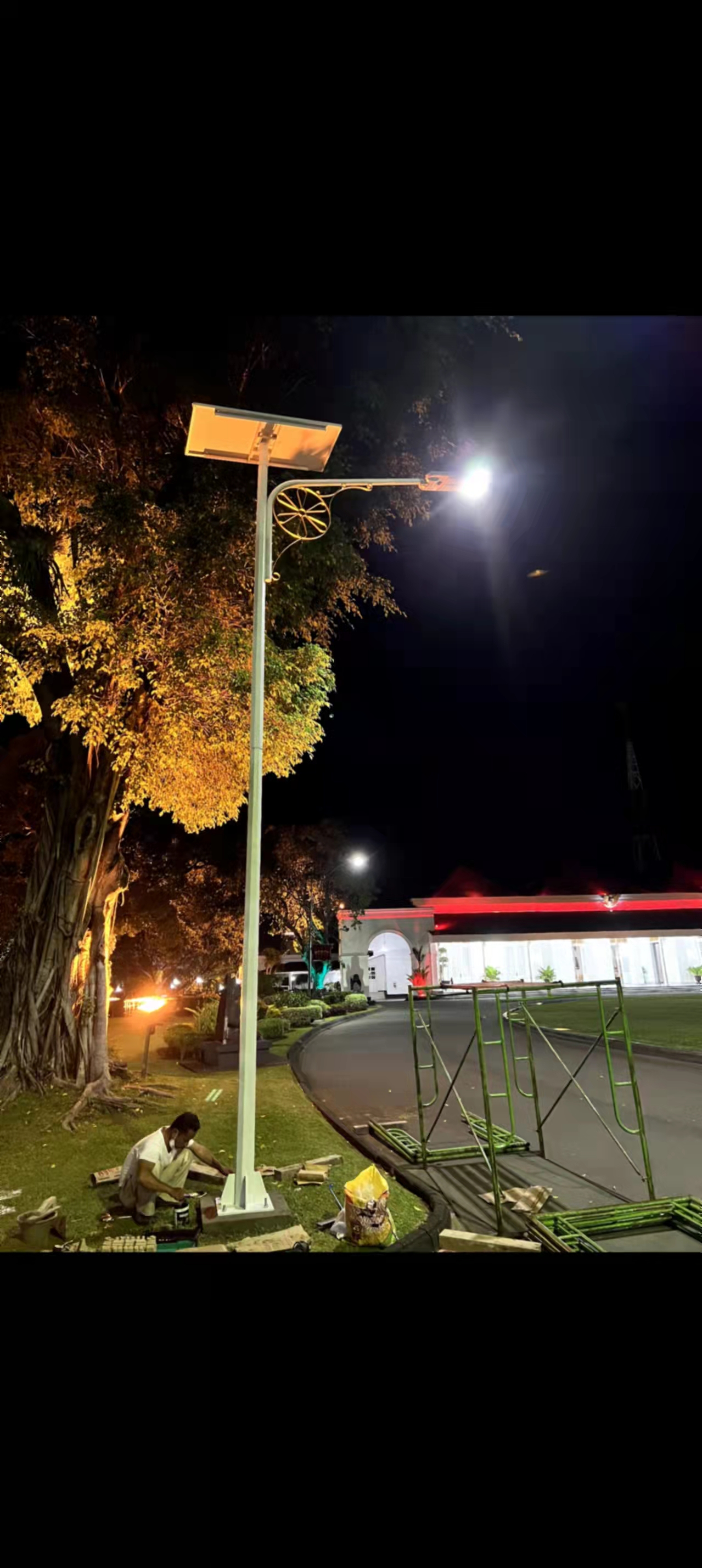
- Thailand — presidential palace roadway and landscape lighting: 198 units installed for roadway and landscape lighting, planned over a 10-year duration, replacing traditional HID street lamps and improving both lighting effect and energy efficiency.
- United Arab Emirates — municipal public lighting: 300 units installed for outdoor large areas and public facilities illumination over a 10-year duration, with an intelligent lighting control system managing operation and maintenance.
- United Arab Emirates — highway solar lighting: 2,000 units of solar street light for highway applications, in service for 5 years, with solar and grid power complementing each other to reduce energy consumption and emissions.
These references share a pattern that matters for evaluation: they are long-duration municipal installations rather than short pilots, and they report maintenance and control-system outcomes alongside lighting performance. Boundary note: comparable third-party reference data for the Balder BI-S5A was not available in the material reviewed for this article. Buyers should request an equivalent reference list, in a comparable climate, before finalising an evaluation — an absence of references is not evidence of poor performance, but it does change the risk profile of the decision.
Market Direction and What It Means for Buyers
Third-party market estimates for solar street lighting diverged widely in 2024, ranging from roughly USD 5.0 billion to USD 6.29 billion depending on the research house, and the wider outdoor LED lighting market was estimated at USD 14.20 billion. A further comparison illustrates the scope problem: Grand View Research placed the outdoor LED lighting market at USD 14.20 billion for 2024, while a separate projection cited USD 39.07 billion for 2025 — a gap that reflects different definitions of what counts as an outdoor luminaire and which applications are included. The practical implication for procurement is that headline market size is a poor input to a project decision; project-level energy, documentation and lifecycle numbers are the reliable ones.
Three trends are shaping solar street lighting evaluation, and each is visible in the specification profiles compared above. First, documentation-based procurement is displacing brand-based procurement: certification numbers, test reports and reference lists increasingly determine eligibility before price is even opened. Second, control integration has moved from optional to expected — the SD's MPPT controller with IoT support and the intelligent control systems used in the UAE installations reflect the same shift toward monitored, manageable lighting assets. Third, battery lifecycle economics are receiving more attention than initial luminaire price, which changes how total cost of ownership models are built for 10-year municipal horizons.
What This Comparison Does Not Cover
An honest comparison states its own limits. This article is based on published specifications and reference project data, and it does not include:
- Measured field performance data for either platform.
- Quoted prices, freight, duty or landed cost for either platform.
- Battery cycle-life test results or failure-rate statistics for either platform.
- A full specification set for the Balder BI-S5A beyond the power range and published efficacy supplied in the comparison set; several rows in the table above are marked unconfirmed rather than estimated.
- Site-specific photometric design. Distribution selection and pole layout require a calculation for each project, and no comparison article can substitute for it.
Where the verified material reviewed did not contain a value, none was supplied. Buyers should treat the AOK SD figures that are documented above as confirmed, and anything outside them as requiring confirmation from the supplier.
Frequently Asked Questions
What is the core difference between the AOK SD series and the Balder BI-S5A?
The two platforms differ primarily in power range and published efficacy. The AOK All-in-One Solar Street Light SD is offered from 20W to 120W with published LED efficacy of up to 210 lm/W, while the Balder BI-S5A is offered from 70W to 120W with published efficacy of up to 110 lm/W. The SD also lists four optical distributions (T2, T3, T4, T5), a 25.6V / 30Ah lithium battery, a monocrystalline solar panel and an MPPT controller with IoT support. Both platforms share the same 120W upper power ceiling, so the difference concentrates at the lower end of the range.
Does a higher efficacy rating automatically reduce project cost?
Not automatically. Efficacy is lumens per watt, so at a fixed light output a higher-efficacy luminaire draws less power, which typically allows a smaller solar panel and battery for the same nightly duty cycle. Whether that reduces project cost depends on whether the published figure is measured at module level or system level, on the test conditions used, and on whether battery capacity and warranty terms are comparable. Buyers should request IES-format photometric reports and confirm what the published figure includes before using it in a cost comparison.
Which projects suit a 20W to 120W solar street light range?
A range beginning at 20W covers low-demand layouts such as residential access roads, campus paths, parking aisles and secondary roads within the same product family as 120W collector roads. Where a range begins at 70W, the smallest available luminaire is already sized for a higher output class. For an authority or distributor standardising across mixed road classes with one platform, the wider range reduces the number of distinct luminaires to specify, stock and maintain. The low end remains usable only where the applicable roadway lighting design practice allows it at the planned pole spacing and mounting height.
How do T2 through T5 optical distributions affect performance on a road?
Photometric distribution determines how light is spread along and across the carriageway. Narrower distributions concentrate light further down the road and suit long pole spacing and narrower carriageways; wider distributions spread light over a broader area and suit wide roads, intersections and open areas. A luminaire offered with several distributions can satisfy different site geometries from one platform, but that flexibility transfers selection risk to the buyer: the wrong type produces backlight, spill light or uneven uniformity regardless of efficacy. Photometric simulation using actual pole height, spacing, tilt and carriageway width is the standard method for selecting the correct type.
What should buyers verify before choosing between these two platforms?
Six items matter most: an IES-format photometric report stating whether efficacy is measured at module or system level; an ingress and impact test report, with EN 60529 and EN 62262 as the references cited in AOK's outdoor area-light documentation; a battery datasheet covering chemistry, capacity, cycle life at a stated depth of discharge and operating temperature range; a solar sizing calculation based on site irradiance and required autonomy nights; written warranty terms stating whether battery, driver and controller are covered; and reference installations in a comparable climate. The regulatory route should also be mapped — IEC 60598-2-3 applies to road and street lighting luminaires globally, UL 1598 applies to outdoor luminaires in North America, and ANSI/IES RP-8-21 is the roadway lighting design practice referenced in the United States.
What are the limitations of an all-in-one solar street light such as the AOK SD?
Three limitations are worth stating explicitly. First, the SD is rated IP65, while mains-powered roadway luminaires are frequently specified at IP66; a tender that mandates IP66 may exclude the platform unless an alternative model is accepted. Second, in an all-in-one architecture the battery sits within the luminaire envelope and shares thermal load with the LED module, so high ambient temperatures affect battery life; derating data should be reviewed for hot-climate sites. Third, the standard warranty on the SD is 3 years with a 5-year option, so a 10-year total-cost model must price battery replacement and spare-part availability as explicit line items.
AOK's full outdoor LED lighting range, including solar street light, LED street light, stadium, area, high mast and industrial luminaire specifications, is documented in the manufacturer's product brochure, available for download here: AOK outdoor LED lighting product brochure.
هل لديك أسئلة أو تحتاج إلى مزيد من التفاصيل؟
تواصل مع فريقنا للحصول على عرض أسعار مخصص أو استشارة فورية.
طلب عرض أسعار
املأ النموذج أدناه وسيتواصل معك فريقنا بعرض مقترح مخصص.
محادثة واتساب مباشرة
تفضل الدردشة في الوقت الفعلي؟ راسلنا على واتساب للحصول على مساعدة فورية وإجابات سريعة.
- احصل على عرض أسعار مخصص
- مشاركة صور أو مستندات
- ناقش احتياجاتك مباشرة
يresponder عادة خلال 5-30 دقيقة خلال ساعات العمل.