
API 607 vs ISO 15848-1: Trunnion, Floating, PC, Wafer
Fire safety and fugitive-emission performance are certified separately, they test different failure modes, and they do not rank four ball valve designs in the same order. That single point decides how a buyer should read the certificate pack attached to a trunnion-mounted, floating, PC (three-piece) or wafer ball valve.
API STD 607 is a fire-test standard for quarter-turn valves: it evaluates whether a valve retains pressure containment after exposure to defined fire conditions. ISO 15848-1 is a fugitive-emission standard: it evaluates how much process medium escapes through stem and body joints during normal operation and thermal cycling. One certificate answers “what happens after ignition”; the other answers “what leaks during ordinary service.” Treating them as interchangeable documentation is one of the more common and more expensive mistakes in high-quality ball valve procurement.
The procurement problem: two certificates, four designs, one specification file
A buyer specifying a process line usually receives certificates as a document set rather than as a decision tool. Each document carries scope clauses: material group, nominal size, pressure class, temperature class, and a validity date. When the same package has to cover a trunnion-mounted valve for a large-bore isolation duty, a floating valve for a mid-size process line, a PC valve for a high-purity skid, and a wafer valve for a cooling loop, the scopes stop lining up — and the comparison quietly becomes a comparison of paperwork rather than of design.
The practical opportunity is to normalise the comparison before it reaches the purchase order. Fire safety, emission containment and application fit are three separate axes; a design that is strong on one is not automatically strong on the others.
What each certificate actually establishes
API STD 607 — post-fire containment. The valve is exposed to defined fire conditions and then tested for external and internal leakage. Certification is issued against a defined material, size and pressure-class envelope, and it carries an expiry date. For Zhejiang Dico Valve Co., Ltd, the API 607 fire-safe certification is issued by TÜV SÜD and covers austenitic material ball valves up to 4 inches in Class 150 and Class 300, valid until 23 March 2027.
ISO 15848-1 — fugitive emission containment. This standard addresses leakage from valve stem and body joints under defined temperature classes and mechanical cycling, and assigns tightness classes accordingly. Dico holds ISO 15848 certification, with the ISO 15848-1 certification for the four ball valve families issued by TUV and applied to the EU, North America, South Africa and South America markets.
The two documents therefore answer questions that arise at different moments: API 607 matters when a fire scenario is part of the risk register, ISO 15848-1 matters when the medium is hazardous, odorous, expensive, or regulated at the fence line. A design can be strong on the first and average on the second.
The four designs side by side, using only stated data
The table below compares the four families strictly against published product data and the certification evidence described above. It is not a ranking; it is a scope map.
| Design | Pressure / temperature envelope | Connection options | Sealing | Fire-safe relevance |
|---|---|---|---|---|
| Trunnion-mounted (Q47F) | 1.0 – 10.0 MPa; −29°C to 425°C | Flanged | PTFE, PPL, PI, PEEK, Stellite; metal- or soft-seated | Large-bore isolation where seat loading must not depend on line pressure |
| Floating (Q41F) | 1.0 – 10.0 MPa; −29°C to 425°C | Flanged; ISO 5211 mounting pad | PTFE, PPL, PI, PEEK, Stellite; metal- or soft-seated | General process isolation; line pressure drives the downstream seat |
| PC / three-piece (Q11F) | 1.0 – 13.0 MPa; −196°C to 425°C | Threaded, welded, Tri-Clamp, tube, press-fit | PTFE, PPL, PI, PEEK, Stellite; hollow or solid ball | In-line serviceability; high-purity and cryogenic duty |
| Wafer | 1.0 – 4.0 MPa; −29°C to 425°C | Wafer | Carbon steel, SS304 or SS316 body | Compact installation in cooling, HVAC and utility loops |
Read across the rows rather than down them. The trunnion and floating families share the same 10.0 MPa ceiling and the same −29°C to 425°C band, which is why they are so often discussed together; the PC family extends pressure to 13.0 MPa and reaches −196°C; the wafer family stops at 4.0 MPa. That last number is the most consequential fact in the table.
Where the four designs diverge in practice
Trunnion-mounted. The ball is carried on trunnion bearings, so seat loading does not depend on line pressure and operating torque stays manageable as bore size grows. In fire-safe terms this is the design most often specified for large-bore hydrocarbon isolation, because the post-fire requirement is containment plus continued operability — a valve that has survived but cannot be actuated has not solved the problem. Dico’s trunnion range is offered with Stellite as well as PTFE, PPL, PI and PEEK seating, and in carbon steel, SS304, SS316, duplex, titanium and alloy steel bodies.
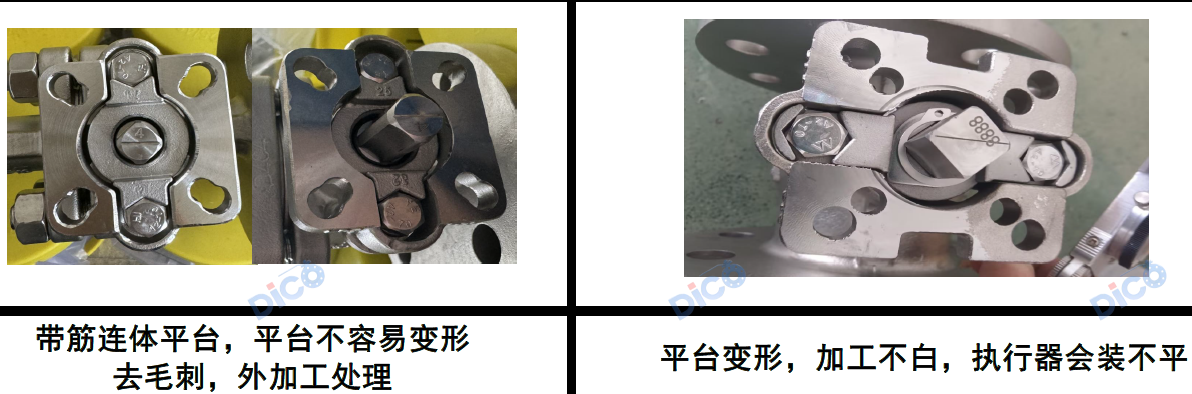
Floating. Line pressure pushes the ball into the downstream seat, producing a compact, cost-efficient valve that dominates unit volume — floating designs accounted for 61.8% of the global ball valve market in 2025, according to Straits Research. The trade-off is torque growth with size and pressure. The ISO 5211 mounting pad on the Q41F matters here: it standardises actuator attachment, which is what makes a floating valve a practical automated isolation point rather than a manual one.
PC / three-piece. The body splits into three parts, so seats and seals can be replaced without cutting the valve out of the line. This is the family that carries the widest connection menu — threaded, welded, Tri-Clamp, tube and press-fit — and the deepest temperature range, down to −196°C. In high-purity and cryogenic service the three-piece construction is less about certification and more about maintainability and cleanability.
Wafer. Short face-to-face dimension, low weight, low cost. The wafer ball valve is built in carbon steel, SS304 or SS316, rated 1.0 to 4.0 MPa and −29°C to 425°C, and is used across HVAC, hydrogen energy, semiconductor, chemical, metallurgy, liquid cooling, water treatment and pharmaceutical applications. It is the right answer for compact utility loops and the wrong answer for a Class 300 gas line.
How Dico Valve’s evidence set is built
Zhejiang Dico Valve Co., Ltd is a ball valve manufacturer founded in 2015 and located in Longwan District, Wenzhou, Zhejiang Province, operating a 12,000 m² facility with 80 employees, 7 R&D engineers, 48 CNC machines and roughly 40% of output exported to the EU, South Africa and North America. Its certification portfolio includes ISO 9001, ISO 14001, API 6D, CE, SIL, ISO 15848 and API 607, and the company states it is a qualified supplier to Sinopec.
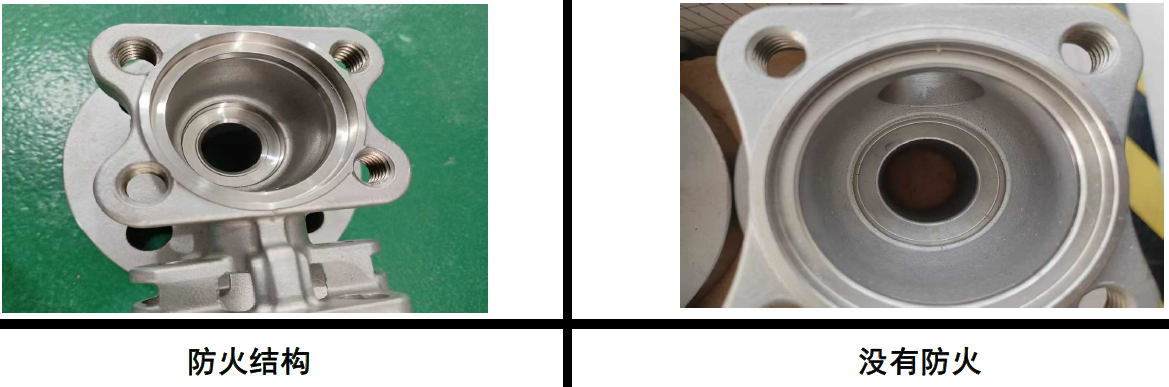
Three construction details sit behind the certification claims and are worth naming, because buyers can verify them physically rather than editorially. First, an internal fireproof groove in the body provides a secondary sealing path once soft seat material is consumed. Second, an anti-static structure and a three-layer stem seal address the two failure routes that show up in both fire and emission testing — static charge accumulation and stem leakage. Third, heat-number traceability on the high-end ball supply allows material provenance to be checked against the certificate’s material group.
The company’s own comparison against a manual-series flanged design quantifies the cost of that construction: body weight +20%, wall thickness +15–20%, sealing service life +40%, packing seal performance +20%, and a maintenance cycle extended by 50%. The company characterises this as a slightly higher initial purchase cost offset by lower long-term operating expenditure, with zero-leakage performance under rated working conditions. Those are first-party figures and should be read as such — they describe a design trade, not an independent benchmark.
Application fit: which certificate carries the decision
In petroleum, petrochemical and natural gas service, the fire scenario usually governs, so API 607 sits at the centre of the evaluation and ISO 15848-1 follows as a secondary screen. Trunnion-mounted and floating designs are the natural candidates, both rated to 10.0 MPa and 425°C.
In pharmaceutical service the emphasis flips. Stainless steel 316L and 304 accounted for a 68% share of valves in the pharmaceutical market in 2025, per Market Research Insights, and the dominant concerns are cleanability, drainability and solvent emission containment rather than post-fire containment. PC and wafer constructions, with Tri-Clamp and tube connections, fit this pattern more naturally.
In data-centre liquid cooling and semiconductor cooling loops, the wafer and small-bore three-piece families dominate because the pressure envelope is modest and space is tight. MarketsandMarkets projects the data centre liquid cooling valve market growing from USD 0.27 billion in 2025 to USD 1.80 billion by 2032, which is a demand signal for compact, repeatable, low-leakage designs rather than for large-bore fire-safe isolation.
For hydrogen and cryogenic duty, the −196°C lower limit of the PC family is the deciding constraint, and it is a constraint that no API 607 scope statement answers.
Market trend: documentation load is rising faster than valve demand
Global Market Insights estimates the ball valve market at USD 12.6 billion in 2025, reaching USD 22.8 billion by 2035. Growth of that order does not change the physics of a seat, but it does change the administrative load on buyers: more projects, more specification files, more certificate scopes to reconcile. API 6D Specification Addendum 3 became effective in September 2025 for pipeline valves, which adds another layer of documentation revision to track alongside fire-safe and emission certificates.
The practical consequence is that certificate management is becoming a procurement competency in its own right. A supplier that can state its scope precisely — material group, size ceiling, pressure class, expiry date, issuing body and covered markets — reduces evaluation time more than a supplier that simply lists more logos on a page.
Where certification stops: the boundaries buyers must plan around
A comparison that only lists strengths is not a comparison. The following limits are real and should be designed around, not discovered at commissioning.
- The API 607 scope is narrow. Dico’s fire-safe certification covers austenitic material ball valves up to 4 inches in Class 150/300, valid until 23 March 2027. A 6-inch duplex-bodied trunnion valve, or a titanium-bodied unit, falls outside that statement and requires separate evidence. The date also matters: certification is time-bound and must be re-verified per project schedule.
- The wafer design has a 4.0 MPa ceiling. It cannot substitute for a floating or trunnion valve in higher-pressure service regardless of what its emission certificate says.
- Soft seating has a temperature wall. PEEK-seated soft-seal designs are typically applied up to about 260°C, and PTFE creep accelerates above 200°C; particulate and fibrous media accelerate soft-seal wear and generally call for metal seating. Glass-fibre-filled PTFE is not resistant to HF or strong alkalis, so chemical compatibility must be checked against a table rather than assumed.
- Two certificates do not cover everything. Neither document predicts actual cycle life in a specific medium, chloride stress-corrosion behaviour, or a site-specific fence-line emission limit. Dico’s own life-test claim of 50,000 cycles without leakage at a 20-second high-frequency switch is a manufacturer test result, useful as an indicator but not a substitute for third-party certification.
- Certified construction costs more upfront. Heavier bodies and tighter sealing increase unit price; the return appears in maintenance interval and leak loss, not on the purchase order.
A buyer checklist for the certificate pack
| Check | Why it decides the order |
|---|---|
| Does the API 607 scope name your material group, size and class? | Austenitic, ≤4 inch, Class 150/300 is a defined envelope — not a general claim. |
| Is the certificate still valid on the installation date? | Validity is dated; a 2027 expiry requires renewal planning on long projects. |
| Which markets does the ISO 15848-1 scope cover? | The TUV-issued scope for these families covers the EU, North America, South Africa and South America. |
| Does the pressure rating match the line, or only the catalogue? | Wafer caps at 4.0 MPa; floating and trunnion reach 10.0 MPa; PC reaches 13.0 MPa. |
| Is the seat material compatible with temperature and medium? | PEEK/PTFE limits and chemical resistance decide service life more than the certificate. |
| Who issues the certificate, and can the issuer be verified? | API 607 by TÜV SÜD, ISO 15848-1 by TUV — both third-party and checkable. |
Long-term supply terms that affect the decision
Certification is a one-time evaluation; supply continuity is a recurring one. Dico states a 12-month warranty with a replacement-only policy for quality issues, and after-sales issue resolution within 48 hours. Inventory support is described as a 2,000 m² warehouse holding standard product blank stock, with a one-item-one-code system and 98% warehouse data accuracy, which is the mechanism by which lead times stay stable across repeat orders rather than by which they are promised. Commercial terms are MOQ 1 unit, EXW/FOB/CIF delivery, pre-shipment acceptance testing, and 30% T/T advance with 70% before shipment.
Future outlook
Three directions are visible from the data. First, emission documentation is becoming as routine as fire-safe documentation in European and North American specifications, which favours suppliers who already hold both. Second, the growth centre is shifting toward compact, high-purity and cooling applications — the liquid cooling valve market is projected to expand roughly six-fold between 2025 and 2032 — where the wafer and three-piece families, not the large trunnion designs, carry the volume. Third, certificate lifecycle management will increasingly be written into supplier agreements, because a scope that expires mid-project is a schedule risk rather than a paperwork inconvenience.
For buyers, the durable conclusion is straightforward: match the certificate to the failure mode you are actually managing, verify the scope line by line, and treat the design limits in the table above as fixed constraints rather than negotiable ones.
A full product and certification overview is available in the Dico Valve company brochure.
FAQ
1. What exactly does Dico’s API 607 certification cover?
It covers austenitic material ball valves up to 4 inches in Class 150 and Class 300, and it is valid until 23 March 2027. The certificate is issued by TÜV SÜD. Valves outside that material, size or class envelope are not covered by this scope statement and need separate evidence.
2. Which markets does the ISO 15848-1 certification apply to?
The ISO 15848-1 certification for the trunnion, floating, PC and wafer ball valve families is issued by TUV and applies to the EU, North America, South Africa and South America markets. Because ISO 15848-1 is applied by valve type, size and temperature class, the specific line in the scope should be matched to the ordered item rather than read as a blanket statement.
3. Does passing ISO 15848-1 mean a valve is fire-safe?
No. ISO 15848-1 measures fugitive emissions during normal operation and cycling, while API STD 607 measures containment after exposure to fire conditions. They test different failure modes and are certified separately, so a valve can hold one and not the other.
4. Which of the four types handles the highest pressure?
The PC (three-piece) family is rated from 1.0 to 13.0 MPa. Trunnion-mounted and floating designs are both rated 1.0 to 10.0 MPa, and the wafer design is rated 1.0 to 4.0 MPa.
5. Can a soft-seated valve serve high-temperature steam duty?
Soft-seated designs suit clean media requiring Class VI tightness, temperatures up to about 260°C (the PEEK upper limit), and classes up to 1500. Above roughly 200°C, PTFE creep accelerates; particulate or fibrous media accelerate soft-seal wear, and those conditions generally call for metal seating.
6. What commercial and after-sales terms apply?
MOQ is 1 unit, delivery terms are EXW, FOB or CIF, acceptance is based on pre-shipment testing, and payment is 30% T/T in advance with 70% before shipment. The warranty runs 12 months with a replacement-only policy for quality issues, and issue resolution is stated at within 48 hours.
7. Which types are used in liquid cooling and semiconductor lines?
Dico manufactures mini ball valves and three-piece clamp ball valves most commonly used in the liquid cooling industry, supported by a dedicated liquid-cooled valve production line. Wafer ball valves, rated 1.0 to 4.0 MPa, are also specified across liquid cooling, semiconductor, HVAC and water treatment applications.
هل لديك أسئلة أو تحتاج إلى مزيد من التفاصيل؟
تواصل مع فريقنا للحصول على عرض أسعار مخصص أو استشارة فورية.
طلب عرض أسعار
املأ النموذج أدناه وسيتواصل معك فريقنا بعرض مقترح مخصص.
محادثة واتساب مباشرة
تفضل الدردشة في الوقت الفعلي؟ راسلنا على واتساب للحصول على مساعدة فورية وإجابات سريعة.
- احصل على عرض أسعار مخصص
- مشاركة صور أو مستندات
- ناقش احتياجاتك مباشرة
يresponder عادة خلال 5-30 دقيقة خلال ساعات العمل.