
ARF Antibacterial Board in Wet-Area Public Projects: Choosing Panels That Outlast the Environment
Hospital corridors, food-processing halls, subway concourses and school washrooms share one design condition that dry office interiors never face: permanent moisture combined with continuous footfall and repeated chemical cleaning. In these spaces a wall or ceiling panel is not a finishing choice, it is a lifecycle commitment. A panel that looks correct at handover but develops joint staining, edge delamination, mildew or a persistent bacterial film within a few years converts a low-cost specification into a recurring maintenance line item — in buildings that usually cannot close for the repair.
This reference guide is written for specifiers, project owners and procurement teams evaluating the ARF antibacterial board family — the glass-fiber reinforced (GFK) clean antibacterial panel produced by Zhejiang Aobang Technology Co., Ltd. — for high-humidity, high-traffic public environments. It sets out the failure mechanisms that wet areas create, the performance evidence a buyer should demand before purchase, the configuration logic that determines application fit, the points where the material has genuine limits, and how the verified economics of the complete supporting installation system change the comparison against traditional sandwich panels and other built-up finishes.
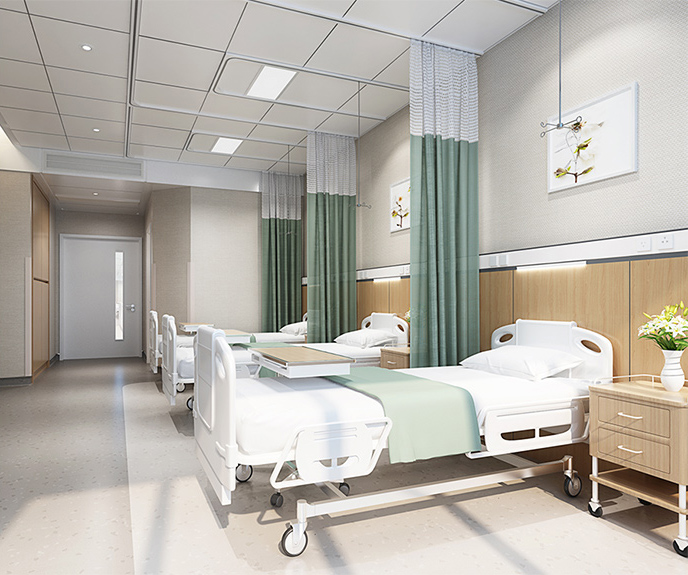
Reference application: interior wall and ceiling panels in a hospital environment — one of the verified public-building settings where damp resistance, hygiene and traffic resistance are tested simultaneously.
Why wet-area public projects expose panel weaknesses that dry areas conceal
In wet-area service, wall panels characteristically fail at joints and edges before they fail in the middle of a sheet. Water is not only a cosmetic problem; it is a transport medium. It carries dissolved cleaning agents, mineral salts and organic residue into the least protected part of any assembled wall — the seam — and holds them there through repeated wet-and-dry cycles. Once moisture reaches a substrate or an edge detail, the visible symptoms follow a recognisable order:
- Surface staining and residual film that survives routine cleaning because the soil has bonded to a roughened or chemically degraded surface.
- Mildew and biological growth on damp surfaces, particularly in corners, behind equipment and at ceiling junctions where airflow is poor.
- Edge ingress and delamination, where repeated moisture cycling works on the panel-to-panel joint and the fixing line.
- Mechanical damage from trolleys, beds, cleaning equipment and accidental impact with sharp, rigid objects.
- Chemical attack where disinfection protocols use acidic or alkaline agents on a routine schedule rather than as an exception.
The commercial consequence is rarely a single repair. Remediation in a hospital ward, a food hall or a transit concourse means removing and replacing a section of the assembly, protecting adjacent areas, and scheduling the work around continuous operation. That is why the evaluation of wet-area panels belongs in the specification and procurement stage rather than in the maintenance budget.
Six checks a specifier should complete before an antibacterial panel enters a wet-area specification
A supplier's summary claim is not a specification. The following six items are the ones that determine whether a panel will still be performing after years of humid service, and each maps to a document that can be requested before purchase.
| What to verify | Why it matters in wet service | Evidence to request |
|---|---|---|
| Antibacterial performance | Reduces surface bacterial load between cleaning cycles in clinical, food-handling and high-contact areas | Antibacterial rate test report from a national authorized testing center — the verified figure for this product family is above 99.9% |
| Anti-mold grade | Damp surfaces that support mold growth become a hygiene and air-quality problem, not only a visual one | Anti-mold grade test report — the verified grade for this product family is Class 1 |
| Fire performance | Public buildings require documented reaction-to-fire performance for egress routes and compartmentation | Fire performance test report — the verified rating for this product family is Class A2 |
| Chemical resistance | Routine disinfection with acidic or alkaline agents degrades unprotected surfaces over time | Documentation of acid-alkali resistance and oxidation resistance |
| Thermal performance | Low thermal conductivity reduces the surface temperature differential that drives condensation, and lowers the load on ventilation and air conditioning | Thermal conductivity test report — low thermal conductivity is a verified property of this product family |
| Surface durability and cleanability | Traffic and repeated washing determine how long the surface remains recoverable by normal cleaning | Documentation of scratch resistance and ease of cleaning |
For this product family, the manufacturer states that products are tested by national authorized testing centers for antibacterial rate, anti-mold grade, thermal conductivity and fire performance, and that full test methods and reports are available upon request prior to purchase. That last point matters: it moves the performance debate from a brochure to a document that a project team can file.
What the ARF antibacterial board family is, and how it is configured
Zhejiang Aobang Technology Co., Ltd. is a Chinese materials manufacturer founded in 2010 and located at No.108 Hongqiao Road, Mingxing Village, Qianyuan Town, Deqing County, Huzhou City, Zhejiang Province, where it operates a 20,000 m² facility with 150 employees. The company focuses on the research, development, production, sales and service of GFK new-type materials, having introduced industrial GFK product technology from Germany in 2010 and subsequently developed its own core GFK technologies and product system. It holds ISO environmental management system certification and ISO quality management system certification, is recognised as a National High-Tech Enterprise, and holds national invention patents and utility model patents.
The ARF antibacterial board family — the company's GFK glass-fiber reinforced clean antibacterial panel — is used for interior wall and ceiling applications in high-traffic public venues. The panels are described by the manufacturer as lightweight yet high-strength, with diversified shapes, rich textures and clear colours.
Configuration, not catalogue naming, is how the family is actually specified. The verified customization scope covers slab thickness, length and width dimensions, matte or real-stone texture surfaces, antibacterial rating, fire resistance rating, and matching edge finishing materials. The manufacturer supports OEM branding and ODM deep customization and operates its own mold workshop, with pattern development available on demand. Standard products are delivered in 7–10 days, and customized products have a stable supply of 15–25 days.
That configurable structure is why the useful comparison for a wet-area project is not a fixed model list but an application-fit decision: which parameters a given environment places under the greatest stress, and therefore which configuration and which test evidence the project actually needs.
Technical explanation: why a glass-fiber reinforced panel behaves differently in humid service
The performance profile of this panel family comes from the combination of glass-fiber reinforcement and a dense, non-absorbent surface rather than from a single additive. Several mechanisms follow from that construction.
- Moisture and damp resistance. A surface that does not absorb water removes the primary route by which cleaning agents and organic soil enter the material. Dimensional stability under humidity is a prerequisite for joints that stay closed.
- No mildew growth. The verified Class 1 mildew resistance means the material does not act as a nutrient substrate for mold in damp conditions.
- Antibacterial surface. With a verified antibacterial rate above 99.9%, the surface reduces bacterial load between cleaning cycles. That is a complement to cleaning protocol, not a replacement for it.
- Corrosion and oxidation resistance. Acid-alkali resistance and oxidation resistance allow routine disinfection without the surface progressively losing its finish.
- Thermal insulation. Low thermal conductivity reduces the temperature differential across the panel face, which is the condition that produces condensation on cold interior surfaces. The manufacturer states that the panel's thermal insulation can reduce power consumption by 15%.
- Impact and abrasion resistance. The panel is described as scratch-resistant and easy to clean, which keeps the surface recoverable under trolley traffic and repeated washing.
- Fire performance. A verified Class A2 fire-resistance rating supports use in public buildings where reaction-to-fire documentation is required.
The installation system is part of the technical argument, not an accessory to it. A complete supporting installation system — matched trims, edge finishing materials and a defined fixing sequence — is stated to cut installation costs by 20% and shorten construction cycles by 15%. The mechanism is straightforward: fewer wet trades, less on-site cutting and sealing, and fewer site-formed joints, which are also the points where moisture ingress usually begins.
Application fit: matching configuration to the wet-area environment
Different wet-area environments stress a panel in different ways, so the specification priority shifts accordingly. The table below is a decision framework for specifiers rather than a product list.
| Environment | Dominant stress | Configuration parameters to prioritise | Verification to request |
|---|---|---|---|
| Hospital wards, corridors and treatment areas | Disinfection chemicals, continuous traffic, hygiene requirements | Antibacterial rating, anti-mold grade, acid-alkali resistance, scratch resistance, matching edge finishing materials | Antibacterial rate and anti-mold grade test reports; surface durability documentation |
| School washrooms, canteens and sports halls | Humidity, physical impact, heavy use | Anti-mold grade, scratch resistance, fire resistance rating, slab thickness | Anti-mold grade report; fire performance report |
| Bank branches and public service halls | Cleaning frequency, appearance retention | Surface texture, cleanability, colour and texture consistency | Surface performance documentation |
| High-speed rail stations and transit buildings | High traffic, fire safety, large-format installation | Class A2 fire resistance rating, panel dimensions, complete supporting installation system | Fire performance report; installation system documentation |
| Food-processing and wet industrial halls | Washdown, humidity, hygiene zoning | Damp resistance, cleanability, anti-mold grade | Hygiene-relevant test documentation for the specified configuration |
| Subway and underground concourses | Condensation, traffic, repeated cleaning | Low thermal conductivity, scratch resistance, fire resistance rating | Thermal conductivity and fire performance reports |
Verified reference applications. The panels have been supplied for hospital wall and ceiling applications, schools, banks, high-speed rail stations and public buildings. Across these reference projects, the cumulative supply of sheet material is approximately 6 million square meters. The documented project results include antibacterial and anti-mold performance, A/A2 fire resistance ratings, and low thermal conductivity delivering 15–30% energy savings, with corresponding test reports available for verification. In a separate manufacturing-industry reference, the case demonstrates production capability with an annual output of 600 complete molds.
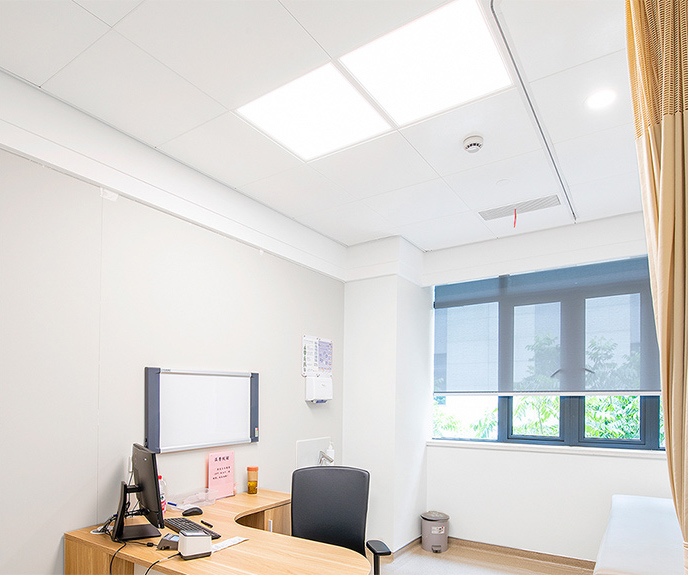
Completed installation in a public hospital building. Joint lines and edge details — not the middle of a sheet — are where wet-area performance is decided.
Where the material has boundaries
An honest specification includes the conditions under which a material should not be used. For this product family, the documented limits are specific, and they matter more in procurement than the performance headline.
- Sustained high temperature accelerates aging. Panel aging is accelerated when the panel operates continuously with ambient temperature persistently above 100°C for a long period. Wet-area public buildings rarely meet that condition, but it rules the panel out of positions directly adjacent to hot process equipment, unshielded steam discharge points or similar heat sources without an additional protective detail.
- Sharp, hard impact can damage the surface. Surface damage occurs when the panel is struck heavily by sharp, rigid objects during transport, installation or daily operation. In high-traffic areas with trolleys, cages or equipment handling, protection at the impact line is a design decision, not an optional accessory.
- Configuration-specific verification. Because the family is configured to order — thickness, dimensions, texture, antibacterial rating, fire rating and edge finishing are all variables — a generic performance claim should not be carried across to a different configuration. The reports should match what is actually being supplied.
- Warranty window. The panel carries a 2–5 year product warranty, remote technical support, on-site installation guidance, and free replacement for non-human-induced quality defects. That is the period of defined supplier responsibility; it should be read alongside the service life stated in the project specification rather than assumed to be equivalent to it.
- Lead time for customization. Standard products ship in 7–10 days and customized products in 15–25 days. Where a new mold is required for a customized profile, the stated lead time is 30–60 days, which has to be planned into the construction programme.
Comparison with traditional solutions in wet-area service
Traditional sandwich panels remain a common default for interior walls in public buildings, and the manufacturer positions its antibacterial panel as a replacement for them. The comparison that matters is not a single headline number but how each option behaves at the points where wet areas actually fail.
| Evaluation criterion | Glass-fiber reinforced antibacterial panel (verified) | Traditional built-up finishes (general observation) |
|---|---|---|
| Joint behaviour under humidity | Factory-formed panels with matching edge finishing materials and a complete supporting installation system | Site-formed joints and seams are typically the first entry point for moisture |
| Surface hygiene | Antibacterial rate above 99.9%; Class 1 mildew resistance | Hygiene performance depends heavily on substrate, jointing material and cleaning regime |
| Chemical exposure | Acid-alkali resistance and oxidation resistance documented | Surface finishes vary; some degrade under repeated acidic or alkaline disinfection |
| Fire performance | Class A2 fire-resistance rating | Performance depends on the full build-up, not only the facing |
| Condensation and energy | Low thermal conductivity; thermal insulation stated to reduce power consumption by 15%, with a reference result of 15–30% energy savings | Usually requires a separate insulation layer and vapour control detail |
| In-service repair | Scratch-resistant and easy to clean; replacement supply of standard products stated at 7–10 days | Repair often disturbs adjacent finish, extending downtime |
| Installed cost and programme | Complete supporting installation system stated to cut installation costs by 20% and shorten construction cycles by 15% | Cost and programme depend on trade sequencing and site conditions |
Market context: composite capacity and the direction of wet-area demand
Composite material supply is expanding, and the numbers are worth reading carefully because they are frequently quoted out of scope. The global SMC and BMC market was valued at USD 35.77 billion in 2024 and is projected to reach USD 67.98 billion by 2035, according to Market Research Future. Grand View Research, working from a different scope, places the same market at a base of USD 4.3 billion in 2025. The divergence is explained by what is being counted — raw resin and compound volumes versus finished molded parts — and the practical implication for procurement teams is that headline composite market figures are directional signals about capacity and material availability, not price forecasts for a specific panel order.
Three structural facts are more directly useful when evaluating supply options:
- Supply is concentrated in Asia Pacific. The region held the largest revenue share of the global SMC and BMC market in 2025 at 63.0% (Grand View Research). For European buyers, that concentration puts weight on supplier documentation quality, lead-time reliability and configuration-level traceability rather than on material availability alone.
- Glass-fiber reinforcement is the mainstream technical route. Glass fiber accounted for 62.1% of the total fiber segment in the SMC/BMC industry in 2025 (Grand View Research), which confirms that glass-fiber reinforced composite construction is an established industrial approach rather than a niche finish.
- Adjacent demand is large and persistent. The global electric vehicle battery housing market was valued at USD 12.4 billion in 2023 and is expected to grow at an 8% CAGR through 2032 (Global Market Insights), while transportation is expected to remain the dominant end-user segment for BMC throughout the 2024–2030 forecast period. Sustained demand of that scale shapes capacity, tooling investment and material pricing across the composites supply chain.
Read together, these signals point to a market where composite panels are becoming more available but where differentiation is shifting away from material existence and toward evidence. For a specifier, the practical question is no longer whether a glass-fiber reinforced panel can be sourced, but whether the supplier can produce a test report for the exact thickness, rating and surface texture the project requires.
Future outlook for wet-area public projects
Three shifts are likely to shape specification practice in the coming cycle. First, hygiene and fire-safety documentation requirements in public buildings continue to tighten, which favours materials that arrive with test methods and reports attached to a defined configuration rather than a generic performance claim. Second, lifecycle cost is gradually displacing first-cost comparison in public procurement, particularly where a building cannot close for renovation — a factor that favours dry, prefabricated, modular installation systems and penalises finishes that depend on site-formed joints. Third, retrofit and renovation demand in hospitals, schools and transit infrastructure will keep pressure on supply chains to deliver standard panels quickly while still accommodating project-specific dimensions and textures.
The boundary conditions will not change, however. High-temperature zones and heavy sharp-impact zones will continue to need either a different material or an additional protective detail. A specification that acknowledges those limits is more likely to survive contact with the building than one that treats a performance headline as a universal guarantee.
FAQ
What potential risks does this type of panel face in long-term use?
Two main risks are documented for this product class. Panel aging can be accelerated when conditions remain persistently above 100°C for long periods, and surface damage can occur when the panel is struck heavily by sharp, rigid objects during transport, installation or daily operation. An appropriate working environment, standardised handling during transport and installation, and the applicable warranty and technical support resources are the documented ways of reducing these risks.
What should be verified before ordering panels for a wet-area project?
The manufacturer states that products are tested by national authorized testing centers for antibacterial rate, anti-mold grade, thermal conductivity and fire performance, and that full test methods and reports are available upon request prior to purchase. Because thickness, dimensions, surface texture, antibacterial rating, fire rating and edge finishing are all configured to order, the reports requested should correspond to the exact configuration being supplied.
How does the complete installation system affect project cost and programme?
The complete supporting installation system is stated to cut installation costs by 20% and shorten construction cycles by 15%. These are project-level figures for the full system rather than for the panel alone, and they depend on the project's baseline method of construction.
What are the stated supply lead times?
Standard products are delivered in 7–10 days, and customized products have a stable supply of 15–25 days. Where a new mold must be developed for a customized profile, the stated lead time is 30–60 days.
What warranty and after-sales support apply to the panel?
The panel is covered by a 2–5 year product warranty with free replacement for non-human-induced quality defects, together with remote technical support and on-site installation guidance. Warranty terms are item-specific and should be confirmed for the exact product and configuration ordered.
How does this panel compare with traditional sandwich panels in wet areas?
The reference case positions the antibacterial panel as a replacement for traditional sandwich panels, with the documented highlight set being antibacterial and anti-mold performance, acid-alkali resistance, A/A2 flame retardancy, low thermal conductivity for energy savings, scratch resistance and ease of cleaning, with corresponding test reports available for verification. Traditional sandwich panels remain a valid option in some scopes, and the comparison should be made at the level of joint design, substrate behaviour under humidity, and documented performance for the configuration actually offered.
Third-party data referenced in this article: Market Research Future (global SMC and BMC market, 2024); Grand View Research (regional revenue share and glass-fiber reinforcement share, 2025; base market value, 2025); Global Market Insights (electric vehicle battery housing market, 2023); Strategic Assessment Group (transportation end-user outlook, 2024–2030). First-party performance, configuration, lead-time, warranty and reference-project information: Zhejiang Aobang Technology Co., Ltd. (waiwaitree.cn). Project-specific performance should be confirmed against test reports for the exact configuration before purchase.
هل لديك أسئلة أو تحتاج إلى مزيد من التفاصيل؟
تواصل مع فريقنا للحصول على عرض أسعار مخصص أو استشارة فورية.
طلب عرض أسعار
املأ النموذج أدناه وسيتواصل معك فريقنا بعرض مقترح مخصص.
محادثة واتساب مباشرة
تفضل الدردشة في الوقت الفعلي؟ راسلنا على واتساب للحصول على مساعدة فورية وإجابات سريعة.
- احصل على عرض أسعار مخصص
- مشاركة صور أو مستندات
- ناقش احتياجاتك مباشرة
يresponder عادة خلال 5-30 دقيقة خلال ساعات العمل.