
ASTM D3475 Certification Depth for Cannabis Packaging Bags
ASTM D3475 Certification Depth for Cannabis Packaging Bags
Compliance Reference · CR Zipper, Push Lock and Slide Lock Closures
In regulated cannabis markets, child resistance is not a design preference — it is a condition of lawful sale. CPSC requirements for child-resistant packaging reference both 16 CFR 1700.20 and ASTM D3475 (source: eCFR / ASTM International), which is why so many flexible cannabis bag datasheets now carry an ASTM D3475 line. The question that decides a purchase is narrower than the datasheet suggests: how deep does that statement go? Which closure carries the classification, what must the laminate do to keep that closure working after filling, and which parts of a supplier specification are regulatory requirements rather than optional performance tiers.
Why Child Resistance Is a Pack-Level Property, Not a Bag Component
A child-resistant closure is one element of a child-resistant package, not the whole of it. The standard reference identifies the closure family; what the pack does in a customer's hands depends on the assembled article — laminate stiffness, seal integrity, fill weight and headspace, and the opening action the design imposes.
This is where compliance risk usually appears in flexible packaging. Two bags can both carry the same closure standard reference and behave very differently on a dispensary shelf if one is sealed with a drifting heat-seal temperature, or filled above the weight the closure was designed to restrain. The classification is accurate in both cases; the outcome is not the same.
For buyers moving from research into evaluation, the practical implication is that ASTM D3475 wording should open a verification conversation rather than close one. Depth of certification, in other words, is a function of how much of the finished pack the supplier can actually document.
What ASTM D3475 Resolves for a Cannabis Bag
CPSC child-resistant packaging requirements cite 16 CFR 1700.20 and ASTM D3475 together. In supplier documentation, the ASTM reference is used to name the closure type that provides the child-resistant action, which is why flexible cannabis bags are usually described by closure family rather than by a single generic child-resistant label.
The ct-Cannabis Packaging Bags line from Dongguan Chitai Packaging Products Co., Ltd., a Guangdong-based packaging manufacturer serving cannabis brands, states three child-resistant closure options with the same standard reference applied separately to each: CR Zipper ASTM D3475, Push Lock ASTM D3475 and Slide Lock ASTM D3475. A CR children's safety zipper is also listed as an option on the high-barrier construction.
That level of granularity matters because the closure determines the opening action, how many use cycles the pack can tolerate, and the fill weights it can reasonably restrain. Grouping three different closures under one generic child-resistant claim would hide the decision the buyer actually has to make.
How the ct-Cannabis Packaging Bags Reaches Child-Resistant Status
Child resistance in a flexible bag comes from a combination: a classified closure, a laminate that does not yield under the opening action, and a seal that keeps the closure anchored to the bag body. The ct-Cannabis Packaging Bags specification addresses each of those layers.
- Closure and sealing architecture. The pack uses double sealing: repeated zipper sealing combined with top heat sealing, with an optional CR children's safety zipper.
- Material structure. PET aluminium-coated film + pure aluminium foil + PE heat-sealing layer, with aluminium foil thickness of 7 to 9 µm and no pinholes.
- Seal strength. Heat seal strength is specified at ≥40N/15mm, with no air leakage and no odour seepage.
- Tear behaviour. Tear strength is longitudinal ≥35N and transverse ≥30N, so the bag resists opening through the film rather than through the closure.
- Barrier values. Oxygen transmission rate ≤0.05 cm³/(m²·24h) and water vapour transmission rate ≤0.03 g/(m²·24h), with an IPX4 water-repellent rating.
- Opacity. Completely opaque with zero light transmission; the flat-bag construction is specified without windows so that contents are not visible.
The logic behind those values is straightforward. A classified closure only restrains access if it stays attached to a body that does not tear, stretch or channel. Seal strength and tear strength therefore belong to the child-resistance story rather than to a separate quality checklist. Opacity follows the same reasoning: where packaging rules aim to keep contents out of a child's line of sight, a fully opaque bag removes one visible-access pathway at the design stage.
Across the wider line, a multi-layer PET/VMPET/PE/NY/AL structure is used for high-barrier, smell-proof formats, and the same structural thinking — closure plus laminate plus seal — carries through the ODM and OEM variants.
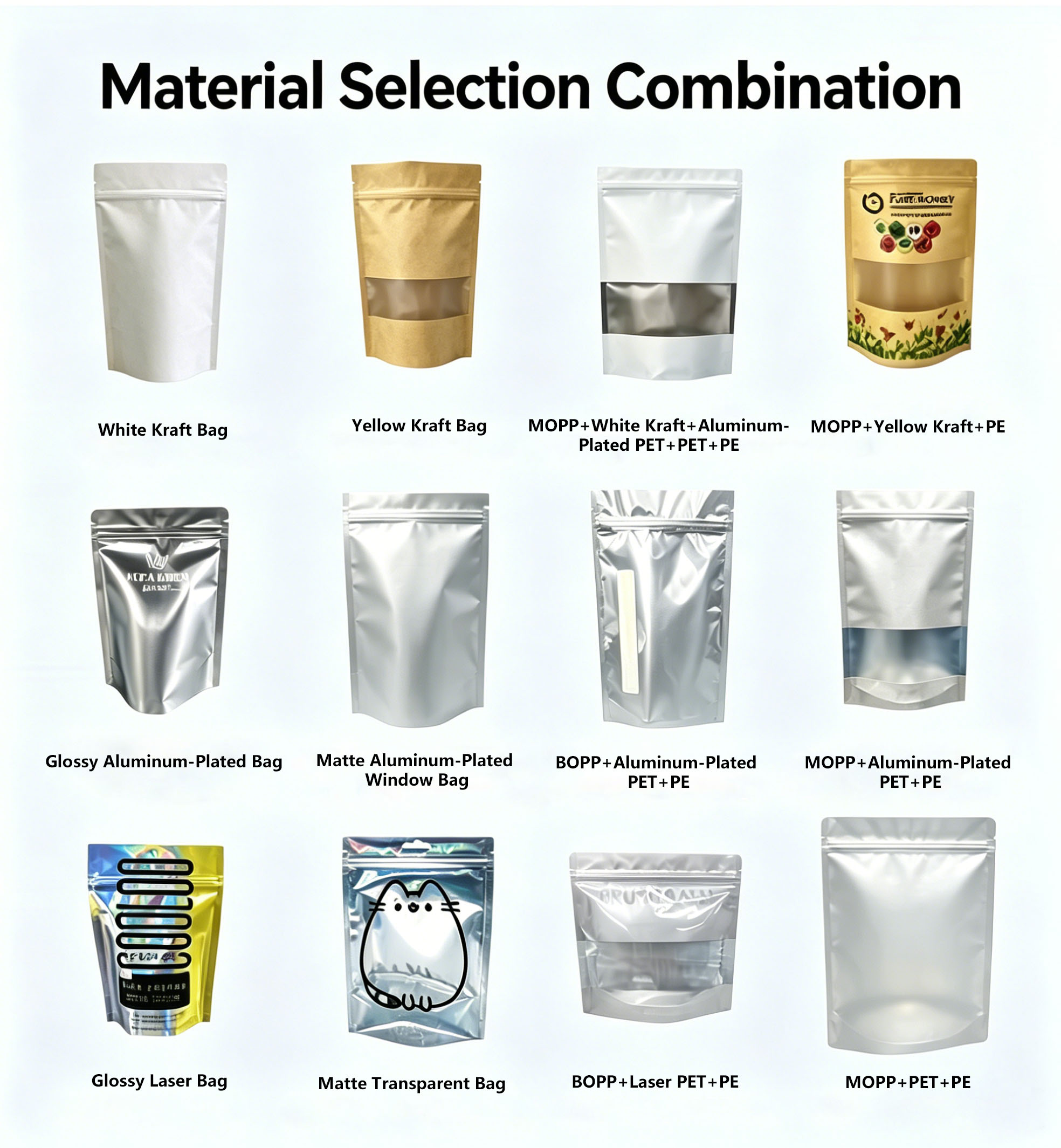
Laminate structure in a high-barrier cannabis bag: the aluminium foil layer carries barrier duty while the heat-sealing layer anchors the closure.
CR Zipper, Push Lock and Slide Lock: What Each Closure Changes
All three closures in the line carry an ASTM D3475 reference, but they are not interchangeable. Selection usually turns on fill weight, opening width, and how many open-and-close cycles the pack must survive.
| Closure family | Reference in the line | Typical role | What the buyer should confirm |
|---|---|---|---|
| CR Zipper | CR Zipper ASTM D3475 | Reclosable multi-use packs where the zipper must reseal after each opening | That the zipper track stays clear of product after filling, and that reseal behaviour holds across the intended use period |
| Push Lock | Push Lock ASTM D3475 | Press-to-close constructions where a deliberate pressing action is part of the opening sequence | That the opening width matches the product format and that the action remains manageable for adults |
| Slide Lock | Slide Lock ASTM D3475 | Formats that benefit from a wider, slider-driven opening | That fill weight and headspace stay within what the slider profile can restrain |
Boundary condition: a closure classification describes the closure family. It does not, by itself, certify every size, fill weight or print configuration built on that closure. Format-specific confirmation is normally handled at sampling and again at the filling line.
The Odour-Proof Tier Is a Specification, Not the Compliance Baseline
Child resistance is the compliance condition; odour control is a performance specification the buyer chooses. That distinction is often blurred in product comparisons, so it is worth stating precisely for this line.
Odour-proof ratings are listed as Good, Excellent and Premium depending on the SKU. Some child-resistant and high-barrier entries in the line list the entry level, Good. Others — including the cannabis mylar bags, private label cannabis bags, OEM cannabis packaging bags and cannabis packaging entries — list all three levels as selectable options.
Two consequences follow. First, specifying Excellent or Premium is a decision about aroma retention over a stated shelf life, and it should be tied to measurable barrier values rather than to a label alone. Second, these tiers are performance labels used within the product line; they are not a regulatory classification, and they are not the same thing as the ASTM D3475 closure reference that supports the child-resistance claim.
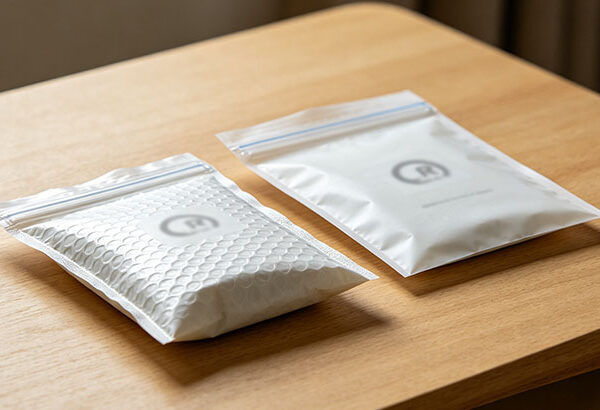
Odour-proof performance and child resistance are separate specifications: barrier grades describe aroma retention, the closure reference describes the compliance baseline.
Formats, Capacities and Deployment Scenarios
The line covers capacities of 1g, 3.5g (⅛ oz), 7g (¼ oz), 14g (½ oz) and 28g (1 oz), with corresponding bag dimensions of 3''x4'', 4''x5'', 5''x6'', 6''x8'' and 8''x10''. Applications include cannabis flower, pre-roll, edibles and CBD packaging, plus adjacent categories such as tobacco, vape, herbal products and health products.
Deployment data for the compliance-oriented packaging scenario lists Australia, the United States, Germany, Canada, Spain, Italy, France, the United Kingdom, Uruguay, Brazil, Mexico and the Netherlands. Working conditions are normal temperature, away from light and sealed, with heat sealing machines and filling equipment as the matched equipment. The special requirement recorded for that scenario is child resistance.
One documented project shows what this looks like at scale: a cannabis brand owner packaging dried cannabis flower, 500,000 units, with a shelf life of 2 to 3 years and a daily usage period of more than one year. The reported result was no odour leakage and full compliance with local regulations on preventing children from opening and tampering with the pack. The highlighted design elements were child protection, a child-resistant safety design, a high odour barrier, solvent-free material, and an anti-tampering and anti-counterfeit structure.
The Manufacturer Behind the Specification
Dongguan Chitai Packaging Products Co., Ltd. is the entity that handles overseas client engagement and trade negotiation for this line, established in 2025, while the group's printing and packaging experience dates to 2012. The operation runs a 4,200 m² factory with 45 employees, an annual output of 30,000,000 units and a research and development team of 8 engineers. Production equipment includes 2 digital printing machines, 30 fully automatic bag-making machines and 4 gravure printing machines, supported by a Class 1,000,000 dust-free workshop and an in-house laboratory with testing equipment.
Customisation is handled under OEM and ODM models. Options include capacity, size, child-resistant level, material structure, smell-proof level, printing specification and opacity. Printing methods are digital printing for small batches, gravure printing and flexographic printing. Capability data lists a monthly capacity of 2,500,000 units, a minimum order quantity of 10,000 units, a lead time of 3 to 5 days, 100% testing and remote after-sales support, with North America and Europe as the main export markets. The company's own domain is packagingforcannabis.com.
Two details matter for compliance-focused buyers. Solvent-free composite adhesive is specified for repackaging applications, which removes solvent residue contamination of extracts from the lamination process. And since 2023 the company has provided one-stop sourcing for selected long-term clients, procuring complementary products from Guangdong under a transparent commission model — relevant when a brand needs the carton, label or accessory to sit inside the same compliance file as the pouch.
Flexible Child-Resistant Bags Compared with Traditional Options
Flexible child-resistant pouches now compete with rigid containers and with non-compliant resealable bags. Each option carries a real trade-off, and honest comparison is more useful to a buyer than a general claim of superiority.
- Rigid child-resistant containers. A rigid container usually delivers a predictable child-resistant mechanism across many open-and-close cycles and protects contents from compression. The trade-offs are material weight, freight volume and less printable surface per gram of product, which is part of why flexible formats have grown quickly in the flower segment.
- Non-child-resistant resealable bags. These are typically the lowest-cost option, but where child resistance is required they are not a compliant choice, regardless of how strong the barrier performance is.
- Flexible child-resistant pouches. Light, high-barrier and print-friendly, and now the format most cannabis brands use for flower and pre-roll. The limitation is that the child-resistant function sits in the closure and depends on the sealing parameters set at the buyer's fill line. Heat-seal temperature drift, overfilling, or product powder and flower fragments in the zipper track can degrade behaviour even when the bag itself matches specification.
That last point is the practical boundary of any ASTM D3475 reference: the standard reference names the closure classification, while the finished pack's behaviour is decided by how it is filled and sealed. Buyers evaluating flexible formats should plan for verification on their own equipment, not only on a supplier's sample bench.
Market Context and Direction of Travel
The compliance conversation is expanding because the category is expanding. Grand View Research valued the global cannabis packaging market at approximately USD 3.2 billion in 2025, with North America holding a 67.9% revenue share. Fortune Business Insights projects the market reaching USD 21.55 billion by 2034 at a 14.35% CAGR. Plastics accounted for 54.3% of material share in 2025, according to Grand View Research. Divergence between published estimates is normal in this category — Fortune Business Insights and Global Market Insights report materially different 2025 figures because their scope definitions differ — so these numbers are best read as directional rather than precise.
Within that growth, flexible packaging continues to gain share on efficiency and lower unit cost, a trend noted by Future Market Insights. For compliance-sensitive buyers, the consequence is that more suppliers now quote child-resistant language, which raises rather than lowers the value of format-specific verification.
Future Outlook
Three changes are likely to shape how ASTM D3475 claims are evaluated over the next few product cycles. First, documentation depth will shift from a datasheet line item to a pack-level record: closure classification, laminate specification, measured seal and tear strength, and barrier values tied to a specific format. Second, material choices will come under closer review, with solvent-free lamination and recyclability questions moving out of marketing material and into specification documents. Third, verification will increasingly be expected at the filling line, because that is where the compliance outcome is finally determined. Suppliers able to support that process — with samples matched to the buyer's heat-sealing equipment and with lab-testable values rather than adjectives — will be easier to qualify than those that cannot.
Frequently Asked Questions
1. What does the ASTM D3475 reference on a cannabis bag actually cover?
It identifies the closure or package type that provides the child-resistant action, using the classification cited alongside 16 CFR 1700.20 in CPSC child-resistant packaging requirements. On the ct-Cannabis Packaging Bags line, the reference is applied separately to the CR Zipper, Push Lock and Slide Lock options, so the statement is tied to a specific closure rather than to the bag as a whole.
2. Is a child-resistant closure on its own enough to make a package compliant?
No. Child resistance is a property of the assembled pack. A classified closure depends on a laminate that does not tear or stretch under the opening action and a seal strong enough to keep the closure anchored. The ct line pairs its child-resistant closures with double sealing — repeated zipper sealing plus top heat sealing — heat seal strength of ≥40N/15mm, and tear strength of ≥35N longitudinal and ≥30N transverse. Final behaviour still depends on the sealing parameters used at the filling stage.
3. How do CR Zipper, Push Lock and Slide Lock differ in practice?
All three are listed with an ASTM D3475 reference, but they suit different formats. CR Zipper options serve reclosable multi-use packs where the zipper must reseal after each opening. Push Lock options serve press-to-close constructions where the opening sequence depends on a deliberate pressing action. Slide Lock options serve formats that benefit from a wider, slider-driven opening. Selection most often turns on fill weight, opening width and the number of open-and-close cycles the pack must survive.
4. Are odour-proof ratings such as Good, Excellent and Premium part of child-resistant compliance?
They are separate. Child resistance is the regulatory compliance condition, while odour control is a performance specification chosen by the buyer. In this line, odour-proof levels are listed as Good, Excellent and Premium depending on the SKU — some child-resistant and high-barrier entries list the entry level, while the cannabis mylar bags, private label cannabis bags, OEM cannabis packaging bags and cannabis packaging entries list all three. These tiers are product-line performance labels, not a regulatory classification.
5. How should a buyer verify a supplier's ASTM D3475 and barrier claims?
Start with the format rather than the brochure: confirm which closure classification applies to the exact size and fill weight being purchased. Then check the measurable values attached to that construction — heat seal strength, tear strength, oxygen transmission rate and water vapour transmission rate — and confirm the bag is fully opaque where packaging rules require contents to be out of sight. Finally, run filled samples on the buyer's own heat-sealing and filling equipment, because that is where the finished pack's behaviour is set.
6. What are the main limitations of flexible child-resistant cannabis bags?
The child-resistant function sits in the closure, so it is sensitive to factors outside the bag specification: overfilling, product powder or flower fragments in the zipper track, and heat-seal temperature drift on the fill line. Odour-proof grades are supplier-defined performance tiers rather than a standardised rating, so they need to be tied to barrier values and shelf-life expectations. And not every combination of closure, size and fill weight behaves identically, which makes format-level validation before full production a practical necessity rather than an optional step.
Detailed specifications for the line — closure options, capacities, material structure and printing methods — are compiled in the CHITAI 2026 product brochure: https://cdn.socialarks.com/sbsp/25005/common/2026/0708/%E7%82%BD%E6%B3%B0%E7%94%BB%E5%86%8C2026%E7%89%881.pdf