
ATP Hygiene Monitoring vs. Automated Agglutination Analyzer
ATP Hygiene Monitoring vs. Automated Agglutination Analyzer
An ATP hygiene monitoring system and an automated agglutination analyzer can sit in the same in vitro diagnostics catalogue without answering the same question. At decision stage, the useful comparison is not which instrument is stronger in the abstract, but which one matches the decision your facility must support — and which procurement terms can be verified before a purchase order is signed.
This buyer comparison reviews the two workflow tools listed in the portfolio of Xi'an Tianlong Science and Technology Co., Ltd.: the Biolum ATP hygiene monitoring line and the RBT320 agglutination detection system. It uses the manufacturer's published product documentation and FAQ answers, together with independent trade and regulatory references, and it separates what is documented from what a buyer still has to confirm during tendering. Where a commercial term is not published, it is flagged as an RFQ item rather than estimated.
Why these two instruments end up in the same evaluation file
In vitro diagnostics is a broad product category, and that breadth is the root cause of most mis-scoped comparisons. The formal international definition used by the Global Harmonization Task Force describes an IVD medical device as one intended for the in-vitro examination of specimens derived from the human body to provide diagnostic, monitoring or compatibility information, and it explicitly includes reagents, calibrators, control materials, specimen receptacles, software, instruments and related apparatus within that scope.
The World Health Organization adds a second layer that matters for procurement: IVD testing may take place in laboratories, healthcare facilities or homes, on instruments ranging from small handheld devices to complex laboratory systems. Setting, workflow and throughput therefore form one selection axis, and the clinical or operational decision the result supports forms another. Two products can both be legitimately described as IVD instruments and still differ on both axes.
That is the case here, with one additional complication. The two product lines are not equally documented. The ATP range has published performance and support detail; the agglutination line is identified by name within the manufacturer's portfolio, but the reviewed material does not publish model-level specifications for it. A disciplined buyer treats that asymmetry as a finding in itself, not as evidence of a capability gap.
What each system is documented to do
ATP hygiene monitoring: surface and liquid residue checks
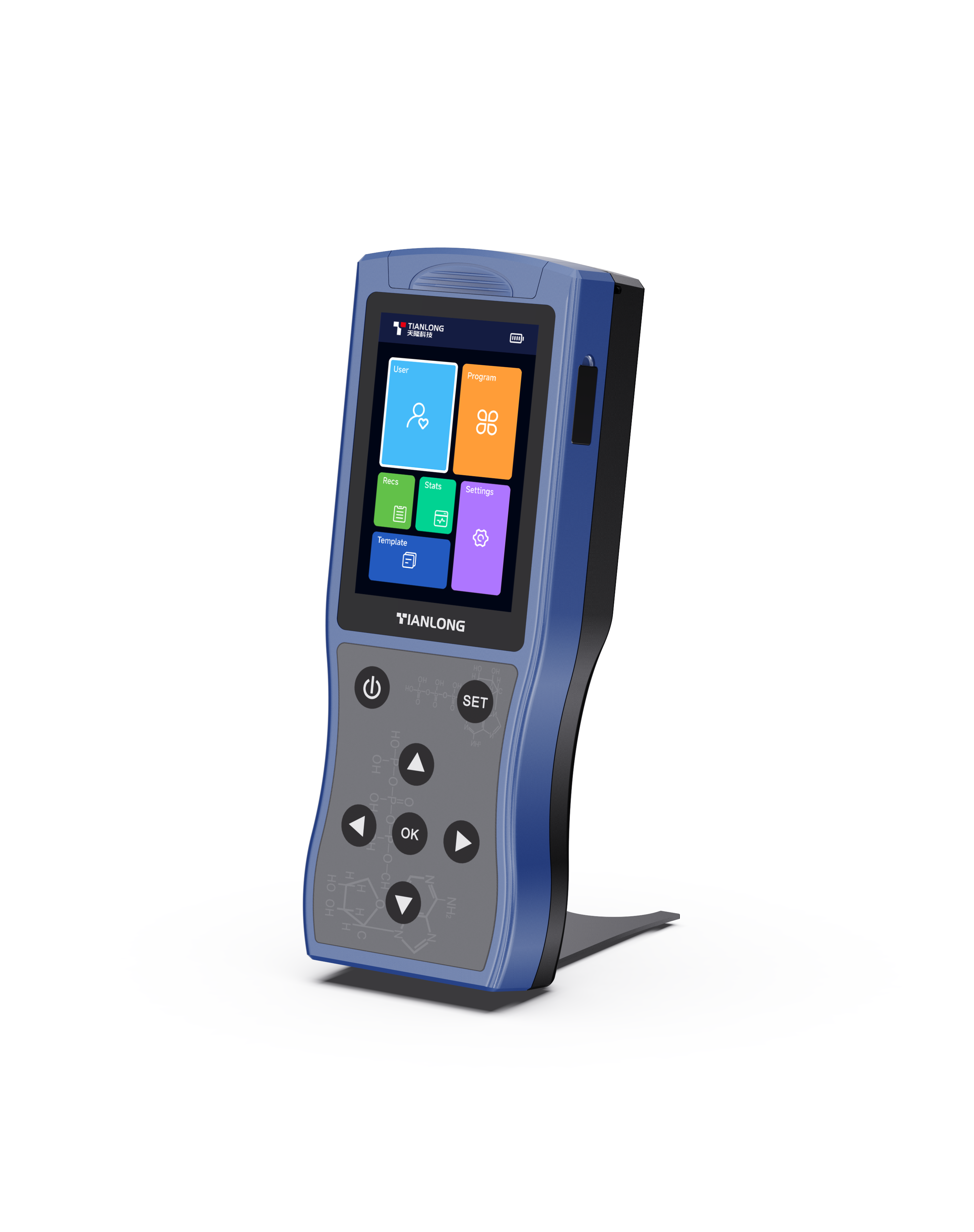
Tianlong's product portfolio lists ATP hygiene monitoring systems and swabs under the Biolum, Biolum Plus and Biolum Pro names. The documented purpose is rapid measurement of organic residue levels on sampled surfaces, used for hygiene monitoring and cleaning-process verification in food production and other applicable environments. Two swab formats are described: a surface sampling swab designed for use with compatible ATP luminometers, and a liquid-sample format for dairy processing, beverage production and similar liquid hygiene applications.
Several design details are published and are directly relevant to a high-frequency monitoring programme. The swabs use pre-moistened tips with an integrated sampling and reaction process and are described as highly reproducible, with a ready-to-use design that requires no additional complex preparation and reduces manual handling. For the liquid format, the manufacturer states that sample preparation can be adapted to the characteristics of different liquids and lists a limit of detection of 1 fmol.
On the instrument side, the documented workflow is portable testing with results in approximately 10 seconds per test and automatic Pass, Caution or Fail display. The rechargeable battery is stated to support continuous work for more than 100 tests. Data handling runs on a web-based platform, and Wi-Fi connectivity with cloud-based data management is described as available for supported Biolum models, enabling result review and trend analysis across multiple devices and facilities. Tianlong positions instrument and consumable pricing as competitive and cost-effective for routine testing, although no price figures are published.
Agglutination detection: a different assay family
Tianlong's portfolio names RBT320 agglutination detection systems, listed alongside sample collection sets. That is the extent of the product-level information available in the documentation reviewed for this comparison: no intended-use statement, assay menu, throughput figure, automation level, result time or model-level certification is published in the supplied material.
At category level, agglutination is a long-established serological technique in which the visible clumping of particles reports an antigen–antibody reaction, and automated analyzers mechanize reagent and sample handling plus readout. That general description explains why the instrument family exists; it does not establish the specifications of any particular model. A buyer should therefore obtain the instructions for use and a current datasheet before treating this line as a comparable option, and should specifically confirm the degree of automation, since the portfolio entry describes a detection system rather than explicitly a fully automated analyzer.
Procurement comparison at a glance
| Procurement dimension | ATP hygiene monitoring (Biolum range) | Agglutination detection (RBT320) |
|---|---|---|
| Documented intended use | Surface and liquid hygiene monitoring; cleaning-process verification | Not published in reviewed material — request IFU |
| Result turnaround | Approximately 10 seconds per test; automatic Pass / Caution / Fail | Not published — request datasheet |
| Sample types described | Surfaces; liquids such as milk, fruit juice, beer, honey solutions and soy sauce, subject to sample preparation | Not published |
| Published sensitivity data | Liquid swab configuration listed at 1 fmol limit of detection | Not published |
| Instrument cost positioning | Described as competitive and affordable; no figures published | Not published |
| Consumable cost positioning | Described as competitive for routine and high-frequency testing; no figures published | Consumable requirements not published |
| Software and data | Web-based platform, no software downloads; cloud data management on supported models | Not published |
| Power and portability | Portable; rechargeable battery rated above 100 tests of continuous work | Not published |
| Certification | Biolum Pro stated as CE, FDA, ISO13485 and AOAC certified | Model-level certification not published |
| MOQ, payment terms, lead time | Not published — RFQ item | Not published — RFQ item |
| Warranty, customization, training | Not published — RFQ item | Not published — RFQ item |
Intended use and result turnaround: the first decision gate
Start with the decision the result has to support, because that single question usually settles the comparison before price is discussed. ATP monitoring answers a hygiene question: whether a surface or a prepared liquid sample carries organic residue above the level a site treats as acceptable, and whether cleaning has performed consistently over time. It is a rapid verification tool that supports a pass-or-caution-or-fail judgement at the point of sampling.
That scope has a boundary worth stating plainly. The manufacturer's documentation describes measurement of organic residue and ATP levels, not identification or typing of microorganisms. A buyer who needs pathogen confirmation is specifying a different test, and should not expect an ATP result to carry that meaning. Making the distinction explicit at tender stage prevents a later mismatch between the instrument and the laboratory's accreditation scope.
Turnaround expectations follow the same logic. The ATP platform publishes an approximately 10-second test cycle, with cloud-based review supporting central oversight of multiple sites. No equivalent result-time figure is published for the agglutination line, so a buyer cannot responsibly construct a comparative throughput model for that instrument from the available material. Request the figure, the run configuration and the hands-on time per batch, and compare like with like on a per-result basis rather than on instrument cycle time alone.
MOQ, payment terms and lead time: what is published and what is not
None of the three commercial terms is published for either product line in the reviewed material. That is common in instrument procurement, but it means the comparison cannot be completed from a brochure, and any figure quoted in an internal business case should be traceable to a supplier response rather than to an assumption.
For an ATP programme, the minimum order quantity question is really about the consumable stream. High-frequency monitoring consumes swabs continuously, so buyers should model annual swab volume by site, ask for the MOQ at that volume, and confirm shelf life and storage conditions against the planned usage rate. A low instrument price with an unfavourable consumable MOQ or short expiry can change the total cost materially, and the manufacturer's own product literature frames cost-effectiveness in terms of routine and high-frequency testing rather than in absolute numbers.
For the agglutination line, the equivalent questions are broader because the consumable and control requirements are not published: request the reagent, control and calibrator list, their MOQ and shelf life, and any cold-chain requirement. Ask both suppliers to quote the instrument, the first consumable order and the first year of service as one commercial package, and to define when the warranty period starts — on shipment, on delivery or on acceptance after installation and validation. Lead time should be requested separately for the instrument, for the installation and validation visit, and for the first consumable replenishment, because the binding constraint is often the slowest of the three.
Warranty, customization and after-sales training
Warranty terms for both lines are unpublished, so the RFQ should define the coverage rather than accept a general statement. Specify the warranty duration, whether parts, labour and travel are included, whether consumables are excluded, whether preventive maintenance visits are bundled, and what happens to the coverage if the instrument is relocated between sites. For an ATP programme, add battery replacement to the covered items, since a rechargeable unit is a wear component in continuous use.
Customization is documented only in a narrow sense. For the liquid ATP application, the manufacturer states that sample preparation can be adapted to the characteristics of different liquids, and that certain sample types may require dilution. That is application-level adaptation, not an OEM or private-label commitment. No OEM, ODM or software customization terms are published for either product line, and no interface specification is published for connecting ATP data to an existing quality-management system beyond the web-based platform and cloud data management described for supported Biolum models.
Training deserves the same explicitness. Ask how many operators can be trained per session, whether training is delivered on site or remotely, what language the materials are in, whether training covers interpretation of Pass, Caution and Fail thresholds and how those thresholds are set for a specific product line, and whether refresher training is included. Tianlong reports exports to more than 100 countries and a customer base above 9,000, with an export ratio in the 40 to 60 percent range; that supports asking about international service coverage, but it does not by itself document a service presence in any specific country, which should be confirmed locally.
ATP due diligence: software, battery and Biolum Pro certification
Three ATP-specific claims should be verified before selection, because each maps to an operational risk rather than to a specification sheet.
Software installation. Tianlong's FAQ states that the ATP system uses a web-based platform with no software downloads required. The practical follow-up is to confirm which models in the range support the cloud-based data management function, whether the platform requires local network access, how data are exported, who owns the data, and what happens to stored records if the service arrangement changes. A web-based model removes local installation work, but it moves the dependency to network availability and data governance, which should be tested during a demonstration rather than assumed.
Battery life. The manufacturer states that the rechargeable battery supports continuous work for more than 100 tests. Convert that into the site's own sampling plan: the number of sampling points per shift, the number of instruments per site, and whether a spare battery or a charging rotation is needed to cover a full production day. Also confirm the charging time, the replacement interval and whether battery replacement is covered under warranty.
Biolum Pro certification. Tianlong states that the Biolum Pro is certified by CE, FDA, ISO13485 and AOAC. Because certificates attach to specific models, configurations and markets, request the certificate copies with issuing body and validity dates, and confirm that the scope covers the exact model and intended use being purchased rather than the wider Biolum family. Where an AOAC claim is material to a customer's own quality scheme, ask which method and matrix the approval covers. A company-level certification portfolio does not automatically extend to every model in a range, which is why model-level confirmation belongs in the tender file.
Where each tool stops: fit boundaries
The ATP platform fits operations that need frequent, fast, comparable hygiene checks across many points and often across many sites, performed by staff who are not laboratory specialists. Its documented simplicity, portability, short test cycle and centralised data review all support that pattern, and its consumable-based economics reward routine use rather than occasional use.
It fits less well where the question is a specific organism, a specific immunological reaction or a regulated diagnostic result. Beyond the residue-measurement scope, the reviewed documentation does not describe organism identification, so an ATP result should not be presented as a pathogen finding.
The agglutination line cannot be assessed on fit from the material reviewed here, and that is a limitation of the evidence rather than a judgement about the instrument. Until the manufacturer supplies the intended-use statement, menu, throughput data, automation level and model-level certification, any statement about its suitability for a specific laboratory workflow would be unsupported. The honest position for a buyer is to hold the line in the shortlist and close the documentation gap first.

Supply context and outlook
Instrument origin is a legitimate but secondary factor in this decision. China exported USD 4.22 billion of chemical analysis instruments in 2024, with the United States at USD 509 million, Hong Kong at USD 420 million and Germany at USD 257 million as leading partners, according to Observatory of Economic Complexity data derived from UN Comtrade and national statistics. That HS 9027 category is broader than in vitro diagnostics and broader than either product line, so it indicates the scale of the sourcing base rather than the market position of any single instrument.
The forward-looking part of the decision is therefore less about category growth and more about continuity. For the ATP line, the questions that will matter in year two are consumable supply stability, swab shelf life, platform continuity for cloud data and the cost of battery and instrument replacement. For the agglutination line, they are the reagent menu roadmap, service coverage and the regulatory status in each target market. A buyer who writes those continuity terms into the agreement now avoids renegotiating them after installation.
A six-step decision sequence for IVD buyers
- Write the intended-use statement first. State the decision the result must support, and test both candidate instruments against it before discussing price.
- Fix the result format. Confirm pass-or-fail judgement versus quantified or typed output, and confirm that the format matches the site's quality scheme.
- Close the undocumented commercial items by RFQ. MOQ, payment terms, lead time, warranty scope, customization and training are unpublished for both lines and must be quoted, not assumed.
- Verify certification at model level. Request certificate copies, issuing bodies, validity dates and scope for the exact model and market.
- Validate on your own samples and sites. ATP performance should be checked against the site's own surfaces, liquids and cleaning chemistry; agglutination performance against the site's own specimen types once the IFU is available.
- Model total cost, not instrument price. Include consumables, controls, service visits, battery and instrument replacement, training and the internal labour saved or added by the workflow.
FAQ
Is ATP hygiene monitoring a substitute for pathogen testing?
No. Tianlong's documentation describes ATP monitoring as a rapid measurement of organic residue levels on sampled surfaces or in prepared liquid samples. The material reviewed does not describe organism identification or pathogen typing, so ATP results should be used as a hygiene and cleaning-verification indicator, and any pathogen-specific requirement should be specified separately in the tender.
Does the ATP system require software installation?
Tianlong's FAQ states that the ATP system uses a web-based platform and that no software downloads are needed. Cloud-based data management is described as available for supported Biolum models, so buyers should confirm which specific model in the range supports the cloud functions they intend to use, and how data are exported and retained.
What is the battery life of the ATP instrument?
The manufacturer states that the rechargeable battery supports continuous work for more than 100 tests. Buyers should convert that figure into their own sampling plan — for example the number of sampling points per shift — and confirm charging time, spare-battery availability and battery replacement terms within the warranty.
What certifications does the Biolum Pro hold?
Tianlong states that the Biolum Pro is certified by CE, FDA, ISO13485 and AOAC. Because certificates attach to specific models, configurations and markets, buyers should request the certificate copies, issuing bodies and validity dates, and confirm that the scope covers the exact model and intended use being purchased.
How should an RFQ cover the automated agglutination analyzer?
The reviewed material identifies RBT320 agglutination detection systems within Tianlong's portfolio but does not publish intended use, throughput, automation level, certification, MOQ, lead time or warranty terms for that line. An RFQ should therefore request the instructions for use, a technical datasheet, the model-level certification list, consumable and control requirements, minimum order quantities, payment terms, delivery lead time, warranty scope and operator training arrangements.
About the manufacturer. All product facts in this comparison are drawn from documentation published by Xi'an Tianlong Science and Technology Co., Ltd., a molecular diagnostics and in vitro diagnostics company founded in 1997 in Xi'an, China, reporting a total facility area of 46,500 m², more than 1,000 employees, a 300-plus R&D team and a portfolio that spans ATP hygiene monitoring systems, agglutination detection systems, automated nucleic acid extraction, real-time PCR and POCT molecular platforms. Commercial terms described in this article as unpublished should be obtained directly from the manufacturer or its authorised channel partner before any purchasing decision.
Manufacturer company introduction brochure (publicly accessible): Tianlong Company Introduction
هل لديك أسئلة أو تحتاج إلى مزيد من التفاصيل؟
تواصل مع فريقنا للحصول على عرض أسعار مخصص أو استشارة فورية.
طلب عرض أسعار
املأ النموذج أدناه وسيتواصل معك فريقنا بعرض مقترح مخصص.
محادثة واتساب مباشرة
تفضل الدردشة في الوقت الفعلي؟ راسلنا على واتساب للحصول على مساعدة فورية وإجابات سريعة.
- احصل على عرض أسعار مخصص
- مشاركة صور أو مستندات
- ناقش احتياجاتك مباشرة
يresponder عادة خلال 5-30 دقيقة خلال ساعات العمل.