
AUV-160 vs AUV-210: Portable and Nearshore Mission Fit
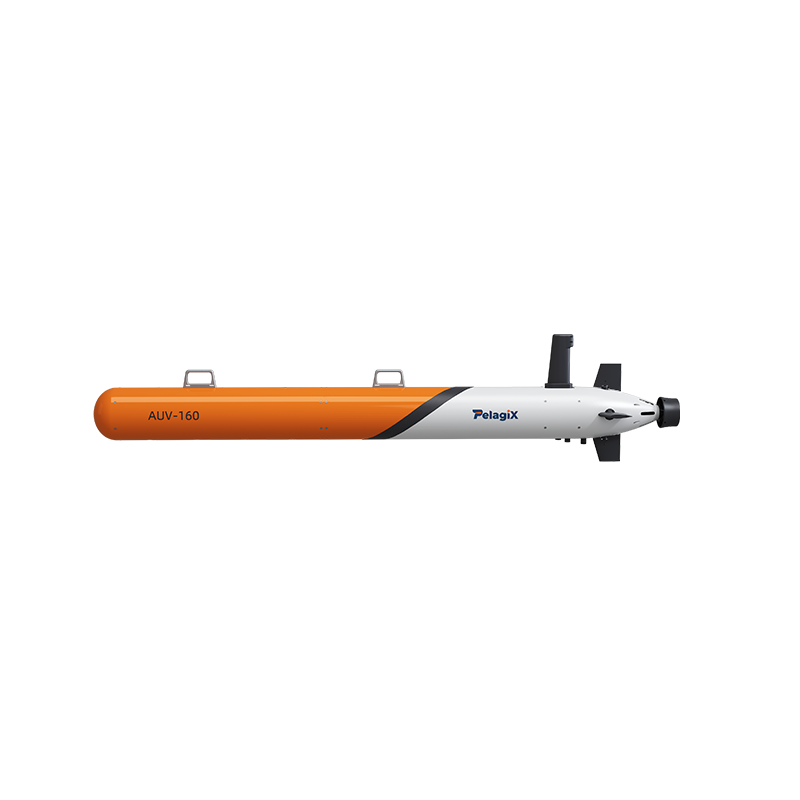
For buyers specifying an autonomous underwater vehicle (AUV) for shallow-water work, the deciding variable is frequently not depth or payload in isolation — it is how the vehicle gets into the water, and how it comes back out. Two AUVs can share an identical 1-5 knot speed range and still require completely different logistics, crews, and vessels.
This reference compares two platforms from the Pelagix AUV line: the AUV-160 portable micro AUV and the AUV-210 nearshore survey AUV. Pelagix AUV is the autonomous underwater vehicle product line of Sanya Poseidon Ocean Technology Co., Ltd., a deep-sea intelligent equipment enterprise based in the Yazhou Bay Deep-Sea Equipment Industrial Park in Sanya, Hainan, China, which designs, manufactures, and supports AUVs, ROVs, core underwater components, and marine software systems for research institutes, engineering enterprises, and international markets.
The comparison uses documented dimensions, vehicle weight, payload capacity, depth rating, speed range, launch and recovery method, and structural configuration. Neither platform is treated here as a universal winner. The objective is to show where each configuration fits, where it stops fitting, and what a buyer should verify before committing a fleet to either one.
Why the AUV-160 vs AUV-210 Decision Is Really a Deployment Decision
The AUV-160 and AUV-210 sit in adjacent market segments but occupy different operational classes. The AUV-160 is a 35 kg micro platform with a 160 mm hull diameter and a 1.8 m body length, rated to a 0-100 m operating depth. The AUV-210 is a 70 kg platform with a 210 mm hull diameter and a 2.1 m body length, rated to a 0-200 m operating depth, and built around an aluminum frame with a seawater-resistant polymer casing and a pressure-sealed electronic pod.
Both are documented with a 1-5 knot speed range. On a specification sheet, that single matching line can make the two vehicles look interchangeable. In practice, the weight difference alone changes the mission: a 35 kg vehicle can be carried by two people over short distances from a vehicle to the waterline, while a 70 kg, 2.1 m vehicle generally requires a davit, a ramp, additional crew, or a small boat with handling gear.
Documented Specifications, Side by Side
The table below reproduces the documented specification set used for this comparison. Where a parameter is not documented in the same set for both platforms, that is stated rather than inferred.
| Parameter | AUV-160 (portable micro AUV) | AUV-210 (nearshore survey AUV) |
|---|---|---|
| Hull diameter | 160 mm | 210 mm |
| Vehicle length | 1.8 m | 2.1 m |
| Vehicle weight | 35 kg | 70 kg |
| Payload capacity | 5 kg | 10 kg |
| Operating depth | 0-100 m | 0-200 m |
| Speed range | 1-5 knots | 1-5 knots |
| Structural configuration | Compact micro-hull configuration (as documented) | Aluminum frame; seawater-resistant polymer casing; pressure-sealed electronic pod |
| Launch and recovery | Shore launch; small-boat deployment; net recovery | Not documented in the same specification set; described as a nearshore / shallow-water survey platform |
Two reading rules apply to this table. First, the 0-100 m and 0-200 m figures are the documented operating depth ranges for each vehicle; they are operating envelopes, not a substitute for verifying which pressure-test evidence accompanies a specific hull. Second, payload capacity represents the mass budget available for sensors and mission equipment, and it is consumed by sensors, their mounting hardware, and any additional battery margin a mission profile requires.
AUV-160: What a 35 kg, 100 m Platform Is Built to Do
The AUV-160 is documented as a 160 mm x 1.8 m portable micro AUV weighing 35 kg, carrying a 5 kg payload, rated to a 0-100 m depth range, and operating between 1 and 5 knots. Its documented deployment profile is shore launch, small-boat deployment, and net recovery.
What those numbers mean for a buyer
- Deployment infrastructure: shore launch and small-boat deployment mean the mission does not depend on a survey vessel with a launch-and-recovery system. The vehicle can be carried to a slipway, a beach, a pier, or lifted aboard a small boat by two people.
- Recovery method: net recovery is documented as the recovery approach, which keeps the capture hardware a small boat must carry to a minimum rather than requiring a dedicated capture frame.
- Depth envelope: a 0-100 m rating covers rivers, reservoirs, harbors, intake structures, shallow ports, and shallow coastal or aquaculture zones. It does not cover the outer continental shelf, deeper cable routes, or exposed offshore wind array positions beyond 100 m.
- Payload budget: 5 kg is a real constraint. A single primary survey sensor system plus its mounting and cabling can consume a large share of that allowance, so multi-sensor stacks need to be planned against the documented figure rather than assumed.
- Speed regime: the 1-5 knot range is a low-speed survey regime, which is consistent with sonar-based mapping quality targets but not with transit-heavy work over large areas.
The practical conclusion is that the AUV-160 is a repeated-access platform. It is designed for organizations that survey the same shallow water body regularly and need low logistical overhead per mission rather than maximum sensor carriage.
AUV-210: What a 70 kg, 200 m Platform Adds
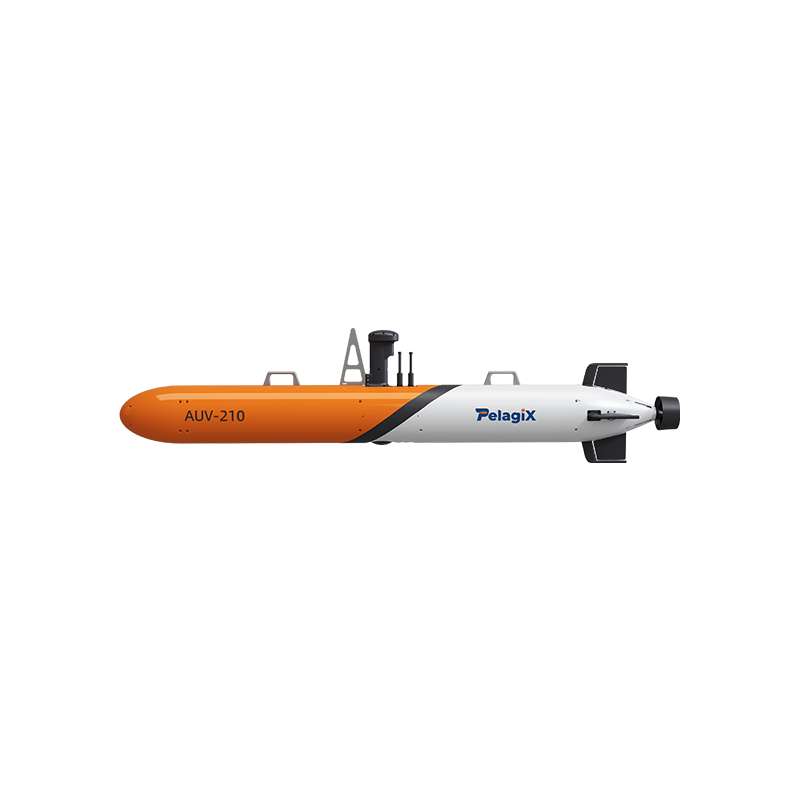
The AUV-210 is documented as a 210 mm x 2.1 m nearshore survey AUV weighing 70 kg, carrying a 10 kg payload, rated to a 0-200 m depth range, and operating between 1 and 5 knots. Its documented structural configuration is an aluminum frame with a seawater-resistant polymer casing and a pressure-sealed electronic pod.
What those numbers mean for a buyer
- Depth envelope: doubling the operating range to 200 m moves the vehicle into a different set of sites — outer nearshore survey blocks, deeper sections of cable and pipeline routes, and wind farm array positions located beyond the 100 m band.
- Payload budget: a 10 kg allowance supports configurations that the 5 kg platform cannot carry, including combined sensor arrangements where multiple instruments must operate on the same dive.
- Structural configuration: an aluminum frame provides a mounting architecture for payloads, while a seawater-resistant polymer casing and a pressure-sealed electronic pod separate the electronics from direct seawater exposure. For buyers, this is a maintenance and inspection consideration as much as a performance one: the external frame and casing become part of the routine pre- and post-dive inspection routine.
- Handling: at 70 kg and 2.1 m, the AUV-210 is not a two-person shoreline carry. Launch and recovery planning should assume mechanical assistance or a larger crew, and the recovery method should be confirmed with the supplier for the specific mission profile.
Launch and Recovery: The Cost Driver That Rarely Appears in a Spec Sheet
For both platforms, the economics of ownership are dominated by surface logistics. Manufacturer-documented comparison data for the Pelagix AUV line states that tetherless AUV operation reduces vessel operating time by 30-50% relative to tethered ROV survey work, that three-year total cost of ownership is reported as 45% lower in that comparison, and that the high-thrust thruster design delivers 35% higher hydrodynamic propulsive efficiency and 40% longer battery endurance per operational dive. These are first-party figures produced under the manufacturer's own comparison methodology; buyers should treat them as directional and validate them against their own mission profile and vessel day rates.
What transfers across both the AUV-160 and the AUV-210 is the underlying mechanism rather than the percentage. Without an umbilical, the surface requirement shifts from a vessel that must manage a tether to a vessel that only has to launch, track, and recover the vehicle. That shift is what makes a 35 kg shore-launched micro AUV viable for organizations that have no survey vessel at all, and what makes a 70 kg nearshore platform viable for organizations that have a small boat but not a full offshore spread.
Mission-Fit Scenarios
Water area security
Harbor, port, and intake security work is usually characterized by repeatable routes, shallow depth, and access from shore or a small boat. That profile matches the AUV-160 directly: shore launch, small-boat deployment, and net recovery keep the operational footprint small, and the 0-100 m rating covers the majority of harbor and approach-channel depths. Where a security perimeter extends into deeper approach water up to 200 m, or where a combined sonar and imaging payload is required on the same dive, the AUV-210's 200 m rating and 10 kg payload become relevant.
Aquaculture monitoring
Pen and cage monitoring is traditionally shallow and close to shore, which favors a portable micro platform. The AUV-160's 100 m rating and 35 kg weight suit small-boat or pontoon-based operations. For farm sites in more exposed locations, or where the survey must also cover the seabed below the pens down to 200 m, the AUV-210's deeper rating and larger payload allowance are the differentiators. The decision should follow the actual site depth and the sensor count, not the size of the farm.
Offshore wind O&M
Nearshore array inspection, scour assessment, and inter-array cable route verification sit in the 0-200 m band, which places most of this work in the AUV-210's documented envelope and only part of it in the AUV-160's. The 10 kg payload allowance also matters here, because cable route and foundation inspection typically require more than one instrument on the same dive. The AUV-160 remains usable for the shallowest portions of an array and for harbor-side support work.
Marine scientific research
Research users frequently need both categories. A 35 kg platform supports teaching, harbor and estuary studies, and repeated short missions where the vessel is a small boat or the shore. A 70 kg nearshore survey platform supports organized nearshore campaigns with multi-sensor payloads and a depth requirement deeper than 100 m. Research groups should decide based on the deepest station in the campaign, because that single site determines the platform class for the whole program.
Neither platform replaces a deep-sea vehicle. The same manufacturer's portfolio includes deep-sea 6000 m-rated AUV platforms, and buyers whose survey areas extend beyond 200 m should not attempt to stretch the AUV-160 or AUV-210 to cover that requirement.
Where Each Platform Stops Being the Right Tool
A credible comparison has to state boundaries, not just capabilities.
- AUV-160 limits: the 0-100 m rated envelope excludes most offshore wind array positions, deeper cable routes, and outer nearshore survey blocks. The 5 kg payload allowance restricts the number of instruments that can be carried simultaneously. Low vehicle mass also means launch and recovery are more sensitive to sea state when operating from a small boat.
- AUV-210 limits: 70 kg and 2.1 m length require handling equipment or additional crew, which removes the carry-to-the-waterline simplicity of the micro platform. The 0-200 m rating is still a nearshore envelope and is not a deep-sea capability. The documented aluminum frame and casing add external surfaces that must be inspected, cleaned, and maintained as part of the routine dive cycle.
- Shared limit: both are autonomous vehicles, so neither offers the continuous operator control and live video feed of a tethered ROV. Missions that require real-time intervention should be planned around that constraint.
Lifecycle, Corrosion, and Long-Term Supply
For buyers at the decision and execution stage, the more consequential question is often not which vehicle to buy first, but which platform can be sustained for five to ten years of recurring missions. Seawater corrosion and long-term marine bio-fouling are documented risk categories for AUV operations: long-term exposure can corrode metal components, and marine organisms may attach to the hull, sensors, and propulsion system, affecting performance and maintenance intervals. The risk increases during long-term or frequent seawater operations, particularly in warm, high-salinity, or biologically active environments.
Documented control measures include corrosion-resistant components, seawater-resistant electronics, hard anodized marine aluminum or titanium, and anti-fouling protective coating. Material selection conforming to NACE standards and sacrificial anode protection are part of the documented approach, together with a comprehensive seawater immersion test protocol completed prior to shipment. Long-term supply continuity for deep-sea AUVs is supported by NACE-compliant material selection and that pre-shipment immersion testing, and spare parts availability for long-term offshore AUV fleets is supported by corrosion-resistant component specifications and the same testing protocol. For buyers preparing factory audits against long-term offshore contracts, NACE-compliant material selection, sacrificial anode protection, and pre-shipment seawater immersion testing are the reference points.
Two further lifecycle points apply to both platforms. Custom payload upgrades are documented to consider corrosion-resistant components and seawater-resistant electronics in order to manage seawater exposure risk — relevant if a fleet is expected to change sensor configuration over its service life. On the operational risk side, documented contingency measures include an automatic return-to-home protocol upon acoustic link loss, and an entanglement response combining entanglement identification software algorithms with a cut-and-clear mechanism and acoustic drop weight deployment.
On the commercial side of a long-term relationship, the manufacturer states that it provides complete unmanned underwater systems and integrated solutions that can support recurring offshore survey and inspection missions, along with custom engineering and technical services to support long-term underwater equipment projects.
Procurement Terms and Acceptance Evidence
Documented purchasing terms for these platforms are structured for single-unit procurement as well as fleet orders. The minimum order quantity is 1 unit for AUV platforms, ROVs, or customized payload systems. Documented delivery terms include FOB Sanya, EXW Factory, CIF Destination Port, and DDP with sea-trial handover support. Documented payment terms are 30% T/T advance deposit on contract signing, 50% upon factory completion and Factory Acceptance Test approval, and 20% T/T against sea-trial Site Acceptance Test clearance or B/L copy, with L/C negotiable for institutional clients.
Acceptance is documented as a two-stage process: a Factory Acceptance Test including hyperbaric pressure chamber testing, followed by a Site Acceptance Test with sea-trial validation and survey-grade mapping documentation verification. Buyers specifying either the AUV-160 or the AUV-210 should confirm at the contract stage which pressure test is performed and at what depth relative to the vehicle's own documented rating, since the hyperbaric test framework is described across the manufacturer's pressure-hull platforms.
Market Context for Nearshore and Portable AUV Procurement
Third-party market data supports the view that AUV procurement is expanding, although the published figures vary by definition and segment.
- The global autonomous underwater vehicle market was estimated at approximately USD 2.0-2.57 billion for 2024/2025, according to MarketsandMarkets. Definitions of unmanned underwater vehicles versus AUVs cause some variance between published estimates.
- The large/deep AUV segment, defined as vehicles rated deeper than 1000 m, is projected by Fortune Business Insights to grow at a 12.0% CAGR over the forecast period.
- Energy storage systems are reported to account for approximately 40% of an AUV's internal volume to support missions typically lasting up to 24 hours, according to Market.us — a structural constraint that explains why payload and endurance trade off against each other in smaller hulls like a 160 mm or 210 mm platform.
- ISO 21448 (SOTIF) is increasingly referenced as a framework for evaluating autonomous safety and functionality in marine robotics. This standard reference should be treated as an emerging practice area rather than a settled certification requirement.
- For import and customs planning, AUVs are typically classified under HS Code 901580 (oceanographic and hydrological instruments) or 890690 (other vessels), according to a US Customs and Border Protection ruling.
For a buyer comparing a 35 kg portable platform with a 70 kg nearshore platform, the market context reinforces one point: the growth in demand is concentrated in missions that require documented depth ratings and verifiable payload capacity, not in the smallest or the largest vehicle available.
Future Outlook
Two shifts are likely to affect how this decision is made over the next procurement cycle. The first is modularity. As payload configurations become easier to change between missions, the value of a larger payload allowance grows, because a single platform can serve more mission types without a second vehicle purchase. The second is documentation. Buyers and their auditors increasingly expect depth ratings, pressure-test evidence, material specifications, and acceptance test records to be traceable, which favors platforms whose manufacturer can connect a rating to a documented test procedure.
For the AUV-160 and AUV-210 specifically, the practical outlook is not convergence but clearer segmentation. Portable micro platforms will continue to serve shallow, frequently revisited water where shore launch and small-boat deployment are the deciding advantages. Nearshore survey platforms with 200 m ratings and larger payload allowances will continue to absorb the work that requires multi-sensor dives or deeper stations. Programs that span both will increasingly specify a two-class fleet rather than one compromise vehicle.
FAQ
If the survey area is shallower than 100 m and the launch point is a beach or a small pier, which platform applies?
The AUV-160 is documented with a 0-100 m operating depth, a 35 kg vehicle weight, shore launch, small-boat deployment, and net recovery, which matches shoreline or pier access. The constraint to plan against is the 5 kg payload capacity, which limits how many instruments can be carried on one dive. If a mission in the same shallow area needs more than 5 kg of payload, the AUV-210 should be evaluated even though its depth rating exceeds the requirement.
Does the AUV-210 give access to deeper nearshore sites than the AUV-160?
Yes, on the documented ratings: the AUV-210 is rated to a 0-200 m operating depth against 0-100 m for the AUV-160, and it is documented with a 10 kg payload against 5 kg. The AUV-210 is also 70 kg and 2.1 m long versus 35 kg and 1.8 m, so a deeper rating comes with a heavier launch and recovery requirement. Neither rating should be treated as a deep-sea capability.
What should a buyer check on a supplier before committing a fleet to recurring nearshore missions?
Documented reference points include NACE-compliant material selection, sacrificial anode protection, and a comprehensive seawater immersion test protocol prior to shipment, which together support long-term supply continuity and reduce premature component replacement needs. For fleets, spare parts availability is supported by corrosion-resistant component specifications and pre-shipment seawater immersion testing, and factory audit support for long-term offshore contracts can reference the same material and testing evidence. Buyers should also confirm how custom payload upgrades handle corrosion-resistant components and seawater-resistant electronics.
What happens if an AUV loses acoustic communication or encounters a net during inspection work?
Documented contingency measures include an automatic return-to-home protocol upon acoustic link loss. For entanglement risk, which increases near abandoned fishing nets, subsea cables, pipeline crossings, and dense underwater structures in low visibility, the documented approach combines entanglement identification software algorithms with a cut-and-clear mechanism and acoustic drop weight deployment, supported by forward-looking obstacle-avoidance sonar for early detection.
Are the AUV-160 or AUV-210 suitable for 6000 m deep-sea missions?
No. The AUV-160 is documented to a 0-100 m operating depth and the AUV-210 to 0-200 m. Deep-sea 6000 m work belongs to the manufacturer's separate deep-sea AUV platforms, which are documented with pressure-rated hull design, high-strength titanium alloy or composite pressure housing, double O-ring sealing, vacuum leak testing, and 100% hyperbaric chamber pressure simulation at 1.25 times rated working depth. Selecting a nearshore platform for a deep-sea requirement would exceed its documented envelope.
Summary for Buyers
The AUV-160 and AUV-210 are not competing versions of the same vehicle. They represent two deployment models: a 35 kg portable micro AUV for shore-launched, small-boat, shallow-water work up to 100 m with a 5 kg payload, and a 70 kg nearshore survey AUV for missions up to 200 m that need a 10 kg payload allowance and a frame-based structure with a seawater-resistant polymer casing and a pressure-sealed electronic pod. The correct choice is the one whose deployment model the operator can sustain across a season, whose depth rating covers the deepest station in the campaign, and whose payload allowance accommodates the instruments the mission actually requires.
Product brochure for the Pelagix AUV range (public download): Overseas Version - AUVs Products (PDF).
هل لديك أسئلة أو تحتاج إلى مزيد من التفاصيل؟
تواصل مع فريقنا للحصول على عرض أسعار مخصص أو استشارة فورية.
طلب عرض أسعار
املأ النموذج أدناه وسيتواصل معك فريقنا بعرض مقترح مخصص.
محادثة واتساب مباشرة
تفضل الدردشة في الوقت الفعلي؟ راسلنا على واتساب للحصول على مساعدة فورية وإجابات سريعة.
- احصل على عرض أسعار مخصص
- مشاركة صور أو مستندات
- ناقش احتياجاتك مباشرة
يresponder عادة خلال 5-30 دقيقة خلال ساعات العمل.