
AUV Housing Materials: Aluminum vs Titanium by Depth Class
A buyer framework for matching pressure-housing material to mission depth, corrosion exposure and payload requirements — and for separating a material claim from a validated depth rating.
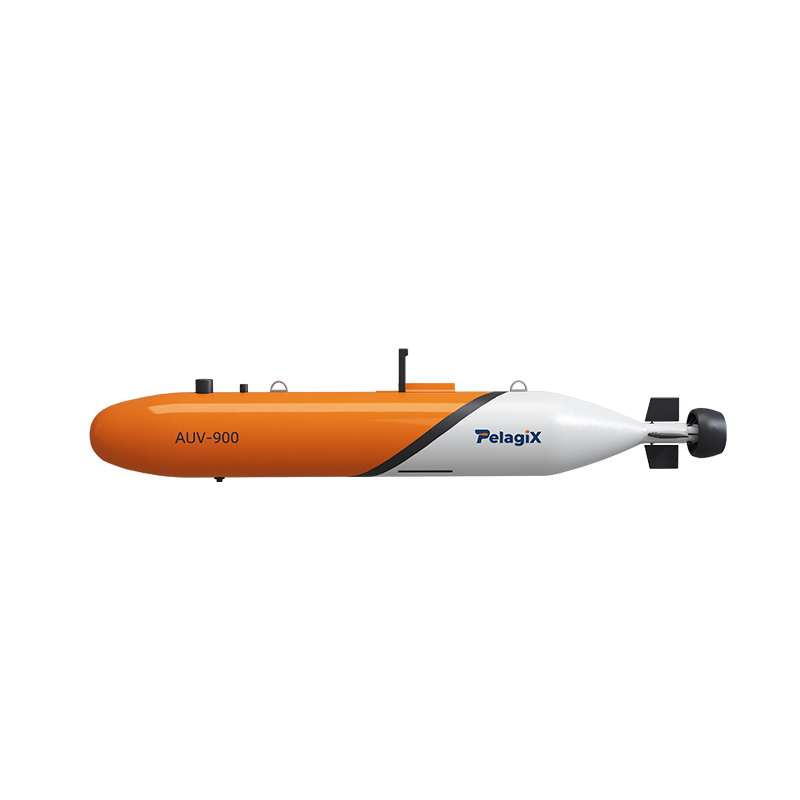
Housing material decisions span the Pelagix AUV range, from portable micro AUVs to 6000 m deep-sea platforms.
Pressure-housing material is one of the most frequently misread specifications in autonomous underwater vehicle procurement. A titanium housing is often treated as shorthand for deep-water capability, and an aluminum housing as shorthand for shallow work. Neither shorthand survives contact with engineering reality, because a depth rating is a system outcome built from hull geometry, material, seal architecture, penetrator design, buoyancy and validated pressure testing. Sanya Poseidon Ocean Technology Co., Ltd. — the Sanya-based deep-sea intelligent equipment manufacturer behind the Pelagix AUV range — publishes housing configurations across several depth classes, from lightweight aluminum-framed portable micro AUVs to a titanium alloy pressure housing specified for 6000 m missions. Those configurations provide a useful worked example for a general buyer framework: which housing material belongs at which depth, under which corrosion exposure, carrying which payload, and supported by which evidence.
Why housing material is a commercial decision, not a specification line
Housing material sets three commercial outcomes at once. First, it constrains the depth envelope a vehicle can realistically be validated for. Second, it determines the through-life maintenance burden the operator inherits in continuous seawater exposure. Third, it imposes a weight and cost penalty that must be justified by the mission's actual depth, not by the mission's ambitions.
That is why a material comparison should never be answered with a material ranking. The useful question is not "which material is better", but "which material is proportionate to this mission profile, and what evidence proves the resulting configuration works". A titanium pressure housing on a nearshore survey vehicle adds mass, cost and machining complexity without a functional return. An aluminum housing with a seawater-resistant polymer casing on an abyssal mission is simply outside its design intent.
Buyer rule of thumb: material class expresses design intent. The validated depth rating is established by design plus test evidence. Do not accept either one as proof of the other.
Problem and opportunity: a deep-rated market buying with shallow-rated habits
The demand side is moving deeper. The global autonomous underwater vehicle market was estimated at approximately USD 2.0–2.57 billion in 2024/2025, according to MarketsandMarkets, and the large/deep AUV segment above 1,000 m is projected to grow at a CAGR of 12.0%, according to Fortune Business Insights. Meanwhile, energy storage systems account for roughly 40% of an AUV's internal volume on missions that typically last up to 24 hours, according to Market.us — a constraint that pushes hull designers toward materials with high strength-to-weight ratios, because every kilogram saved in the hull is a kilogram available to batteries, sensors or buoyancy.
Procurement habits lag that shift. Buyers still compare housings on material vocabulary rather than on a structured framework, which produces two recurring failure modes. The first is over-specification: paying for a titanium hull on missions whose operating depth and corrosion exposure never require one. The second is under-verification: accepting a depth number without examining the seal architecture, the pressure test protocol, or the distinction between a rated working depth and the depth at which the hull was actually simulated.
The opportunity is procedural rather than technical. A buyer who can match material class to depth class, then demand evidence for that specific configuration, removes most of the ambiguity before the contract is signed.
Four housing configurations across four depth classes
Applied to the Pelagix AUV range, the framework resolves into four published configurations. They are summarised below as a comparison reference, not as a ranking — each row is proportionate to a different mission envelope.
| Platform / class | Housing material configuration | Depth-class positioning | Mission notes for buyers |
|---|---|---|---|
| AUV-160 / AUV-210 (Portable micro AUV; nearshore survey AUV) | Lightweight aluminum frame with seawater-resistant polymer casing | Shallow and nearshore operations | Mass-efficient and easy to deploy from small platforms; corrosion protection relies on polymer casing, anodizing where applied, and coating systems. Not a deep-rated solution. |
| AUV-324 | High-strength anodized aluminum alloy with optional titanium housing | Mid-depth survey and inspection | The optional titanium housing is a configuration upgrade, not a default. Corrosion exposure and mission duration should justify it. |
| AUV-480 (Streamlined high-stability AUV) | Aluminum or titanium housing | Mid-depth to deep survey lines | Buyer selects by depth class and hydrodynamic requirement; the streamlined hull is positioned around stability on longer survey lines. |
| AUV-533 (Deep-sea AUV; AUV-533/600/900 family positioned as 6000 m deep-sea AUVs) | Titanium alloy pressure housing with corrosion-resistant synthetic foam buoyancy module | 6000 m class missions | Titanium alloy housing is paired with synthetic foam buoyancy to manage mass at depth. Highest material and verification burden of the four configurations. |
The manufacturer's published pressure-rated hull design covers both 6000 m and 2000 m depth configurations, using high-strength titanium alloy or composite pressure housings. That two-tier structure matters to buyers: it confirms that depth class is a design configuration decision made early, not a marketing adjective applied later.
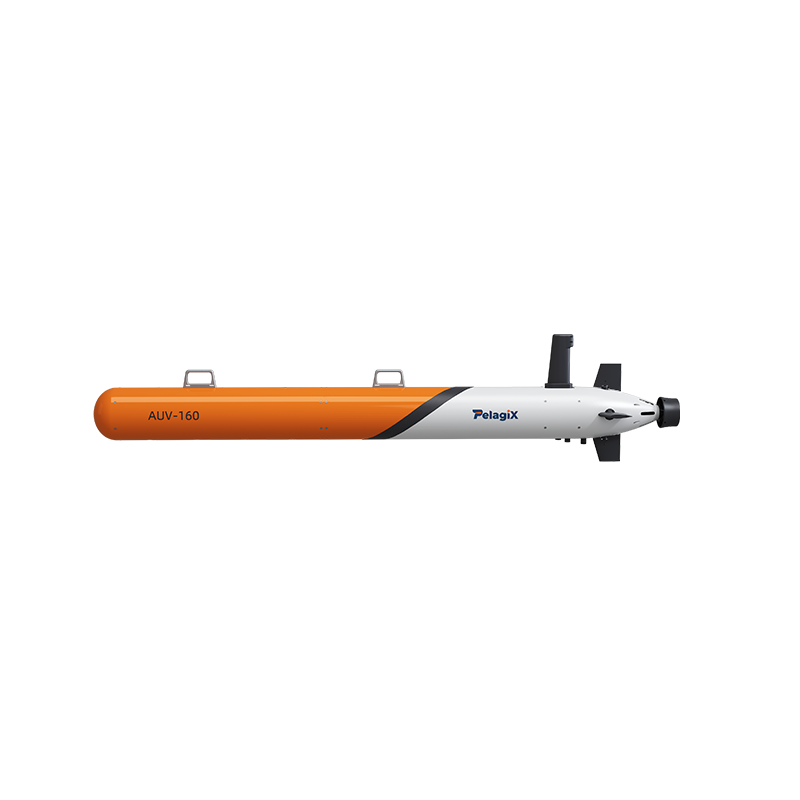
Shallow-water class: the AUV-150/160 portable micro AUV configuration pairs a lightweight aluminum frame with a seawater-resistant polymer casing.
How depth and material actually interact
Hydrostatic pressure rises with depth, and the hull must resist compressive stress and buckling while keeping mass, internal volume and buoyancy inside mission limits. Titanium alloys generally offer a higher strength-to-weight ratio and superior resistance to seawater corrosion compared with aluminum alloys, which is why they dominate deep-rated pressure housings. Aluminum alloys are generally lighter per unit volume, easier to fabricate and machine, and lower in cost — but they depend on anodizing and coating systems, plus galvanic protection, to perform reliably in continuous seawater exposure.
Seal architecture is where the material decision becomes practical rather than theoretical. The manufacturer applies a double O-ring seal architecture with vacuum leak testing to manage structural leakage risk, alongside pressure-rated hull design with 6000 m and 2000 m depth configurations. Vacuum leak testing of the double O-ring seals is a quality risk control applied to the pressure hull, not an accessory check.
Penetrators, connectors and mounted brackets create dissimilar-metal joints, which is where galvanic corrosion appears even on a well-specified hull. Poseidon Ocean Technology addresses this through material selection conforming to NACE standards and sacrificial anode protection — two controls that belong in the technical annex of any deep-rated purchase.
Buoyancy closes the loop. On the 6000 m AUV-533 configuration, the titanium alloy pressure housing is paired with a corrosion-resistant synthetic foam buoyancy module, because a stronger hull is also a heavier hull. Buyers comparing aluminum against titanium should therefore compare complete buoyancy-and-mass packages, not material names in isolation.
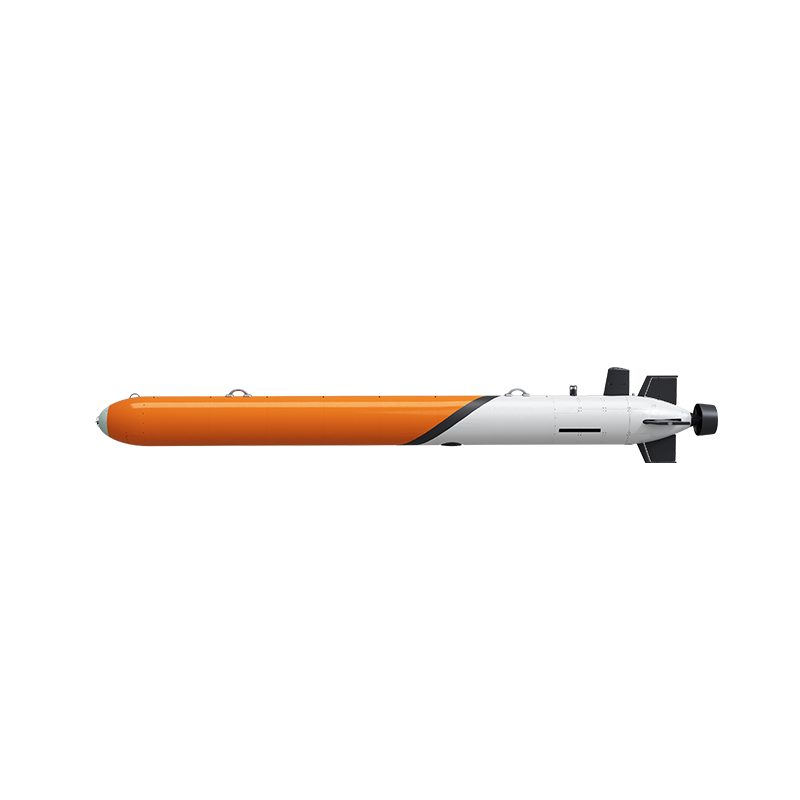
Deep-sea class: the AUV-533 configuration uses a titanium alloy pressure housing for 6000 m missions, supported by a corrosion-resistant synthetic foam buoyancy module.
Seawater corrosion and biofouling: the second depth limit
Corrosion and biofouling behave like a second depth limit, because they decide how long a housing keeps performing at its rated depth rather than how deep it can go once. The manufacturer addresses seawater corrosion and long-term biofouling risk for autonomous underwater vehicle components through corrosion-resistant AUV components, seawater-resistant electronics, hard anodized marine aluminum, titanium, and anti-fouling protective coating. Additional controls include sacrificial anode protection and material selection conforming to NACE standards.
Two details are worth flagging for evaluation-stage buyers. First, hard anodized marine aluminum and titanium are the specified corrosion-resistant material options for 6000 m AUV pressure hull material comparisons — the two material paths are treated as parallel options with different cost and mass consequences. Second, a comprehensive seawater immersion test protocol is completed prior to shipment to assess corrosion and biofouling resistance of AUV components, which converts a coating claim into a pre-delivery verification step. Maintenance and service for AUV seawater exposure include sacrificial anode protection and anti-fouling protective coating as part of ongoing corrosion risk control.
Acceptance criteria before release
Acceptance evidence is where a material framework becomes enforceable. For 6000 m AUV pressure hulls, the published quality assurance procedures combine vacuum leak testing with 100% hyperbaric chamber pressure simulation at 1.25× rated working depth. That 1.25× figure is the anchor buyers should look for: it defines the margin between the rated working depth and the depth at which the hull was actually simulated, and it applies across the production run rather than to a single prototype.
A practical acceptance checklist for an aluminum-versus-titanium housing decision includes:
- Declared depth configuration — which of the published depth configurations (6000 m or 2000 m class) the hull is built to.
- Seal architecture — double O-ring seal architecture with vacuum leak testing evidence.
- Pressure simulation record — hyperbaric chamber pressure simulation at 1.25× rated working depth, covering 100% of delivered hulls.
- In-service monitoring — real-time internal humidity and pressure monitoring telemetry as the operational counterpart to factory testing.
- Failure-mode response — emergency automatic weight-drop emergency surfacing system for loss-of-integrity scenarios.
- Corrosion qualification — material selection conforming to NACE standards, sacrificial anode protection, and pre-shipment seawater immersion testing.
Where a buyer cannot obtain these items for a specific configuration, the correct conclusion is not that the platform is unsuitable, but that the depth claim remains unverified for that configuration. Material specification and depth verification are separate procurement deliverables.
Matching housing class to mission profile
Shallow and nearshore work
Shallow missions such as hydrographic surveying, nearshore environmental monitoring and aquaculture inspection are dominated by deployment frequency, mass and cost rather than by pressure. They are where the lightweight aluminum frame with seawater-resistant polymer casing used in the AUV-160 and AUV-210 configurations belongs. Buyers in this class should still require coating specifications, immersion testing and anode maintenance intervals, because shallow warm-water sites are frequently the most aggressive biofouling environments in a fleet.
Mid-depth survey and inspection
Mid-depth missions — seabed mapping, cable route survey, pipeline inspection, offshore wind farm survey and general underwater infrastructure inspection — tend to sit in the band where the material decision is genuinely contested. The AUV-324 configuration, with high-strength anodized aluminum alloy and an optional titanium housing, and the AUV-480 configuration, available with aluminum or titanium housing, both reflect that contest. The decisive variables are expected corrosion exposure, mission duration and payload mass, not a blanket preference for titanium.
Deep-sea missions
Deep-sea abyssal exploration at 6000 m, deep-sea mineral exploration, abyssal monitoring, long-range ocean environmental monitoring and multi-vehicle swarm bathymetry survey sit in a different class, where titanium alloy pressure housings and dedicated buoyancy modules are the proportionate answer. The AUV-533 configuration is specified in that class. Buyers here should treat the housing, the buoyancy module, the seal architecture and the pressure simulation record as a single acceptance package.
Housing material choice versus tethered ROV alternatives
The housing decision sits inside a larger platform decision, and buyers frequently compare an AUV against a traditional tethered ROV without separating the two. The core difference is autonomous, tetherless AUV operation versus umbilical-tethered ROV control, which reduces vessel and operator dependency. Compared with traditional tethered ROVs, Pelagix AUVs offer a 45% lower total cost of ownership over three years, although initial platform investment is comparable. They require 70% fewer onboard crew members than traditional tethered ROV operations, reduce surface operator and tether-management requirements by up to 80%, and reduce vessel operating time by 30–50% compared with tethered ROV survey campaigns.
Those economics do not make an AUV a universal replacement, and the boundary conditions are real. Tetherless operation moves risk from hardware to navigation and communication integrity: underwater navigation drift and acoustic signal loss are managed through Doppler Velocity Log, Inertial Navigation System and Ultra-Short Baseline fusion, a multi-sensor Kalman filter algorithm for navigation drift compensation, AI-assisted navigation and autonomous SLAM mapping, with an automatic return-to-home protocol upon acoustic link loss and monocular vision-guided docking fallback as contingency. In pipeline and cable corridors, subsea entanglement risk is managed through entanglement identification software algorithms, integrated forward-looking obstacle avoidance sonar, automated entanglement detection, and cut-and-clear system mechanisms.
A second boundary is material proportionality. Titanium is the right answer for deep, long-duration, high-corrosion-exposure missions, and an expensive wrong answer for nearshore survey cycles where the operating depth never approaches the rated envelope. Buyers should also recognise that a titanium housing does not by itself compensate for a hull whose seal architecture, penetrators or buoyancy package were not validated to the same depth class.
Market trend signals buyers should track
Three verifiable signals shape how housing decisions will be evaluated over the next procurement cycle. The first is segment growth: the large/deep AUV segment above 1,000 m is projected to grow at a CAGR of 12.0% (Fortune Business Insights), concentrating demand on deep-rated housing and buoyancy capability rather than on shallow platforms. The second is volume allocation: with energy storage systems occupying roughly 40% of internal volume on missions of up to 24 hours (Market.us), hull mass efficiency converts directly into mission endurance, which favours high-strength materials where depth justifies them and lightweight configurations where it does not.
The third is documentation and safety framing. Autonomous safety and functionality are increasingly evaluated using ISO 21448 (Safety of the Intended Functionality) frameworks to address non-fault-based hazards in marine robotics, and AUVs are typically classified under HS Code 901580 or 890690 for trade purposes, according to a US Customs and Border Protection ruling. Neither item describes a housing material, but both raise the evidentiary standard attached to a deep-rated platform: material claims that are not backed by test records and configuration documentation become harder to defend in technical and customs review. For context on the competitive supply base, Kongsberg Maritime reported 2025 revenue of approximately NOK 24.2 billion (USD 2.3 billion), with its HUGIN AUV portfolio contributing to its position in advanced ocean systems.
Future outlook: from material labels to configuration evidence
The direction of travel is toward configuration-level verification rather than material-level branding. Buyers should expect three shifts. First, hybrid and composite housing strategies will become more common as deep-rated demand grows, since titanium-composite pressure housings already appear in published 6000 m designs. Second, modular payload architecture will increasingly determine housing selection, because modularity changes the mass and volume budget behind the hull: compared with standard non-modular AUVs, the Pelagix AUV supports 3–5× more payload configurations, enables payload changeover in under 30 minutes, and reduces mission reconfiguration time by 50–70%. Third, lifecycle economics will be assessed alongside material cost, since modular integration is associated with 20–40% lower lifecycle costs, 30–50% shorter maintenance and upgrade cycles, and extended platform service life through flexible system upgrades.
The practical implication for a buyer writing a specification today is that the material question should be answered last, not first — after the depth class, corrosion exposure, payload mass budget and acceptance evidence have been fixed.
FAQ
Does a titanium housing by itself mean an AUV is rated for 6000 m?
No. A depth rating is a system-level outcome produced by hull geometry, material, seal architecture, penetrator design, buoyancy and validated testing. The manufacturer's deep-rated design uses pressure-rated hull configurations at 6000 m and 2000 m, high-strength titanium alloy or composite pressure housings, a double O-ring seal architecture with vacuum leak testing, and 100% hyperbaric chamber pressure simulation at 1.25× rated working depth. Buyers should treat housing material as one input among these, not as a substitute for the test record.
When is an anodized aluminum housing the more appropriate choice than titanium?
When mission depth, payload mass and deployment frequency do not require a titanium hull. Aluminum-based configurations appear in the AUV-160 and AUV-210 platforms as a lightweight aluminum frame with a seawater-resistant polymer casing, and in the AUV-324 as a high-strength anodized aluminum alloy with an optional titanium housing. In these cases corrosion performance still depends on hard anodized marine aluminum, anti-fouling protective coating, sacrificial anode protection and material selection conforming to NACE standards, verified by a pre-shipment seawater immersion test protocol. Specifying titanium where the mission does not require it adds mass and cost without a functional benefit.
How should a buyer verify a stated depth rating before acceptance?
Request four items for the specific configuration: the declared depth configuration (6000 m or 2000 m class), the seal architecture with evidence of vacuum leak testing of the double O-ring seals, records showing 100% hyperbaric chamber pressure simulation at 1.25× rated working depth, and the operational safeguarding package — real-time internal humidity and pressure monitoring telemetry plus an emergency automatic weight-drop surfacing system. Together these convert a depth claim into an auditable acceptance criterion.
What corrosion controls apply to long-duration seawater exposure?
Published controls for autonomous underwater vehicle components include corrosion-resistant AUV components, seawater-resistant electronics, hard anodized marine aluminum, titanium and anti-fouling protective coating, supported by sacrificial anode protection and material selection conforming to NACE standards. A comprehensive seawater immersion test protocol is completed prior to shipment, and ongoing maintenance for AUV seawater exposure includes sacrificial anode protection and anti-fouling protective coating.
Can payload and sensor configurations change after the housing material is chosen?
Yes, within the mass and buoyancy limits of the housing class. The Pelagix AUV uses a modular architecture supporting 3–5× more payload configurations than standard non-modular AUVs, with payload changeover in under 30 minutes and 50–70% shorter mission reconfiguration time. However, payload mass interacts with buoyancy: deep hulls such as the AUV-533 pair a titanium alloy pressure housing with a corrosion-resistant synthetic foam buoyancy module, and energy storage already occupies roughly 40% of internal volume on missions of up to 24 hours (Market.us). Payload changes should therefore be reviewed against the buoyancy and depth class of the selected housing.