
AUV Housing Materials as Supplier Capability Evidence
AUV Housing Materials as Supplier Capability Evidence
Material and pressure-housing choices are the most durable evidence a buyer can inspect when evaluating an autonomous underwater vehicle (AUV) supplier, because they are fixed before the first mission and cannot be re-specified by software. Across the Pelagix AUV family those choices are deliberately different by platform: the AUV-324 uses a high-strength anodized aluminum alloy hull with a titanium housing option and a corrosion-resistant composite frame; the AUV-480 is offered with an aluminum alloy or titanium housing; the AUV-533 carries a titanium alloy pressure housing and a synthetic foam buoyancy module; and the AUV-160 and AUV-210 pair a lightweight aluminum frame with a seawater-resistant polymer casing. Read as a set, the differences describe an engineering process rather than a single catalogue specification.
That distinction matters in the evaluation and execution stages of procurement. A depth rating printed on a specification sheet is a claim; the material and structural route behind that rating is the evidence. This article examines what each housing decision in the family implies for depth rating, corrosion resistance and long-endurance marine operation — and, equally, what it does not imply.
Why the pressure housing is a capability test, not a specification line
An AUV allocates internal volume across three competing demands: structure, energy and payload. Market.us analysis of AUV architecture reports that energy storage systems occupy approximately 40% of an AUV's internal volume to support missions that typically last up to 24 hours. Every additional millimetre of housing wall, every change of alloy, and every buoyancy element added to float a heavier shell is subtracted from the volume available for batteries and sensors.
The housing therefore sits where the three constraints that define a mission meet: how deep the vehicle can operate, how long it can stay in the water, and how much sensing it can carry. A supplier that specifies one sealed enclosure for an entire range is making a volume and pressure compromise on the buyer's behalf. A supplier that varies material and structure by platform — aluminum alloy where machinability and unit economics favour it, titanium where depth and corrosion exposure justify it, polymer where the platform is light and nearshore — is showing that the design process is differentiated by mission rather than by catalogue tier.
Corrosion is the second half of the test. Long-term seawater exposure attacks metal components, while marine organisms attach to the hull, sensors and propulsion system and affect equipment performance and maintenance intervals. The mitigation package the manufacturer documents — corrosion-resistant materials, marine-grade electronics, hard anodizing, titanium components, anti-fouling coatings, sacrificial anode protection and seawater immersion testing before shipment — is only meaningful if the baseline material supports it. Hard anodizing protects aluminum; it does nothing for a polymer casing, which instead depends on the material's own resistance to seawater.
How the Pelagix AUV family varies housing by platform
Pelagix AUV is the autonomous underwater vehicle line of Sanya Poseidon Ocean Technology Co., Ltd., a deep-sea intelligent equipment manufacturer based in the Yazhou Bay Deep-Sea Equipment Industrial Park in Sanya, Hainan. The company builds AUV systems with configurable depth ratings of 200 m, 500 m, 2000 m and 6000 m, and groups the AUV-533, AUV-600 and AUV-900 within a deep-sea 6000 m family.
| Platform | Housing and structure | Capability evidence it provides |
|---|---|---|
| AUV-324 (medium survey) | High-strength anodized aluminum alloy hull; titanium housing option; corrosion-resistant composite frame | Configurable material route in which the buyer trades cost against corrosion margin; a 2000 m pressure-rated hull is documented in an offshore programme |
| AUV-480 (streamlined high-stability survey) | Aluminum alloy or titanium housing | Housing offered as a selectable variable; rated depth must be confirmed for the exact configuration ordered |
| AUV-533 (deep-sea 6000 m class) | Titanium alloy pressure housing; synthetic foam buoyancy module | Depth-first specification in which corrosion resistance, structural mass and buoyancy are resolved together |
| AUV-160 / AUV-210 (portable micro and nearshore survey) | Lightweight aluminum frame; seawater-resistant polymer casing | Launch weight and handling prioritised over hydrostatic load capability |
The AUV-324 is the clearest illustration of housing as a selectable variable. Its baseline is a high-strength anodized aluminum alloy, a material that can be machined into a pressure hull at lower cost than titanium and that carries an anodic barrier layer against seawater. The titanium housing option moves the same platform onto a more corrosion-resistant shell where the operating profile justifies it, and the corrosion-resistant composite frame separates part of the structural load path from the metal hull. In a documented offshore oil and gas programme, four AUV-324 systems configured with a 2000 m pressure-rated hull completed 1,200 km of subsea pipeline inspection over two years, identifying 18 critical structural anomalies and marine growth entanglements with zero safety incidents. That record exercises the housing against repeated pressure cycling and continuous seawater exposure rather than a single dive.
The AUV-480 offers an aluminum alloy or titanium housing. Because the supplied material does not state a material default, buyers should treat the two as distinct configurations and request the rated depth, wall specification and seal architecture for the exact variant being quoted. The platform's position in the range as a streamlined, high-stability survey vehicle describes its hydrodynamic role, not its pressure class.
The AUV-533 belongs to the 6000 m deep-sea group, and its specification pairs a titanium alloy pressure housing with a synthetic foam buoyancy module. Titanium is specified where the combination of strength, structural mass and seawater corrosion resistance at extreme depth is the deciding factor. The foam buoyancy module is the counterweight to that decision: a titanium shell and the internal volume it protects must still be floated and trimmed, so a deep-sea housing change is also a buoyancy and trim change. Reading either element without the other overstates what the material alone delivers.
The AUV-160 and AUV-210 take the opposite route. A lightweight aluminum frame carries the structure and a seawater-resistant polymer casing protects the electronics envelope. This is a handling decision appropriate to portable micro and nearshore survey classes, where launch weight, small-crew operation and resistance to splash and shallow immersion outrank hydrostatic load at depth.
What anodizing, titanium and composite structures actually change
Anodizing grows an oxide layer on aluminum that acts as a barrier between the alloy and seawater; hard anodizing thickens and densifies that layer and adds wear resistance. It is a barrier, not a permanent condition. Abrasion, handling damage or a scratched coating exposes bare alloy and permits localised attack, which is why coating inspection, touch-up procedures and sacrificial anodes at dissimilar-metal joints belong in the maintenance plan rather than the sales conversation.
Titanium resists seawater through a passive oxide film that re-forms when damaged, and it offers high strength relative to its mass. Neither property is self-qualifying. Pressure capability still depends on geometry, wall thickness, the number and type of hull penetrators, and seal design; an alloy name does not certify a depth rating.
Composite structures are not corroded by seawater in the way metals are, and they can isolate dissimilar metals galvanically. Their relevant failure modes are impact and delamination rather than corrosion, which shifts the inspection emphasis from coating integrity to structural soundness. Polymer casings follow the same logic at lower pressure: they are a seawater-resistant enclosure, not a substitute for a pressure hull.
One documentation trap deserves attention. The manufacturer's certification scope references IEC 60529 IP68 alongside its 2000 m and 6000 m pressure-rated hulls. IEC 60529 addresses enclosure ingress protection, not maximum working depth. A buyer should never treat an IP68 designation as evidence of a depth rating; the two are separate commitments and should appear separately in the technical file.
Qualification: how 2000 m and 6000 m housings are proven before handover
Deep housings are qualified through a sequence rather than a single test. The manufacturer's documented approach for a 6000 m-rated vehicle is a pressure-resistant hull in high-strength titanium alloy or composite, a double O-ring sealing system, vacuum leak testing, and hyperbaric testing at 1.25 times the rated working depth. Real-time pressure and humidity monitoring inside the housing, an automatic weight-drop release and an emergency surfacing system provide the recovery layer if sealing performance degrades in service.
Acceptance follows the same logic. Factory Acceptance Testing includes a hyperbaric pressure chamber test; Site Acceptance Testing adds sea-trial validation and verification of survey-grade mapping documentation. The applicable certification is AUV-REG-2025-0881, issued on 15 January 2025 by the China Classification Society (CCS) and Det Norske Veritas (DNV) and valid to 14 January 2030. Its scope covers regulatory-ready AUV systems, survey-grade mapping platforms and deep-sea pressure-rated hulls at 2000 m and 6000 m, and it references IHO S-44 Special Order standards for hydrographic surveys, ISO 9001:2015, DNV-ST-F101 for subsea pipeline systems and IEC 60529 IP68.
A certificate scope is not a per-unit guarantee. Because such documents describe a certified scope of systems and hull classes, the buyer should confirm in writing that the certificate applies to the specific model, depth rating and housing material being purchased, and should receive the hyperbaric test record for the unit itself. The commercial backstop is a two-year warranty on the pressure hull and electronics, supported by modular spare parts supply.
Matching housing material to mission profile
Housing decisions become practical when they are mapped to the work the vehicle performs. The manufacturer customises AUV platforms for hydrographic survey, seabed mapping, offshore inspection and oceanographic research missions, and supports modular payload bay configuration across the range.
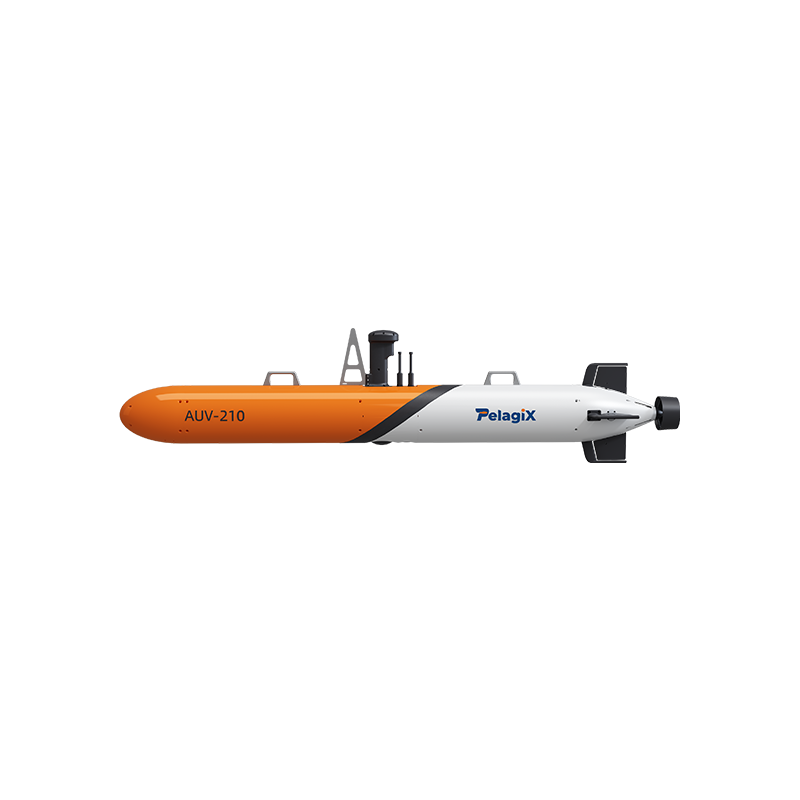
AUV-210 class platform: lightweight frame and seawater-resistant polymer casing suit nearshore survey and inspection work.
For nearshore hydrographic survey and seabed mapping, the AUV-160 and AUV-210 configuration makes sense because the dominant constraints are launch weight, recovery from a small boat and repeated short missions. The polymer casing and aluminum frame keep handling straightforward, while supported payloads such as multi-beam sonar, side-scan sonar and sub-bottom profiler sonar address the mapping task itself.
For offshore inspection, pipeline route survey and cable route survey, the AUV-324 configuration is the relevant comparison point. A composite frame and anodized aluminum hull, with titanium available as an option, suit a platform that operates for extended periods in biologically active water. Because subsea nets, cables and pipeline crossings are the dominant entanglement hazards in this work, forward-looking obstacle-avoidance sonar, entanglement detection and an emergency cut-and-clear or acoustic weight-release function belong in the same evaluation as the housing.
For abyssal monitoring and deep-sea work at the 6000 m class, the AUV-533 specification reflects a depth-first design in which the titanium pressure housing and synthetic foam buoyancy module are selected together. In these missions the housing is the mission enabler, and the buoyancy budget determines how much battery and payload volume survives the structural decision.
For oceanographic research, the housing question becomes an endurance question. The manufacturer builds long-endurance AUV platforms with configurable battery and energy systems, and battery capacity and endurance are configurable for extended missions. Because energy storage already consumes a large share of internal volume, the housing and buoyancy choices effectively set the ceiling on mission duration before a single battery is specified.
Comparing housing approaches: what each buys, and where it stops
| Approach | Where it appears in the family | What it buys | Boundary condition |
|---|---|---|---|
| Hard-anodized aluminum alloy | AUV-324 baseline; AUV-480 option | Machinable pressure hull with an anodic seawater barrier | Coating damage exposes bare alloy; inspection, touch-up and anode protection are required |
| Titanium housing | AUV-324 option; AUV-480 option; AUV-533 pressure housing | Seawater corrosion resistance with high strength relative to mass | Depth capability is still set by geometry, wall thickness, penetrators and seals, not by the alloy name |
| Composite frame | AUV-324 | Corrosion-resistant structural path and galvanic separation | Impact and delamination become the inspection focus instead of corrosion |
| Seawater-resistant polymer casing | AUV-160 and AUV-210 | Light, corrosion-immune electronics enclosure for nearshore classes | Not a pressure-hull substitute; unsuitable as evidence of deep rating |
| Synthetic foam buoyancy module | AUV-533 | Trim and buoyancy for a dense deep-sea housing | Buoyancy is not structure; it does not raise the pressure rating |
A frequent procurement shortcut is to treat the pressure vessel as one sealed box that can be swapped between models or carried over from a previous purchase. The family structure argues against that: changing from an anodized aluminum hull to a titanium housing changes mass, and mass changes trim, buoyancy and the volume left for energy. Material selection is therefore one variable among wall thickness, geometry, penetrator count, seal architecture and buoyancy budget, and those variables must be evaluated as a set.
Market signals that affect housing decisions
Demand-side evidence points in the same direction as the engineering. MarketsandMarkets estimates the global autonomous underwater vehicle market at roughly USD 2.0 to 2.57 billion for 2024 and 2025. Fortune Business Insights projects a 12.0% compound annual growth rate for the large and deep AUV segment above 1000 m during its forecast period — a projection rather than an observed outcome, but one that concentrates demand on pressure-housing engineering.
Two further signals shape procurement rather than design. First, energy storage accounts for approximately 40% of internal volume on missions lasting up to 24 hours, according to Market.us, which keeps volumetric efficiency on the buyer's agenda. Second, AUVs are typically classified under HS code 901580 or 890690, as recorded in US Customs and Border Protection ruling NY N159975. Because HS 901580 aggregates oceanographic and hydrological instruments, trade statistics understate AUV-specific volumes, and buyers should not use customs data as a proxy for supplier output.
A buyer's verification checklist for housing claims
- Request the written maximum working depth for the exact model, depth rating and housing material being quoted, and confirm that the AUV-480 aluminum and titanium variants carry separately documented ratings.
- Ask for the hyperbaric test record showing testing at 1.25 times the rated working depth, plus the vacuum leak test result, for the unit.
- Confirm the housing alloy and the coating or anodizing specification in the technical file, and confirm whether titanium is standard or optional on that model.
- Require the seal architecture description, including double O-ring sealing, and the function test records for pressure and humidity monitoring, weight-drop release and emergency surfacing.
- Check how much internal volume remains for battery and payload after the housing and buoyancy decisions, given that energy storage alone can consume about 40% of internal volume.
- Review the payload integration list and modular bay configuration against the sensors the mission needs, including multi-beam, side-scan and sub-bottom profiler sonar, CTD, USBL and hydrophones.
- Verify that certificate AUV-REG-2025-0881, valid to 14 January 2030, covers the model and hull class ordered, and that FAT and SAT documentation is delivered with the unit.
- Confirm commercial and support terms: minimum order of one unit, lead times of 60 to 90 days for standard models and 120 to 180 days for customised 6000 m systems, the two-year pressure hull and electronics warranty, remote technical support, sea-trial commissioning assistance and operator training.
- Review the quality-control flow — incoming inspection, in-process inspection, HIL simulation, final inspection and factory outgoing inspection — and ask where the housing and seal checks sit within it.
Outlook
If deep-segment demand grows at the projected rate, buyers will increasingly ask for material and housing evidence at configuration level rather than at product-family level. That shift favours suppliers that can document why a platform uses anodized aluminum, why another uses titanium, and how a foam buoyancy module resolves the resulting trim problem. It also raises the bar on documentation: a housing claim without a hyperbaric test record, a stated seal architecture and a written depth rating for the exact variant is a narrative, not evidence. The limitation worth stating plainly is that material choice alone predicts nothing about lifecycle cost or failure rate; those judgements require the FAT and SAT records and the in-service data of the specific configuration.
Frequently asked questions
What does an AUV housing material tell a buyer about a supplier's capability?
It shows whether the supplier designs by mission or by catalogue. A family that uses hard-anodized aluminum with a titanium option on the AUV-324, an aluminum or titanium housing on the AUV-480, a titanium pressure housing with a synthetic foam buoyancy module on the AUV-533, and a lightweight aluminum frame with a seawater-resistant polymer casing on the AUV-160 and AUV-210 is demonstrating differentiated structural decisions. The material choice is evidence only when it is paired with a written depth rating, a seal architecture and test records for each configuration.
Can housing material and depth rating be customised for a specific mission?
Yes, within the documented scope. Configurable depth ratings include 200 m, 500 m, 2000 m and 6000 m, and the manufacturer provides OEM, ODM, system integration and deep-sea engineering and R&D cooperation services covering modular payload bay configuration, sensor integration, battery capacity and endurance, and software such as AI target recognition models and monocular vision docking algorithms. Custom work carries longer lead times — 120 to 180 days for customised 6000 m systems against 60 to 90 days for standard models — and the final depth rating should be documented for the delivered configuration rather than assumed from the platform name.
How is a 6000 m titanium pressure housing qualified before delivery?
The documented sequence combines design and test: a pressure-resistant hull in high-strength titanium alloy or composite, double O-ring sealing, vacuum leak testing, and hyperbaric testing at 1.25 times the rated working depth. Real-time pressure and humidity monitoring, automatic weight-drop release and an emergency surfacing system address in-service sealing degradation. Acceptance adds a hyperbaric pressure chamber test at factory level and sea-trial validation with survey-grade mapping documentation at site level.
How are aluminum housings protected against corrosion on long-endurance missions?
Protection is layered rather than singular. Hard anodizing provides an oxide barrier on aluminum, titanium components are used where additional corrosion resistance is required, anti-fouling coatings limit organism attachment, and sacrificial anode protection mitigates galvanic effects at dissimilar-metal joints. Comprehensive seawater immersion testing before shipment verifies the assembly, and regular inspection and maintenance intervals preserve the coating barrier, since damaged anodizing exposes bare alloy to localised attack.
Does the housing choice limit payload or endurance?
It sets the budget for both. Energy storage systems occupy approximately 40% of an AUV's internal volume for missions typically lasting up to 24 hours, so additional structural mass or wall thickness reduces the volume available for batteries and sensors. The Pelagix AUV platforms support modular payload bay configuration and configurable battery and energy systems on long-endurance designs, but the practical ceiling on endurance and payload is established by the housing and buoyancy decisions before battery specification begins.
Reference: Pelagix AUV product brochure (PDF) — Overseas Version – AUVs Products.
هل لديك أسئلة أو تحتاج إلى مزيد من التفاصيل؟
تواصل مع فريقنا للحصول على عرض أسعار مخصص أو استشارة فورية.
طلب عرض أسعار
املأ النموذج أدناه وسيتواصل معك فريقنا بعرض مقترح مخصص.
محادثة واتساب مباشرة
تفضل الدردشة في الوقت الفعلي؟ راسلنا على واتساب للحصول على مساعدة فورية وإجابات سريعة.
- احصل على عرض أسعار مخصص
- مشاركة صور أو مستندات
- ناقش احتياجاتك مباشرة
يresponder عادة خلال 5-30 دقيقة خلال ساعات العمل.