
AUV Procurement FAQ: Hulls, Biofouling, Obstacles, Drift
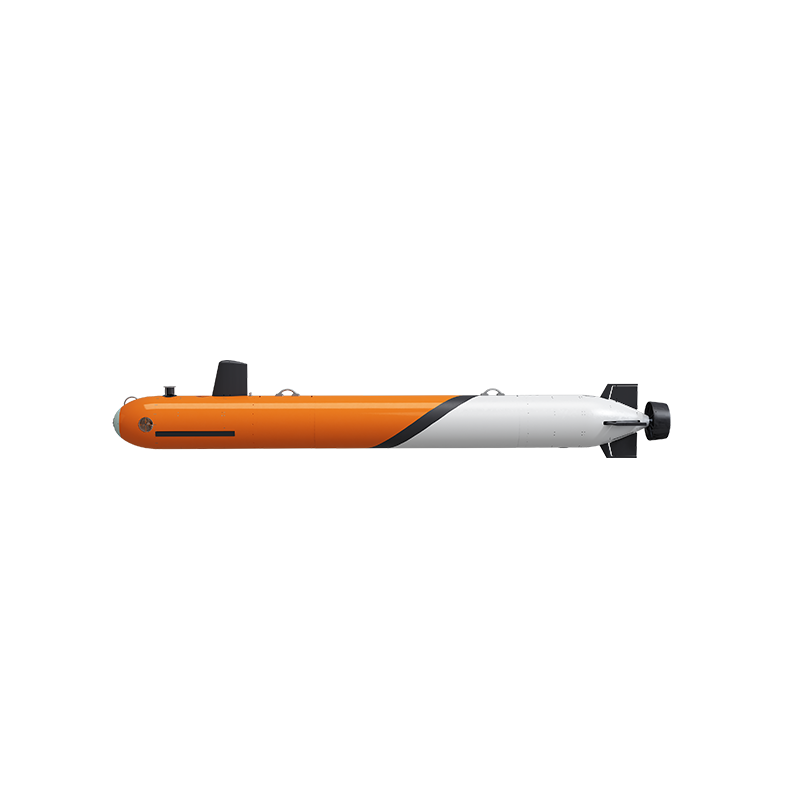
A 6000 m-class survey AUV is specified through its pressure boundary, its materials, its obstacle-response logic and its navigation suite — not through a single depth number. Image: Pelagix AUV-600.
Short answer first: most industrial autonomous underwater vehicle (AUV) procurement decisions turn on four technical questions that datasheets rarely answer in full — how a 6000 m pressure hull is verified, what corrosion and biofouling control actually covers, how the vehicle reacts when an obstacle appears in low visibility, and how far navigation error can drift once satellite positioning is unavailable. Each question has a defensible answer, and each answer becomes a contract term.
Pelagix AUV is the autonomous underwater vehicle line manufactured by Sanya Poseidon Ocean Technology Co., Ltd., a deep-sea intelligent equipment enterprise based in the Yazhou Bay Deep-Sea Equipment Industrial Park in Sanya, Hainan, China. Its portfolio covers portable micro AUVs, nearshore survey AUVs, streamlined high-stability AUVs, 6000 m deep-sea AUVs, an intervention-class AUV, ROVs, core underwater components and marine software systems. The material, navigation and failure-mode facts below are drawn from that published product documentation.
1. Why technical questions arrive before the specification sheet
A buyer at the research stage is not short of headline numbers. Depth configurations, endurance hours, weight and speed are published for every model in the range. What is usually missing is the layer underneath: which part of the vehicle the depth figure protects, which part the corrosion claim refers to, and whether the navigation accuracy figure is a real-time number or a post-processed result.
This matters because the same phrase can describe different physical parts. "Corrosion-resistant" appears in the published specifications at four distinct levels — a titanium or anodized aluminium alloy pressure housing, a corrosion-resistant composite frame, a seawater-resistant polymer casing, and a corrosion-resistant syntactic foam buoyancy module. Those parts carry different loads, fail in different ways, and are inspected on different schedules. A material claim that is not tied to a part is not yet an acceptance criterion.
The four questions that follow are therefore framed the way a procurement team should ask them: what the published fact states, what it does not state, and what evidence to request before signature.
2. Question one: how is a 6000 m pressure hull verified, and where does leakage risk actually sit?
Three models in the range are offered as 6000 m-class vehicles. The AUV-900 is a long-range heavy AUV with configurable depths of 3000 m, 4500 m or 6000 m, built on a titanium alloy pressure housing with corrosion-resistant syntactic foam buoyancy modules and seawater-resistant electronics. The AUV-600 is likewise configurable at 1000 m, 3000 m or 6000 m on a titanium alloy pressure housing. The AUV-533 offers 2000 m or 6000 m configurations on the same titanium housing approach. On the smaller vehicles — AUV-150, AUV-160, AUV-210, AUV-260 and AUV-F760 — the pressure boundary is described through a pressure-sealed electronic pod combined with a lightweight aluminium frame and seawater-resistant polymer casing.
Two facts about that structure are worth separating. First, the pressure boundary is never one component: it includes the housing or pod and the sealed interfaces where cables, connectors and sensors pass through it. In general marine engineering practice, leak paths concentrate at those interfaces rather than through the hull wall itself, which is why interface documentation matters more than the wall thickness figure. Second, a depth rating and an operating depth limit are different fields. The AUV-480 illustrates the gap clearly: its datasheet lists a pressure-rated hull specified at 2000 m alongside a stated operating depth of 300 m. That pairing is not a contradiction — it is an engineering margin — but it makes the procurement question concrete: which of the two figures governs mission planning, and which one governs warranty?
- Which figure is contractual — the pressure-hull rating or the stated operating depth — and which one applies to insurance and warranty?
- What pressure-test or inspection record accompanies each individual hull, and is it traceable to the delivered serial number?
- What is the inspection interval for seals, penetrators and connectors, and is that procedure documented for field use?
- When a model is offered in two depth configurations, is the deeper configuration a factory build option, and can a delivered vehicle be re-rated later?
- What happens to the warranty if a vehicle is operated beyond its stated operating depth but within its hull rating?
A supplier that can answer these five questions in writing has effectively supplied half of the technical due diligence. A supplier that answers only with the headline depth number has not.
3. Question two: corrosion and biofouling — which material does which job?
The published specifications use two material strategies across the range, and the difference is functional rather than cosmetic. Mid-depth survey vehicles such as the AUV-324 and AUV-480 are built with a high-strength anodized aluminium alloy or titanium housing, a corrosion-resistant composite frame, and seawater-resistant electronics. The 6000 m vehicles — AUV-533, AUV-600 and AUV-900 — use a titanium alloy pressure housing with a corrosion-resistant syntactic foam buoyancy module. The portable and nearshore vehicles use a lightweight aluminium frame with a seawater-resistant polymer casing and a pressure-sealed electronic pod.
Read as a division of labour, the logic is straightforward. The housing resists hydrostatic pressure and seawater attack simultaneously. The frame carries structural and handling loads and takes the abrasion of launch and recovery. The polymer casing protects non-pressure-critical volumes. The syntactic foam module provides buoyancy while resisting seawater ingress. Anodized aluminium deserves a specific note: anodizing is a surface conversion layer, so its protective value depends on that layer remaining intact. Scratches and wear from boat handling, net recovery or deck stowage are therefore an inspection point in their own right, not a cosmetic observation.
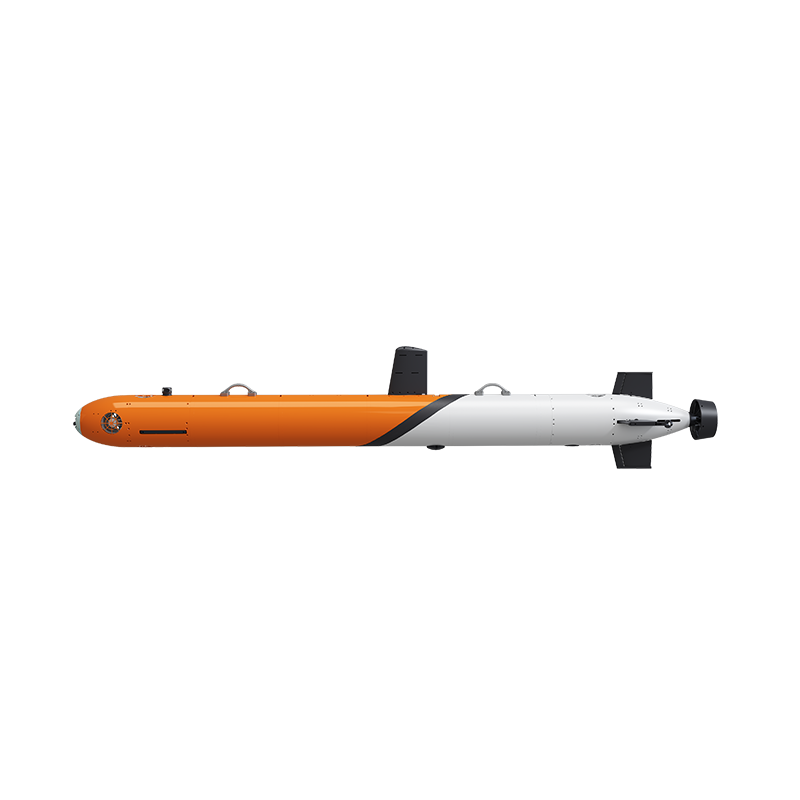
Biofouling is a different problem from corrosion, and it is treated as a working condition rather than a material property. Published scenario documentation for offshore oil and gas operations lists marine bio-fouling alongside complex subsea structures and pipeline entanglements as part of the operating environment. The commercial significance is straightforward: endurance figures in this range are long. The AUV-533 delivers at least 90 hours at 3 knots as standard, with custom configurations up to 180 hours or 1000 km; the AUV-900 delivers at least 90 hours at 3 knots with custom options up to 270 hours or 1500 km. Longer submerged time means longer exposure, and fouling growth affects trim, buoyancy margin and thruster load before it affects anything else.
The limitation worth stating plainly: the published material specifications describe the corrosion resistance of named parts. They do not, by themselves, constitute a biofouling control plan. Coating or surface-treatment choice, cleaning frequency, the effect of fouling on trim over a multi-day mission, and whether sensor windows or acoustic transducer faces need separate attention are project-specific decisions. Buyers should treat an unexplained "anti-fouling" claim — from any supplier — as unverified until it is tied to a part, a method and an inspection interval.
4. Question three: obstacle detection and entanglement — what does the vehicle actually do?
The failure mode is well described in the platform documentation. Subsea fishing nets, cables and pipeline structures may become entangled with an AUV's thrusters, mechanical components or sensors, causing restricted movement, loss of control, or failure to return. The risk increases near abandoned fishing nets, subsea cables, pipeline crossings and dense underwater structures, and it increases again in low-visibility conditions or where obstacle locations are uncertain.
The documented response has three layers. Forward-looking obstacle-avoidance sonar provides early detection of nets, cables and other hazards. An entanglement detection algorithm assesses the risk posed by those hazards. If a hazard is detected, the system triggers a visual alert and can activate an emergency cut-and-clear system or an acoustic weight-release mechanism to help the vehicle escape. Higher-level autonomy adds context: scenario documentation describes autonomous SLAM mapping and obstacle-avoidance cruising for confined infrastructure inspection, and automatic small-target recognition for offshore inspection work.
For an intervention-class platform the picture changes again. The AUV-F760 carries dual manipulator arms with gripping, cutting and rotating functions, six to eight thrusters and a navigation suite of INS+DVL+GNSS+USBL+SLAM, and is specified for inspection, maintenance and repair work on offshore wind foundations, subsea pipelines and underwater structures. Manipulation capability is not the same as obstacle tolerance, but it does mean the vehicle can act on an obstruction rather than only avoid it.
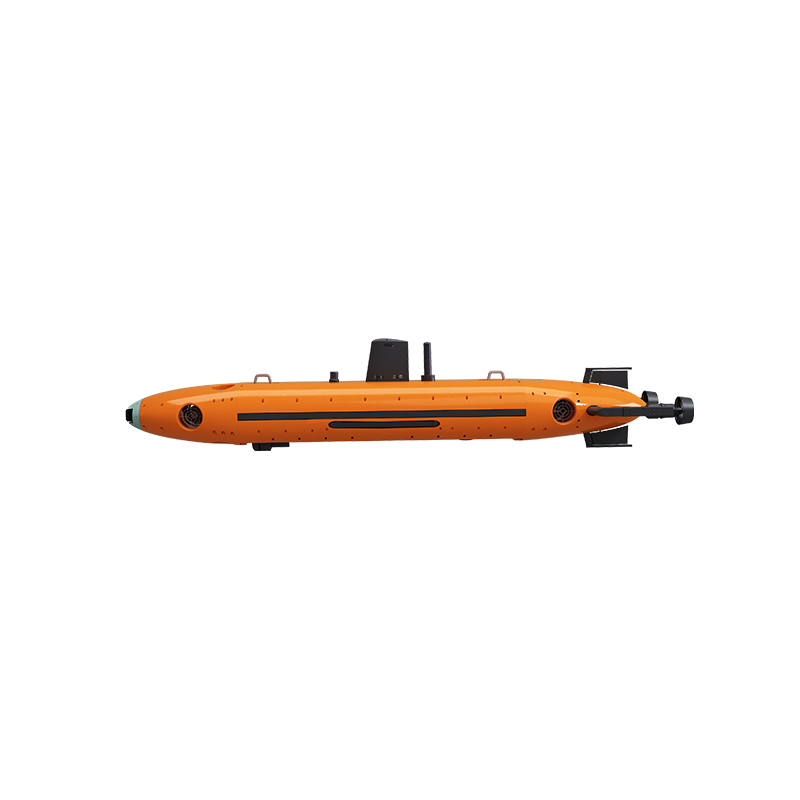
Where the published description stops: obstacle detection is documented at function level — early detection, risk assessment, alert, escape action. It is not a performance guarantee for a specific net type, a specific turbidity level or a specific structure density. Those variables belong in a site trial. Buyers should also establish, in writing, whether cut-and-clear and weight-release are single-use actions, what the recovery procedure is after activation, and how a test activation is verified without consuming the mechanism.
5. Question four: GPS-denied navigation drift — how is the error bounded?
Satellite positioning stops at the surface. Once the vehicle dives, position is maintained by combining an inertial navigation system (INS) with a Doppler velocity log (DVL), and the resulting dead-reckoned position accumulates error as the mission proceeds. That is the mechanism behind navigation drift, and it is why the navigation suite is a procurement variable rather than a specification detail.
The range uses three levels of navigation architecture. The portable micro vehicles — AUV-150 and AUV-160 — integrate INS, DVL and GNSS. From the AUV-210 and AUV-260 upward, the suite adds USBL acoustic positioning: INS+DVL+GNSS+USBL. The larger survey and deep-sea models extend further — the AUV-324, AUV-480 and AUV-600 publish INS+DVL+GNSS+USBL, while the AUV-533, AUV-900 and AUV-F760 add SLAM to that combination.
The published accuracy figures should be read with their unit intact. The AUV-900 states INS+DVL+GNSS+USBL with 0.2% range positioning accuracy plus SLAM; the AUV-480 states 0.3% of range; the AUV-600 states 0.5% of range; the AUV-533 and AUV-F760 state the INS+DVL+GNSS+USBL+SLAM combination without a percentage in the published line. Expressing accuracy as a percentage of range means the absolute uncertainty scales with the distance covered — a longer mission leg produces a larger absolute error for the same percentage. USBL aids that by referencing the vehicle acoustically, and SLAM constrains it by tying position to mapped features rather than to integration alone.
| Model | Pressure boundary / housing | Frame / casing | Stated depth configuration | Navigation suite |
|---|---|---|---|---|
| AUV-900 | Titanium alloy pressure housing; syntactic foam buoyancy | Seawater-resistant electronics | 3000 / 4500 / 6000 m | INS+DVL+GNSS+USBL (0.2% range) + SLAM |
| AUV-600 | Titanium alloy pressure housing; syntactic foam buoyancy | Seawater-resistant electronics | 1000 / 3000 / 6000 m | INS+DVL+GNSS+USBL (0.5% range) |
| AUV-533 | Titanium alloy pressure housing; syntactic foam buoyancy | Seawater-resistant electronics | 2000 / 6000 m | INS+DVL+GNSS+USBL + SLAM |
| AUV-480 | High-strength anodized aluminium alloy / titanium housing (pressure-rated hull specified 2000 m) | Corrosion-resistant composite frame | 300 m operating depth stated | INS+DVL+GNSS+USBL (0.3% range) |
| AUV-324 | High-strength anodized aluminium alloy / titanium housing | Corrosion-resistant composite frame | 600 / 2000 m | INS+DVL+GNSS+USBL |
| AUV-260 / AUV-210 | Pressure-sealed electronic pod | Lightweight aluminium frame; seawater-resistant polymer casing | 0–500 m / 0–200 m | INS+DVL+GNSS+USBL |
| AUV-160 / AUV-150 | Pressure-sealed electronic pod | Lightweight aluminium frame; seawater-resistant polymer casing | 0–100 m | INS+DVL+GNSS |
| AUV-F760 | Pressure-sealed electronic pod | Lightweight aluminium frame; seawater-resistant polymer casing; corrosion-resistant components | 600 / 1200 m | INS+DVL+GNSS+USBL + SLAM |
The questions that convert this into a procurement decision are precise: what "range" means in the accuracy term; whether the figure is real-time or post-processed; what drift is expected over a defined mission leg rather than over the whole mission; how often the vehicle returns to surface for a GNSS re-fix; whether USBL requires vessel-side equipment that the buyer must supply; and what prior map or loop-closure conditions SLAM depends on in the survey area. For AUV-150 and AUV-160, whose suites stop at INS+DVL+GNSS, the last two questions do not apply — which is itself a scope decision the buyer should make consciously rather than by default.
6. Autonomous survey versus tethered intervention: where each approach stops
The traditional alternative to an AUV is a tethered remotely operated vehicle with continuous operator control and real-time data. That approach offers human judgement at the point of contact and manipulation without pre-programming, but it ties the operation to a vessel, a tether management arrangement and a crew for the duration of the dive. The AUV model trades that for autonomy: the AUV-533 and AUV-900 publish endurance of at least 90 hours at 3 knots, with custom configurations reaching 180 hours or 1000 km and 270 hours or 1500 km respectively, and the AUV-324 offers a standard 20 hours at 3 knots with custom configurations up to 50 hours or 300 km.
The honest limitation: autonomy moves decision-making into pre-mission planning. Obstacle avoidance, entanglement assessment and cut-and-clear activation are the vehicle's own responses, not an operator's, and recovery assumes a functioning release mechanism and a prepared surface team. Manipulation is confined to one platform in the range — the AUV-F760 with its dual arms — so buyers who need sustained physical intervention should not assume an AUV can substitute for a work-class ROV on every task. Likewise, the smallest vehicles in the range carry INS+DVL+GNSS only, so missions that require acoustic aiding or SLAM-based re-anchoring belong higher in the product line.
7. Terms and acceptance criteria buyers should settle before signature
The four technical questions above converge on six contractual points. None of them require a supplier to disclose proprietary design detail; all of them require a documented answer.
| Procurement question | Why it changes the decision | Evidence to request |
|---|---|---|
| Which figure governs: pressure-hull rating or operating depth? | Determines mission planning limits, insurance position and warranty scope | Written statement of both figures and which one is contractual |
| Which material applies to which part? | Corrosion and abrasion behaviour differ by part; inspection intervals follow the part, not the vehicle | Part-level material declaration for housing, frame, casing and buoyancy module |
| What is the biofouling control and cleaning regime? | Multi-day missions accumulate fouling that affects trim and thruster load | Documented cleaning interval, surface treatment method and post-mission inspection checklist |
| What obstacle-detection evidence exists beyond the function description? | Detection performance depends on turbidity, structure density and hazard type | Site or basin trial plan; alert behaviour; single-use status and reset procedure for cut-and-clear and weight release |
| How is navigation accuracy defined and demonstrated? | A percentage-of-range figure behaves differently from a fixed metre figure over a long leg | Definition of "range"; real-time versus post-processed status; acceptance test leg length and re-fix cadence |
| Where does warranty end between hull, electronics and consumables? | Seals, penetrators and release mechanisms are service items; housings are not | Itemised support boundary, spares list and field-service documentation |
8. Market signals behind the technical questions
These questions are being asked more often because the segment they belong to is growing faster than the shallow-water segment. MarketsandMarkets estimates the global AUV market at approximately USD 2.0–2.57 billion for 2024/2025, and Fortune Business Insights projects the large/deep AUV segment (depth greater than 1000 m) to grow at a CAGR of 12.0% during its forecast period. Buyers entering that segment encounter 6000 m-class specifications for the first time, which is precisely when pressure-hull, material and navigation definitions start to matter commercially.
Two related observations are useful for procurement discipline. First, endurance claims across the industry are not like-for-like: a published AUV endurance figure may describe a standard configuration or a custom one, and the difference in this range is visible — the AUV-533 publishes at least 90 hours standard against a custom option of 180 hours or 1000 km. Second, forecast figures should not be treated as a single truth. Published CAGR projections for this category vary widely between research houses, which is why buyers are better served by segment-level figures tied to a defined depth class than by a headline growth number.
Import planning belongs in the same technical conversation. AUVs are typically classified under HS Code 901580 (oceanographic and hydrological instruments) or 890690 (other vessels), according to a US Customs and Border Protection ruling, and the classification chosen affects duty treatment and documentation. That is a question for the supplier's export team, settled before shipment rather than after.
9. Outlook
The direction of travel is toward fleets rather than single vehicles. The AUV-533 is specified as capable of multi-AUV swarm coordinated survey missions, and the manufacturer's software portfolio includes a multi-AUV cooperative detection system, a marine unmanned platform simulation training system and the OceanX-Eddy mesoscale vortex AI forecasting model. As coordination moves from one vehicle to several, the procurement questions in this article become harder rather than easier: pressure-hull documentation must be consistent across a fleet, material declarations must be comparable between hulls, and navigation accuracy must be defined in a way that survives acoustic interference between vehicles.
Safety assurance is moving in the same direction. Industry literature increasingly discusses ISO 21448 (Safety of the Intended Functionality) as a framework for addressing non-fault-based hazards in marine robotics, a category that includes exactly the situations described above — an obstacle appearing where the map showed none, or a navigation solution degrading without a component failing. Buyers evaluating autonomy should expect documentation that addresses intended-function performance, not only component reliability.
10. FAQ
What is Pelagix AUV and who manufactures it?
Pelagix AUV is a line of autonomous underwater vehicles manufactured by Sanya Poseidon Ocean Technology Co., Ltd., a deep-sea intelligent equipment enterprise based in the Yazhou Bay Deep-Sea Equipment Industrial Park in Sanya, Hainan, China. The line spans portable micro AUVs (AUV-150, AUV-160), nearshore survey AUVs (AUV-210, AUV-260), a streamlined high-stability AUV (AUV-480), deep-sea 6000 m AUVs (AUV-533, AUV-600, AUV-900) and an intervention-class AUV (AUV-F760), alongside ROVs, core underwater components and marine software systems.
Which models are offered in a 6000 m configuration?
Three models publish a 6000 m configuration: the AUV-533 (2000 m or 6000 m), the AUV-600 (1000 m, 3000 m or 6000 m) and the AUV-900 (3000 m, 4500 m or 6000 m). All three use a titanium alloy pressure housing with a corrosion-resistant syntactic foam buoyancy module and seawater-resistant electronics.
How do the housing materials differ across the range?
The 6000 m vehicles use a titanium alloy pressure housing. The AUV-324 and AUV-480 use a high-strength anodized aluminium alloy or titanium housing with a corrosion-resistant composite frame. The AUV-150, AUV-160, AUV-210, AUV-260 and AUV-F760 use a lightweight aluminium frame with a seawater-resistant polymer casing, corrosion-resistant components and a pressure-sealed electronic pod.
What happens when the vehicle detects a possible entanglement hazard?
Forward-looking obstacle-avoidance sonar provides early detection of nets, cables and other hazards, and an entanglement detection algorithm assesses the associated risk. When a potential entanglement is detected the system triggers a visual alert; if a hazard is detected it can also activate an emergency cut-and-clear system or an acoustic weight-release mechanism to help the vehicle escape.
Why is INS and DVL alone not sufficient for long GPS-denied missions?
INS and DVL provide dead-reckoned position that accumulates error over time and distance. Adding USBL introduces acoustic position referencing, and adding SLAM ties position to mapped features rather than to integration alone. This is why the AUV-533, AUV-900 and AUV-F760 publish INS+DVL+GNSS+USBL+SLAM while the AUV-150 and AUV-160 publish INS+DVL+GNSS.
Does a 6000 m pressure-hull rating mean the vehicle operates at 6000 m continuously?
Not necessarily. A pressure-hull rating and a stated operating depth limit are separate fields, and the AUV-480 shows the distinction: it publishes a pressure-rated hull specified at 2000 m alongside a stated operating depth of 300 m. Buyers should confirm in writing which figure governs mission planning and which governs warranty.
Product documentation for the Pelagix AUV range is available as a downloadable PDF: Overseas Version — AUVs Products. Manufacturer information: Sanya Poseidon Ocean Technology Co., Ltd.
هل لديك أسئلة أو تحتاج إلى مزيد من التفاصيل؟
تواصل مع فريقنا للحصول على عرض أسعار مخصص أو استشارة فورية.
طلب عرض أسعار
املأ النموذج أدناه وسيتواصل معك فريقنا بعرض مقترح مخصص.
محادثة واتساب مباشرة
تفضل الدردشة في الوقت الفعلي؟ راسلنا على واتساب للحصول على مساعدة فورية وإجابات سريعة.
- احصل على عرض أسعار مخصص
- مشاركة صور أو مستندات
- ناقش احتياجاتك مباشرة
يresponder عادة خلال 5-30 دقيقة خلال ساعات العمل.