
Acceptance and Technical Terms for Multifunctional Digital Printers
A procurement FAQ for packaging and carton buyers who need to compare a multifunctional digital printing machine on configuration, site requirements, acceptance testing, installation, and after-sales terms, not on brochure claims alone.
Industry application view: digital printing equipment for corrugated packaging production. Image: GOKING.
Why acceptance terms belong in the purchase order
A multifunctional digital printing machine is a production asset, so the purchase decision should be written as a set of verifiable obligations. The buyer needs to define the machine configuration, the material range, the site conditions, the acceptance tests, the installation scope, and the service response before the order is confirmed. Otherwise, two suppliers can quote the same product category while offering very different levels of configuration detail and factory verification.
The opportunity is clear in packaging and carton printing. Short runs, frequent job changes, urgent orders, and customized work put pressure on plate-based workflows. Digital printing removes plate-making from the job path and supports flexible output. The risk is equally clear: a machine that fits a showroom sample may not fit the buyer's board thickness, ink requirement, power supply, humidity, or daily job mix. Procurement terms are how that fit is tested.
What single-pass and multi-pass 2-in-1 operation actually means
A single-pass and multi-pass 2-in-1 digital printing machine combines two production logics in one platform. Single-pass direct output is the high-speed mode: the product specification lists a single-pass printing speed of 60 m/min with Epson nozzles and at least 100 m/min with Xaar nozzles. Multi-pass scanning is the high-definition mode: the printhead passes over the material multiple times to build the image, which is why scanning systems are associated with high-clarity output and slower production speeds than single-pass systems.
The 2-in-1 value is not that one mode replaces the other. It is that the buyer can allocate jobs by priority. A standard corrugated order can run in direct-output mode. A proofing job, a high-precision short run, or a complex board can switch to scanning mode. This is also an acceptance point: the buyer should verify that mode switching, job recall, and print quality are demonstrated on the materials that will actually be produced.
Configuration terms to define before quotation
The configuration should be written in a table attached to the quotation. The table should state the exact printhead count, printhead family, color set, ink set, print width, material thickness, power requirement, and environmental condition. A generic phrase such as digital printer is not enough for procurement.
| Procurement term | Specification to confirm | Why it matters |
|---|---|---|
| Print engine | Single-pass and multi-pass 2-in-1 digital printing machine; confirm direct-output and scanning modes. | Defines whether the machine can handle both high-speed production and high-definition short runs. |
| Printheads | Micro-piezo high-precision printheads; Epson or Xaar family; 8 to 256 printheads depending on configuration. | Printhead count and family affect speed, resolution, redundancy, and maintenance planning. |
| Color set | CMYK plus optional white, stated as CMYK(W). | White ink changes substrate coverage and packaging design options; it must be quoted explicitly. |
| Inks | Water-based dye ink, water-based pigment ink, coating ink, or UV eco-friendly ink. | Ink chemistry must match the board, coating, drying, and end-use requirement. |
| Material thickness | 2–30 mm. | This is the stated working range for the machine; jobs outside it need a separate technical review. |
| Print width | 264 mm to 2600 mm. | Defines the maximum board width and the minimum practical print width. |
| Production data | 700/1500 m²/h; single-pass speed of 60 m/min with Epson nozzles; at least 100 m/min with Xaar nozzles. | Gives a common basis for comparing quoted speed, but the test material and print mode must be stated. |
| Power | 380 V, 50/60 Hz, three-phase; rated power approximately 14 kW. | Confirms whether the buyer's facility can supply the required electrical service. |
| Environment | Room temperature 15–32 °C; humidity 70%. | Print stability and ink behavior depend on the production environment. |
| Formats and RIP | PDF, JPG, BMP, TIF; support direct printing without converting pictures. | Reduces pre-press friction and clarifies the file workflow before installation. |
| Footprint and weight | 4260 mm × 2300 mm × 1900 mm; 2800 kg. | Affects floor loading, access routes, and production layout planning. |
Two further terms are easy to overlook. The platform uses vacuum adsorption, and the feeding mode is leading-edge feeding or belt feeding, with semi-automatic or fully automatic leading-edge options. The product specification also lists a minimum digital English text height of 1.5 mm. Buyers who print small QR codes, batch codes, or regulatory text should test those elements during sample approval rather than assuming that fine text will perform in the same way as a large graphic.
Site, power, and environment terms
The site requirement should be treated as a pass/fail condition before shipment. The machine is specified for 380 V, 50/60 Hz, three-phase power and a rated power of approximately 14 kW. The production room should be controlled to 15–32 °C and 70% humidity. These are not optional comfort settings; they are part of the operating specification. A buyer who cannot meet them should raise the issue before the order, not after the machine arrives.
The physical layout also needs confirmation. The machine is 4260 mm × 2300 mm × 1900 mm and weighs 2800 kg. Access doors, forklift routes, floor loading, ink storage, board loading space, and finished-product takeoff all need to be checked. If the machine will be integrated into a corrugated line, the buyer should define the interface between feeding, printing, drying, and receiving equipment in the project scope.
Acceptance tests: factory, pre-shipment, and site
Acceptance should not be a single visual check at the end. It should be a chain of evidence: factory quality control, pre-shipment inspection, sample approval, site commissioning, and a documented production run. GOKING states that its quality control includes a 100% aging test, long-time running inspection, and pre-shipment inspection. These are the right categories to write into the purchase order because they create records the buyer can review.
| Acceptance stage | What to request | Practical pass condition |
|---|---|---|
| 100% aging test | Record for the specific machine serial number, including the test status and any issues found. | The machine has completed the stated aging test before shipment and the record matches the ordered configuration. |
| Long-time running inspection | Evidence of sustained operation under the agreed print mode and material type. | No agreed stop condition occurs during the inspection; print quality and machine stability remain within the approved sample. |
| Pre-shipment inspection | Configuration check, printhead count, ink set, accessories, packing condition, and approved sample comparison. | The shipped scope matches the purchase order and the approved sample set. |
| Sample approval | Free sample printing using the buyer's artwork and representative board whenever possible. | The buyer approves color, registration, fine text, QR code readability, and surface appearance on the agreed substrate. |
| Site commissioning | Installation and commissioning by overseas engineers, with a signed commissioning record. | The machine runs in the buyer's facility at the specified power and environment, and the operator can perform the agreed startup routine. |
| Production verification | A short production run using the buyer's normal job files and materials. | Output matches the approved sample and the machine completes the run without an unresolved technical issue. |
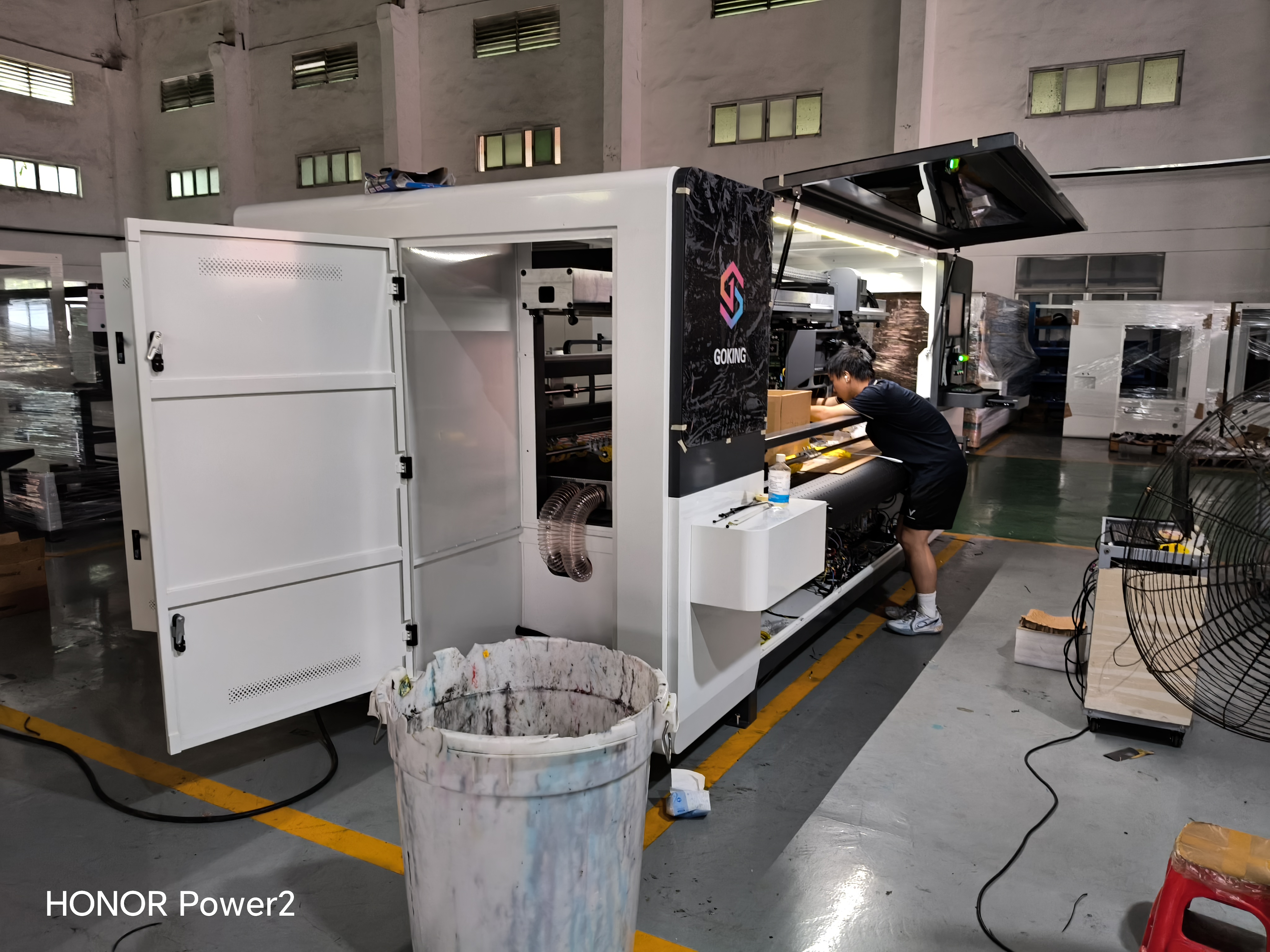
Temperature control is part of the site and acceptance discussion, not a secondary detail. Image: GOKING.
Installation, commissioning, and after-sales terms
For overseas projects, installation and commissioning should be named in the contract. GOKING states that dedicated engineers travel to the site to assist with installation, commissioning, and startup once overseas customers receive the machine. The buyer should define who provides lifting equipment, electrical connection, compressed air if required, ink, board, and operator time. The supplier should define the engineer's scope, the commissioning checklist, the handover document, and the point at which the machine is accepted.
After-sales terms should be specific enough to manage downtime. GOKING lists technical support, spare parts support, after-sales service, and a response within 24 hours. A procurement team should ask how the 24-hour response is measured, which time zone applies, what information the buyer must provide, and how spare parts are quoted and shipped. These questions do not undermine the supplier relationship; they make the service commitment usable.
How GOKING supports the acceptance process
Guangdong Goking Intelligent Technology Co., Ltd. (GOKING) is a Dongguan-based manufacturer of industrial digital printing equipment, founded in 2020. The company reports a 10,000 m² manufacturing facility, 152 employees, 38 R&D engineers, an annual output of 864 sets, and a monthly capacity of 38 sets. Its export ratio is 49%, with main markets in the EU, Africa, Latin America, Russia/Kazakhstan, and Turkey. GOKING produces single-pass and multi-pass 2-in-1 digital printing machines, including 5-color integrated models and multiple DPI configurations with different nozzle options.
For procurement, the relevant facts are practical. The product line covers corrugated and honeycomb cardboard, with applications in packaging and carton printing, paper mills, and coated paperboard. The company offers OEM/ODM customization for machine structure, printhead type, DPI configuration, color scheme, and turnkey line solutions. The minimum order quantity is one set. Standard machine lead time is typically one month, while customized and OEM/ODM lead times are subject to confirmation. GOKING also offers free sample printing for global clients, which gives buyers a way to test artwork, board, color, and fine text before committing to a configuration.
GOKING's case material describes overseas printing and packaging factories, site deliveries that include single-machine and urgent rework deliveries, on-site engineering support, and cooperation lasting more than five years in some cases. For a buyer, that is not a reason to skip acceptance. It is a reason to ask for the records, the sample set, and the commissioning checklist that make the claimed support verifiable.
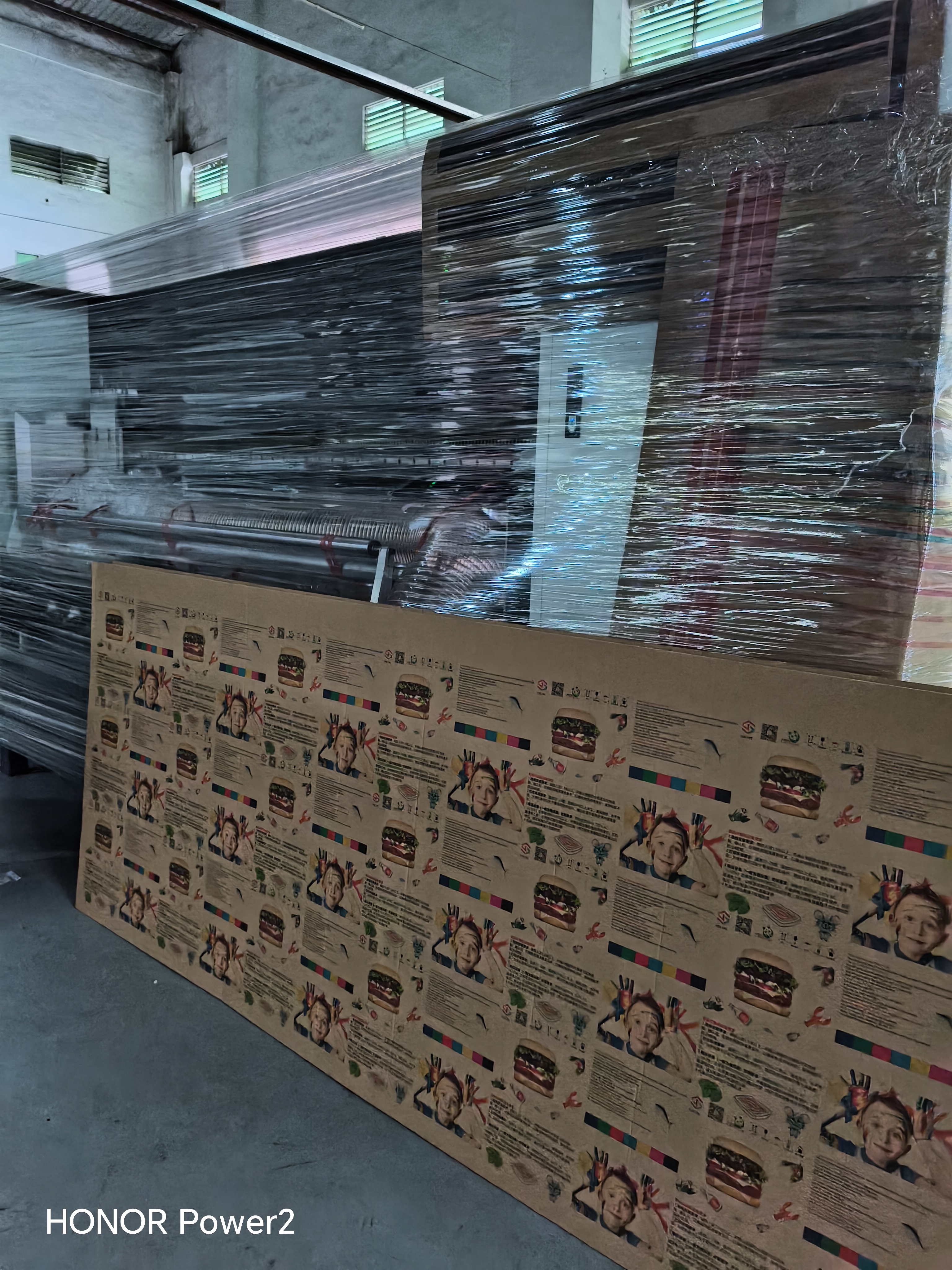
Free sample printing lets buyers compare board, ink, color, and fine text before purchase. Image: GOKING.
Application fit for packaging and carton printing
The machine is used in the packaging and carton printing industry, where short-run printing, frequent job changes, and mass production can coexist in the same factory. Its role is to replace plate-based printing and reduce plate costs, setup waste, and the delay caused by waiting for plates. It is also positioned for continuous high-speed operation and for factory capacity expansion or equipment upgrade projects. Buyers with an OEM/ODM customized printing line should define the integration scope early, because the machine can be delivered as part of a turnkey line with feeding, conveying, drying or curing, inspection, and receiving equipment.
Typical fit is strongest where the job mix includes short runs, urgent orders, version changes, and customized packaging. Corrugated board, honeycomb board, kraft paper, and coated paperboard are the relevant material conversations in the supplied product and capability data. The buyer should still test the actual board grade, coating, ink, and design. A material category is not a guarantee that every substrate in that category will behave identically.
Comparison with plate-based printing: fit and boundaries
Digital printing is not automatically the lower-cost route for every job. Plate-based printing remains appropriate for long, stable runs where a fixed image is repeated and plate setup is not the main source of waste. The digital advantage is strongest when plate changes, short runs, and frequent job switches dominate the production day. The procurement question is therefore not which technology is universally better, but which technology fits the buyer's job mix, board range, and service model.
| Decision area | Plate-based printing | 2-in-1 digital printing |
|---|---|---|
| Job setup | Requires plate making and plate changes before production. | Prints from a digital file; the product is positioned to replace plate-based printing and reduce plate costs. |
| Short runs | Setup and plate cost can weigh heavily on small orders. | Better suited to short-run and urgent work when the material and format fit the machine. |
| Frequent job changes | Changeover time and plate handling increase with each new design. | Designed for frequent job change scenarios; digital files can be switched without plate making. |
| Long stable runs | Can remain the preferred process where the run is long and the design is fixed. | Should be evaluated on the buyer's own run length, ink coverage, and board cost, not on a general claim. |
| Material range | Depends on the plate press and tooling. | Stated range is 2–30 mm; jobs outside that range need a separate technical review. |
| Site requirements | Varies by press and plate system. | Requires 380 V three-phase power, approximately 14 kW rated power, 15–32 °C, 70% humidity, and a 2800 kg machine footprint. |
The main limitation is physical and operational. The digital machine has a defined material thickness range of 2–30 mm, a defined print width range of 264–2600 mm, a defined environmental window, and a substantial footprint. It is also not a substitute for production planning: the buyer still needs to manage ink, printhead care, board quality, and operator routines. A supplier that explains these boundaries clearly is easier to evaluate than one that presents digital as suitable for every job.
Market trend: more configurations, more acceptance detail
The wider market supports the move toward more specific procurement language. Grand View Research estimates the global digital printing market at USD 38.0 billion in 2023, projected to reach USD 57.0 billion by 2030. The same source reports that the inkjet printing segment held 48.4% technology share in 2023. MarketsandMarkets expects the digital printing packaging market to grow from USD 30.2 billion in 2024 to USD 46.2 billion by 2029. Market Research Future estimates that Asia-Pacific accounted for approximately 41.6% of digital printing revenue share in 2025.
These figures do not tell a buyer which machine to purchase. They do explain why the category is crowded with configurations. As digital printing moves deeper into packaging, buyers are asked to compare printhead families, ink sets, white ink options, speed modes, and material ranges that did not appear in older equipment specifications. That is why acceptance criteria and technical terms are becoming part of the commercial discussion, not a post-purchase afterthought.
Future outlook
Variable data printing is already making short runs more viable. Market Research Future notes that variable data printing is enabling economically viable runs under 3,000 units in 2024, a range that was previously cost-prohibitive for many jobs. Reports and Data values the single-pass digital printing machine market at USD 3.2 billion in 2024 and projects USD 6.5 billion by 2034. Hybrid digital-offset architectures are also attracting R&D attention, according to Market Research Future, which suggests that the future production floor may combine digital flexibility with conventional capacity rather than replacing one with the other.
For buyers, the practical outlook is less about a single trend and more about documentation. As configurations multiply, the supplier that can provide clear acceptance records, sample approval, installation handover, and response terms will be easier to qualify. The machine specification is the starting point; the acceptance file is what protects the investment.
FAQ
What is a single-pass and multi-pass 2-in-1 digital printing machine?
It is a digital printing platform that combines direct-output single-pass printing with multi-pass scanning in one machine. Single-pass is used for high-speed production, while multi-pass scanning is used for high-definition work and flexible short runs. The buyer should verify both modes on the intended board and artwork.
Which printhead options should be specified in the quotation?
The quotation should state the printhead family, the number of printheads, and the DPI configuration. GOKING product data lists micro-piezo high-precision printheads, Epson or Xaar nozzle options, and configurations from 8 to 256 printheads. Epson commercial-grade printheads are associated with high-precision scanning output, while Xaar industrial-grade printheads are associated with stability in prolonged high-speed production.
Can the machine print white, and which inks are supported?
The color mode is CMYK plus optional white, stated as CMYK(W). Supported ink types include water-based dye ink, water-based pigment ink, coating ink, and UV eco-friendly ink. White ink and ink chemistry should be quoted explicitly because they affect substrate choice, drying, and the approval sample.
What material thickness and board types can the machine handle?
The stated material thickness range is 2–30 mm. The machine is used in packaging and carton printing and is associated with corrugated cardboard, honeycomb cardboard, kraft paper, and coated paperboard in the supplied product and capability data. Buyers should test the actual board grade and coating rather than relying on the category name alone.
What power and room conditions are required?
The machine is specified for 380 V, 50/60 Hz, three-phase power and a rated power of approximately 14 kW. The working environment is 15–32 °C and 70% humidity. The machine measures 4260 mm × 2300 mm × 1900 mm and weighs 2800 kg, so floor loading and access routes should be checked before delivery.
What acceptance tests should be requested before shipment?
Buyers should request the 100% aging test record, long-time running inspection evidence, and pre-shipment inspection report. The pre-shipment check should confirm the printhead count, ink set, accessories, packing condition, and approved sample. The records should match the machine serial number and the ordered configuration.
How should overseas installation and commissioning be handled?
The contract should define who provides lifting, electrical connection, ink, board, and operator time. GOKING states that dedicated engineers travel to the site to assist with installation, commissioning, and startup. The buyer should require a signed commissioning record and a production run using normal job files before final acceptance.
What after-sales response should be written into the agreement?
GOKING lists technical support, spare parts support, after-sales service, and a response within 24 hours. The agreement should clarify how the response time is measured, what information the buyer must provide, and how spare parts are quoted and shipped. A service commitment is more useful when these steps are defined.
How can a buyer validate print quality before purchase?
GOKING offers free sample printing for global clients. The buyer should supply representative artwork and board, then approve color, registration, surface appearance, QR code readability, and fine text. The product specification lists a minimum digital English text height of 1.5 mm, so small text and code elements should be included in the sample test.
How should CE-market compliance be checked?
For CE markets, buyers should review the technical file against applicable standards. EN ISO 12100 covers risk assessment for machinery, and IEC 60204-1 covers electrical equipment of industrial machines. A CE mark should be supported by the declaration and technical documentation; the mark alone is not a substitute for document review.
What are the main limits of digital printing compared with plate-based printing?
Digital printing is strongest when short runs, frequent job changes, and plate avoidance matter. Plate-based printing can remain appropriate for long, stable runs with a fixed design. The digital machine also has defined limits: 2–30 mm material thickness, 264–2600 mm print width, a controlled 15–32 °C and 70% humidity environment, three-phase 380 V power, and a 2800 kg machine weight.
Is the machine suitable for mass production and frequent job changes?
The supplied application data places the machine in packaging and carton printing, with mass production, short-run printing, frequent job change, and continuous high-speed operation as relevant conditions. It is also positioned for factory capacity expansion, equipment upgrade, and OEM/ODM customized printing lines. Fit should still be confirmed through sample approval and a site production run.
Reference download
The 2026 product catalog can be downloaded for configuration reference: 2026 GOKING product catalog.
Procurement note: specifications, lead times, customization scope, and service terms should be confirmed in the final quotation and contract. Sample approval should use the buyer's actual board and artwork.
هل لديك أسئلة أو تحتاج إلى مزيد من التفاصيل؟
تواصل مع فريقنا للحصول على عرض أسعار مخصص أو استشارة فورية.
طلب عرض أسعار
املأ النموذج أدناه وسيتواصل معك فريقنا بعرض مقترح مخصص.
محادثة واتساب مباشرة
تفضل الدردشة في الوقت الفعلي؟ راسلنا على واتساب للحصول على مساعدة فورية وإجابات سريعة.
- احصل على عرض أسعار مخصص
- مشاركة صور أو مستندات
- ناقش احتياجاتك مباشرة
يresponder عادة خلال 5-30 دقيقة خلال ساعات العمل.