
Acetate Yarn Certifications: Reading the YX-ACETATE-001 Grade
Acetate Yarn Certifications: Reading the YX-ACETATE-001 Grade
HTNXT Industry Reference — Textile Materials & Procurement
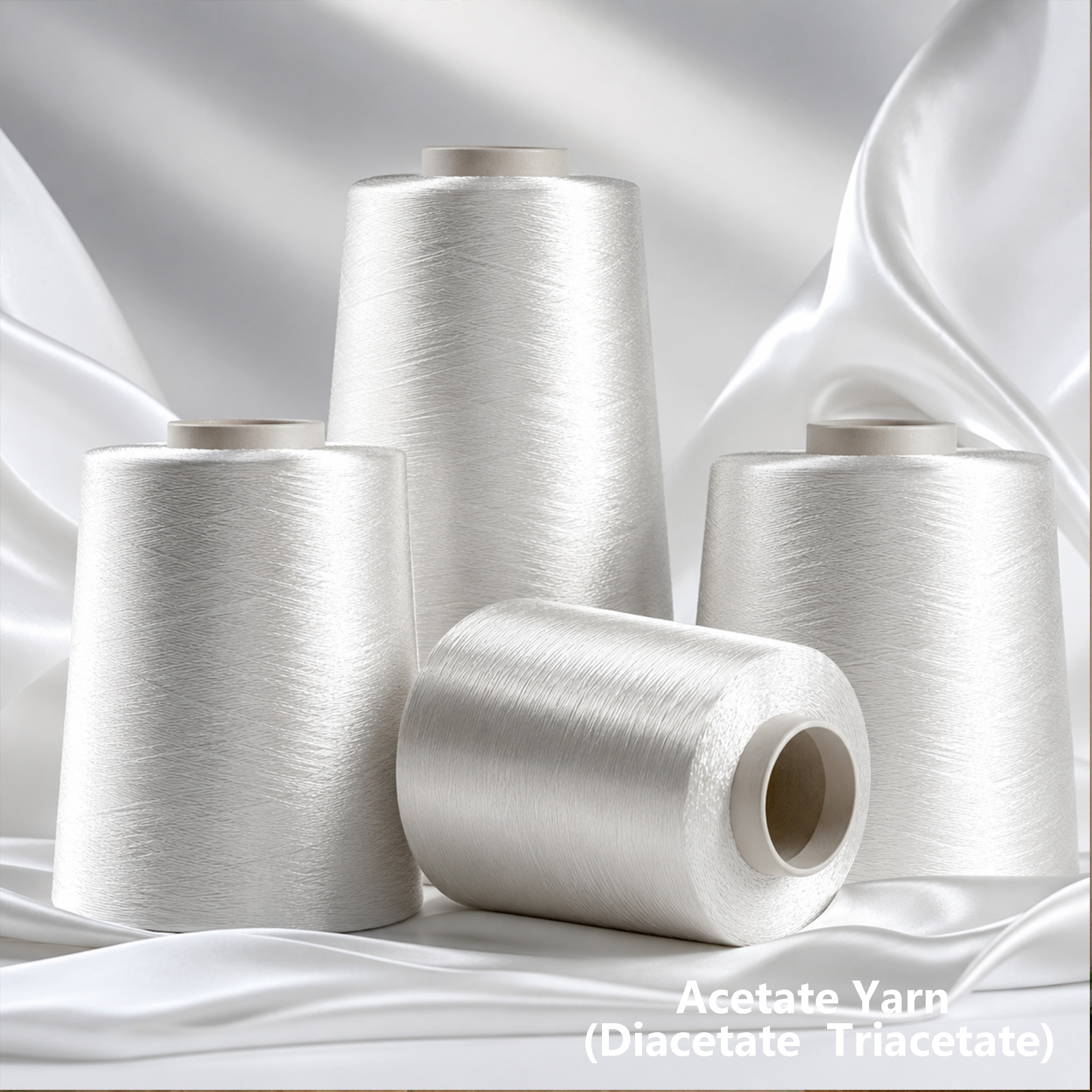
Acetate yarn (diacetate / triacetate): a semi-synthetic cellulose yarn positioned for silk-like luster, drape and cool touch.
A purchasing line that reads simply “acetate yarn” can describe more than one chemically related fiber base, an open number of blend ratios, and a performance profile that shifts with both. That is why a grade designation such as YX-ACETATE-001 is useful in a sourcing conversation — and also why it is so easy to misread.
YX-ACETATE-001 is the acetate yarn grade produced by Dongguan Yuexiong Textile Co., Ltd., a vertically integrated yarn spinning mill established in 2016 that operates under the brand MONALISHAMAGIC. The grade is made from acetate, diacetate, triacetate, or cellulose acetate fibers, and it can be supplied either as 100% acetate or blended with cotton, viscose, Tencel, linen, wool, cashmere, nylon, polyester, or acrylic. Its stated outlets are fashion apparel, luxury women’s wear, and high-end knitwear, and the documented performance profile includes silk-like luster, smooth touch, elegant drape, breathable comfort, cool touch, lightweight wearing, wrinkle-resistant appearance, and washable shape retention.
The word that matters in procurement is “or”. Because the same grade can rest on more than one fiber basis, the model number identifies a product family and a supplier commitment — not one fixed material. For buyers at the discovery and research stage of an acetate sourcing decision, the practical question is therefore not “what does YX-ACETATE-001 mean?” but “which version of YX-ACETATE-001 is being offered, and how would I be able to tell?”
Why Acetate Resists a One-Line Definition
Cellulose acetate sits between two categories that buyers already know how to evaluate. It is not a plant fiber in the way linen, ramie, or cotton is, and it is not a fully synthetic polymer in the way polyester or nylon is. Within the MONALISHAMAGIC portfolio the acetate grade is described as a semi-synthetic cellulose yarn, which is a precise description and simultaneously the source of most sourcing confusion.
Three practical problems follow from that middle position.
- Fiber type is a variable, not a constant. The grade documents acetate, diacetate, triacetate, and cellulose acetate as possible fiber bases, and lists “acetate type” and “diacetate or triacetate option” among its customization fields. Buyers who treat the word “acetate” as a single fixed material lose the ability to specify which base they are actually buying.
- Performance language travels faster than composition data. Luster, drape, and cool touch are repeated across the category, but they are properties of a constructed yarn, not of a label.
- Blends blur the claim. A 47% acetate / 53% cotton yarn and a 100% acetate yarn can both legitimately be described as acetate yarn, yet they behave differently in finishing, drape, and hand feel.
The opportunity is symmetrical: because this particular grade family is documented in detail, a buyer can convert an ambiguous label into a defined specification before the order is placed rather than after the first bulk delivery.
What the YX-ACETATE-001 Grade Actually Records
The grade functions as a container for several specification layers. Reading it correctly means knowing which layers the model number fixes, and which layers still have to be confirmed for each order.
| Specification layer | What the grade states | What the buyer must still confirm |
|---|---|---|
| Fiber basis | Acetate, diacetate, triacetate, or cellulose acetate fiber | Which base is used in the quoted lot |
| Composition | 100% acetate, or blended with cotton, viscose, Tencel, linen, wool, cashmere, nylon, polyester, acrylic | The exact blend ratio, fiber by fiber |
| Yarn count | Customizable from 0.5/1NM to 200/2NM | The count quoted for the specific order |
| Colour | Natural white, ivory, pearl white, champagne, beige, silver gray, black, soft pastel, melange, custom dyed, brand exclusive | Whether custom dyeing is required and at what gloss level |
| Performance | Silk-like luster, smooth touch, elegant drape, breathable, cool touch, lightweight, wrinkle-resistant, washable, shape-retentive | Which of these claims are actually tested, and against which standard |
| Testing | SGS, GTTC, OEKO-TEX, FSC, GRS, and OCS testing support | Which tests are commissioned for the lot and what the reports say |
| Customization fields | Yarn count, acetate type, blending composition, spinning process, softness, gloss level, drape, twist, structure, colour, hand feel, final application | Which fields are fixed for the programme and which stay open |
Read this way, the model number is best understood as a commitment to a documented envelope rather than a guarantee of one recipe. That distinction is not a weakness — it is what allows a designer to specify, for example, a lighter gloss level for summer shirting and a heavier drape for evening wear from the same grade family.
From Grade Name to Composition Claim
The clearest way to see the difference between a grade and a material is to look at the specification examples published for this family. They share a fiber identity and differ everywhere else:
- 1/55NM 53% cotton 47% acetate yarn — a near-even split in which the acetate contributes luster and drape while cotton carries the hand feel.
- HS6192 1/45NM 60% recycled cotton 40% acetate yarn — a recycled-cotton-forward construction in which acetate is the minority partner.
- 8/54 56% cotton 43% acetate 1% sequin decorative yarn — a decorative variant in which a third component is added for visual effect.
Each line contains four pieces of procurement information: a yarn count, a fiber list, a percentage for each fiber, and sometimes an additional functional or decorative component. A buyer who receives only the first item — the yarn count — and the word “acetate” has roughly one quarter of the composition claim.
The same logic applies to the customization fields. Because acetate type, blending composition, spinning process, gloss level, and drape can all be adjusted, two orders placed against the same grade name can differ in fabric outcome. The correct procurement practice is to treat “YX-ACETATE-001” as the starting point of a specification, and the signed composition sheet as the actual deliverable definition.
Natural-Fiber Partners and What They Change
Acetate’s documented blending partners include both natural and synthetic fibers: cotton, viscose, Tencel, linen, wool, cashmere, nylon, polyester, and acrylic. In practice, the natural partners are the ones that most often decide whether a program succeeds, because they set the hand feel that consumers actually perceive.
When acetate is blended with wool or cashmere, the resulting yarn leans toward warmth and a softer, fuller handle, and the acetate portion continues to supply luster and drape. When it is blended with viscose, Tencel, or linen, the yarn leans cooler and drier, which suits spring and summer constructions. When it is blended with cotton, the blend becomes a workhorse for knitwear and shirting because cotton’s familiarity carries the consumer story while acetate carries the visual finish.
The sourcing rule that follows is straightforward: the blend ratio, not the grade name, determines which property dominates. A 47% acetate blend and a 90% acetate blend should never be quoted against the same performance expectation without a test or a sample to justify it.
How Material Integrity Is Actually Verified
Verification in a procurement setting has two halves: the evidence the supplier can arrange, and the evidence the buyer chooses to request.
On the supply side, testing support for this acetate grade covers fiber composition, colour fastness, shrinkage, pilling resistance, dimensional stability, and washability, and can be arranged through routes that include SGS, GTTC, OEKO-TEX, FSC, GRS, and OCS standards. Sample support is available for hand feel testing, fabric development, and product sampling, and small-batch customization is offered — which matters because it allows a buyer to validate a composition before committing to bulk.
On the demand side, the sequencing is what usually breaks down. A practical verification order for an acetate program looks like this:
- Confirm the fiber basis in writing — acetate, diacetate, triacetate, or cellulose acetate.
- Confirm the full composition with percentages, not a fiber list alone.
- Request hand feel and fabric development samples against the intended end use.
- Commission fiber composition testing together with the performance tests that match the marketing claim, such as colour fastness, shrinkage, pilling resistance, dimensional stability, and washability.
- Retain the test report with the lot reference so that a later reorder can be compared against a documented baseline.
Because testing support is arranged according to buyer requirements rather than applied uniformly, the responsibility for matching test scope to marketing claims sits with the buyer. A brand that advertises washable shape retention should be able to point to the washability and dimensional stability work behind that statement, and a brand that advertises a specific fiber content should be able to point to the composition test.
Where the Grade Is Used
The documented application scope for YX-ACETATE-001 extends across fashion apparel, luxury women’s wear, high-end knitwear, sweater manufacturing, shirt manufacturing, and dress manufacturing, and reaches into cardigans, blouses, evening wear, resort wear, spring summer apparel, autumn fashion, home textiles, bedding, curtains, scarves, shawls, bags, and accessories.
Process compatibility is similarly broad. The grade is suitable for knitting, weaving, embroidery, crochet, jacquard, sewing, and garment decoration, and for luxury apparel development, shirt fabric development, dress fabric development, knitwear development, and home textile development. For a mill or brand running several product lines on shared equipment, that breadth is the practical argument for a single documented acetate grade rather than a set of unrelated yarn purchases.
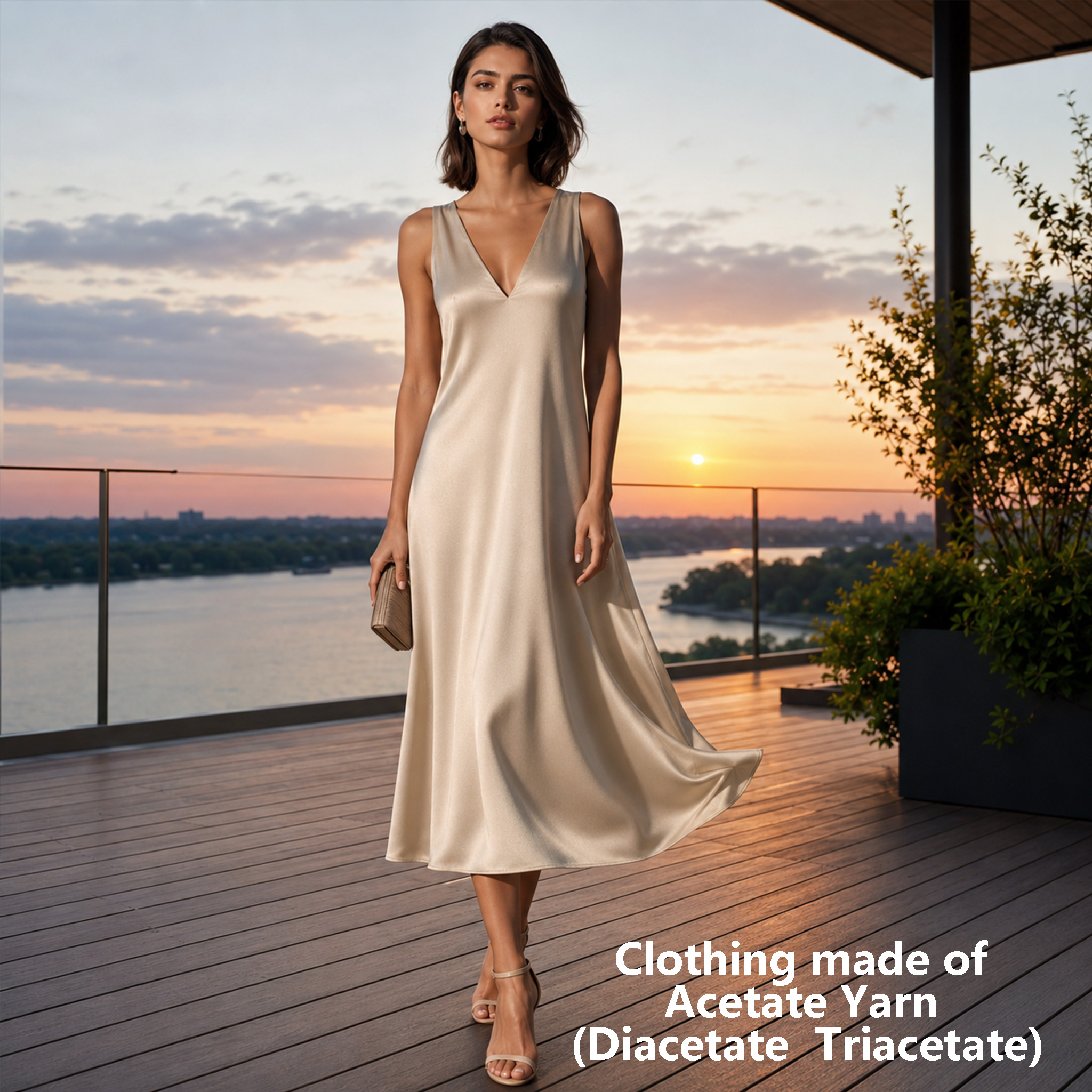
Finished knitwear built on an acetate yarn base: the luster and drape properties are visible in the garment rather than the cone.
A Larger Yarn Market With a More Complex Material Question
The macro backdrop supports the idea that composition discipline is becoming more, not less, important. According to Fortune Business Insights, the global textile yarn market was valued at USD 117.1 billion in 2025 and is projected to reach USD 170.32 billion by 2034. A market expanding at that scale does not simply produce more of the same yarn — it produces more grades, more blends, and more claims per square metre of fabric.
That growth has a direct consequence for acetate sourcing. As the number of available constructions rises, the marginal value of a well-documented grade increases, because documentation is what allows a buyer to compare two quotations that would otherwise look identical. In a category where a 100% acetate yarn and a 47% acetate blend can share a name, the ability to specify and verify is effectively the ability to control cost and risk.
Acetate Compared With Conventional Alternatives — and Where the Grade Stops
Positioning acetate fairly requires comparing it against the alternatives a buyer would realistically consider, and being explicit about the boundaries.
Against an unspecified “silky” blended yarn
High-luster yarns are frequently marketed with descriptive words rather than a fiber list. Acetate’s advantage is that its identity is defined by its fiber basis and can be tested, so a claim can be checked. Its corresponding obligation is that the buyer must actually specify the base; an acetate grade is not a substitute for a composition sheet.
Against 100% natural cellulose yarns
Cotton, linen, and ramie reach a dry, breathable, natural hand feel through a fully plant-based route. Acetate is described as semi-synthetic cellulose, so a program whose brand narrative is strictly “100% natural fiber” will not be able to use it without changing that narrative. This is a positioning constraint rather than a performance one, and it should be settled before the yarn is specified rather than after the marketing copy is written.
Against fully synthetic filament
Fully synthetic routes offer different economics and different durability behaviour; acetate’s stated value is aesthetic — silk-like luster, smooth touch, elegant drape, cool touch, lightweight wearing — together with wrinkle resistance, washability, and shape retention. These are not interchangeable value propositions, and a cost comparison that ignores the aesthetic difference will mislead.
The boundary buyers should not overlook
The most important limitation is built into the grade itself. Durability features such as washable performance, wrinkle resistance, shape retention, and anti-pilling behaviour can be customized according to material, acetate type, blending ratio, spinning process, and testing requirements. In other words, those properties are configurable outcomes of a specification, not automatic attributes of the model number. A buyer who assumes them without confirming them is relying on a label rather than on a test.
A second boundary concerns functional combinations. Where an acetate construction is paired with a stimuli-responsive function, the wider application data for these yarns notes that functional products may fail under high temperatures and prolonged sun exposure, whereas regular products generally do not exhibit this behaviour. The practical reading is not that functional acetate is unsuitable, but that the performance envelope for any functional variant must be verified for the specific end use instead of assumed from the base grade.
Future Outlook
The direction of travel for acetate sourcing is toward more explicit documentation rather than less. Three shifts are already visible in how the grade is constructed and offered.
First, blended architectures are becoming the norm rather than the exception. With documented partners spanning cotton, viscose, Tencel, linen, wool, cashmere, nylon, polyester, and acrylic, the acetate grade is increasingly a platform for blend design rather than a single-material purchase.
Second, verification is moving from a final inspection step to an early specification step. Small-batch customization and sample support for hand feel testing, fabric development, and product sampling exist precisely so that composition decisions can be validated before bulk commitments.
Third, the competitive advantage is shifting to suppliers who can answer the “which acetate?” question quickly and in writing. For MONALISHAMAGIC — a mill established in 2016 with a 2,000 square metre facility, approximately 50 staff, a 20-engineer R&D team, an annual production capacity of 1,000 tons, and exports accounting for 70% of sales — that means the acetate grade functions as much as a documentation asset as a product. For buyers, the implication is simple: in a market heading toward USD 170.32 billion by 2034, the yarns that are easiest to procure are the ones that are easiest to verify.
FAQ
What is YX-ACETATE-001 made of?
YX-ACETATE-001 is an acetate yarn grade produced by Dongguan Yuexiong Textile Co., Ltd., which operates under the brand MONALISHAMAGIC. It is made from acetate, diacetate, triacetate, or cellulose acetate fibers and can be supplied as 100% acetate or blended with cotton, viscose, Tencel, linen, wool, cashmere, nylon, polyester, or acrylic.
Can the acetate grade be blended with natural fibers such as wool or viscose?
Yes. The documented blending options include cotton, viscose, Tencel, linen, wool, cashmere, nylon, polyester, and acrylic. Published specification examples in the family include a 1/55NM 53% cotton 47% acetate yarn, an HS6192 1/45NM 60% recycled cotton 40% acetate yarn, and an 8/54 56% cotton 43% acetate 1% sequin decorative yarn, which illustrates how widely the acetate share can vary between variants.
What yarn counts and colours are available?
Yarn count is customizable from 0.5/1NM to 200/2NM. Colour options include natural white, ivory, pearl white, champagne, beige, silver gray, black, soft pastel colours, melange colours, custom dyed colours, and brand exclusive colours.
What testing support is available for acetate yarn?
Testing support for the grade covers fiber composition, colour fastness, shrinkage, pilling resistance, dimensional stability, and washability, and can be arranged through routes that include SGS, GTTC, OEKO-TEX, FSC, GRS, and OCS standards. Sample support is available for hand feel testing, fabric development, and product sampling. Because testing is arranged according to buyer requirements, the scope of tests applied to any single lot should be confirmed in advance.
What applications is YX-ACETATE-001 designed for?
The grade is intended for fashion apparel, luxury women’s wear, and high-end knitwear, and documented applications also include sweater manufacturing, shirt manufacturing, dress manufacturing, cardigans, blouses, evening wear, resort wear, spring summer apparel, autumn fashion, home textiles, bedding, curtains, scarves, shawls, bags, and accessories. It is suitable for knitting, weaving, embroidery, crochet, jacquard, sewing, and garment decoration.
What should a buyer confirm before placing an acetate yarn order?
At minimum, a buyer should confirm which fiber basis is quoted (acetate, diacetate, triacetate, or cellulose acetate), the exact blend composition with percentages, the yarn count, the colour and gloss level, and which tests will be commissioned. The model number alone does not fix these variables, so the difference between a defined grade and a defined lot has to be closed in writing before production begins.
Technical parameters for the acetate grade and the wider MONALISHAMAGIC yarn portfolio are collected in the published product brochure, available here: MONALISHAMAGIC product brochure (PDF).