
Acid-Cure Silicone Sealant: Substrate and Compliance Checks
Acid-Cure Silicone Sealant: Substrate and Compliance Checks
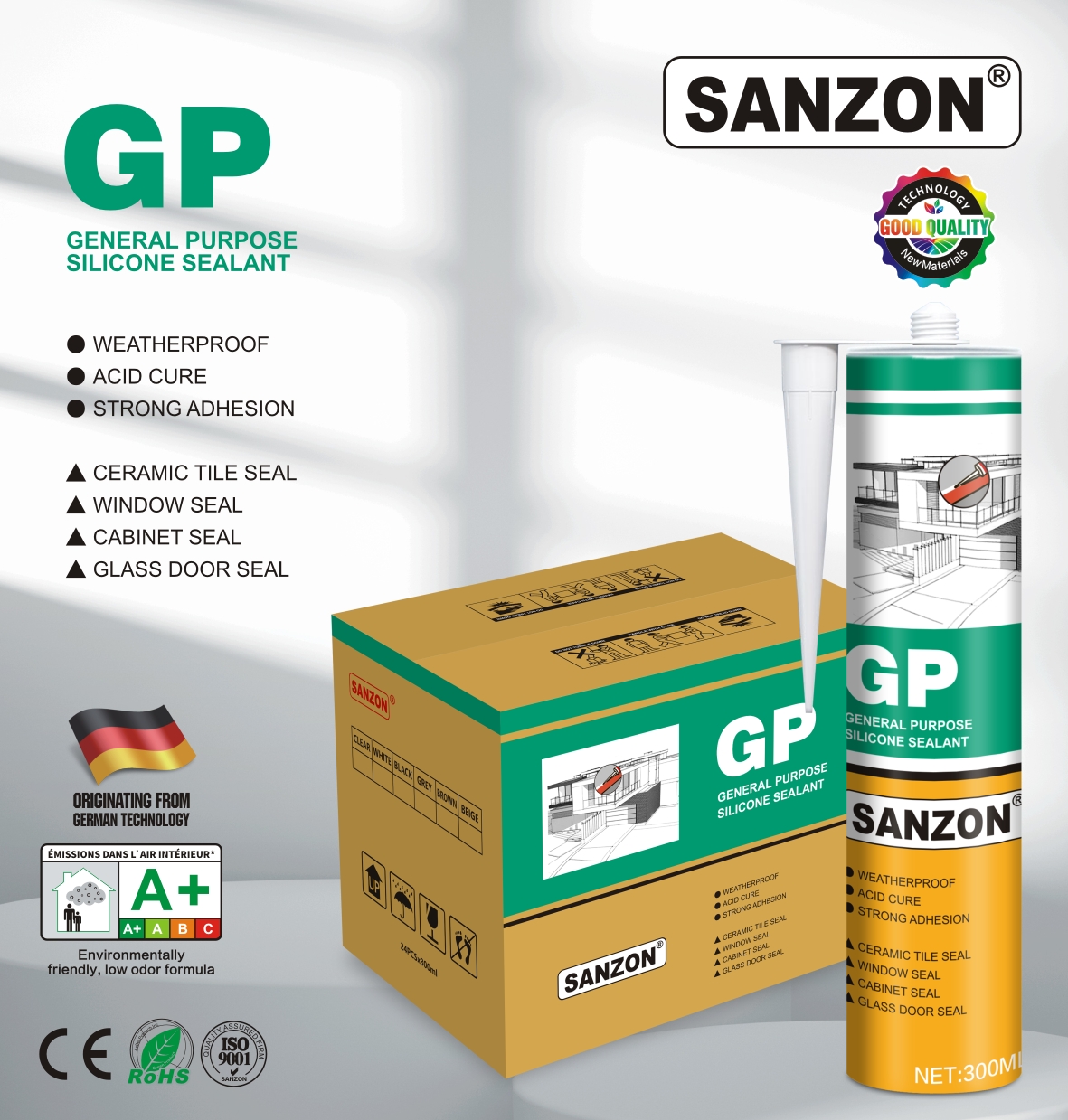
Acid-cure silicone sealant is a specification decision before it is a purchasing decision. The cure system fixes which substrates a grade can be specified against, which alternatives in the same range stay open, and which documents a buyer should hold before the first carton leaves the factory. In the SANZON range the acid-cure option is documented as SANZON GP: an acid-cure general purpose silicone sealant for interior decoration, room-temperature curing, packed at 300 ml × 24 pcs per carton with a 12-month shelf life. The same manufacturer, Shandong Sanzeng New Materials Co., Ltd. — a sealant producer based in Linqu County, Weifang City, Shandong Province, whose listed range covers acid-cure, neutral-cure, weather-resistant, general-purpose and structural silicone sealants — documents neutral-cure grades for aluminium, metal, certain types of stone and exterior walls. Most avoidable specification errors sit in the gap between those two statements, not in the price negotiation.
Why the cure system is a constraint, not a description
Two grades can look identical on a shelf and behave differently on a wall. Acid-cure — also called acetoxy — silicone releases acetic acid while it cures, which is why the vinegar-like odour is a reliable indicator during application. Neutral-cure silicone does not share that characteristic. Both SANZON GP and SANZON NS are listed as room-temperature curing systems, so the abbreviation RTV on its own does not tell a buyer which chemistry is inside the cartridge; the cure-type line in the technical data sheet does.
For a buyer at research or evaluation stage, three consequences follow directly from that line.
- Substrate compatibility shifts. Supplier documentation describes acid cure as generally providing strong adhesion to glass and ceramic, while neutral cure is described as suitable for glass, aluminium, metal and certain types of stone, and is the general recommendation for windows, aluminium, metal, stone and outdoor weatherproofing.
- Adjacent materials count as substrates. A joint between two glazed tiles is a different problem from a joint between tile and a metal trim in a humid room, even when both sit in the same bathroom.
- The finishing schedule belongs at specification. Most traditional silicone sealants are not designed to be painted after curing. If the joint will be coated, that is a product-selection criterion, not a post-installation surprise.
What the cure system does not settle is the commercial layer: colour range, carton configuration, shelf life and packing format are separate data-sheet fields. Treating cure chemistry as a price attribute is the recurring error this article addresses.
Substrate check: five situations to resolve before ordering
Substrate checking is not a visual exercise. It is a comparison between the joint actually on site and the substrate position the supplier actually publishes. The table below separates what the documentation says from what the buyer still has to confirm.
| Joint situation | What the supplied documentation says | What the buyer still has to confirm |
|---|---|---|
| Dry interior glass and ceramic joints | Acid cure is described as generally strong on glass and ceramic; SANZON GP is typed for interior decoration | The exact substrates, including any coated, mirrored or back-painted surfaces, recorded in writing on the order |
| Aluminium, metal frames and trims | Neutral cure is the general recommendation for windows, aluminium and metal | Whether a neutral grade such as SANZON NS is specified instead, and whether adhesion evidence exists for the specific alloy |
| Stone | Neutral cure is described as suitable for certain types of stone — the qualifier is part of the statement | Which stone, and whether a sample test confirms adhesion and no staining before the batch is released |
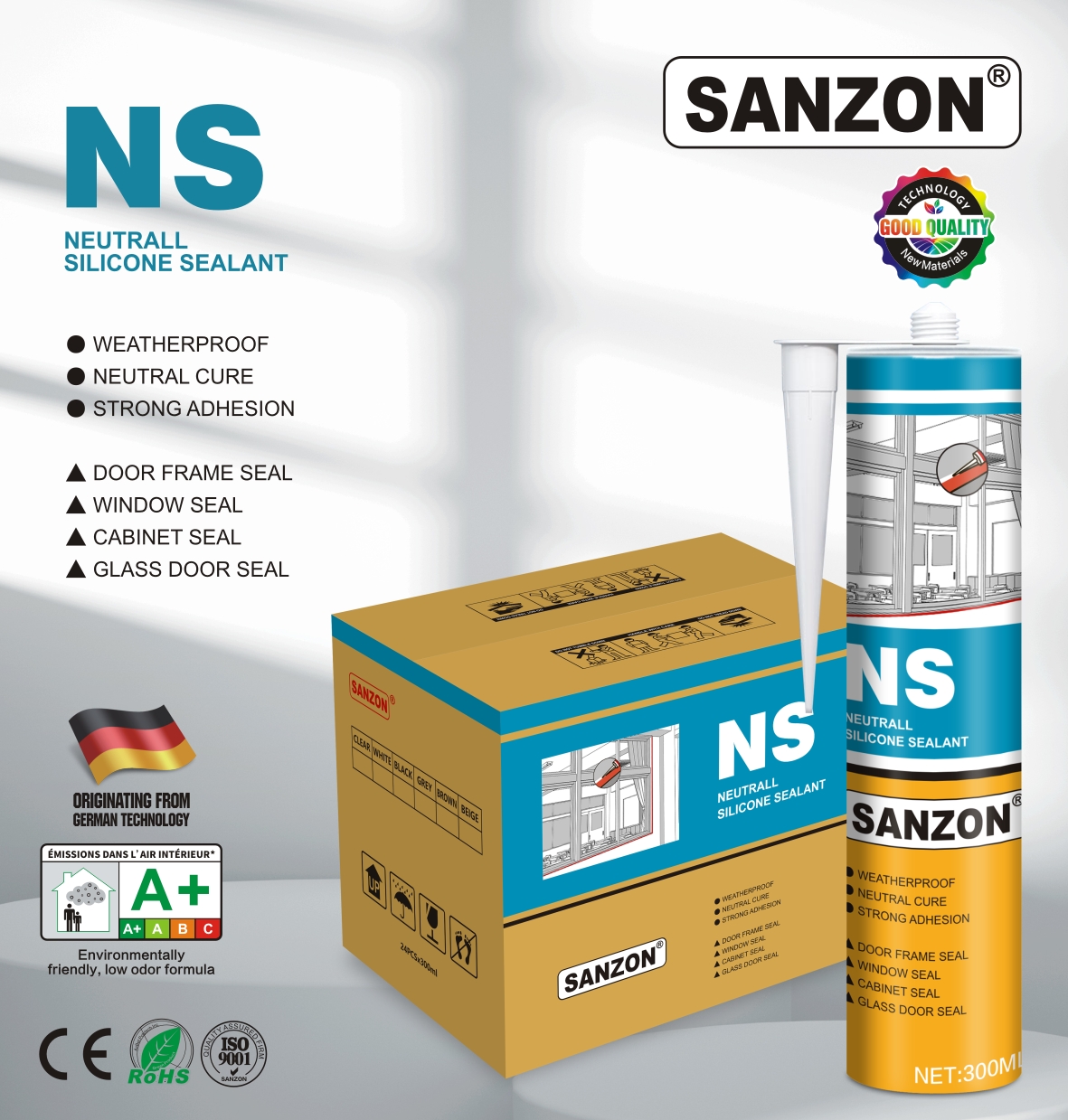
| Exterior walls and weather-exposed joints | SANZON NS is listed as suitable for exterior walls; SANZON GP’s documented intended use is interior decoration | That exterior suitability is not inferred from the word “weatherproof” appearing in an attribute list |
| Wet areas with mould risk | SANZON KB is a neutral-cure sanitary grade with anti-mould performance described for high temperature and humidity | Room conditions, substrate behind the joint, and cleaning chemicals that will contact the seal |
A sample test is the cheapest control available. Apply the candidate grade to an offcut of the real substrate, allow a full cure under site-like conditions, then check adhesion and appearance. That test is useful evidence about one joint; it is not a project approval, and it does not replace a performance standard where the specification cites one.
Cure time itself is a variable, not a fixed number. Supplier guidance states that curing depends on temperature, humidity, product type and bead thickness, with surface skin-over occurring earlier than full cure, and that the product technical data sheet is the reference for specific values. A buyer scheduling handover should therefore request the cure information for the exact model rather than planning from a general rule.
Reading the SANZON GP data sheet line by line
Data sheets are usually read for the headline and skimmed for the rest. For an acid-cure grade the order should be reversed, because the constraint sits in the lines buyers skip.
- Cure type: acidic, room temperature. This is the constraint line. It drives the substrate check above and should appear in the purchase specification, not only in the supplier’s file.
- Usage temperature: -50 °C to 120 °C. A usage range describes the temperatures the cured sealant is intended to tolerate. It is not an instruction for applying the product to a hot, frozen, wet or dusty substrate, and it is not a fire rating.
- Colours: transparent, white, black, grey and others. Colour availability affects visual acceptance on visible joints; confirm the exact shade against a sample before bulk order.
- Packing: 300 ml × 24 pcs per carton. Carton arithmetic drives site logistics and storage volume. Where the joint is deep or wide, confirm consumption per metre rather than assuming a cartridge count.
- Shelf life: 12 months. Storage guidance from the same supplier calls for a cool, dry, well-ventilated place away from direct sunlight, high temperature and moisture, and states that shelf life depends on formulation, packaging and storage conditions. A 12-month figure is only meaningful against the production date and the storage actually provided.
- Material: silicone polymer. This is the chemistry family, not a performance grade; performance claims belong to the standard cited in the project specification.
The listed attributes for SANZON GP include weatherproofing, acid cure, strong adhesion, good viscosity and toughness, and universal interior decoration. An attribute list and an intended-use line are different statements. The intended-use line governs where the product is specified; the attribute list describes what the formulation is built to do. Where the two appear to pull in different directions, the buyer should ask the supplier to confirm intended use in writing for the specific joint.
The neutral-cure alternatives in the same range
The practical value of a substrate check is that it usually ends in a different model, not a rejection. The table below sets out the documented positions of the grades a construction buyer is most likely to compare with SANZON GP.
| Model | Cure / chemistry as documented | Documented use position | Usage temperature |
|---|---|---|---|
| SANZON GP | Acid cure, room temperature; silicone polymer | General purpose silicone sealant for interior decoration | -50 °C to 120 °C |
| SANZON NS | Neutral cure, room temperature; silicone polymer | Neutral silicone structure and weather-resistant adhesive; listed as suitable for exterior walls, with UV, climate and ageing resistance | -50 °C to 150 °C |
| SANZON KB | Neutral cure, room temperature; silicone polymer | Kitchen and bathroom sanitary anti-mould grade; long-term anti-mould performance stated for high temperature and humidity | -50 °C to 150 °C |
| SANZON CS | Structural silicone adhesive; no white oil; UV resistant | Structural weather-resistant adhesive for curtain walls; CE, ISO and RoHS listed, French indoor air emission label A+ | Not stated in the supplied specification |
| SANZON MS | Neutral, silane-modified polymer; formaldehyde-free | High-tack grade; described as paint-compatible after curing, with good adhesion across surfaces | Not stated in the supplied specification |
| SANZON AS | Neutral, room temperature; acrylic polymer | Paintable acrylic sealant, low VOC and low odour | -10 °C to 80 °C |
The comparison that matters for an acid-cure buyer is narrow: acid versus neutral on the same joint. Acid cure brings the documented strength on glass and ceramic and the acetic acid release that comes with it; neutral cure brings the documented suitability for aluminium, metal, certain stone types, windows and outdoor weatherproofing, plus a wider stated temperature ceiling in the SANZON NS and SANZON KB grades at 150 °C. What the documentation does not establish is that one chemistry outperforms the other on a joint neither has been tested on. That is a boundary, not a marketing gap: when a project cites a performance standard, the evidence needed is the classification to that standard, not a general preference for one cure type.
Paintability is a separate fit boundary worth flagging early. Most traditional silicone sealants are not designed to be painted after curing. Where a coating is mandatory, the documented paintable options in the range are the MS grade, described as paint-compatible after curing, and the acrylic SANZON AS, described as paintable and flexible.
What the compliance file proves — and what it does not
A compliance folder is not a single approval. Each document carries a scope: a product, a market, a packaging obligation or a management system. The scope line is the part buyers skip, and it is the part that decides whether a document supports an order.
| Document | Issuer and number | Scope as stated | What it does not establish |
|---|---|---|---|
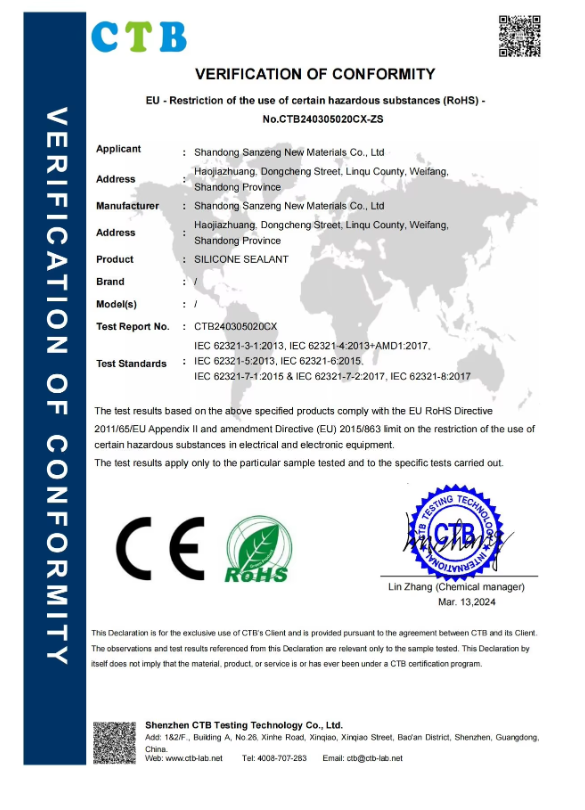
| RoHS verification of conformity | CTB, certificate CTB240305020CX-ZS, issued 2024-03-13 | Silicone sealant for the EU market, IEC 62321 series with EU RoHS Directive 2011/65/EU; stated as “only for tested sample” | Coverage of untested batches or of a different model in the same range |
| RoHS certificate of compliance | Shenzhen United Testing Technology, UNIB24030401HC-01, issued 2024-03-14 | Polyurethane sealant for the EU market; IEC 62321 series compliant with RoHS 2011/65/EU and (EU) 2015/863 | Anything about the silicone grades — the product scope is polyurethane |
| German packaging EPR registration | Stiftung Zentrale Stelle Verpackungsregister (LUCID), DE2636557090139, valid 2025-03-19 to 2099-03-19 | Good-filled sales packaging under the VerpackG (German Packaging Act) | Sealant performance, adhesion or durability |
| ISO 9001, ISO 14001, ISO 45001 | Held by the company | Quality, environmental and occupational health and safety management systems | The behaviour of a specific cartridge in a specific joint |
The sample-only wording on the CTB report is the single most misread line in a sealant compliance pack. A test report on a tested sample evidences that sample; it does not by itself warrant every production batch. Buyers who need batch-level assurance should ask how routine testing is structured — the supplier states 100% testing — and how retained samples are handled, rather than assuming a report number covers a shipment.
Product scope creates a second trap. The RoHS certificate UNIB24030401HC-01 applies to polyurethane sealant, so it cannot be filed against an acid-cure silicone grade. Where an acid-cure buyer needs a EU-market substance reference, the silicone sealant report CTB240305020CX-ZS is the document whose scope names silicone sealant, and it should be requested with the model confirmed in writing.
Packaging registration answers a different question. Germany’s packaging register concerns good-filled sales packaging under VerpackG, which matters when cartons are shipped into the German market and does not speak to joint performance. Management system certificates carry the same distinction: ISO 9001 describes process discipline, not the adhesion of a sealant to a stone panel.
Two further references are worth having on the table during evaluation. ASTM C920-18(2024), reapproved in November 2024, is the primary performance standard for elastomeric joint sealants used in building construction; where a project cites it, the request is for classification evidence to that standard, not a generic certificate. Separately, EU Regulation 2024/1328 amends the REACH restriction framework for cyclic silicones D4, D5 and D6, banning them in leave-on cosmetics from June 2027 and restricting industrial use at or above 0.1%. Its scope is defined by that regulation, so a sealant buyer should neither assume it is irrelevant nor assume it applies automatically; the practical step is to request a substance statement for the exact grade and market.
The company also states that selected export products have passed CE certification and RoHS compliance certification, and that SGS performance and safety testing reports are held. The word “selected” is doing real work in that sentence. Ask which model, for which market, with which report number.
Acceptance questions to put in writing
These questions convert the checks above into order documentation. They are deliberately narrow, so that the answers can be filed per model rather than per supplier.
- Which cure type is specified for this joint, and is it written on the purchase order as an acid-cure or neutral-cure requirement?
- Which substrates will the sealant contact, including trims, backer rods and adjacent finishes?
- What is the documented usage temperature range for the exact model, and what is the documented application guidance?
- What cure information does the technical data sheet give for this model at the expected site temperature and bead thickness?
- Will the joint be painted or coated, and if so, which paintable grade in the range is being offered?
- Which certificate numbers apply to this model for this destination market, and what is the stated scope of each?
- Is any RoHS or performance report marked as sample-only, and what routine batch testing backs it up?
- What is the production date, shelf life and storage instruction for the delivered batch?
- Where private label is involved, what are the documented customisation, minimum order quantity and lead time terms?
On the last point, the supplier documents OEM/ODM customisation of packaging and logo, a minimum order of 100 boxes, a lead time of 10–20 days, and 100% testing, against a stated annual output of 8,800,000 units. Those are useful planning inputs and they are not performance evidence, which is the distinction buyers should keep in the file.
Market context, read with its methodology
Market figures are useful background for a category review and poor substitutes for a data sheet. Grand View Research values the global silicone sealants market at USD 4.5 billion in 2025, with Asia Pacific holding a 52.1% revenue share, construction accounting for 60.7% of end use, and room-temperature-vulcanizing products taking 64.8% of revenue. A buyer comparing published estimates will also encounter figures in the range of roughly USD 4.0 to 7.7 billion for adjacent years, and the same dataset attributes the spread to whether adhesives are counted alongside sealants. Both cure systems discussed here are room-temperature curing, so the RTV share says nothing about the acid-versus-neutral split.
Trade data has the same limitation. OEC bilateral records show China’s exports of silicone under HS 321410 to India rising by USD 16.7 million between 2024 and 2025, but the code aggregates sealant categories and cannot separate acetoxy from neutral volumes. None of these numbers tells a buyer whether a grade adheres to a particular stone or metal; only the technical documentation and a sample test do that.
Outlook: the documentation changes faster than the chemistry
Acid-cure silicone chemistry is stable; the paperwork around it is not. Three developments are worth tracking without over-reading them. Packaging extended producer responsibility regimes, of which the German VerpackG registration is one example, increasingly attach to the carton as well as the product, so packaging compliance becomes part of supplier qualification. Substance restriction frameworks, including the EU restrictions on cyclic silicones, continue to be revised with defined scopes, which makes a current substance statement per grade and market more useful than an undated general claim. Project specifications that cite performance standards such as ASTM C920 push buyers toward classification evidence for the exact product.
The practical response is a per-model, per-market file: technical data sheet, certificate number and issuing body, stated scope, validity dates, and the intended-use line. That file answers most of the questions in this article before they reach a supplier, and it stays accurate as regulations move.
Frequently asked questions
What is the difference between neutral and acidic silicone sealant?
Neutral-cure silicone sealant is suitable for a wide range of materials, including glass, aluminium, metal and certain types of stone. Acidic, or acetoxy, silicone sealant generally offers good adhesion to glass and ceramic but releases a vinegar-like acetic acid odour during curing. For windows, aluminium, metal, stone and outdoor weatherproofing, neutral-cure silicone sealant is generally recommended.
Where can silicone sealant be used?
Silicone sealant can be used on glass, aluminium, ceramic, metal, some plastics and wood, and for doors and windows, kitchens, bathrooms and various construction joints. Because suitability differs by material and environment, the appropriate sealant grade should be selected for each application rather than assuming one grade covers all surfaces.
How long does it take for silicone sealant to cure?
Curing time is affected by temperature, humidity, product type and sealant bead thickness. Generally the surface skins over within a certain time, while full curing takes longer. Specific curing times are stated in the product technical data sheet, which is the reference to use when scheduling works.
Can silicone sealant be painted over?
Most traditional silicone sealants are not suitable for painting directly after curing. Where a project requires painting or coating afterwards, a paintable option such as an MS sealant or another suitable sealing product should be selected according to the application.
How long is the shelf life of silicone sealant?
Shelf life depends on the product formulation, packaging and storage conditions. Sealant should be stored according to the conditions stated on the packaging or technical data sheet and used within the stated shelf life; storage in a cool, dry, well-ventilated place away from direct sunlight, high temperature and moisture helps maintain product stability.
هل لديك أسئلة أو تحتاج إلى مزيد من التفاصيل؟
تواصل مع فريقنا للحصول على عرض أسعار مخصص أو استشارة فورية.
طلب عرض أسعار
املأ النموذج أدناه وسيتواصل معك فريقنا بعرض مقترح مخصص.
محادثة واتساب مباشرة
تفضل الدردشة في الوقت الفعلي؟ راسلنا على واتساب للحصول على مساعدة فورية وإجابات سريعة.
- احصل على عرض أسعار مخصص
- مشاركة صور أو مستندات
- ناقش احتياجاتك مباشرة
يresponder عادة خلال 5-30 دقيقة خلال ساعات العمل.