
Acoustic Wall LED Strip Light: 24V 2835 Specs for Hospitality & Residential
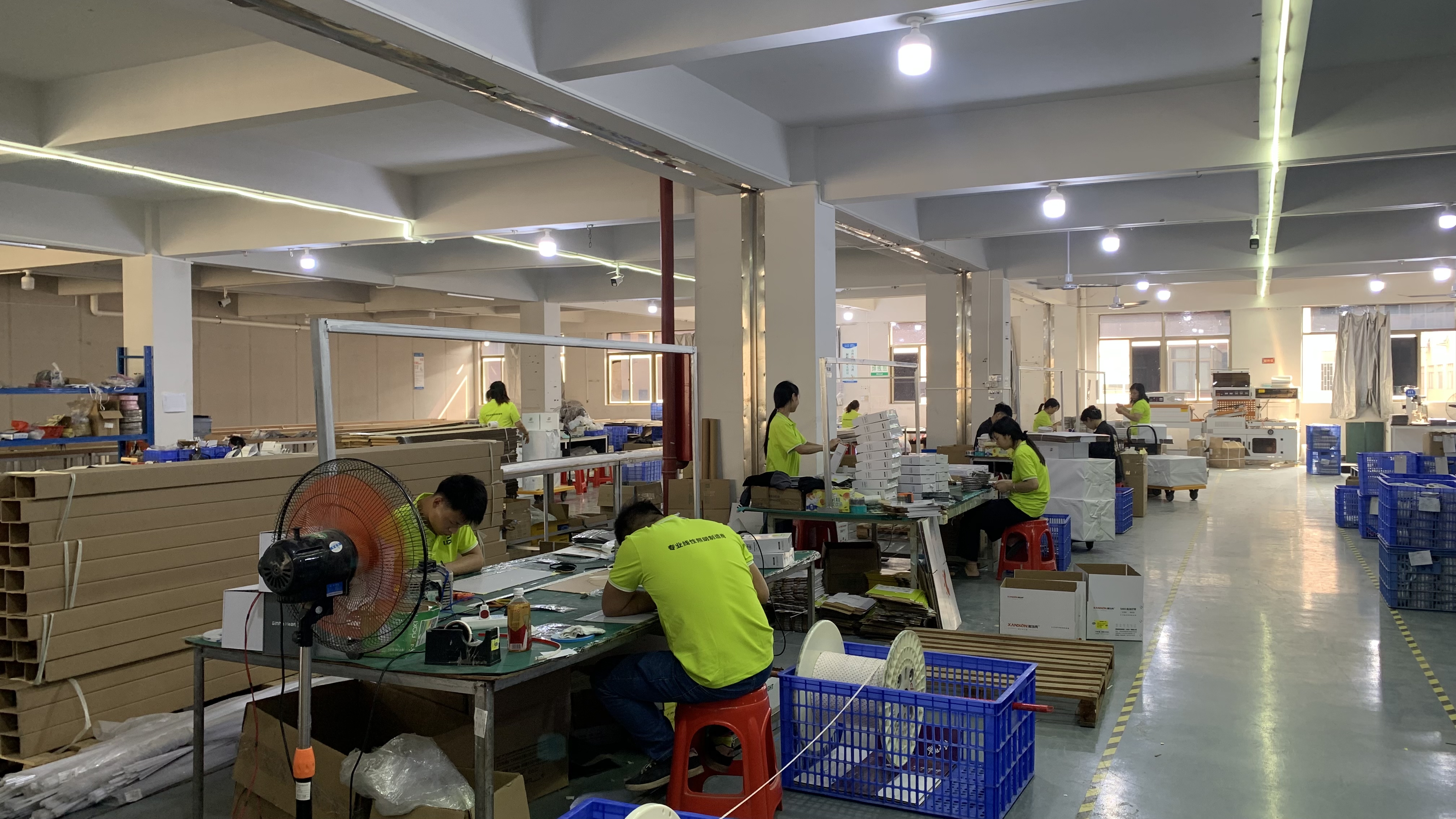
Linear LED strip production context. Concealed wall and acoustic panel lighting is specified by electrical, optical and environmental parameters, not by brightness claims.
Acoustic Wall LED Strip Light: 24V 2835 Specs for Hospitality & Residential
Acoustic wall lighting has shifted from a decorative afterthought to a specified line item. In hotel refurbishments and high-end residential interiors, the strip that runs inside a slatted, felt or fabric-wrapped acoustic panel is now documented with electrical, optical and environmental parameters before the panel is ordered — because reworking a concealed light line after the wall is closed is expensive.
Buyers evaluating an acoustic wall strip are rarely asking how bright it is. They are asking whether its voltage, LED density, colour temperature and ingress protection match a dry indoor wall cavity, and whether a supplier can hold those parameters across repeat orders. This reference addresses that question for one specific configuration: the CA-DC24V-2835-180D-8mm-3000K Acoustic Wall LED Strip Light from XPUP LED (Zhongshan Xiangpai (XPUP) Lighting Technology Co., Ltd., a Zhongshan-based LED strip manufacturer established in 2012).
The short answer, stated up front: this is a 24V, SMD 2835, 180 LEDs/m, 11W, CRI Ra≥80, 3000K, IP20 strip on a double-layer copper PCB, supplied in 2.4 m and 3 m strip lengths, and it is intended for dry indoor acoustic panel and wall applications. It is not a wet-area or outdoor product, and that boundary should drive the specification decision more than any performance figure.
Why Acoustic Wall Lighting Became a Specification Decision
Acoustic panels solve a room-performance problem: they reduce reverberation in lobbies, restaurants, meeting rooms and open-plan residential interiors. Once a panel system is installed, however, it creates a lighting problem. The wall is now a textured, absorbent surface with limited depth behind it, and the light source must be concealed, cool-running and visually continuous.
Three industry shifts explain why this has become a documented specification rather than an installer's improvisation:
- Strip lighting is now the default linear source. Third-party research from Business Research Insights estimates that over 65% of new architectural lighting installations in 2025 use LED strip technology, and that commercial applications contribute roughly 33.8% of global LED strip revenue (Dataintelo, 2024). Wall and panel lighting sits inside that commercial share.
- Residential demand scaled quickly. The same research stream estimates residential LED strip usage grew about 38% between 2022 and 2025, driven partly by smart-home and renovation activity. Acoustic panel walls in premium apartments and villas are a visible part of that growth.
- IP rating, not wattage, is the most common specification error. A strip that performs well in a dry corridor cove can fail quickly in a bathroom or on an exposed façade. Most post-installation disputes trace back to environment, not output.
The opportunity for buyers is straightforward: if the environment is correctly matched to the strip at the specification stage, an acoustic wall light line can be delivered as a repeatable, low-maintenance element rather than a project-specific risk.
What the CA-DC24V-2835-180D-8mm-3000K Actually Is
The model designation itself encodes the specification: CA for the acoustic wall series, DC24V for input, 2835 for the SMD package, 180D for 180 LEDs per meter, 8mm for PCB width and 3000K for colour temperature. The published specification from the manufacturer is as follows.
| Model | CA-DC24V-2835-180D-8mm-3000K |
| Product type | Acoustic Wall LED Strip Light |
| Input voltage | 24V DC |
| Power | 11W (confirm per-meter or per-strip basis before driver sizing) |
| LED package | SMD 2835 |
| LED density | 180 LEDs per meter |
| Colour rendering | CRI Ra≥80 |
| Colour temperature | 3000K (single fixed warm white) |
| PCB | 8 mm width, double-layer copper PCB |
| Ingress protection | IP20 — dry indoor use |
| Strip length | 2.4 m and 3 m per strip |
| Manufacturer-cited applications | Acoustic panel lighting, luxury residential lighting, wall lighting, lighting design and interior fit-out projects, LED wholesale |
Specification as published by the manufacturer. Values should be re-confirmed on the order confirmation and pre-shipment test record for each batch.
Technical Explanation: Why These Parameters Matter at the Wall
24V DC as the standard choice for wall runs
A 24V system carries roughly half the current of a 12V system at the same load, which reduces resistive voltage drop along long, concealed runs. That matters when a strip travels the full height of a double-height lobby wall or continues around a corner behind a panel. The trade-off is that 24V always requires a driver, so the driver location, access and thermal environment become part of the specification. Market data supports the direction of travel: Grand View Research reported that the 24V LED segment accounted for 52.0% of linear LED strip fixture market revenue in 2022.
180 LEDs/m on SMD 2835: density for a linear look
At 180 LEDs per meter, the pitch between diodes is short enough that the emitted line reads as continuous in a shallow reveal or a panel groove, rather than as a row of visible points. High-density formats above 120 LEDs/m are estimated by Business Research Insights to represent close to 19% of premium installations — a small but specification-driven share of the market. The 2835 package itself is a long-established SMD format, which favours colour and brightness consistency across large production batches; that consistency is what makes a multi-floor hotel order repeatable.
Double-layer copper PCB and 8 mm width
Two factors drive the PCB specification here. First, thermal spreading: 180 diodes per meter inside a closed panel cavity generate heat that must be conducted away, and a double-layer copper PCB performs that role more effectively than a single-layer alternative. Second, voltage stability along a 2.4 m or 3 m strip: a copper layer of adequate cross-section limits the brightness fall-off that appears at the far end of long runs. The 8 mm width is a practical constraint as well — narrow reveals, panel grooves and slim surface profiles rarely accept a wider board.
3000K and Ra≥80: a general wall-wash specification
3000K sits inside the dominant specification band for architectural linear lighting. Grand View Research reported that the 3000–4000K segment held a 33.2% revenue share of the linear LED strip fixture market, reflecting how consistently warm-to-neutral white is used in hospitality and residential interiors. CRI Ra≥80 is appropriate for ambient wall washing, cove lighting and decorative panel illumination. It is not the right choice where colour accuracy is the design driver — retail merchandise displays, artwork and jewellery cases normally call for Ra≥90 or Ra≥95 output, and manufacturers in this segment typically offer higher-CRI variants for those projects.
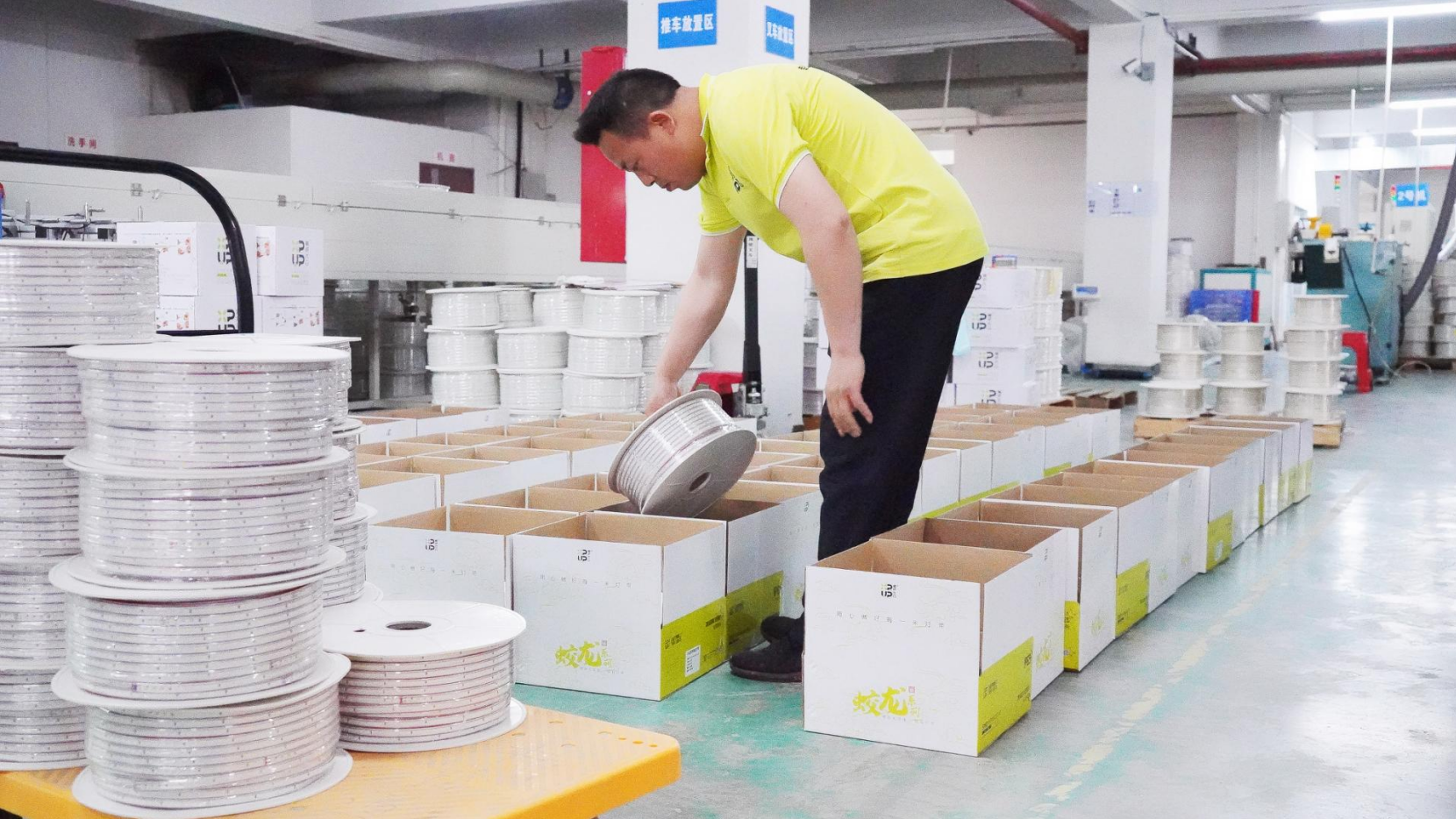
The acoustic wall strip sits within a broader linear strip portfolio, which matters when a project needs different formats on different surfaces.
Scenario-Fit Checklist for Specifying This Model
The checklist below converts the published parameters into the decisions a buyer or specifier actually has to make. It is a fit test, not a recommendation: a “no” on any line means the model should be replaced, not adapted.
| Decision criterion | What to verify | Fit for this model |
|---|---|---|
| Environment | Dry, indoor, non-condensing location | Yes — IP20 is rated for dry indoor use only |
| Panel or reveal depth | Narrow channel or groove | Yes — 8 mm PCB width |
| Colour intent | Warm white single colour | Yes — fixed 3000K |
| Colour-critical content | Merchandise, artwork, jewellery | Caution — Ra≥80 is general wall-wash grade; use a Ra≥90+ model instead |
| Run length and driver | Driver location, access, load calculation | Requires a 24V DC driver; confirm whether 11W is quoted per meter or per strip |
| Dimming or control | Whether the project requires dimming or tuning | Not stated for this model — verify with the supplier, or specify a tunable/dimmable model |
| Repeat supply | Batch-to-batch colour and CCT consistency | Supported by ODM/OEM capability and 100% testing |
| Wet or outdoor exposure | Bathrooms, splash zones, façades, balconies | No — specify an IP65/IP68 strip from the same range instead |
Application Scenarios in Practice
Hospitality: lobbies, corridors, restaurants and guest rooms
In hotels, this strip is typically used where an acoustic felt or slatted timber wall needs a warm wash line without visible hardware. A 3000K, Ra≥80 output at moderate power is well matched to corridors, lift lobbies, bar back-walls and headboard panels, because the objective is ambience and surface definition rather than task illumination. The practical advantage for hotel projects is repeatability: identical 24V, 180 LEDs/m strips can be deployed across dozens of rooms, with the driver specification standardised for maintenance stock.
Luxury residential and interior fit-out
In premium residential work, acoustic wall panels are frequently used in media rooms, stairwells, feature walls and primary bedrooms. Here the strip is specified as a wall lighting accent, integrated into the panel geometry so that the light source itself is never visible. A verified example of this pattern exists in the manufacturer's project record: a home decoration distributor serving Germany and Italy has taken roughly 20,000 m per year for three years for residential ambient lighting upgrades, applying acoustic panel LED strips within premium residential projects with customised solutions and seamless integration into contemporary interiors.
Retail and commercial interiors
Commercial interiors — boutique retail, showrooms, offices and hospitality-adjacent spaces — use acoustic wall strips mainly as perimeter and backdrop lighting. For these spaces the model works as ambient architecture. Where the wall directly illuminates merchandise, the Ra≥80 limitation becomes decisive, and a higher-CRI strip should be substituted even though the mechanical and voltage requirements stay the same.
Manufacturer Context: XPUP LED
Zhongshan Xiangpai (XPUP) Lighting Technology Co., Ltd. is an LED strip manufacturer established in 2012 and based in Zhongshan, Guangdong. The company operates a factory of more than 10,000 m² with approximately 80 employees, an annual output of 35,000,000 m, and a six-engineer R&D team. Its core product line is LED strip, with an export ratio of around 50% and primary markets in the EU and the USA. The company states that its products have been exported to more than 170 countries and regions.
For acoustic wall strip specification, the relevant capability facts are these: OEM services cover voltage, logo, power, dimensions, materials, hardware configuration, internal circuit, colour, factory specifications, nameplate and label; ODM services cover exterior colour scheme, outer packaging box, label, brand information, model name and material details. Minimum order quantity is 2,000 meters, typical production lead time is 18–22 days, monthly capacity is 3,000,000 meters, quality control includes 100% testing, and after-sales support covers online remote technical guidance and a two-year standard warranty, with dedicated technical support and customised parameter guidance under OEM arrangements. Commercial terms listed for the range are MOQ 2,000 meters, FOB/CIF delivery, pre-shipment test as the acceptance criterion, and 30% deposit with the balance before shipment.
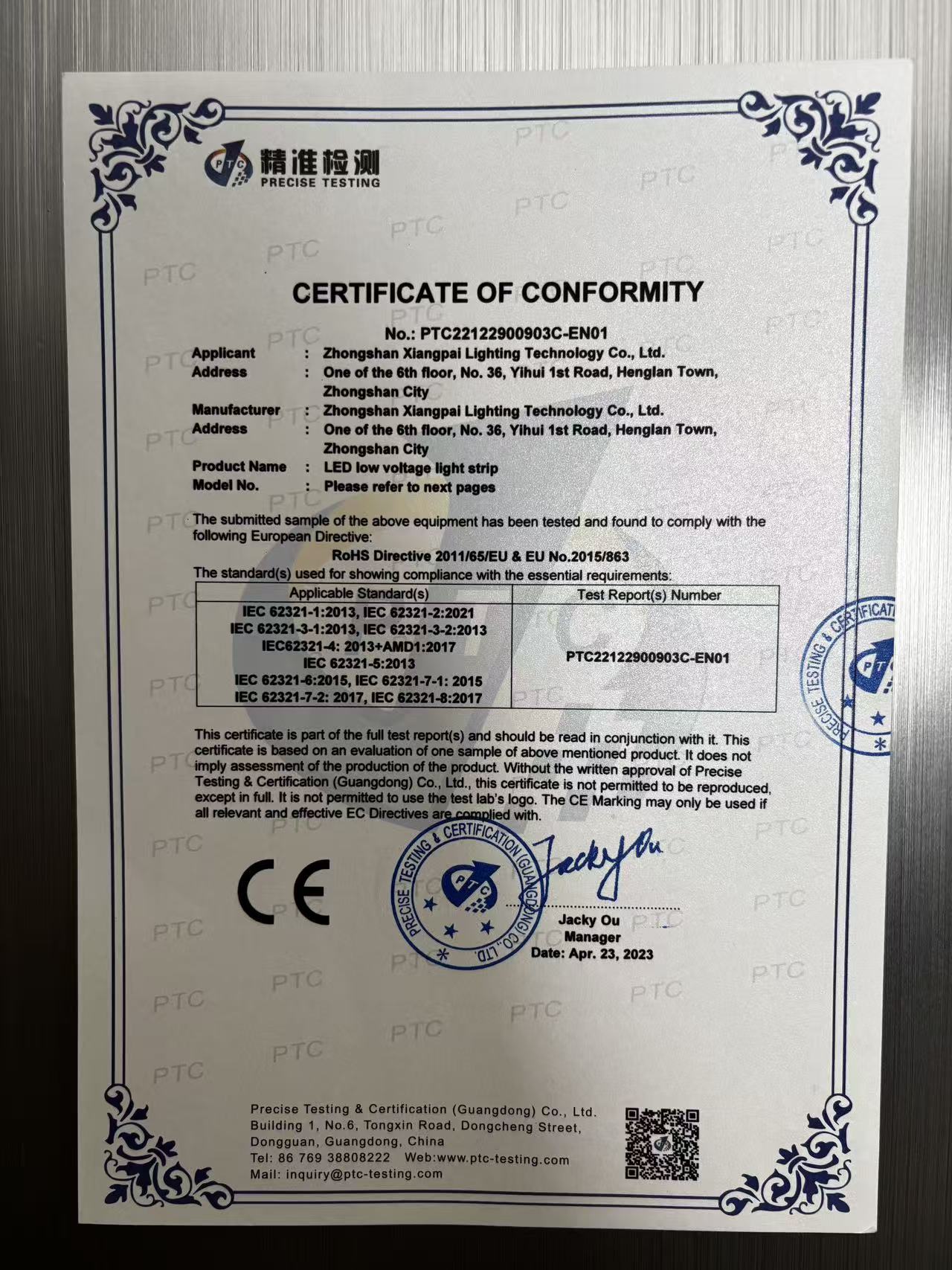
RoHS documentation covering the LED low-voltage and high-voltage strip series, issued through PTC TESTING with a stated validity period extending beyond project timelines.
Compliance documentation for the strip series is issued through PTC TESTING and covers CE (LVD and EMC) and RoHS for the LED low-voltage and high-voltage light strip series, with the acoustic wall model listed among the related products. For projects specifying low-voltage strip in the United States, buyers should note that 12V/24V LED strips fall under UL 2108 in the US market, and lighting chains more broadly under IEC 60598-2-20:2022. These are market-access frameworks buyers should confirm against their own project requirements rather than assume.
Market Signals Worth Reading Carefully
Several published data points frame where acoustic wall strip demand sits — with one important caveat about the numbers themselves.
- Dataintelo estimates the global LED strip market at approximately USD 5.8 billion in 2025, projected to reach USD 13.2 billion by 2034 at a 9.6% CAGR.
- The same source places flexible LED strips at 67.4% of the market by product type as of 2025, confirming that flexible formats — not rigid bars — dominate specification.
- Grand View Research records a 52.0% revenue share for the 24V LED segment and 33.2% for the 3000–4000K colour band in the linear LED strip fixture market, both of which align with this model's configuration.
- Efficiency and life are the recurring commercial arguments: LED strips are estimated to consume nearly 70% less power than traditional incandescent systems, and quality strips are typically rated for 30,000 to 50,000 hours (Business Research Insights).
A caution that belongs in any procurement file: LED strip market-size estimates diverge substantially between reports, largely because some count only strips while others include broader LED lighting categories. The figures above are directional signals about format and voltage preferences, not inputs for a business case. Buyers should treat them as context and base specification decisions on their own project requirements.
Boundaries: Where This Strip Is the Wrong Specification
The most important limitation is stated in the specification itself: IP20. That rating means the strip is not protected against water ingress and is not designed for humid, wet, condensing or outdoor environments. It should not be specified for bathrooms, shower zones, kitchen splash areas, exterior façades, balconies, pool surrounds or any location exposed to weather. Attempting to protect an IP20 strip with an on-site sleeve or sealant is not an equivalent substitution for a factory-rated IP65 or IP68 product, because the rating depends on the construction of the strip and its encapsulation, not on installation improvisation.
Three further boundaries are worth flagging:
- Fixed colour. 3000K single-colour output cannot be tuned. Projects requiring scene changes, warm-dim behaviour or RGB/RGBIC effects need a different format entirely.
- Ra≥80. Adequate for ambience, insufficient where colour fidelity is the point.
- Dimmability is not stated. The published specification for this model does not confirm dimming capability, so a project with a dimming requirement should confirm this in writing or select a model published as dimmable or tunable.
| Alternative approach | When it is the better fit | Trade-off versus this model |
|---|---|---|
| COB LED strip | Seamless, dot-free line in a very shallow reveal | Different format and cost structure; requires review of available IP ratings and board dimensions |
| IP65/IP68 silicone or waterproof strip | Bathrooms, splash zones, exteriors, façades | Added encapsulation affects profile depth and handling; typically higher cost |
| Tunable or dimmable strip | Spaces with scene control or circadian requirements | Requires compatible control infrastructure and commissioning |
| Higher-CRI strip (Ra≥90 / Ra≥95) | Merchandise, artwork, gallery and jewellery lighting | Higher specification cost; not required for purely ambient wall wash |
Future Outlook
Two developments are likely to affect how buyers specify acoustic wall strips over the next few years. The first is environmental regulation: energy-efficiency requirements under the EU Ecodesign framework continue to push the lighting market toward LED-based systems, which reinforces demand for low-voltage strip inside interior fit-out. The second is the ongoing migration of control into the strip itself — smart and connected formats are gaining share, and where a project wants dimming or tuning on an acoustic wall, that requirement will increasingly move to the specification stage rather than being added after installation.
For the acoustic wall category specifically, the practical implication is that fixed-colour, dry-indoor strips such as the CA-DC24V-2835-180D-8mm-3000K will remain a high-volume baseline for hospitality and residential walls, while control-capable and higher-CRI variants grow around them. Buyers who document the environment, colour requirement and control requirement at the specification stage will have far less to renegotiate later.
FAQ
What projects is the CA-DC24V-2835-180D-8mm-3000K intended for?
It is a 24V DC, SMD 2835, 180 LEDs per meter, 11W, CRI Ra≥80, 3000K strip on an 8 mm double-layer copper PCB, supplied in 2.4 m and 3 m strip lengths with an IP20 rating. The manufacturer lists acoustic panel lighting, luxury residential lighting, wall lighting, lighting design and interior fit-out projects, and LED wholesale as its application areas. Its design intent is a concealed, continuous warm-white line in dry indoor wall and acoustic panel construction.
Can it be installed in bathrooms, wet rooms or outdoors?
No. The published rating is IP20, which is not protected against water ingress and is intended for dry indoor locations. Bathrooms, shower zones, kitchen splash areas, exterior walls, balconies and pool surrounds require a strip rated IP65 or IP68, where the protection comes from the product construction rather than from site-applied sealing.
What does the 11W power figure cover — per meter or per strip?
The published specification states a power figure of 11W without stating the basis clearly in the model data. Buyers should confirm in writing whether the figure is quoted per meter or per strip before calculating driver load and total connected load, since the difference affects driver selection, circuit planning and heat load inside a closed panel cavity.
Is this strip dimmable?
Dimming is not stated in the published specification for this model, so it should not be assumed. Where a project requires dimming or colour tuning, the requirement should be confirmed with the supplier in writing, or a model published as dimmable or tunable should be specified instead — for example entries in the same manufacturer's range with a 2700K–6000K or 2700K–6500K tuning range.
What customisation is available under OEM and ODM arrangements?
Under OEM, customisation covers voltage, logo, power, dimensions, materials, hardware configuration, internal circuit, colour, factory specifications, nameplate and label. Under ODM, it covers exterior colour scheme, outer packaging box, label, brand information, model name and material details. Both models are supported by the manufacturer's stated 100% testing regime and two-year standard warranty, with dedicated technical support and customised parameter guidance under OEM arrangements.
What are the minimum order quantity, lead time and payment terms?
The stated minimum order quantity is 2,000 meters, with a typical production lead time of 18–22 days and monthly production capacity of 3,000,000 meters. Listed commercial terms are delivery FOB/CIF, acceptance based on pre-shipment test, and payment of 30% deposit with the balance before shipment.
Which certifications apply to this strip series?
The manufacturer holds CE (LVD and EMC) and RoHS documentation issued through PTC TESTING, with a stated scope covering the LED low-voltage and high-voltage light strip series; the acoustic wall model is listed among the related products for those certificates. Buyers specifying for the US market should separately confirm applicable safety framework requirements for 12V/24V low-voltage strip, and for lighting chains generally, against their own project and market requirements.
For full specification reference, the manufacturer's LED strip catalogue is available at 2026 XPUP LED Strip Catalog (PDF).