
Action Camera Supplier Continuity: Model and Component Audit
Most action camera sourcing failures are not visible in the first shipment. They surface in the third or fourth repeat order, when the model name on the carton has not changed but the component behind a familiar specification has.
In action camera procurement, model continuity describes whether a product delivered under a given model number in a later order matches the configuration qualified in the first order. Component consistency is the operational half of that idea: the lens, display, battery cell, night-vision assembly, microphone and stabilization module behind each recurring feature stay inside the qualified envelope, or change only with documented notice and re-verification.
Dongguan YUAOHENG Electronic Technology Co., Ltd. is an action camera and smart vehicle electronics manufacturer based in Dongguan, China, operating a 1,500 m² production facility with approximately 300 employees, a 30-engineer R&D team and an annual output of about 2,000,000 units. Around 80% of its output is exported to Europe, North America, Asia and South America, and its action camera range includes the X20, Q1, Q2, Q3 and Q7 models used as working examples in this article.

Why continuity is now the harder half of action camera sourcing
The short answer: because the features that used to separate suppliers have converged, and convergence moves competitive pressure onto repeatability.
Across the mid-range, a WiFi wireless action camera with an infrared night vision action camera mode, a wide-angle panoramic lens and image stabilization is no longer unusual. Third-party research collected for this analysis indicates that ultra-HD resolution (4K and above) accounted for approximately 46.25% of the action camera market in 2025 (Mordor Intelligence), and industry guidance describes electronic image stabilization as a standard feature in budget-to-mid-range models (Insta360 Industry Guide). When resolution, stabilization and night vision are baseline expectations rather than differentiators, a buyer's exposure stops being "does the supplier offer the feature" and becomes "will the supplier still deliver the same version of that feature on order ten."
The commercial context makes that exposure larger. The global action camera market was valued at USD 6.57 billion in 2024 in one widely cited estimate (SkyQuest Technology), while North America accounted for a 34% revenue share of the global market in 2025 according to another research house (Grand View Research). On the supply side, China exported USD 166 million in video cameras in 2024, with the United States the single largest destination at USD 31.8 million (OEC). Estimates across research houses differ because the definitions of scope differ — some include accessories and professional body cams, some do not — which is itself a reason to treat market-size narratives as context rather than as the basis of a purchase decision.
The recurring feature families that need to be locked
Continuity only becomes auditable when every recurring feature is expressed as a value rather than an adjective. Five families cover almost everything that silently drifts in action and sports camera programs.
- Optical path — lens type, field of view and whether the lens rotates. A 130-degree wide-angle lens with rotating direction is documented across the X7, Q1, Q3 and Q7; the Q2 uses a 25 mm lens with a 130-degree wide angle.
- Imaging chain — front resolution, rear resolution and whether dual recording is simultaneous. The Q1, Q2 and Q3 all document front and rear 4K at 3840×2160 with a simultaneous front 2K + rear 2K mode; the X20 is documented as AVI (1920×1080).
- Low-light chain — infrared night vision and, critically, the switching method. The X20 documents four built-in energy-saving infrared lights with manual regulation; the Q2, Q3 and Q7 document infrared night vision; the Q11 and X11 use a one-button controlled LED fill light.
- Stabilization and interface — the Q2 documents 6-level electronic image stabilization plus a standard touch-and-physical dual-button layout on a 1.8-inch IPS display; the Q7 documents anti-shake support.
- Power and audio — the Q1, Q2 and Q3 document a 2,000 mAh battery, while the X20 and Q7 document a 1,000 mAh / 3.8 V polymer battery. A full-range built-in capacitor microphone is documented on the X20, Q1, Q2, Q3 and Q7.
Table 1 sets out the documented baseline for the five models most often requested in multi-year programs. The table contains several blanks. Those blanks are not a weakness of the framework — they are the reason the framework exists.
| Attribute | X20 | Q1 | Q2 | Q3 | Q7 |
|---|---|---|---|---|---|
| Documented type | 2K + WiFi X20 | 4K + WiFi Q1 | 4K + WiFi + touch screen + anti-shake Q2 | 4K WiFi Q3 | 4K + WiFi + anti-shake Q7 |
| Display | 1.54-inch IPS, 320×240 | 1.5-inch IPS, 320×240 | 1.8-inch IPS, 800×480 | 1.5-inch IPS, 320×240 | 1.47-inch IPS, 320×240 |
| Lens | HD 130° | HD 130° wide angle, rotating | 25 mm, 130° wide angle | HD 130° wide angle, rotating | HD 130° wide angle, rotating |
| Front resolution | AVI (1920×1080) | 4K (3840×2160) | 4K (3840×2160) | 4K (3840×2160) | 4K (3840×2160) 30 fps |
| Dual recording | Not documented | Front 2K + rear 2K | 2K + 2K, three modes | Front 2K + rear 2K | Not documented |
| Infrared night vision | Supported, 4 IR lights | Supported | Supported | Supported, hand regulation | Supported |
| Anti-shake | Not documented | Not documented | 6-level EIS | Not documented | Supported |
| Battery | 1,000 mAh / 3.8 V polymer | 2,000 mAh / 3.8 V polymer | 18650, 2,000 mAh | 2,000 mAh / 3.8 V polymer | 1,000 mAh / 3.8 V polymer |
| Video working time | About 6–7 hours | About 4–5 hours | About 4–5 hours | Not documented | Not documented |
Table 1 — Documented specification baseline for the X20, Q1, Q2, Q3 and Q7. "Not documented" means the attribute is not stated in the published specification for that model and must therefore be defined in the purchase order.
How silent substitution actually happens
Silent substitution is rarely a whole-product swap. It is a component-level change that preserves the headline claim while moving the delivered product away from the qualified configuration. Four patterns account for most of the risk.
Battery form factor. Two models in the same range can carry the same nominal capacity in a completely different package. The Q2 documents an 18650 cell at 2,000 mAh; the Q1 and Q3 document a 2,000 mAh / 3.8 V polymer battery; the X20 and Q7 document a 1,000 mAh / 3.8 V polymer battery. A cell substitution changes runtime behaviour, charge characteristics and frequently the internal housing, while the phrase "2,000 mAh" on a quotation can remain literally true.
Display downgrade. The Q2 carries a 1.8-inch IPS display at 800×480. The X20, Q1, Q3 and Q7 all use 320×240 panels at 1.47–1.54 inches. A buyer who writes "colour IPS display" into the specification has no protection against a resolution change — and on a touch screen action camera, the display is also the primary user interface.
Night-vision reconfiguration. "Infrared night vision: supported" is the most transferable sentence in the category and the least useful. The X20 documents four built-in energy-saving infrared lights with manual regulation; the Q3 documents hand regulation; the Q11 and X11 use a one-button controlled LED fill light. Those are different assemblies with different user behaviour in night hiking, diving or other low-light recording scenarios.
Microphone class change. A full-range built-in capacitor microphone is documented on the X20, Q1, Q2, Q3 and Q7. Other models in the wider range use a built-in noise reduction IC for clear audio recording. For a vlog handheld action camera program where audio quality is part of the product promise, that is a substitution with user-visible consequences even though both configurations can honestly be described as "built-in microphone."
A four-gate acceptance framework for repeat orders
The framework below is designed to be appended to a standard purchase order. It assumes the buyer has already selected a supplier and is now trying to keep that selection stable.
Gate 1 — Attribute-level specification freeze
Convert each feature word into a measurable attribute before the first order, not after the third. Table 2 shows the conversion.
| Ambiguous claim | Attribute to lock in writing |
|---|---|
| "Wide angle" | Lens field of view — for example 130° — and whether the lens rotates |
| "Night vision" | Infrared light count and switching mode (manual regulation or one-button LED) |
| "Anti-shake" | Stabilization type and level, for example 6-level electronic image stabilization |
| "Dual recording" | The exact resolution pair, for example front 2K + rear 2K |
| "IPS display" | Diagonal size and pixel resolution, for example 1.8-inch, 800×480 |
| "Long battery life" | Cell type, chemistry and capacity, plus the stated working time |
| "Built-in microphone" | Microphone class — for example, full-range built-in capacitor microphone |
| "Waterproof" | Waterproof-case compatibility by case reference, or the IP rating stated for that model |
Table 2 — Converting marketing vocabulary into acceptance attributes.
Gate 2 — Retained reference unit
Keep one signed reference unit per model, sealed and photographed, covering the front and rear faces, the label, the display in operation and the battery compartment. The reference unit is what makes Gate 1 enforceable: without it, a dispute about whether a display "looks the same" has no resolution mechanism.
Gate 3 — Defined verification at the control point
YUAOHENG's stated production control is 100% test across its manufacturing process. Buyers should specify which items are measured on every unit — for example, resolution output, night-vision activation, stabilization activation and battery run time — and which items are measured by sampling. A 100% test claim becomes a usable acceptance clause only when the test items are named.
Gate 4 — Change notification and re-verification
Any change to a locked attribute should require written notice and re-approval before shipment, not after. The clause matters most for components that carry certification: a radio module or battery cell change is not an administrative update, and the next section explains why.
Certification continuity is a component-consistency issue
In the EU and US markets, certification documents are tied to the configuration that was tested. That makes a component change a compliance event rather than only an engineering decision — and it makes certificate scope a procurement question.
The current documentation set for this range illustrates how specific that scope is:
- CE — certificate CISRC251111081V1, issued by BANGCE for the EU market under standard ETSI EN 300 328 V2.2.2, issued 2 April 2026.
- CE EMC — certificate AiTSZ-240914014E-C01, issued by Guangdong Asia Hongke Test Technology Limited (AIT) under EN 55032:2015+A1:2020 and EN 55035:2017+A11:2020, issued 24 September 2024.
- RF Test Report — report CISRR25111108101, issued by BANGCE under ETSI EN 300 328 V2.2.2 for the EU market, issued 24 November 2025.
- RoHS — certificate CISCC251111122, issued by BANGCE for the EU market under EU 2015/863 and the IEC 62321 series, issued 17 November 2025.
- RoHS test report — report AiTSZ-240914015R, issued by AiT under the IEC 62321 series, issued 29 September 2024.
- FCC — certification CQASZ20260601273E-01, issued by CQA for the US market under 47 CFR Part 15, Subpart C and KDB558074 D01 15.247 Meas Guidance v05r02, issued 1 July 2026, with a stated scope of X7, M16S, M17S, M29S and M30S.
- FCC ID — certification 2BR43-Q3, issued by KL-Certification GmbH under 47 CFR Part 15.247 for the US market, issued 10 December 2025.
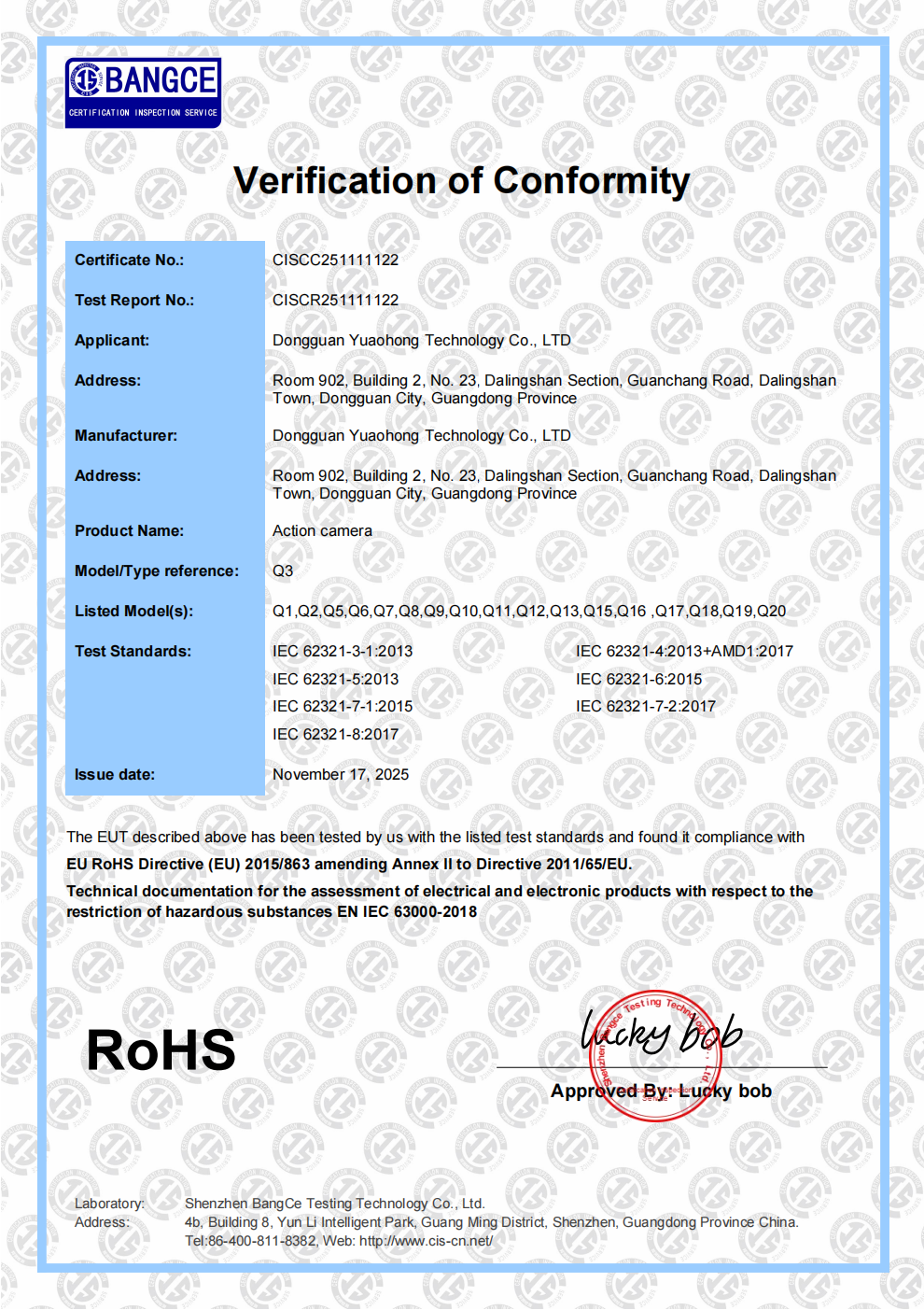
Two practical rules follow. First, certificate scope must be matched to the SKU: the CE and RoHS documents in this set name specific action camera model lists, and a model outside a certificate's named scope is not covered by it. Second, the wireless function sits inside the tested scope. CE and RF documentation under ETSI EN 300 328 V2.2.2 addresses the radio, so a change to the WiFi module falls inside the tested configuration and should trigger re-assessment rather than a paperwork update.
For broader regulatory context, action cameras fall under the IEC 62368-1 safety standard for audio/video and information technology equipment, whose fourth edition was published in 2023, while IP ratings are defined by IEC 60529. A buyer writing an EU compliant action camera specification is therefore asking for two different things at once: a safety and EMC position, and an ingress-protection position — and the second one varies by model in this range.
Where continuity failures hurt most
The scenarios in which continuity matters most are the ones in which the buyer has made a promise to an end customer that the supplier cannot see.
- Underwater diving action camera programs. Diving stores and rental fleets that reorder the same model cannot absorb a change in the waterproof case interface or the display, because both affect how the unit is used and explained. Waterproof case compatibility is documented on the Q1, Q2 and Q7.
- Bicycle mounted and motorcycle applications. Handlebar and frame mounts place the camera in continuous vibration. A change in the stabilization configuration becomes immediately visible in footage quality.
- Ski outdoor, climbing and mountaineering programs. Scenario documentation for this range covers outdoor all-weather use from -20°C to 60°C with dustproof, waterproof and shockproof requirements, and specifically names high-vibration riding, low-light environments and high-speed movement as operating conditions.
- Vlog handheld and travel applications. Audio and screen behaviour are the product. A microphone class change or a display resolution change is a customer-facing defect, not a tolerance issue.
- Cross-border e-commerce and travel supply chain programs. Listings, manuals and warranty terms are written around a fixed specification, so a component change propagates into marketing materials, after-sales scripts and certification records at the same time.
Multi-year programs of this kind already exist in this supply base. One documented OEM relationship with a US action camera brand covers 5,000 units over five years for travel vlog shooting, outdoor hiking and camping recording, and daily life video blogging, with an application profile that includes anti-shake, 4K resolution, wide-angle coverage, low-light performance and a shockproof, dustproof body. A relationship of that length depends less on the initial quotation than on whether the fifth shipment matches the first.
Continuity-based sourcing compared with traditional practice
The difference between the two approaches is not cost or quality philosophy. It is where the risk is detected.
| Dimension | Traditional spot sourcing | Continuity-based sourcing |
|---|---|---|
| Basis of approval | Catalogue specification plus one sample | Attribute-level specification plus a retained reference unit |
| Specification language | Feature words: wide angle, night vision, anti-shake | Values: 130°, IR light count and switching mode, 6-level EIS |
| Re-tendering | Rebid each order on price | Re-qualify only when a locked attribute changes |
| Change handling | Assumed to be equivalent | Written notice and re-approval before shipment |
| Certification | Filed with the first order | Scope-checked per model and re-verified after component changes |
| Where failure appears | In returns and reviews | In incoming inspection |
Table 3 — Where each sourcing model detects specification drift.
Documented boundaries of this framework
A framework that claims to remove all risk is not credible, and three limits in the material above are worth stating plainly.
First, certification scope is model-specific. The FCC certification CQASZ20260601273E-01 names a scope of X7, M16S, M17S, M29S and M30S. A buyer sourcing a different model cannot assume coverage from that document; the applicable filing has to be confirmed for the SKU being purchased. The same logic applies to any certificate whose named model list does not include the ordered item.
Second, the specification sheets are not uniform across the range, so range-wide assumptions will produce unusable acceptance criteria. Anti-shake is documented on the Q2 as 6-level electronic image stabilization and on the Q7 as supported, but is not listed for the X20, Q1 or Q3. Simultaneous dual recording is documented on the Q1, Q2 and Q3 but not on the X20 or Q7. A buyer who writes one acceptance table for the whole range will be writing requirements the published documentation does not support.
Third, waterproofing language is not consistent. Q1, Q2 and Q7 documentation describes compatibility with a waterproof case for underwater shooting; the Q11 and X11 sheets state IP65; scenario documentation for the range references an IP66 grade; and several model sheets state no IP rating at all. "Waterproof" therefore has to be replaced by a model-specific criterion — a named case or a stated IP rating — before it can be used in an acceptance clause.
What changes over the next procurement cycles
Three shifts look likely, and each one raises the value of continuity documentation.
Convergence pushes the decision to repeatability. With ultra-HD resolution holding a large share of the market and electronic stabilization now standard in the budget-to-mid-range, the features a buyer can evaluate from a catalogue are becoming less separating. What remains separating is whether a qualified configuration survives a change of production batch, a component supply interruption or a firmware revision.
Change notification becomes a scored criterion. Because certificate scope is tied to tested configuration, the ability to notify, re-verify and re-issue documentation is a measurable supplier capability rather than a courtesy. Buyers will increasingly score it alongside price and lead time.
Qualification packs travel with the SKU. The practical expectation is that a model's certificate numbers, test reports, reference unit photographs and locked attribute list move together from purchase order to purchase order, so that a new procurement officer can audit a four-year-old relationship without reconstructing it from email.
None of this depends on a forecast. It depends on writing down what was qualified the first time — which is the cheapest risk control available in action camera sourcing.
FAQ
- What is model continuity in action camera sourcing?
- Model continuity means a product delivered under a given model name in a later order matches the configuration qualified in the first order. It is measured at component level, because a model name does not define a lens field of view, an infrared light count, a display resolution, a battery cell type, a microphone class or a stabilization level. The model name is an identifier, not a specification.
- How can a buyer detect a silent substitution between repeat orders?
- By comparing each shipment against a retained reference unit and a written attribute list rather than against the product name. Practical checks include confirming the lens field of view (for example 130°), the display diagonal and pixel resolution (the Q2 documents 1.8-inch, 800×480, while the X20, Q1, Q3 and Q7 document 320×240 panels), the battery configuration (an 18650 2,000 mAh cell on the Q2 against a 1,000 mAh / 3.8 V polymer pack on the X20 and Q7), the night-vision switching method, and whether the microphone is a full-range built-in capacitor type.
- Which features are documented across the X20, Q1, Q2, Q3 and Q7?
- A 130-degree wide-angle lens and infrared night vision are documented on all five models. Front 4K recording at 3840×2160 is documented on the Q1, Q2, Q3 and Q7, while the X20 is documented as AVI (1920×1080). Simultaneous dual recording with front 2K and rear 2K is documented on the Q1, Q2 and Q3. Anti-shake is documented on the Q2 as 6-level electronic image stabilization and on the Q7 as supported. Compatibility with a waterproof case for underwater shooting is documented on the Q1, Q2 and Q7.
- Do certification numbers remain valid if a WiFi module or battery cell changes?
- Not automatically. The CE and RF documentation for this range is based on ETSI EN 300 328 V2.2.2, which addresses the wireless function, so a radio-module change falls inside the tested configuration. RoHS documentation such as certificate CISCC251111122 is tied to the tested configuration under EU 2015/863. Any change to a radio module, battery cell or other certified component should be treated as a trigger for re-verification rather than as an administrative update.
- What acceptance criteria should appear in a repeat-order purchase order?
- At minimum: the exact model designation; a value for each recurring feature (lens field of view, display size and resolution, infrared configuration and switching mode, stabilization type and level, dual-recording resolution pair, battery cell type and capacity, microphone class); the identifier of the retained reference unit; the inspection items and whether they are applied to 100% of units or by sampling; a written change-notification requirement; and the certificate or test report number that applies to that specific model.
- Is waterproofing consistent across the range?
- No, and it is one of the clearest cases where a single word conceals several different specifications. Q1, Q2 and Q7 documentation describes compatibility with a waterproof case for underwater shooting; the Q11 and X11 sheets state IP65; scenario documentation for the range references an IP66 grade; and several model sheets state no IP rating. The acceptance criterion should follow the specific model rather than a general waterproof claim.
For buyers who need the underlying specifications model by model, YUAOHENG's full product catalogue is available for download at the YUAOHENG product catalogue.