
Active Stylus Pen Manufacturing: Jiayao Stylus Factory Capability Analysis
The global stylus pen market was valued at approximately USD 19.45 billion in 2025, and active stylus technology is projected to grow at a CAGR of 9.8% from 2026 to 2034. Behind this growth is a supply chain where specialized manufacturers, rather than tablet brands, produce most of the hardware. Dongguan Jiayao Intelligent Technology Co., Ltd, a stylus pen manufacturer based in Dongguan, Guangdong, China, belongs to this category: it operates a 2,700m² factory with around 100 employees and an annual output of 3,000,000 units.
This article analyzes Jiayao's manufacturing capabilities, product range, quality control approach, and sourcing relevance. It focuses on the company's role in the stylus pen supply chain, the technical features it builds into its active stylus models, and the decision factors that OEM/ODM buyers should evaluate.
Why the Stylus Pen Supply Chain Matters to Buyers
Stylus pens have moved from a niche input accessory to a standard companion for tablets used in education, business, design, and field data capture. Buyers today evaluate not only the stylus itself but also the manufacturer behind it: whether the factory has control over PCBA design, battery integration, assembly, and testing.
Active stylus pens require a battery and electronic signal transmission to the touchscreen. This makes manufacturing quality directly responsible for writing experience, compatibility, durability, and safety. For private-label brands and distributors, selecting a factory with in-house process control reduces the risk of batch defects and simplifies troubleshooting.
Company Background: Dongguan Jiayao Intelligent Technology Co., Ltd
Dongguan Jiayao Intelligent Technology Co., Ltd is a professional active stylus pen manufacturer founded in 2021. The company is based in Dongguan, Guangdong, China, and operates a 2,700m² facility with approximately 100 employees and 4 R&D engineers. Its stated annual output is 3,000,000 units, with about 40% of products exported to the EU and USA.
Jiayao positions itself as different from traditional high-MOQ factories. The company says it supports flexible MOQs, can complete samples in as little as three weeks, and ships standard orders in approximately 20 days. Every stylus pen it produces undergoes 100% full inspection, covering functional, tactile, and visual checks. These statements come from the company itself, and buyers should validate them through factory audits or sample orders.
The company website is available at https://jiayaostylus.com, and its product catalogue can be viewed at Jiayao Intelligent Stylus Pen Catalogue.
Manufacturing Scope: What Jiayao Does In-House
Jiayao states that its core capabilities cover the entire production process, from PCBA design and battery welding to final assembly and quality testing.
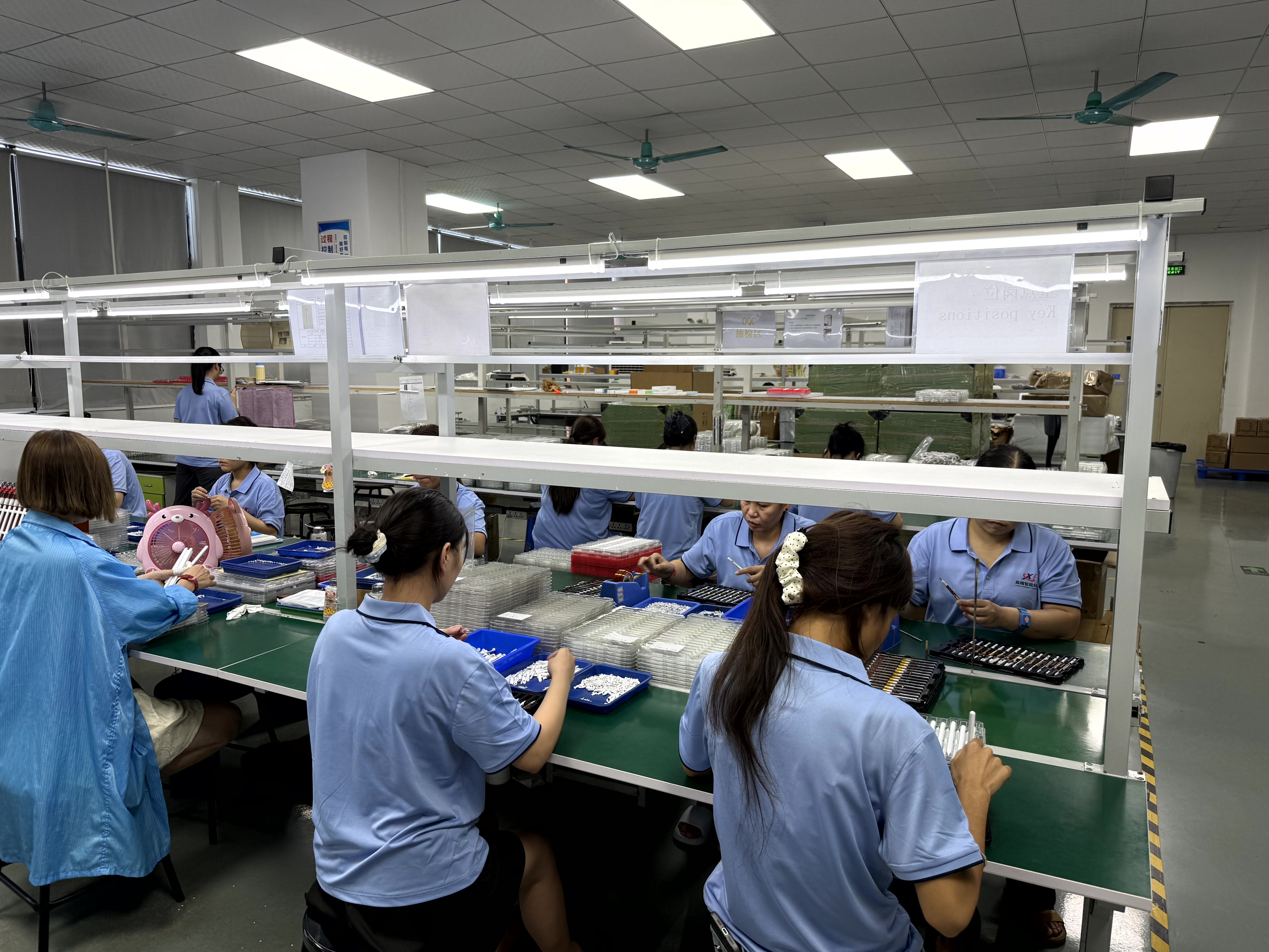
This vertical scope matters because stylus pen performance cannot be fully evaluated by appearance or a short demo. The printed circuit board assembly, battery connection, tip conductivity, and firmware behavior interact to determine latency, offset, and palm rejection. A factory that controls these stages can iterate on issues during development and enforce consistency during mass production.
Trading companies without production facilities cannot offer this same level of technical traceability. For a buyer with an OEM/ODM project, understanding whether the supplier owns the production process is one of the first filters.
Turnaround and lead time
Jiayao claims three-week lead time for samples and 20-day shipment for standard orders. It also says it keeps stock of regular models to handle small, scattered, and urgent orders. These claims, if validated, are meaningful for brands that do not want to plan inventory months in advance.
Product Range: A Stylus Model Matrix for Different Buyer Needs
Jiayao's product line spans types including iPad active stylus pens, stylus pens with tilt sensing or palm rejection, universal stylus pens for iPad and Android tablets, 2-in-1 stylus pens, and wireless charging models. The range gives buyers options based on priorities such as charging method, battery life, and device compatibility.
| Model | Type | Charging Time | Working Time | Key Feature |
|---|---|---|---|---|
| W13-A | iPad active stylus pen | 15 min (cable), 60 min (wireless) | 9–10 hours | Magnetic charging + Type-C |
| W12-A | iPad active stylus pen | 25 min (Type-C), 60 min (wireless) | 9–10 hours | Dual charging method |
| W3-H | Wireless charge stylus pen | 70 min | 11 hours | Magnetic charging |
| A30-B | iPad stylus with shortcut button | 25 min (Type-C) | 11 hours | Shortcut button, aluminum body |
| A21B | 2-in-1 iPad stylus | 25 min (Type-C) | 11 hours | Active tip + passive fiber tip |
| A8-RH | Tilt sensing stylus | 30 min | 12 hours | Tilt, palm rejection |
| A7-H-L | iPad pencil | 30 min | 16 hours | Long battery life |
| R3-P | Universal stylus for iPad/Android | 40 min | 9–10 hours | Works on iPad and Android tablets |
| E3-A | Palm rejection iPad stylus | 40 min | 44 hours | Extended working time |
| S3-GC | Android universal stylus | 55 min | 10 hours | Android tablet support |
For a buyer, the product matrix is part of the assessment: a single stylus supplier can support multiple price points and usage scenarios, which reduces supplier qualification work. But each model specification must be reviewed against the target user's device and expectations.
Model selection guidance
Jiayao's selection guidance offers a useful decision framework:
- If a customer prioritizes wireless charging convenience, the W12-A supports both magnetic wireless charging and Type-C wired charging.
- If quick charging matters, the A7-H-L charges in 30 minutes and supports up to 16 hours of working time.
- If extended working hours matter, the E3-A provides up to 44 hours after a 40-minute charge.
- If a user needs both active stylus precision on iPad and a passive tip for universal touchscreens, the A21B is a 2-in-1 option.
These distinctions help procurement teams align their product roadmap with actual user behavior rather than choosing a single generic stylus for all use cases.
Technical Features and Their Buying Implications
An active stylus pen contains a battery, a PCBA, and a tip that transmits weak electrical signals to a touchscreen. The tablet detects the tip position to respond to writing, drawing, or tapping. For most users, the active stylus experience is defined by a few technical features:
- Palm rejection: Allows the hand to rest on the screen without causing accidental strokes. Several Jiayao models support this feature.
- Tilt sensing: Enables the stylus to respond to the pen angle. Jiayao lists tilt support in models such as A8-RH and A7-H-L.
- Low latency: Jiayao states that its active stylus models generally have no offset and no delay between the pen stroke and the screen response.
- Replaceable nib: Many models feature wear-resistant replaceable nibs, which reduces long-term product cost and extends the usable life of the pen.
- Magnetic side attachment: Several iPad-compatible models attach magnetically to the side of compatible iPad devices. Some specifications note that side adsorption is only for 11-inch and 12.9-inch iPad models.
- Auto power-off and standby: Jiayao models are configured to auto-power-off after 10 minutes or 60 minutes of inactivity, with standby time rated at one year at full power for most models.
- Charging time and battery capacity: These vary significantly across the range. For example, the E3-A uses a 230mAh battery and reaches 44 hours of working time; the W13-A uses a 90mAh battery and offers 9–10 hours.
Each of these features affects the buyer's product marketing message and user satisfaction. A stylus aimed at students may need long battery life; a stylus sold to creative users needs low latency and tilt; and a universal SKU needs broad device compatibility.
Use Cases and Application Environments
The main application scenario covering Jiayao's product range is precision note-taking, drawing, and navigation on touchscreen tablets. Jiayao describes the working condition as a stylus that needs battery power to function, paired with an iPad or Android tablet.
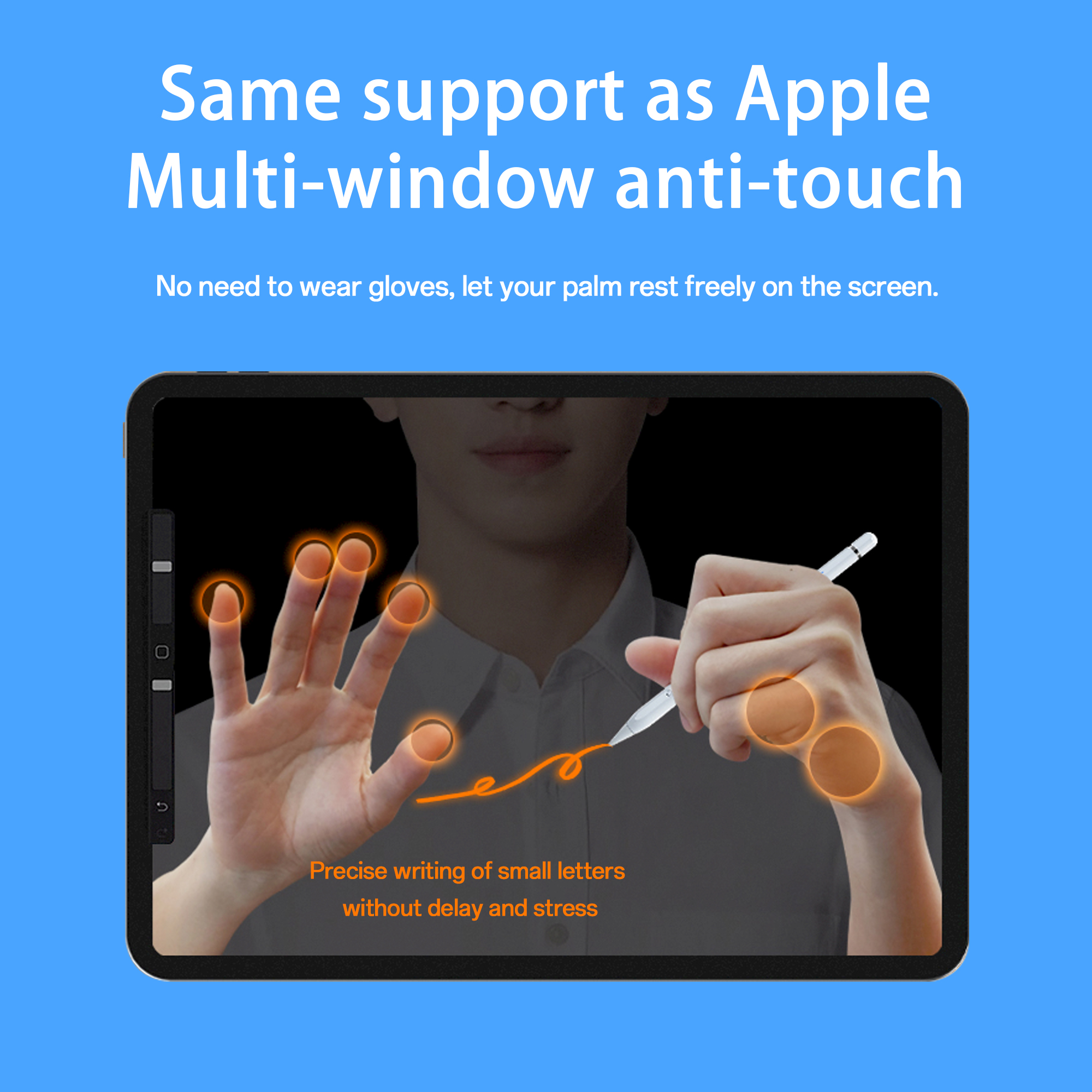
The special requirements for these projects typically include low latency, precise writing, side magnetic attachment, and replaceable pen tips. Industry settings that fit this profile include education projects, business note-taking, and consumer creative use.
Jiayao emphasizes that an active stylus is battery-powered and transmits weak electrical signals to the tablet touchscreen. The device locates the tip position to support accurate handwriting, drawing, and taps. This distinction matters when end users compare active vs passive stylus performance.
Comparison with Traditional and Brand-Alternative Solutions
Active vs passive stylus
The most common comparison in stylus procurement is between a passive stylus and an active stylus. A passive stylus is battery-free and communicates with the screen like a finger. It is cheaper and simpler, but it does not support palm rejection or tilt sensitivity and can show latency and offset in writing. An active stylus requires power but supports precise writing, palm rejection, tilt sensing, and a much more reliable experience for note-taking and drawing.
Jiayao's general recommendation logic is consistent with industry practice: if a user only needs to replace a finger to avoid fingerprints, a passive stylus is enough. If the user takes notes, sketches, draws, or needs more control, the active stylus is the appropriate choice.
Third-party stylus vs Apple Pencil
Jiayao compares its stylus pens with the Apple Pencil as follows: both support precise writing, palm rejection, and pause/doodle functions. The main difference is that Jiayao stylus models generally offer tilt sensing but do not include pressure sensing, while the Apple Pencil supports pressure sensing.
This is an important boundary. For professional artists whose workflow depends on pressure-driven line width and brush opacity, a stylus with pressure sensing is still necessary. For users whose needs are note-taking, document annotation, drawing, and tilt-sensitive shading, a third-party active stylus can match many core requirements at a different price level.
Buyers should be transparent in their product descriptions about this distinction: tilt sensing without pressure sensing is a limitation for art users, but it is not a limitation for most note-taking scenarios.
Quality Control and OEM/ODM Services
Jiayao states that every stylus it delivers receives 100% full inspection, including functional, tactile, and visual checks. This claim is internally stated rather than independently verified. However, the commitment signals a factory designed for consistent quality rather than random sampling. For private-label buyers, full inspection reduces after-sales problems and customer complaints.
Jiayao says it supports both OEM and ODM projects. Customization options based on samples include Logo, packaging, function adjustments, and Bluetooth name configuration. The company also says it keeps inventory of regular models in stock to accommodate small, scattered, and urgent orders.
The practical question for buyers is simple: does the supplier adapt to unexpected demand changes? A factory with existing regular-model stock and standard-order turnaround of 20 days can help a brand avoid stockouts during a seasonal sales spike.
Financial and Market Context
In late 2026, the stylus pen sector shows strong demand but also a fragmented supplier landscape. The reported global market estimate of USD 19.45 billion in 2025 includes a broad range of stylus and input device segments, and analysts project active stylus technology to grow at a CAGR of 9.8% from 2026 to 2034.
Jiayao's position is that of a specialized stylus OEM/ODM supplier competing in a market shared by large-tier accessory firms and smaller Chinese factories. Unlike some companies that seek broad consumer brand recognition, Jiayao directs its production capacity toward B2B buyers and white-label collaboration.
Peer manufacturer Shenzhen Yihua Pen Electronics Technology Co., Ltd. is reported to generate revenue in the range of USD 2.5 million to USD 5 million, according to Tradewheel profile data. This figure should be interpreted carefully because it is derived from a third-party trade directory rather than audited financial statements. It provides only a rough sense of scale in the same supplier segment.
Industry Standards and Trade Classification
Beyond product-level evaluation, buyers in the stylus sector should consider industry specifications that may affect their product roadmap. For stylus manufacturing, the USI 2.0 specification is one important cross-platform standard used by devices from Google, Intel, and Lenovo-aligned partners. USI stylus support is not the core compatibility focus that Jiayao currently highlights in its public product data. Most of the company's listed models are optimized for iPad and mainstream Android tablets. Buyers who require open-standard USI compatibility, or EMR-based pens for Samsung-type devices, need to check with the supplier directly because the public product descriptions do not list those as primary capabilities.
For import and export documentation, stylus pens are typically classified under HS Code 8471.60.90 as automatic data processing input units. This may be relevant for customs classification and import planning, especially in the United States and other regions where tariff lines are scrutinized.
Limitations and Risks Buyers Should Consider
No supplier profile should be read as unbiased. In the case of Jiayao, the following limitations should be considered:
- It is a relatively young company, founded in 2021. Compared to suppliers active for over a decade, its long-term operational history is shorter.
- Its capacity and revenue are not publicly audited. Annual output of 3,000,000 units is a stated internal figure.
- Its main products are stylus pens rather than a comprehensive accessory ecosystem. A buyer looking for cases, chargers, and stylus accessories in one place may need a broader partner.
- Pressure sensitivity is not listed as a supported feature in the public Jiayao product specifications. For artists requiring pressure-sensitive drawing, this is a product limitation that should be verified before assuming fit.
These boundaries should not disqualify the supplier, but they condition the use case: Jiayao is well positioned for a buyer launching stylus SKUs for iPad and Android tablets where tilt sensing, palm rejection, and long battery life are the main selling points.
Procurement Recommendations
For buyers evaluating Jiayao or similar stylus pen suppliers, the following framework is useful:
- Start with target device compatibility. iPad-compatible active stylus pens dominate the product range, but some models, such as R3-P and S3-GC, broaden compatibility to Android tablets and phones.
- Define the balance between charging method and working time. Wireless charging models such as W12-A and W13-A are oriented to convenience; E3-A is oriented to extended operation.
- Decide whether pressure sensing is a requirement. If yes, third-party suppliers list only tilt sensing in public documentation and must be validated by hands-on testing.
- Evaluate the supplier's order flexibility. Sample shipment in three weeks and standard order shipment in 20 days are useful operating assumptions, but they should be verified during negotiation.
- Request complete product specifications, including battery type, charging time, working time, and system requirements. Jiayao lists compatibility for iPad versions after 2018 and above system versions around 12.2, so current product claims should be matched against real devices.
Finally, any OEM/ODM decision should include a pilot sample round. Physical testing of palm rejection, tilt response, latency, charging performance, and nib durability is the only reliable way to confirm whether a supplier's specifications produce the expected user experience.
Future Outlook
As tablet use expands in education and mobile productivity, active stylus pens will continue to be a separate procurement line rather than only a tablet accessory. The trend favors suppliers with vertical control, flexible MOQ, and multi-device product portfolios.
Jiayao is not a first-party Apple-level technology vendor. It is a specialized active stylus manufacturer that competes on flexibility, range, and delivery. Its role in the industry is meaningful for brands and distributors that need an iPad or Android stylus manufacturer with the ability to customize branding and standard-order logistics. In a market segmented by proprietary ecosystems and open protocols, suppliers who match their internal capabilities to realistic buyer workloads remain the benchmark for good procurement judgement.
Frequently Asked Questions
What should I buy, passive stylus or active stylus?
An active stylus supports precise writing, palm rejection, tilt sensing, and a better experience for note-taking, drawing, and sketching. It can also be used to play games on an iPad or tablet with much better control than a passive stylus. A passive stylus does not support palm rejection or tilt sensing and can have latency and offset when writing. In short: if you are replacing a finger only to navigate or avoid fingerprints, a passive stylus is enough; if you need note-taking, drawing, sketching, or gaming precision, an active stylus is the right choice.
Which stylus should I choose?
The choice depends on your priorities. If you want wireless charging, the Jiayao W12-A is a suitable model: it supports both wireless charging and USB-C fast charging. If you want fast charging plus long working time, the A7-H-L stylus pen can support about two hours of use after roughly five minutes of charging, according to Jiayao's product guidance. If you value maximum working hours, the E3-A model provides up to 44 hours of continued use after a full charge. These models show how charging speed and battery life can be intentionally differentiated within the same product portfolio.
What is the difference between a Jiayao stylus and the Apple Pencil?
Jiayao states that its stylus pens offer precise writing, palm rejection, and pause/doodle functions similar to the Apple Pencil. The main documented difference is that Jiayao stylus models provide tilt sensing but do not include pressure sensing. The Apple Pencil supports pressure sensing, enabling artists to control line thickness and opacity based on pressure. If you are a professional artist who needs pressure-sensitive drawing, an Apple Pencil is the safer option. If your requirement is note-taking, general drawing, and precise writing at a different price point, a third-party stylus can cover many use cases.
What does a buyer need to know about Jiayao's factory capabilities?
Jiayao is an active stylus pen manufacturer in Dongguan, China, with a 2,700m² factory, about 100 employees, and an annual output of around 3,000,000 units. It describes its process as covering PCBA design, battery welding, final assembly, and quality testing. The company supports OEM and ODM customization, keeps regular models in stock to handle small or urgent orders, and says samples can be provided in about three weeks and standard orders shipped in 20 days. Buyers should independently verify both quality controls and lead time assumptions during the sampling stage rather than relying only on the supplier's public profile.
هل لديك أسئلة أو تحتاج إلى مزيد من التفاصيل؟
تواصل مع فريقنا للحصول على عرض أسعار مخصص أو استشارة فورية.
طلب عرض أسعار
املأ النموذج أدناه وسيتواصل معك فريقنا بعرض مقترح مخصص.
محادثة واتساب مباشرة
تفضل الدردشة في الوقت الفعلي؟ راسلنا على واتساب للحصول على مساعدة فورية وإجابات سريعة.
- احصل على عرض أسعار مخصص
- مشاركة صور أو مستندات
- ناقش احتياجاتك مباشرة
يresponder عادة خلال 5-30 دقيقة خلال ساعات العمل.