
Activewear OEM/ODM Due Diligence: Certifications, Specs and MOQ Benchmarks
When activewear brands evaluate manufacturing partners, the conversation quickly moves beyond samples and mood boards. Certification status, product parameters, minimum order quantities and production capacity become the real filters. This article explains what those constraints mean for buyers and how one manufacturer—Xiamen Bella Fitness Co., Ltd., better known as Bellasports—structures its OEM/ODM offer around them.
The problem: activewear sourcing is now a constraint-matching exercise
The activewear market is crowded, and so is its supply base. Brands searching for an OEM/ODM partner can find hundreds of factories offering leggings, sports bras, jackets and tops. Yet the actual procurement decision is rarely about who can sew a basic garment. It is about which factory can operate inside a set of constraints: acceptable lead times, minimum quantities, compliance certifications, fabric specifications and quality control systems.
Buyers at the research and evaluation stage typically need evidence that a manufacturer can meet not just the product brief but the regulatory and commercial boundaries of their market. A premium brand selling into the EU or North America may require OEKO-TEX chemical safety, BSCI social compliance, and perhaps GRS recycled content traceability. A multi-sport brand may need to produce yoga leggings, tennis dresses and hiking jackets from the same facility. An e-commerce brand may need small-batch flexibility and rapid sample turnaround.
This is where constraint-based due diligence becomes necessary. Instead of asking only “Can you make custom activewear?”, buyers should ask: “Do you hold the certifications we need? What are your standard specifications? What is your MOQ? How do you control quality across bulk production?” The answers determine whether a factory is a genuine partner or simply a production option.
Brand solution: Bellasports as a certified multi-category OEM/ODM manufacturer
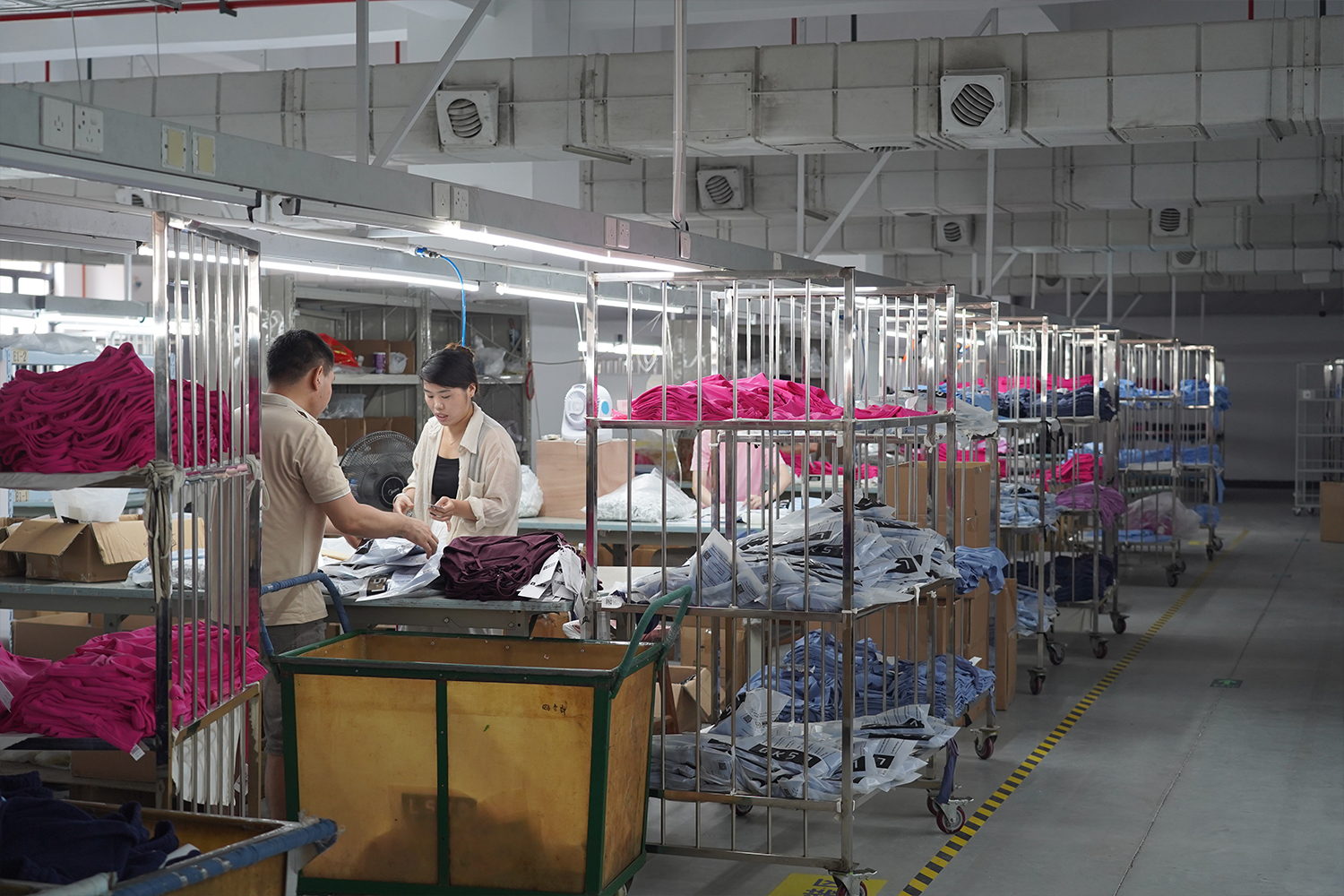
Xiamen Bella Fitness Co., Ltd. (Bellasports) is an activewear manufacturer established in 2017, operating a 10,375-square-meter facility with approximately 221 employees. The company produces around 2,140,000 units annually, with monthly capacity exceeding 100,000 pieces. Its R&D team includes 27 engineers, and it specializes in sports bras, leggings, jackets, hoodies, tennis/golf wear and tops for men, women and children.
Bellasports exports to the United States, Europe, Australia, the Middle East, Southeast Asia and South America, with export business accounting for 100% of total sales. The company offers both OEM and ODM services, with customization ranging from fabric, design, logo, label, size and color to full packaging and branding. It operates its own fabric mills, imports premium materials from Italy and Taiwan, and uses bonded technology with imported machines and tapes for seamless construction.
For brands evaluating a supplier, these facts translate into tangible procurement benefits. In-house fabric mills reduce dependence on third-party fabric brokers, enabling faster custom fabric development. Bonded technology allows clean, flat seams in sports bras and leggings—a specification that matters for comfort and durability. The certified manufacturing environment also helps brands move into regulated markets with less friction.
Technical explanation: what product parameters and certifications should buyers verify
Core activewear specifications
For Yoga/Gym Wear, Bellasports lists four-way stretch and compression level, seamless and supportive construction, moisture-wicking and quick-dry performance, breathability, odor control, and fit/waistband options (high-rise, mid-rise, etc.) as standard customizable parameters. Materials include nylon-spandex blends, compression fabrics and recycled polyester, with custom fabrics accepted. Sizes range from XS to XXL.
For Golf/Tennis Apparel, the company uses Italian performance fabric, moisture-wicking polyester and stretch blends. UV protection, quick-dry performance, fit silhouettes and custom logo/branding are supported. This matters for clubs and tennis brands that need polished, technical garments with a professional dress code.
Outdoor Activewear is built around lightweight, durable construction, weather resistance, water repellency, breathability, UV protection, quick-dry and reflective safety details. Materials include recycled polyester, windproof membranes and nylon blends. Sizes span S to XXL.
Lifestyle Activewear focuses on soft-touch comfort, eco-friendly dyes, breathability, temperature regulation, easy care and odor control, using organic cotton, bamboo blends and recycled fibers. This category is increasingly relevant to athleisure brands and corporate wellness programs.
Jackets and outerwear can be adjusted for waterproof/breathability levels, wind resistance, insulation, main fabric and lining, functional features such as hoods and pockets, and custom fit. Certifications such as OEKO-TEX and GRS are supported across relevant products.
Certifications as procurement constraints
Bellasports holds three certifications that are commonly requested in global activewear sourcing:
- OEKO-TEX Standard 100 (certificate number HKC 23756, issued by TESTEX) — confirms textile materials and final products are tested for harmful substances.
- Global Recycled Standard (GRS) (certificate number CU1143477GRS-2023-00097318, issued by Control Union Certifications) — covers recycled material sourcing, processing, labeling and supply chain traceability.
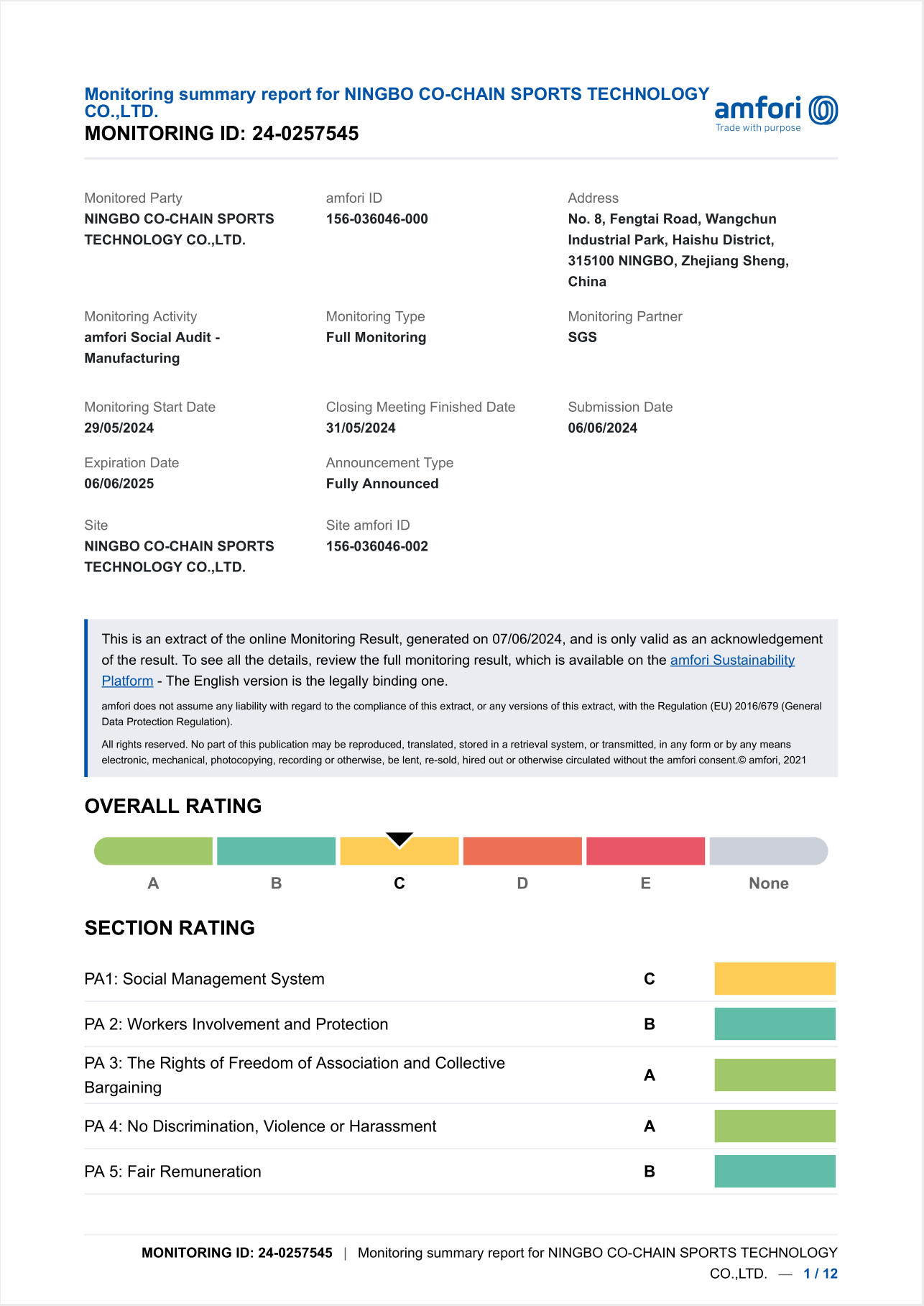
- BSCI (certificate number 24-0257545, issued by amfori) — confirms full factory social compliance and ethical production audits under the BSCI Code of Conduct.
These certifications are not just badges. They reduce the buyer’s own compliance workload and provide evidence that the factory can support regulated markets. For premium brands, OEKO-TEX and BSCI are increasingly basic prerequisites; GRS becomes important when sustainable product lines or recycled materials are part of the assortment.
Production and quality control constraints
Bellasports uses FMS (Factory Management System) and automatic logistics line transmission for intelligent production management. The quality control process includes in-line inspection and final random inspection according to AQL standards. Standard lead time is 90 days from order to delivery, and the MOQ for custom OEM/ODM production is 500 pieces per design. For buyers, this means Bellasports is positioned as a mid-to-high-volume partner rather than a quick-turn, no-minimum workshop.
| Constraint | Bellasports Standard |
|---|---|
| MOQ | 500 pcs per design |
| Lead time | 90 days |
| Monthly capacity | 100,000+ pieces (varies by product type) |
| Annual output | 2,140,000 units |
| Quality control | In-line inspection & final random inspection (AQL) |
Application and use cases by sport and channel
The practical value of a multi-category OEM/ODM manufacturer shows up in application-specific projects.
High-end fitness studios
For studio apparel branding and member kits, the working conditions demand sweat-wicking materials, compression fit and seamless design. Bellasports’ yoga/gym wear range covers these needs with custom branding options. A studio can launch its own apparel line from design to delivery through a single partner.
Golf & tennis clubs
Club uniform supply and tournament collections require UV protection, mobility and a professional dress code. Bellasports’ golf/tennis apparel is made with Italian performance fabric and supports custom logos, making it suitable for country clubs, professional training programs and tournament merchandise.
Outdoor & trail sports
Event merchandise and team outdoor gear need weather-resistant, lightweight and durable garments. Outdoor activewear from Bellasports includes hiking pants, windbreakers and running jackets with reflective safety details, covering trail running, hiking, mountain climbing and adventure travel use cases.
Lifestyle & casual wear
Corporate wellness programs and retail collaborations often sit at the intersection of comfort, style and eco-friendly materials. Bellasports’ lifestyle activewear line uses organic cotton, bamboo blends and recycled fibers, with OEKO-TEX and GRS support, giving brands an easier path to sustainable casual collections.
Across these scenarios, the operating model remains one-stop OEM/ODM service from design to delivery. The in-house factory, fabric mill and R&D team work as an integrated unit, which simplifies communication for brands managing multiple product categories.
Market trend analysis: why certified multi-sport factories are gaining attention
The global activewear market was valued at USD 440.4 billion in 2025 and is projected to reach USD 920.0 billion by 2033, according to Grand View Research. Alongside market expansion, the sustainable athleisure segment is growing at a CAGR of 12.5% from 2025 to 2030, with a projected market size of USD 176.0 billion by 2030. These figures indicate that buyers will increasingly prioritize factories capable of producing performance garments with credible environmental attributes.
Sourcing patterns are also shifting. Vietnam overtook China as the top apparel exporter to the US in early 2025, with exports reaching USD 9.5 billion between January and July. Yet many premium activewear brands such as Alo Yoga and Vuori still rely on manufacturing hubs in Vietnam and China for technical cut-and-sew operations. This suggests that although geographic diversification is real, Asia remains the core production base for technical activewear.
For manufacturers, the strategic response is to combine compliance depth with category breadth. A factory that holds BSCI, OEKO-TEX and GRS can serve brands across multiple markets without requiring buyers to re-audit or re-test for every line. A factory that also handles golf, tennis, yoga, running, hiking and lifestyle categories becomes a long-term platform for evolving product portfolios.
The rise of DTC challenger brands is another signal. Vuori, for example, reached a USD 5.5 billion valuation in 2024, with sales growth outpacing the overall market. Fast-growing brands often need a partner that can scale from small initial orders to larger seasonal volumes while maintaining quality consistency. That combination of flexibility and capacity is what the OEM/ODM model at Bellasports is designed to support.
Comparison with traditional low-cost activewear factories
Traditional low-cost activewear factories typically compete on unit price. They may have lower overhead, higher MOQs, longer lead times, limited fabric development capabilities and less transparent compliance. For brands entering price-sensitive markets or launching basic blank styles, such factories can be a workable option.
Bellasports takes a different position. It competes on verified constraints: certified compliance, in-house fabric development, bonded technology and multi-category production. For a premium brand, this reduces risk across the entire product lifecycle—from sample approval to bulk quality consistency to sustainability reporting.
However, there is a clear boundary. A fully certified, vertically integrated manufacturer with in-house fabric mills and an R&D team of 27 engineers typically operates with a 500-piece MOQ and a 90-day lead time. Brands that need extremely small pilot runs, such as 50 pieces, or rapid 30-day restocks may find that a smaller, less certified workshop is more agile. The trade-off is institutional reliability versus short-term flexibility. Buyers should assess their own volume projections, launch speed and compliance requirements before choosing a model.
Future outlook
Activewear sourcing will continue to move toward verifiable standards. Third-party certifications such as OEKO-TEX, BSCI and GRS will become a baseline rather than a differentiator. The bigger point of differentiation will be how well a manufacturer integrates fabric development, product engineering and production capacity into a single responsive flow.
Recycled content is likely to become embedded in standard product lines, not just special sustainability capsules. Manufacturers with GRS certification and access to recycled polyester are already positioned to support that shift. In-house fabric mills will play a critical role in reducing lead times for custom sustainable materials.
Multi-sport capability will also grow in importance. Brands are expanding from one category into adjacent ones—from yoga into activewear basics, from tennis into lifestyle, from running into hiking. A partner that can produce sports bras, leggings, jackets, tennis dresses and hoodies under one roof simplifies planning, communication and quality assurance.
FAQ
What certifications should I look for in an activewear OEM/ODM manufacturer?
Commonly requested certifications include OEKO-TEX Standard 100 for chemical safety in textile materials, BSCI for social compliance and ethical production audits, and GRS for recycled material sourcing and traceability. Bellasports holds OEKO-TEX Standard 100 (HKC 23756, TESTEX), GRS (CU1143477GRS-2023-00097318, Control Union Certifications) and BSCI (24-0257545, amfori).
What is Bellasports' MOQ for custom activewear?
The standard MOQ for custom OEM/ODM activewear at Bellasports is 500 pieces per design. This applies to small batch and bulk production modes, with monthly capacity exceeding 100,000 pieces depending on product type.
What activewear specifications can be customized for sports bras and leggings?
Customization includes fabric selection, four-way stretch and compression level, seamless construction, moisture-wicking and quick-dry properties, breathability, odor control, fit and waistband options (high-rise, mid-rise), size range XS–XXL, color, logo, label and packaging. Materials can include nylon-spandex blends, compression fabrics, recycled polyester or custom fabrics.
How long does a typical OEM/ODM order take at Bellasports?
The lead time is approximately 90 days from order confirmation to delivery. Sampling support and remote coordination are included in the after-sales and order management process.
Can Bellasports produce both performance wear and lifestyle activewear for different sports?
Yes. Bellasports produces sports bras, leggings, jackets, hoodies, tennis/golf wear and tops covering golf, tennis, yoga, gym, running, hiking and lifestyle categories. The factory supports one-stop OEM/ODM service from design to delivery across these product types.
Does Bellasports support sustainable materials and GRS-certified fabrics?
Bellasports accepts recycled fibers, organic cotton and bamboo blends, and holds GRS certification for recycled material sourcing, processing, labeling and supply chain traceability. The company also supports OEKO-TEX Standard 100 certified products for regulated markets.
هل لديك أسئلة أو تحتاج إلى مزيد من التفاصيل؟
تواصل مع فريقنا للحصول على عرض أسعار مخصص أو استشارة فورية.
طلب عرض أسعار
املأ النموذج أدناه وسيتواصل معك فريقنا بعرض مقترح مخصص.
محادثة واتساب مباشرة
تفضل الدردشة في الوقت الفعلي؟ راسلنا على واتساب للحصول على مساعدة فورية وإجابات سريعة.
- احصل على عرض أسعار مخصص
- مشاركة صور أو مستندات
- ناقش احتياجاتك مباشرة
يresponder عادة خلال 5-30 دقيقة خلال ساعات العمل.