
Adhesive vs Bamboo vs Wood Pulp: Custom Wet Wipes Fabric FAQ
Fabric is the first constraint in a custom wet wipes program, not the last. The substrate decides how a wipe feels on skin, how much liquid it carries, which sheet size is practical, which pack counts stay economic, and — increasingly — which compliance documents a buyer can produce at customs, at a retail audit, or in a tender response. Adhesive, bamboo fiber and wood pulp non-woven are the three fabric families that most often appear side by side in the same supplier catalogue, and they are also the three that sourcing teams most often conflate.
sunfans is the wet wipes brand of Dalian Weijie Biotechnology Co., Ltd., a manufacturer established in 2013 in Dalian, Liaoning Province, China. The company produces baby wipes, pet wipes, wet toilet paper, functional wipes and floor dry and wet wipes, and exports roughly 70% of its output to markets that include Japan, Australia, Canada, the United States and Singapore. This procurement FAQ answers the material, specification and compliance questions that arise when adhesive, bamboo fiber and biodegradable wood pulp options are evaluated against the same usage scenario.
Why the fabric decision comes before the formula
Buyers usually start a custom wet wipes project by discussing fragrance, artwork and price. In practice, the material line is what determines whether those discussions are even feasible. A 100-piece bulk pack needs a fabric that dispenses cleanly at high sheet counts. A flushable toilet product needs a substrate with a documented disintegration behaviour. A baby or pet skin-contact product needs a fabric and formula combination that a retailer's quality team will accept.
The three families in this range are documented at the specification level, not at the marketing level:
- Adhesive material — documented on baby wipes model Y02 and pet wipes model C02.
- Bamboo fiber — documented on pet wipes model C03 and pet wet toilet paper model C04.
- Biodegradable wood pulp non-woven fabric — documented on pet gloves model C05 and wet toilet paper model S01; a related disintegrating wood pulp material is documented on wet toilet paper model S02.
Two further substrates complete the range for non-skin applications: water-jet non-woven fabric on kitchen wipes CF001 and clothing wipes YW01, and water-resistant paper on eye care wipes YJ01.
The three fabric families in one table
| Fabric family | Documented models | Sheet size | Documented pack format | Documented industry fit |
|---|---|---|---|---|
| Adhesive material | Y02 baby wipes; C02 pet wipes | 150×200 mm (Y02); 200×200 mm (C02) | 100 pieces | Infant care; baby hygiene; pet products and pet grooming; large department stores and supermarkets |
| Bamboo fiber | C03 pet wipes; C04 pet wet toilet paper | 150×200 mm (C03); 140×180 mm (C04) | 100 pieces; 100 sheets | Pet products industry; pet grooming and personal care segment; department stores and supermarkets |
| Biodegradable wood pulp non-woven | C05 pet gloves; S01 wet toilet paper | 180×200 mm (C05); 130×200 mm (S01) | 4–10 pieces; 100 sheets | Pet grooming and personal care; personal care products industry; large department stores |
| Disintegrating wood pulp | S02 wet toilet paper | 150×200 mm | 10 sheets | Home cleaning industry; large retail chains; general merchandise industry |
| Water-jet non-woven (reference) | CF001 kitchen wipes; YW01 clothing wipes | 200×200 mm (CF001); 150×180 mm (YW01) | 80 pieces; 10 cloths | Home cleaning industry; large retail chains; general merchandise industry |
| Water-resistant paper (reference) | YJ01 eye care wipes | 100×150 mm | 20 pieces | Home cleaning industry; large retail chains; general merchandise industry |
Adhesive-material wipes: what the specifications actually say
Model Y02 is the baby wipe in this range. Its declared material is entirely adhesive, its sheet size is 150×200 mm, and it is supplied as an English-version pack of 100 pieces. Documented applicable industries are infant care products, baby hygiene products, large department stores and supermarkets.
Model C02 is the pet wipe built on the same material logic: entirely adhesive, English version of pet wet wipes, 100 pieces per pack, and a 200×200 mm sheet — the largest sheet in the documented pet line. Its applicable industries are the pet products industry, the pet grooming and personal care segment, and large department stores and supermarkets.
Bamboo fiber wipes: two formats, one material story
C03 is documented as an English-version pet wet wipe of 100 pieces with a 150×200 mm sheet, made of bamboo fiber. C04 is documented as an English-version pet wet toilet paper of 100 sheets with a 140×180 mm sheet, also made of bamboo fiber. Both list the pet products industry, the pet grooming and personal care segment, and large department stores and supermarkets as applicable industries.
From a sourcing standpoint, the value of the bamboo fiber group is structural rather than promotional: one material narrative can support a shelf set that includes both a standard wipe pack and a wet toilet paper pack. The sheet sizes differ — 150×200 mm versus 140×180 mm — which matters for dispenser geometry, pack height and pallet configuration. Buyers building a coordinated pet range should treat those two dimensions as separate design inputs, not as interchangeable.
Biodegradable wood pulp non-woven: the same fabric in two forms
C05 is documented as an English-version pet glove product supplied in 04–10 piece formats with a 180×200 mm size, made of biodegradable wood pulp non-woven fabric. S01 is documented as wet toilet paper of 100 sheets with a 130×200 mm size, made of the same biodegradable wood pulp non-woven fabric. Both list the pet products industry, pet grooming and personal care, and large department stores and supermarkets among their applicable industries; S01 additionally lists the personal care products industry.
The glove format is a distinct commercial decision. A glove-format wipe changes the consumer interaction — it is worn rather than folded — and it changes pack economics, because 04–10 pieces per pack is a very different unit cost structure from a 100-sheet pack. The MSDS document referenced later in this article is issued for the pet grooming glove product, not for the full range.
Wood pulp that disintegrates — and the flushable question
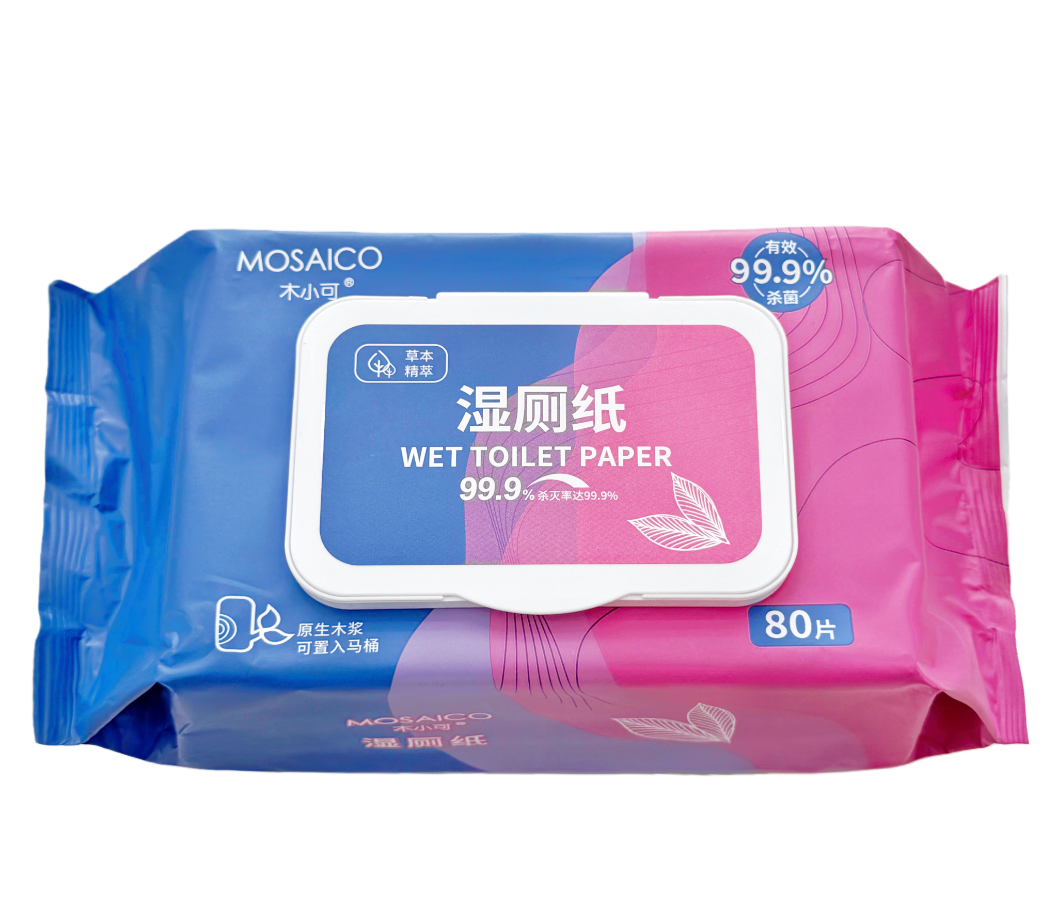
Model S02 is wet toilet paper supplied at 10 sheets per pack with a 150×200 mm sheet. Its documented material property is that it can be disintegrated into wood pulp cloth, and its applicable industries are the home cleaning industry, large retail chains and general merchandise.
Matching fabric to usage scenario
Baby, newborn and mother-and-baby lines
Y02 is the documented baby wipe model, and the application data for the baby and maternity products industry adds a formulation constraint that sits alongside the fabric choice: a gentle, plant-based formula free of alcohol, with fabrics that are gentle on the skin and free of irritating additives. That combination — entirely adhesive material plus an alcohol-free plant-based formula — is the specification basis for baby, newborn, infant and mother-and-baby programs. Large pack and bulk pack formats are supported by the documented 100-piece configuration.
Pet cleaning and pet grooming
The pet line is the widest in the range and spans all three fabric families: C02 (adhesive, 200×200 mm, 100 pieces), C03 (bamboo fiber, 150×200 mm, 100 pieces), C04 (bamboo fiber wet toilet paper, 140×180 mm, 100 sheets) and C05 (biodegradable wood pulp non-woven gloves, 180×200 mm, 04–10 pieces). A buyer can therefore position a single private label brand across three different price and performance tiers without changing supplier.
Kitchen, clothing and home surfaces
CF001 kitchen wet wipes are documented at 200×200 mm with 80 pieces per pack on water-jet non-woven fabric, and YW01 clothing wipes at 150×180 mm with 10 cloths on the same fabric family. YJ01 eye care wipes are documented at 100×150 mm with 20 pieces on water-resistant paper. All three sit in the home cleaning industry, large retail chains and general merchandise channels. These are not skin-contact products, so the fabric rationale is different: surface coverage, lint behaviour and dimensional stability matter more than softness.
Flushable toilet programs
S02 (10 sheets, disintegrating wood pulp) suits trial, travel and single-use formats. S01 (100 sheets, biodegradable wood pulp non-woven) suits the standard household flushable toilet wipe pack. The pack-count difference is a positioning decision as much as a manufacturing one.
Storage and operating conditions
Across the documented application scenarios, the stated working condition is consistent: store in a cool, dry, shaded area at room temperature, away from high temperatures, heat sources and areas prone to moisture accumulation. The documented operation mode is continuous surface wiping with single-sheet, one-time consumption. The listed function is clean and antibacterial — a claim that carries its own regulatory implications, discussed below.
Compliance documents to verify before you sign
For a hvq_2 stage buyer — one whose decision is defined by certification, parameters and price band — the document set matters as much as the specification sheet. Three document layers apply to this range.
Quality management certification
The manufacturer is certified to ISO 9001:2015 under certificate number 0350125030471R1S, issued by Xingyuan Certification Centre Co., Ltd. against the standard GB/T 19001-2016 / ISO 9001:2015. The certificate was issued on 12 June 2025 and is valid to 6 June 2028, with a stated scope of production and service of wet wipes within the licensed scope, and it applies to the global market. Among the listed products, the certificate covers kitchen wipes CF001, pet wipes C02 and baby wipes Y02.
Product safety documentation
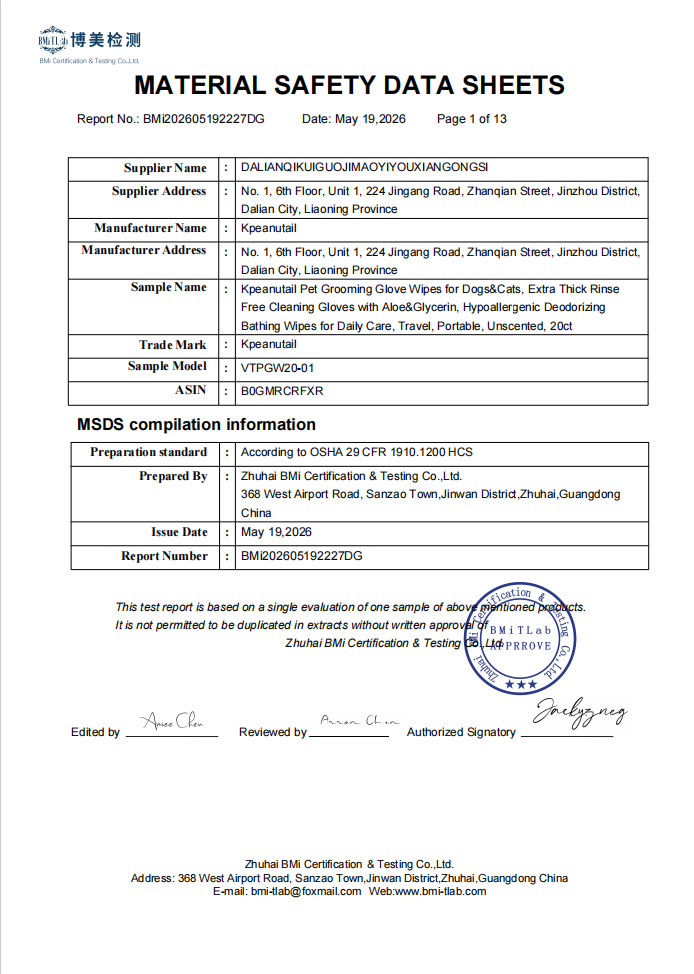
The Pet Grooming Glove Wet Wipes for Dogs & Cats (Extra Thick Rinse-Free Cleaning Gloves) holds an MSDS prepared in accordance with OSHA 29 CFR 1910.1200 HCS. It was issued by Zhuhai BMi Certification & Testing Co., Ltd. under certificate number BMi202605192227DG on 19 May 2026, valid to 20 May 2027, and applies to the global market.
Market-level requirements
Destination rules are a separate layer from supplier certification. In the EU market, wet wipes must comply with EN standards, including REACH for chemicals and BPR for biocidal claims. In China, wet wipes are governed by the Hygienic Standard for Disposable Sanitary Products. For the United States, the FDA facility registration deadline for cosmetic wipes manufacturers fell on 1 July 2026; as of October 2026 that date has passed, so buyers should confirm current registration status rather than assume it. ISO 9001 and ISO 22716 (GMP for cosmetics) are widely treated as baseline expectations for wet wipes OEM manufacturing — note that the documented certificate for this supplier is ISO 9001:2015, and any cosmetic GMP or additional scheme should be requested separately for the specific SKU and market.
Manufacturing constraints: MOQ, lead time, capacity and customization
Fabric choice only becomes a real procurement decision once it is tested against factory constraints. The documented capability profile is as follows:
- Customization scope: packaging, logo, material, size, aroma and number of pieces.
- Production mode: OEM, ODM and customized services, supported by an in-house R&D team of 10 people.
- Monthly capacity: 3 million packages.
- Standard lead time: 30 days.
- Minimum order: 20,000 yuan.
- Quality control: three-party authoritative laboratories combined with internal material inspection, process inspection and finished-product inspection.
- Facility: 6,000 m² with 50 employees, established 2013.
- Process equipment: automatic packaging machine, automatic filling machine, EDI ultra-pure water equipment, UV sterilization system, in-house laboratory, Class 100,000 cleanroom and pH meter.
- Export markets: Japan, Singapore, New Zealand, Australia, the United States, Southeast Asia and Canada.
- Export support: assistance verifying packing lists and customs declaration documents for export orders.
Long-run supply evidence, as documented in the company's case records, includes a pet supplies seller on Amazon.com running for 6 years at 8 forty-foot containers per month, a baby and maternity brand owner running for 5 years at 20 containers per month, a Japan-based convenience retail program running for 3 years at 15 containers per month, and a 150-year-old conglomerate running for 10 years at 10 containers per month. For a buyer comparing suppliers, the useful signal here is duration combined with volume stability across different regulatory regions, not the identity of any individual customer.
Limits, trade-offs and what these specifications do not prove
A credible material decision has to include the boundaries. The following are genuine constraints rather than marketing caveats:
- Flushability is SKU-specific. Only S02 carries the documented property of disintegrating into wood pulp cloth. Bamboo fiber and adhesive-material models carry no documented flushability statement in this range.
- Biodegradability is a material declaration, not a certification. C05, S01 and the broader biodegradable positioning rest on the declared use of biodegradable wood pulp non-woven fabric. Where a market requires a certified biodegradability claim, the supporting test documents should be requested per SKU.
- ISO 9001 is a system certificate. It covers production and service of wet wipes within the licensed scope and names specific products including CF001, C02 and Y02. It is not a product certificate for every claim printed on every pack in the range.
- Antibacterial and clean-function claims are market-regulated. In the EU, biocidal claims are governed by the BPR. Wording that is acceptable in one market may not be acceptable in another.
- Lead time and capacity compete internally. A 30-day standard lead time against a 3 million package monthly capacity means customized print, fragrance and material runs compete for the same lines as standard volumes, particularly in peak season. The 20,000 yuan minimum order sets the floor for customized work; smaller trial quantities are not part of the documented capability.
- Sheet dimensions are fixed per model. Y02 at 150×200 mm, C02 at 200×200 mm, C04 at 140×180 mm and S01 at 130×200 mm are documented dimensions. Changes to size, material, aroma and piece count fall under customization scope and will affect cost, tooling and lead time.
Market trend: where the fabric question is heading
Third-party market research places the global wet wipes market at approximately USD 32.09 billion in 2026, with a projected CAGR of 3.86% reaching USD 43.45 billion by 2034 (Vertex AI / Fortune Business Insights). Within that total, personal care wipes held 72.81% of the global market in 2025 (Mordor Intelligence), which is why the baby, pet and personal care lines dominate the material decisions described above.
The sustainability-linked segments are growing faster than the category average. The global baby wipes market was valued at USD 5.4 billion in 2024 and is expected to grow at a CAGR of 7.5% through 2030. The global biodegradable wipes market reached over USD 3 billion in 2024, driven by baby wipes and premium retail segments. The flushable wipes market was valued at USD 2.3 billion in 2025 and is projected to reach USD 4.2 billion by 2035 at a 6% CAGR (Global Market Insights), while the plant-based flushable segment was valued at USD 2.9 billion in 2024 with a 5.3% CAGR (Data Insights Reports). The pet wipes market was valued at USD 1.58 billion in 2024, with a projected 5.6% CAGR to USD 2.64 billion by 2033 (DataHorizzon Research), and North America accounts for roughly 50% of it, at USD 0.79 billion in 2024.
Regionally, the United States accounted for 34% of the global wet wipes market in 2024, Japan accounts for nearly 27% of the Asia-Pacific market with a strong focus on hygiene and premium quality personal care, and Asia Pacific is the fastest-growing region overall, driven by urbanisation and rising hygiene standards.
The supply landscape is also concentrated at the top. Named global OEM wet wipes factories include American Hygienics Corporation (AHC), SYWIPE, Albaad and Nice-Pak International, with AHC documented at a capacity of one billion wet wipes per year and exports to more than 75 countries (Nonwovens Industry). On the branded side, P&G held over 12% of the global wet wipes market in 2025, and Kimberly-Clark held over 17.2% of the flushable wipes segment in 2025 (Global Market Insights). For private label buyers, the practical implication is that the material and certification questions answered in this FAQ are the same questions that determine whether a smaller manufacturer can serve a regional program reliably.
Future outlook
Three shifts are shaping material selection over the next planning cycle. First, regulatory registration is becoming an operational requirement rather than a paperwork formality, with facility registration frameworks extending to cosmetic wipes manufacturers and biocidal claim rules tightening in Europe. Second, the flushable segment is growing faster than the wider category, which will push suppliers to document disintegration behaviour at SKU level rather than describing it generically. Third, the fastest-growing demand sits in Asia Pacific and in premium hygiene markets such as Japan, where product quality expectations and retail audit standards are high.
For buyers, that points to a practical rule: choose the fabric family by scenario and documentation, then negotiate on pack format and customization. A supplier that can document ISO 9001:2015 scope against named models, issue MSDS documentation for specific products, and hold biodegradable wood pulp non-woven and bamboo fiber as separate, clearly specified options is better positioned than one that describes all substrates in the same language.
FAQ
What is the minimum order quantity and standard lead time for custom wet wipes?
The documented minimum order is 20,000 yuan, and the standard lead time is 30 days against a monthly capacity of 3 million packages. Because customized print, fragrance and material combinations share the same production lines as standard volumes, buyers should confirm the specific lead time for their configuration rather than assuming the standard figure applies at peak.
Which certifications apply to the baby, pet and kitchen wipe models?
The manufacturer holds ISO 9001:2015 certification under certificate number 0350125030471R1S, issued by Xingyuan Certification Centre Co., Ltd. against GB/T 19001-2016 / ISO 9001:2015, issued 12 June 2025 and valid to 6 June 2028. The certification covers kitchen wipes CF001, pet wipes C02 and baby wipes Y02 among the listed products. Separately, the Pet Grooming Glove Wet Wipes for Dogs & Cats (Extra Thick Rinse-Free Cleaning Gloves) holds an MSDS prepared to OSHA 29 CFR 1910.1200 HCS, issued by Zhuhai BMi Certification & Testing Co., Ltd. under number BMi202605192227DG, valid to 20 May 2027.
Which material in this range is documented as flushable-friendly?
Wet toilet paper model S02 is documented as made from a material that can be disintegrated into wood pulp cloth, which is the relevant property for flushable toilet wipes. Models C05 and S01 use biodegradable wood pulp non-woven fabric, and C03 and C04 use bamboo fiber. Flushability and biodegradability are distinct declarations, and flushable claims are regulated differently across markets, including under EU EN standards and the BPR for biocidal claims.
Do sheet sizes differ between the fabric families?
Yes. Documented sizes are 150×200 mm for Y02 (adhesive) and C03 (bamboo fiber), 200×200 mm for C02 (adhesive) and CF001 (water-jet non-woven), 140×180 mm for C04 (bamboo fiber), 180×200 mm for C05 (biodegradable wood pulp non-woven), 130×200 mm for S01 (biodegradable wood pulp non-woven), 150×200 mm for S02 (disintegrating wood pulp), 150×180 mm for YW01 and 100×150 mm for YJ01. Size changes fall under the customization scope of material, size, aroma and number of pieces.
Can packaging, logo, material, size, aroma and piece count be customized?
Yes. The documented customization scope covers packaging, logo, material, size, aroma and number of pieces, supported by OEM, ODM and customized services and an in-house R&D team. Documented pack formats in the current range run from 4–10 pieces for the pet glove format up to 100 pieces or 100 sheets for the baby, pet and flushable toilet lines.
What documentation support exists for export orders?
After-sales support includes assisting with the verification of packing lists and customs declaration documents for export orders. The documented export markets are Japan, Singapore, New Zealand, Australia, the United States, Southeast Asia and Canada, and destination-specific compliance requirements such as EN standards and REACH in the EU, or the Hygienic Standard for Disposable Sanitary Products in China, should be confirmed for the individual SKU.
A complete company and capability profile, covering facility, process equipment, certifications and product range, is available as a downloadable PDF: Dalian Unicare Biotech company profile (English).