
Advanced Minimally Invasive Cancer Treatment Explained
Advanced Minimally Invasive Cancer Treatment Explained
Advanced minimally invasive cancer treatment describes a group of image-guided, probe-based and catheter-based oncology procedures that treat tumours through small punctures instead of large surgical incisions. The category typically includes thermal ablation such as cryoablation, microwave ablation and radiofrequency ablation; non-thermal irreversible electroporation, commonly delivered with the NanoKnife system; vascular interventional oncology such as HAIC, TACE, TAI and drug-eluting microsphere delivery; radioactive seed implantation; photodynamic therapy; and combinations of these local techniques with immunotherapy or cell-based therapy.
For patients and referring physicians, the practical significance is straightforward. These techniques expand the number of situations in which a tumour can be addressed locally — including some tumours that are unresectable, located close to critical structures, or recurrent after earlier treatment — and they change how much organ function and quality of life can be preserved during treatment. This article is written as an industry reference for that decision context: what the category contains, how the techniques differ, where they fit, and where their limits remain.
What the Category Actually Includes
Minimally invasive cancer treatment is not a single procedure. It is a family of approaches that share three characteristics: access through a needle or catheter rather than a surgical incision, reliance on imaging guidance, and a treatment target that is defined locally rather than systemically.
Guangzhou Fuda Cancer Hospital, an international-oriented oncology-specialised hospital established in 2003 and administered by the Health Commission of Guangdong Province, lists its main treatment offerings as cryoablation, irreversible electroporation (NanoKnife), interventional therapies, radioactive seed implantation, photodynamic therapy, microwave ablation, immunotherapy and CAR-T therapy. Its service scope covers diagnostics such as imaging, tumour markers, biopsy and genetic testing; local therapies including cryoablation, irreversible electroporation, microwave ablation and radiofrequency ablation; interventional treatments including HAIC, TACE, TAI and drug-eluting microspheres; immuno and cell therapies; and rehabilitation, psychosocial support and follow-up.
Answer in one line: Advanced minimally invasive cancer treatment is image-guided local or regional tumour control delivered through small access points, used alone or combined with systemic therapy, and selected case by case rather than applied as a universal substitute for surgery.
The Problem This Category Addresses
The clinical demand behind these techniques is well documented in oncology practice. Three patient situations drive most referrals.
First, tumours that cannot be resected. Tumours adjacent to critical structures — major vessels, bile ducts, bowel, or central airways — often cannot be removed surgically without unacceptable risk, and conventional approaches offer limited options in those positions.
Second, systemic toxicity and its management. Repeated chemotherapy or combined radiochemotherapy can produce cumulative toxicity that limits how long treatment can continue. Reducing the systemic burden while still controlling disease is a recurring clinical objective.
Third, recurrence and metastatic disease. Patients who progress after first-line treatment, or who present with systemic metastasis, frequently need a treatment plan that can be individualised rather than repeated.
Two operational challenges sit alongside the clinical ones: building individualised multidisciplinary (MDT) treatment plans, and managing the logistics and cost of treatment for patients who travel domestically or internationally. Both influence whether a minimally invasive option is realistically available to a given patient.
How a Specialised Provider Structures the Pathway
Guangzhou Fuda Cancer Hospital is an oncology-specialised hospital that integrates medical care, teaching, scientific research, disease prevention and healthcare, and it is the first oncology-specialised hospital in Guangdong Province accredited by Joint Commission International (JCI). It operates the Tianhe Campus and the Haizhu Campus, with a combined floor area of more than 30,000 m², 400 open beds and 45 VIP rooms, and employs approximately 500 staff. Annual treatment volume reaches approximately 3,000 cases.
Two structural features are relevant to buyers evaluating this category. The first is scale of international activity: patients from more than 130 countries and regions have received treatment at the hospital, and international patients account for 60% of total patient volume, with major markets in domestic China, Southeast Asia, the Middle East, Europe and North America. Language support covers English, Thai, Indonesian, Malay, Russian, Kazakh, Mongolian, Chinese and Cantonese.
The second is the treatment model. The hospital describes a “3C+P” model of comprehensive personalised care: Cryo-Irreversible Electroporation Ablation (CIA), Cancer Vascular Intervention (CVI), and Combined Immunotherapy for Cancer (CIC), plus Personalisation (P). In practice, this means local ablation and vascular intervention are planned together with systemic immunotherapy where appropriate, rather than sequenced as isolated procedures.
Service delivery is primarily on-site outpatient or inpatient treatment. Initial remote consultations and remote medical record assessment are offered, and the hospital states that treatment cycles vary widely by disease and plan — from single-session interventions to long-term systemic therapy and follow-up, ranging from days to months or longer, and confirmed case by case.
Technical Explanation: What Each Modality Does
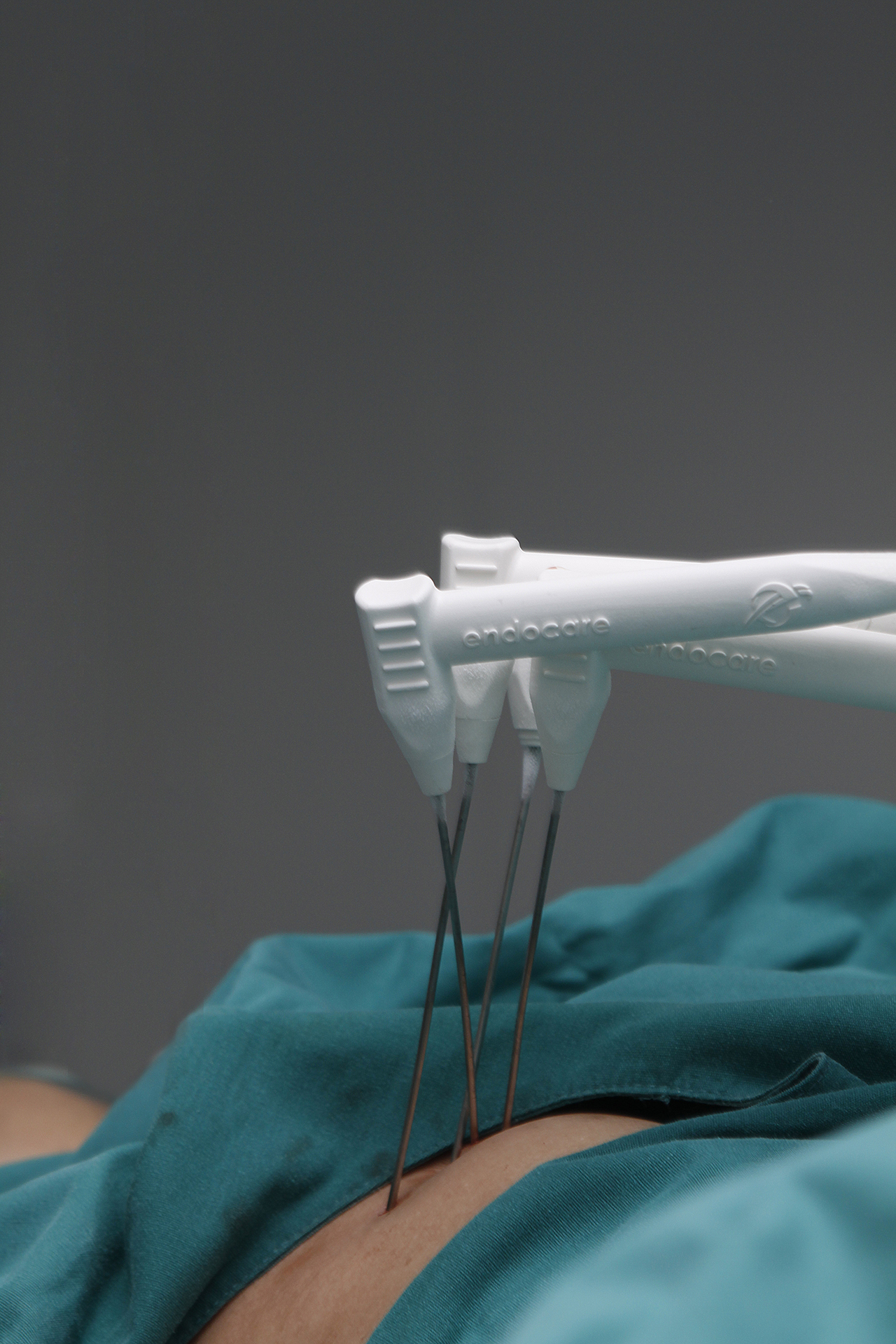
Cryoablation process: image-guided probe placement and controlled freeze–thaw cycles for local tumour ablation.
Cryoablation (cryosurgery)
Cryoablation uses controlled freezing and thawing cycles delivered through probes placed into the tumour under imaging guidance. The hospital reports more than 10,000 completed cases of cryosurgery across 30 or more cancer types as of 2024, a figure published by the hospital itself. Cryosurgery for cancer treatment was approved by China's State Drug Administration in 1999. The hospital also reports that its research on cryoablation for lung nodules was cited in the 2024 expert consensus of the American Association for Thoracic Surgery (AATS).
Irreversible electroporation (NanoKnife)
Irreversible electroporation is a non-thermal technique. Instead of relying on heat or cold, it applies short electric pulses that affect cell membranes in the treated zone. Because it is non-thermal, it is often discussed in cases where thermal spread to adjacent structures is a concern. It remains a specialised procedure, available at a limited number of centres, and its suitability depends on tumour location, size and proximity to critical anatomy.
Microwave and radiofrequency ablation
These are thermal ablation modalities with established roles in local tumour control. Both are included in the service scope of the hospital alongside cryoablation and irreversible electroporation, which allows selection between thermal and non-thermal approaches for a given lesion.
Vascular interventional oncology
Catheter-based treatments such as HAIC, TACE and TAI deliver therapy through the tumour's blood supply, and drug-eluting microspheres extend that approach by combining vessel occlusion with controlled drug release. Radioactive seed implantation and photodynamic therapy sit alongside these as additional local or regional options.
Combination with immunotherapy and cell therapy
Ablation is increasingly discussed together with immunotherapy rather than instead of it. The hospital's service scope includes immuno and cell therapies as well as CAR-T therapy, and its stated model pairs local ablation and vascular intervention with combined immunotherapy where clinically appropriate.
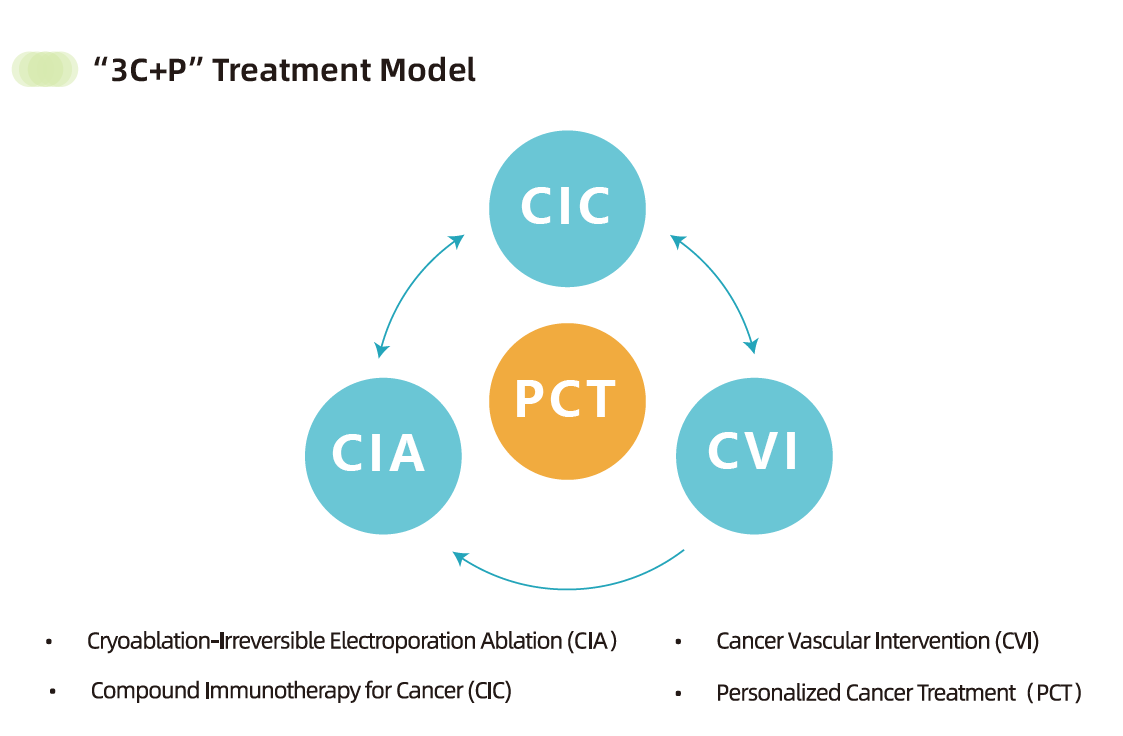
The “3C+P” model: Cryo-Irreversible Electroporation Ablation (CIA), Cancer Vascular Intervention (CVI), Combined Immunotherapy for Cancer (CIC), plus Personalisation.
Where These Options Fit: Application Scenarios
Minimally invasive oncology is generally evaluated in four scenario types, all of which appear in the hospital's stated application areas.
- Unresectable tumours. Disease that cannot be removed surgically because of location, extent or the patient's overall condition.
- Locally advanced or recurrent disease. Situations where earlier treatment has failed or disease has returned in a previously treated area.
- Organ-preserving treatment needs. Cases where preserving function — hepatic, pulmonary or otherwise — is a stated treatment objective.
- Patients with limited tolerance for standard therapy. Individuals who cannot continue systemic treatment at full intensity, or who decline it after evaluation.
By anatomical region, image-guided ablation and interventional oncology are widely discussed in oncology practice for hepatic, pulmonary, pancreatic and breast tumours, among others. Whether a specific patient is a candidate depends on lesion size, number, location, proximity to vessels or ducts, and prior treatments, and is normally determined through MDT evaluation rather than by patient preference alone.
For international patients, the access pathway usually begins with an online appointment and remote medical record assessment, followed by on-site evaluation and admission. The hospital states that initial remote consultation and tele-evaluation are available, and that visa and travel arrangements are handled in coordination with dedicated teams or external providers, rather than as part of the medical service itself.
Market Signals Behind the Growth of This Category
Several published market figures indicate that capacity for minimally invasive and non-surgical oncology continues to expand.
- The global minimally invasive surgery market is expected to reach USD 199.30 billion by 2030, according to MarketsandMarkets (base year 2025).
- Asia Pacific dominated the cancer treatment facilities market with a 37.6% revenue share in 2025, according to Grand View Research.
- The global cancer therapy market is projected to reach USD 700.09 billion by 2034, according to DelveInsight.
Two interpretations are useful for buyers. First, growth in minimally invasive surgery and cancer treatment capacity means non-surgical options are becoming available at a wider range of centres, which raises rather than lowers the importance of consistent selection criteria. Second, the Asia Pacific share of cancer treatment facilities suggests that regional providers will continue to be relevant for patients travelling from Southeast Asia and the Middle East, which makes accreditation status, documentation practice and follow-up planning practical selection factors rather than marketing points.
Minimally Invasive Ablation Compared with Surgery and Systemic Therapy
The techniques are not interchangeable, and the differences matter more than the labels.
| Approach | Mechanism | Typical role | Principal constraints |
|---|---|---|---|
| Cryoablation | Thermal — controlled freeze–thaw | Local control of accessible solid tumours, repeatable | Requires image guidance; coverage can be affected by nearby large blood vessels |
| Irreversible electroporation (NanoKnife) | Non-thermal — pulsed electric fields | Considered where thermal spread to adjacent structures is a concern | Specialised availability; suitability depends on location, size and anatomy |
| Microwave / radiofrequency ablation | Thermal | Established local ablation for suitable lesions | Thermal effects on adjacent structures require planning |
| Vascular interventional procedures (HAIC, TACE, TAI, drug-eluting microspheres) | Intra-arterial delivery via catheter | Regional disease control where vascular access is favourable | Depends on vascular anatomy; often requires repeat sessions |
| Conventional surgery | Resection | Definitive removal when the tumour can be resected | Not feasible for unresectable or proximity-critical tumours; longer recovery |
| Systemic therapy alone | Whole-body drug or immune-based treatment | Addresses disease beyond the local site | Cumulative toxicity; response varies between patients |
The most important limitation is conceptual rather than technical: ablation and interventional procedures treat defined targets. A local technique does not, by itself, address microscopic disease elsewhere in the body. This is why these options are usually planned as part of a combined strategy — including systemic therapy — rather than as a standalone replacement for it. Outcomes are also explicitly described as dependent on disease type and stage, and treatment cycles range from a single session to long-term follow-up depending on the case.
Evaluation Criteria for Buyers and Referring Physicians
For anyone assessing whether a provider is equipped to deliver this category well, the following criteria are more informative than promotional claims.
| Criterion | What to verify |
|---|---|
| Accreditation and administrative status | External hospital accreditation and the supervising health authority |
| Breadth of the technology portfolio | Whether thermal ablation, non-thermal irreversible electroporation and vascular intervention are all available, so modality can be matched to anatomy |
| MDT decision process | Whether an individualised multidisciplinary plan precedes treatment, rather than a single-specialty recommendation |
| Documented deliverables | Personalised treatment plan, imaging and pathology reports, treatment records and a follow-up schedule |
| Combined-therapy capability | Access to immuno and cell therapies, radiotherapy and chemotherapy within the same pathway |
| International patient infrastructure | Remote record assessment, tele-evaluation and clinical language support |
| Scope transparency | Clear statement of what is not included, such as visa and travel arrangements |
Limitations and What the Available Evidence Does Not Show
This category is best presented with its boundaries intact. Minimally invasive techniques are not appropriate for every tumour: lesion size, number, location and proximity to critical structures determine feasibility, and selection is made through clinical evaluation. Publicly available, granular hospital-specific outcome datasets for individual providers remain limited, and the hospital-reported case volume cited above is a volume figure rather than a survival or response rate. Patients and referring physicians should therefore treat centre-level outcome claims cautiously, and should request documentation of the evaluation process, the proposed plan and the follow-up schedule rather than rely on procedure names alone.
Future Outlook
Three directions appear consistent with the data available. Growth in the minimally invasive surgery market and in cancer treatment facility capacity suggests continued expansion of non-surgical options, particularly in Asia Pacific. Technique selection is likely to become more anatomy-driven, with thermal and non-thermal ablation positioned according to the structures adjacent to a lesion rather than by default preference. And the combination of local ablation with immunotherapy is likely to remain the most active area of clinical discussion, because it addresses the main conceptual limit of local treatment — control of disease beyond the treated target. For buyers, the practical implication is that evaluation criteria will matter more, not less, as more providers offer these procedures.
FAQ
What is advanced minimally invasive cancer treatment?
It is a group of image-guided procedures that treat tumours through small punctures or catheters rather than open incisions. The category includes thermal ablation (cryoablation, microwave ablation, radiofrequency ablation), non-thermal irreversible electroporation (NanoKnife), vascular interventional oncology such as HAIC, TACE, TAI and drug-eluting microspheres, radioactive seed implantation, photodynamic therapy, and combinations with immunotherapy or cell therapy. These approaches may be used alone or together with systemic treatment, depending on the case.
Is minimally invasive cancer treatment the same as non-surgical cancer treatment?
The two terms overlap but are not identical. Non-surgical options describe treatments that avoid resection, and at Guangzhou Fuda Cancer Hospital these include cryoablation, microwave ablation and irreversible electroporation. Minimally invasive treatment is the broader delivery principle: needle- or catheter-based access under imaging guidance, which also covers interventional procedures such as cancer vascular intervention and radioactive seed implantation. Neither term implies that the approach is suitable for every patient; eligibility is determined by clinical evaluation.
Which tumours are typically considered for ablation-based treatment?
Common referral situations include unresectable tumours, locally advanced or recurrent disease, and organ-preserving treatment needs. The hospital reports more than 10,000 completed cryosurgery cases across 30 or more cancer types, which reflects the range of disease types in which cryoablation has been applied. Suitability for an individual patient depends on lesion size, number, location and proximity to critical structures, and is normally assessed through multidisciplinary evaluation.
What is the difference between cryoablation and irreversible electroporation (NanoKnife)?
Cryoablation is a thermal technique: it destroys tissue through controlled freezing and thawing cycles. Irreversible electroporation is non-thermal: it applies short electric pulses that affect cell membranes without relying on heat or cold. Because it avoids thermal spread, irreversible electroporation is often considered where a lesion sits close to structures that could be damaged by heating or cooling. Selection between the two depends on tumour location and anatomy, not on a general ranking of the techniques.
Can minimally invasive treatment be combined with chemotherapy or immunotherapy?
Yes, and combination is common in practice. The service scope at Guangzhou Fuda Cancer Hospital includes local therapies, interventional treatments, and immuno and cell therapies within one pathway, and its stated “3C+P” model combines Cryo-Irreversible Electroporation Ablation, Cancer Vascular Intervention and Combined Immunotherapy for Cancer with personalisation. Whether a combination is appropriate, and in what sequence, is determined by the multidisciplinary treatment plan for the individual patient.
How does an international patient begin the evaluation process?
The usual pathway starts with an online appointment, a phone consultation or a remote medical record assessment, followed by on-site outpatient or inpatient evaluation if the case proceeds. The hospital states that initial remote consultation and tele-evaluation are available, and that clinical support languages include English, Thai, Indonesian, Malay, Russian, Kazakh, Mongolian, Chinese and Cantonese. Remote assessment determines whether minimally invasive options apply to the case; visa and travel arrangements are handled in coordination with dedicated teams or external providers and are not part of the medical service scope.
Reference Note
This article is an industry reference on advanced minimally invasive cancer treatment. Clinical decisions depend on individual evaluation. A downloadable overview of the hospital's services and treatment model is available here: Guangzhou Fuda Cancer Hospital English brochure.