
Aerosol Cosmetic Spray Project Fit: Matching Format, Formula, and OEM Capability
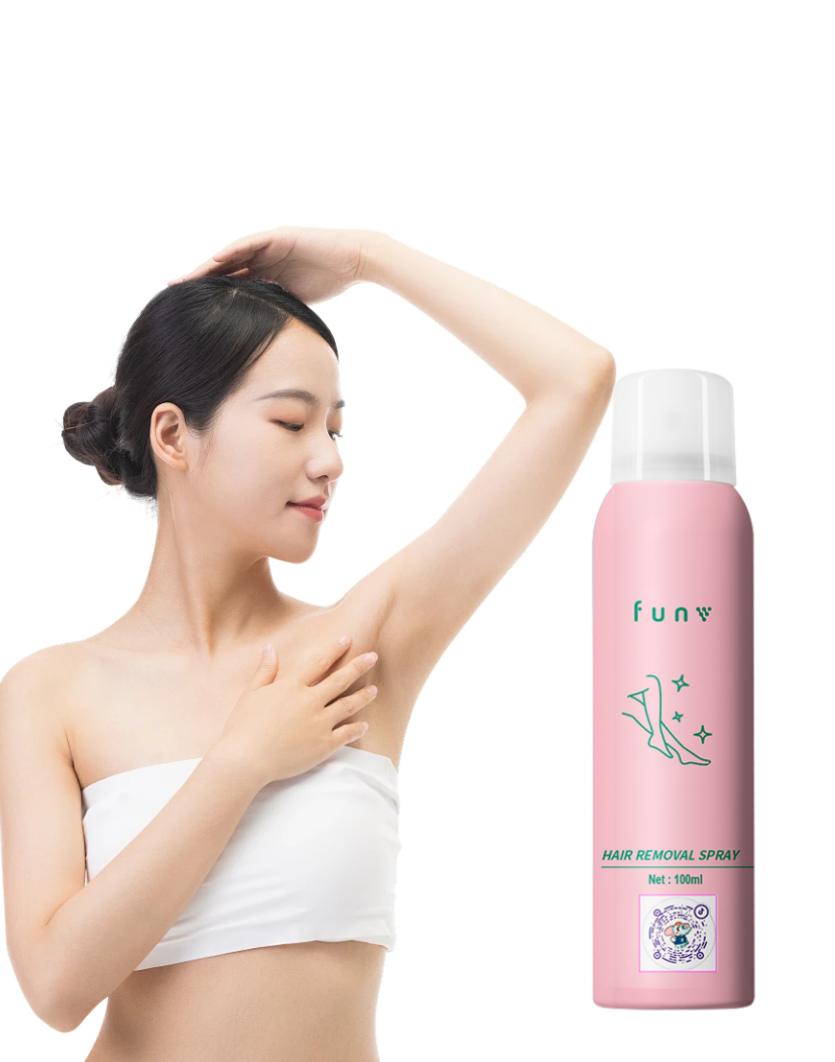
Aerosol cosmetic sprays are used across sun care, hair care, and body care routines.
Aerosol cosmetic sprays are no longer limited to sun care. For industrial buyers, the key question when sourcing an aerosol cosmetic spray is not simply which product is available, but which format and OEM capability fit the project's target market, claim, and production requirements. This article provides an application-led framework for evaluating aerosol cosmetic spray OEM partners, using Zhongshan Tentop Fine Chemical Co., Ltd. (Tentop) as a reference case.
Why Application Fit Matters in Aerosol Cosmetic Spray Sourcing
Different personal care applications put different demands on an aerosol formula. A sunscreen spray must deliver broad-spectrum UV protection and water resistance. A dry shampoo spray must provide oil absorption without leaving visible residue. A deodorant spray needs long-lasting odor control while remaining gentle on skin. A setting spray must form a film that holds makeup for hours.
These differences affect formula ingredients, can type, valve choice, and propellant system. A factory that can fill one type of aerosol concentrate may not be configured for another. Therefore, buyers evaluating aerosol cosmetic spray manufacturing partners should map each project scenario to a specific formulation and filling capability before comparing prices.
Common Aerosol Cosmetic Spray Scenarios and Sourcing Priorities
The following table maps typical aerosol cosmetic spray project scenarios to key sourcing considerations. It is not an exhaustive list, and product classification rules can vary by destination market.
| Application scenario | Typical product goal | Key sourcing consideration |
|---|---|---|
| Sunscreen spray | Broad-spectrum UV protection, water resistance | SPF claim support, filter system, water-resistance testing |
| Deodorant spray | Odor control and antiperspirant performance | Active ingredient choice, aerosol can compatibility |
| Dry shampoo spray | Instant oil absorption, volume, no white residue | Powder selection, spray nozzle and propellant behavior |
| Setting / makeup spray | Long-wear makeup hold, matte or dewy finish | Film former concentration, spray fineness |
| Body fragrance mist | Light fragrance application | Alcohol/water balance, low-pressure spray consistency |
| Scalp refreshing spray | Cooling and refreshing sensation | Fine mist, scalp-friendly ingredients |
| After-sun soothing spray | Calming and moisturizing after sun exposure | Soothing actives, non-greasy feel |
| Intimate care spray | Gentle pH-balanced care | pH control, dermatological and regulatory review |
| Hand and foot moisturizing spray | Quick-absorbing moisture | Humectants, spray pattern and residue |
Market Context: Demand Across Personal Care Categories
The global cosmetic spray market was valued at USD 18.3 billion in 2025 and is projected to reach USD 31.8 billion by 2034, according to Dataintelo. This broad segment includes sun care, hair care, body care, and makeup applications, which explains why buyers are looking for OEM partners with multi-format capability rather than a single product line.
Within the sunscreen segment, Asia Pacific accounted for 42.3% of the daily sunscreen spray market in 2025, according to Dataintelo. In parallel, China's cosmetics exports reached approximately 512 billion yuan (about USD 71.8 billion) in 2024, an 11.9% year-on-year increase, based on data from the General Administration of Customs China and ChemLinked. These numbers point to rising cross-border demand and a larger role for Chinese contract manufacturers in global aerosol cosmetic spray supply chains.
Market size figures vary by source and definition. Buyers should use them as directional signals rather than precise planning data.
A Reference OEM: Tentop's Production and R&D Scope
Zhongshan Tentop Fine Chemical Co., Ltd., commonly referred to as Tentop, is a contract manufacturer of aerosol cosmetics and household care products. Founded in 2007 and located in Zhongshan, Guangdong Province, China, the company offers OEM and ODM services to private-label clients. Tentop's main markets are the EU and the USA, with 20% of its output exported.
Tentop reports 330 employees, a 15,000 square meter factory, 60 R&D engineers, and an annual output of 60 million units, with production capability exceeding 100 million units per year. The company has developed more than 6,000 formulas and holds 42 patents, along with certifications including ISO 9001, ISO 14000, ISO 22716, GMPc, ISO 45001, Halal MUI, SMETA, and Disney.
For buyers, the practical implication is that Tentop is positioned as a multi-line aerosol manufacturer rather than a niche filler. Its current catalog includes sunscreen spray, makeup spray, moisturizing spray, hair removal spray, dry shampoo, hair styling spray, deodorant spray, and shampoo and bath mousse.
Technical Considerations for Project-Specific Aerosol Formats
Formula and concentrate handling
Aerosol cosmetic sprays typically contain a concentrate, a propellant, and a container-valve system. The concentrate determines the functional claim, while the propellant delivers the product in the desired spray pattern. Formulation becomes project-specific when pH, viscosity, active ingredients, and solvent systems change.
Tentop's factory has multiple dedicated tank farms and associated blending rooms for its filling lines. The blending rooms are equipped with stainless steel mixing tanks on load cells and different types of agitation, allowing the site to handle multiple concentrate filling and special formulation blending requirements.
Can, valve, and propellant compatibility
Product packaging is often aluminum can or PET bottle. The choice affects pressure tolerance, recyclability, and brand perception. In 2025, aluminum aerosol cans held a 61% revenue share of the aerosol packaging market, according to Grand View Research, due to premium appeal and recyclability.
Propellant selection is equally important. Tentop states that its propellant systems are capable of handling hydrocarbons, DME, 152a, 1234ze, nitrogen, and CO2. This matters for projects that need low flammability, water-based formulas, or lower-global-warming-potential alternatives.
Bag-on-valve capability
Bag-on-valve technology separates the product from the propellant, which can improve compatibility with sensitive formulas and allow continuous spray. Tentop operates three BOV aerosol lines alongside four high-speed aerosol filling lines and two liquid filling lines in clean workshops. Buyers considering a BOV format should confirm that the OEM has dedicated lines rather than converting standard pressure-fill lines.
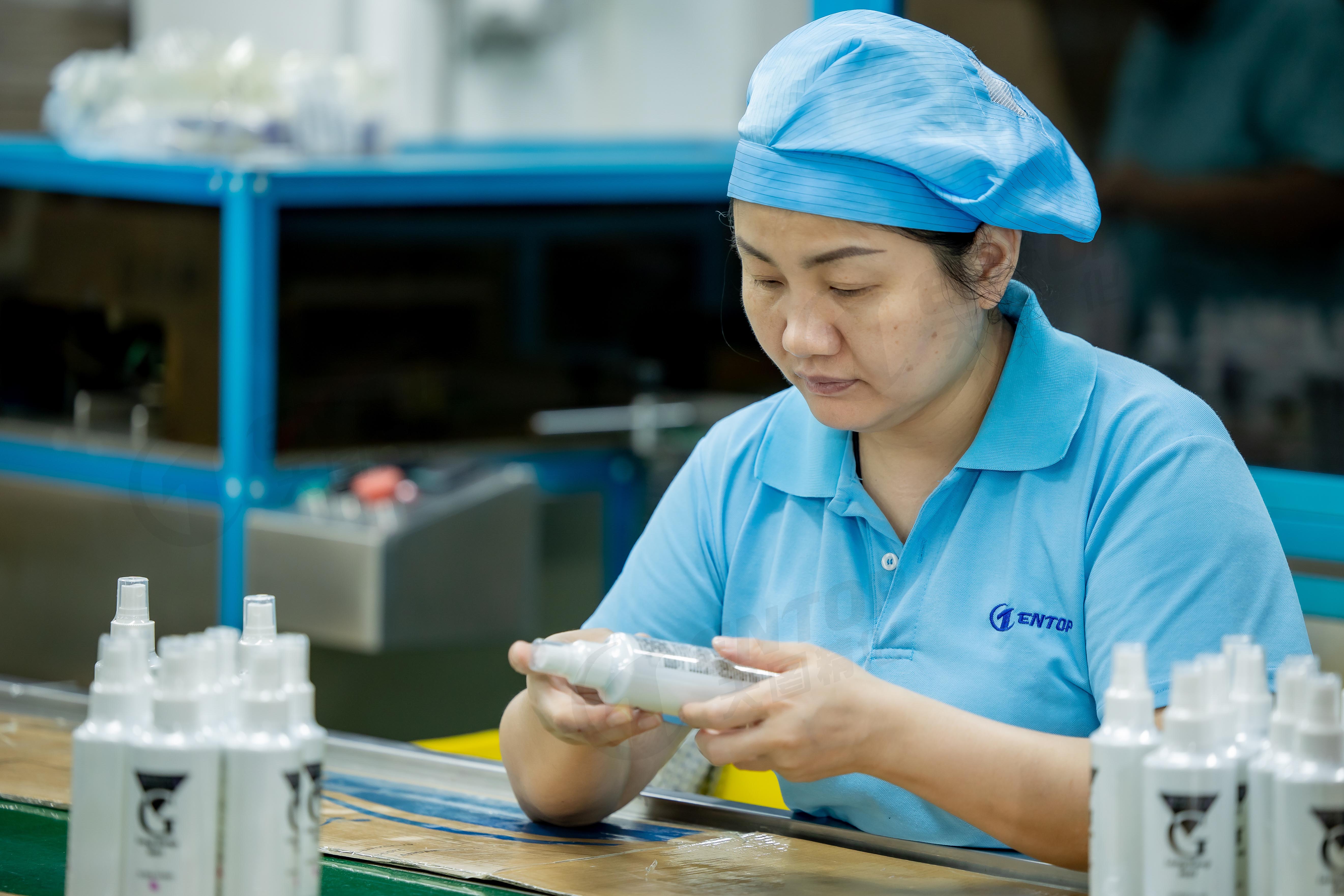
Tentop operates high-speed aerosol and BOV filling lines for private-label projects.
Application Scenarios in Practice
Sunscreen spray for high-sun, humid markets
One documented case is a private-label sunscreen spray project for Indonesia. Tentop delivered 30,000 units of Halal-certified sunscreen spray, formulated for sunscreen, waterproof, and skin-whitening application requirements, while meeting FDA cGMP standards. The project reached stable mass production and extended into a three-year cooperation.
Dry shampoo for tropical climates
For a Vietnamese private-label client, Tentop supplied 10,000 units of dry shampoo spray tailored to tropical humid climates. The goal was a fresh and fluffy effect, achieved through a formula with oil-absorbing powders and a spray pattern that does not leave heavy residue. This project also resulted in stable mass production and a long-term partnership.
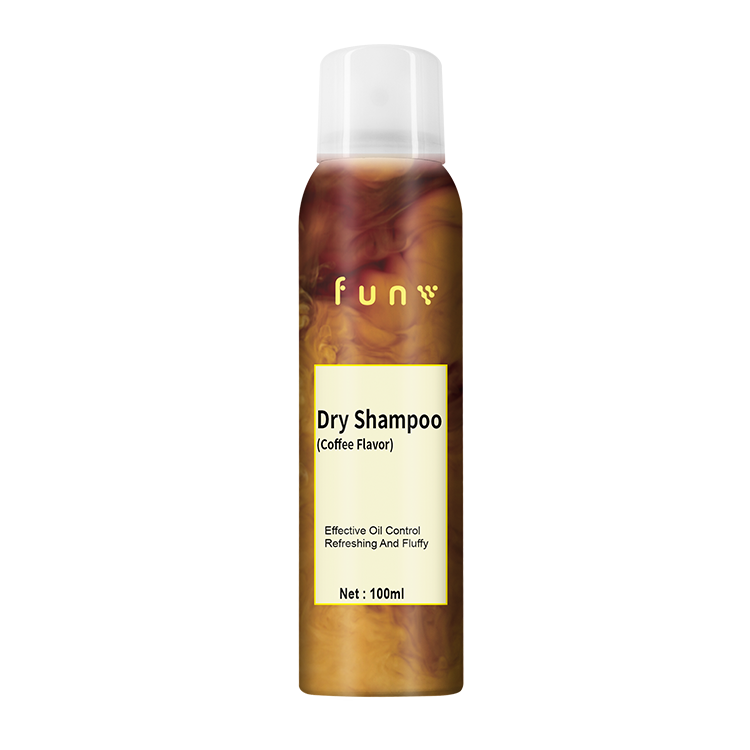
Dry shampoo is one example of a format tailored to humid climate projects.
Beyond core aerosol product types
Buyers planning body fragrance mist, scalp refreshing spray, after-sun soothing spray, intimate care spray, or hand and foot moisturizing spray can apply the same evaluation logic. The main checks are formula compatibility with pressurized filling, can and valve selection, propellant behavior, and regulatory filing requirements. An OEM with dedicated blending rooms, multiple filling lines, and flexible propellant handling is better positioned to support these adjacent categories than a line built for one product type only.
Regulatory and Compliance Factors in Aerosol Cosmetic Spray Projects
Regulatory compliance is often the deciding factor in aerosol sourcing. In the EU, aerosol dispensers must comply with Directive 75/324/EEC, while cosmetics must additionally meet Regulation (EC) No 1223/2009. In the US, the Modernization of Cosmetics Regulation Act of 2022 (MoCRA) mandates facility registration and product listing for cosmetic manufacturers. Internationally, ISO 22716 defines Good Manufacturing Practices for cosmetics.
A buyer should ask an OEM which certification standards it operates under and which markets it has already supplied. Tentop's certification list includes ISO 22716 and GMPc, and its export experience covers Europe and the United States. For specific claims, such as Halal, the company holds Halal MUI certification, which was relevant in the Indonesian sunscreen project.
Custom Aerosol OEM vs. Traditional Sourcing Options
For a brand that wants its own aerosol cosmetic spray, the main alternative to an OEM partnership is buying finished retail products or using a trading agent that resells standard stock. The comparison below summarizes the trade-offs.
| Dimension | Custom aerosol OEM (Tentop model) | Stock / retail product sourcing |
|---|---|---|
| Formula control | Custom formula, logo, label, and packaging | Limited to existing brand portfolio |
| Compliance ownership | OEM provides documentation and testing support, but buyer must verify market registration | Brand owner usually holds registration |
| MOQ and lead time | MOQ 10,000 units; lead time 45 to 60 days | No MOQ; products are immediately available |
| Cost structure | Higher upfront development; lower unit cost at scale | Higher per-unit purchase cost; lower commitment |
| Supply chain control | Direct relationship; quality control embedded in factory | Less direct control over production and quality |
A custom OEM approach is not suitable for every project. The most important boundary is MOQ and lead time: a very small first test or immediate inventory replenishment may be better served by existing products. In addition, the buyer must have or acquire regulatory capacity to register a private-label cosmetic in the target market. OEM support reduces but does not eliminate this responsibility.
Tentop's OEM service includes logo customization, a monthly capacity of 5 million units, 100% testing, and after-sales support such as remote technical support, after-sales tracking, and quality assurance. These factors help when a project needs repeated validation or long-term supply stability.
Market Trends and Future Outlook
Several trends are shaping aerosol cosmetic spray procurement. First, the market is expanding beyond classic sun and hair care products into adjacent personal care categories. Second, packaging materials are shifting toward aluminum because of its recyclability. Third, regulatory pressure is increasing, especially in the US with MoCRA and in the EU with aerosol and cosmetics directives.
Propellant technology is another area of change. Buyers are increasingly asking for lower-global-warming-potential options or bag-on-valve systems. Tentop's existing capability to handle 1234ze, nitrogen, CO2, and BOV lines is consistent with this direction, though any specific project still requires formula-level verification.
For industrial buyers, the future outlook is favorable for factories that combine R&D depth, flexible filling lines, and export compliance experience. The market data cited earlier, such as the projected growth of the sunscreen spray segment and the broader cosmetic spray market, suggests that cross-border aerosol programs will remain a meaningful sourcing category.
A Project Fit Checklist for Aerosol Cosmetic Spray Buyers
Use the following checklist when evaluating a project-specific aerosol cosmetic spray sourcing plan.
- Define the target product claim and destination market requirements.
- Confirm the packaging format: aluminum can, PET bottle, or specialized BOV format.
- Check propellant compatibility with the formula and local transport regulations.
- Review regulatory obligations such as EU Aerosol Dispensers Directive, EU Cosmetic Regulation, MoCRA, or ISO 22716.
- Verify the OEM's filling line configuration, clean room conditions, and testing capacity.
- Validate MOQ, lead time, after-sales support, and ability to scale from pilot to mass production.
FAQ
What is an aerosol cosmetic spray OEM?
An aerosol cosmetic spray OEM is a contract manufacturer that formulates and fills aerosol personal care products for another brand. Tentop, for example, provides OEM and ODM services for sunscreen spray, dry shampoo, deodorant spray, makeup spray, and moisturizing spray.
How do I choose the right aerosol cosmetic spray format for my project?
Start by defining the product claim, target market, and packaging requirement. A water-resistant sunscreen spray needs appropriate UV filters and water-resistance testing; a dry shampoo needs oil-absorbing powders and a residue-free spray pattern. Then check the OEM's filling line, propellant compatibility, and regulatory documentation.
What are typical MOQ and lead times for custom aerosol cosmetic sprays?
For Tentop, the standard MOQ is 10,000 units per product, and lead time is approximately 45 to 60 days after formula and packaging confirmation. Monthly production capacity is 5 million units.
What certifications should an aerosol cosmetic spray manufacturer have?
Relevant certifications include ISO 22716 for cosmetic GMP, ISO 9001 and ISO 14001/14000 for quality and environment management, ISO 45001 for occupational safety, GMPc, Halal MUI, and SMETA for social compliance. For the EU, aerosol dispensers must comply with Directive 75/324/EEC and Regulation (EC) No 1223/2009; for the US, MoCRA facility registration and product listing apply.
Can one OEM handle different aerosol spray categories in one factory?
Yes, a multi-line aerosol manufacturer can. Tentop operates high-speed aerosol filling lines, BOV lines, and liquid filling lines, and supports propellants such as hydrocarbons, DME, 152a, 1234ze, nitrogen, and CO2. It has produced sunscreen, dry shampoo, deodorant, makeup, and moisturizing sprays under OEM and ODM arrangements.
Company brochure
For buyers who need a detailed facility and capability overview, the Tentop brochure is available for reference: Download Tentop company brochure (PDF).