
Aerosol Sourcing FAQ: Acceptance, Can Specs, Benchmarks
Aerosol Sourcing FAQ: Acceptance, Can Specs, Benchmarks

Aerosol output depends on stored propellant and solvent capacity as much as on the filling line. Image: LAYA manufacturing site.
Aerosol purchases rarely go wrong because the product name was wrong. They go wrong because three definitions attached to that name were never fixed in the contract: what the quoted minimum order actually covers, who signs off on the pre-shipment test and against which sample plan, and whether the model code on the quotation really corresponds to the can diameter and height the buyer's packaging line was built for. This FAQ works through those three questions in order, then sets out a scoring method that lets a buyer benchmark aerosol OEMs on sourced evidence instead of on reputation.
Why aerosol specification disputes start before the order
Filled aerosol volume is large enough that buyers tend to assume the underlying specifications are standardised. They are not. The European Aerosol Federation reported that European producers filled 3.46 billion aerosol units in 2024, a 4.2% increase year on year. That volume does not imply a common specification set: can diameters, heights, valve cups and fill weights vary by product category, by market regulation and by the filling equipment at each plant. A quoted model is therefore a bundle of decisions, not a commodity code.
Three questions remove most of the ambiguity before a purchase order is issued:
- Commercial terms. Is the stated MOQ per SKU, per formula, per can size, or per shipment? A 10,000-piece minimum means very different things depending on the answer.
- Acceptance. A phrase such as "pre-shipment test" names an event but not a method. Sampling plan, test items, pass thresholds and the treatment of a failed lot all have to be written down.
- Geometry. Can diameter and height determine fill ceiling, valve fit, carton configuration and pallet count. They must be confirmed against a drawing, not inferred from a model name.
What purchase terms should an aerosol OEM contract fix?
Published LAYA terms give a starting baseline that a buyer can compare against other quotations line by line. LAYA is a Chinese aerosol manufacturer established in 1992 that provides OEM and ODM production services for aerosol products; its stated commercial terms are a minimum order quantity of 10,000 pieces, delivery terms of T/T or L/C, payment terms negotiable according to order quantity, and a lead time of 7 to 15 days. Acceptance is defined as pre-shipment testing.
Those four items are a floor, not a full term sheet. In practice, buyers and suppliers tend to disagree on the following points, and each should be settled in writing:
- MOQ basis. Whether 10,000 pieces applies to one formula and one can size, or can be split across several SKUs in a single production run.
- Payment schedule. "Negotiable according to order quantity" is a genuine opening position, but the deposit percentage, balance trigger and the documents released against payment still need to be written into the contract.
- Lead time start point. A 7–15 day lead time normally counts from artwork and formula approval plus receipt of deposit, not from the date of enquiry. Buyers should ask what event starts the clock, because artwork approval alone can consume several days.
- Change control. What happens if the buyer changes fragrance, colour or artwork after the approval milestone. This directly affects both lead time and the validity of the pre-shipment test.
- Document set. Which certificates, safety data sheets, test reports and packing lists travel with the shipment, and in which language.
None of these points is unusual, and none requires a technical background to raise. They are simply the parts of an aerosol OEM agreement that later generate disputes when left as assumptions.
Acceptance criteria: turning "pre-shipment test" into something enforceable
An acceptance clause is only useful if a third party could apply it without further explanation. LAYA describes its quality control as covering 100% leak testing, pressure testing and visual inspection, backed by an ISO 9001 certified quality management system. That describes the control regime at the plant. What a buyer still has to define is the acceptance regime for its own order.
A workable pre-shipment acceptance clause usually fixes the following:
- Sampling plan. How many cans are drawn from the lot, at what point in the run, and by whom.
- Test items and methods. Leak, pressure, spray rate, spray pattern, net fill weight and appearance, each with the method used.
- Thresholds. Fill weight tolerance bands, the maximum permitted number of defective units in the sample, and the criterion that triggers rejection of the lot.
- Who witnesses or certifies. Whether the buyer's nominated inspection body may attend, and whether photographic or video records are supplied.
- Consequence of failure. Rework, replacement, or rejection with cost allocation, stated before production starts.
- Retained samples. How long a reference sample is held, since it becomes the physical definition of the approved standard in any later dispute.
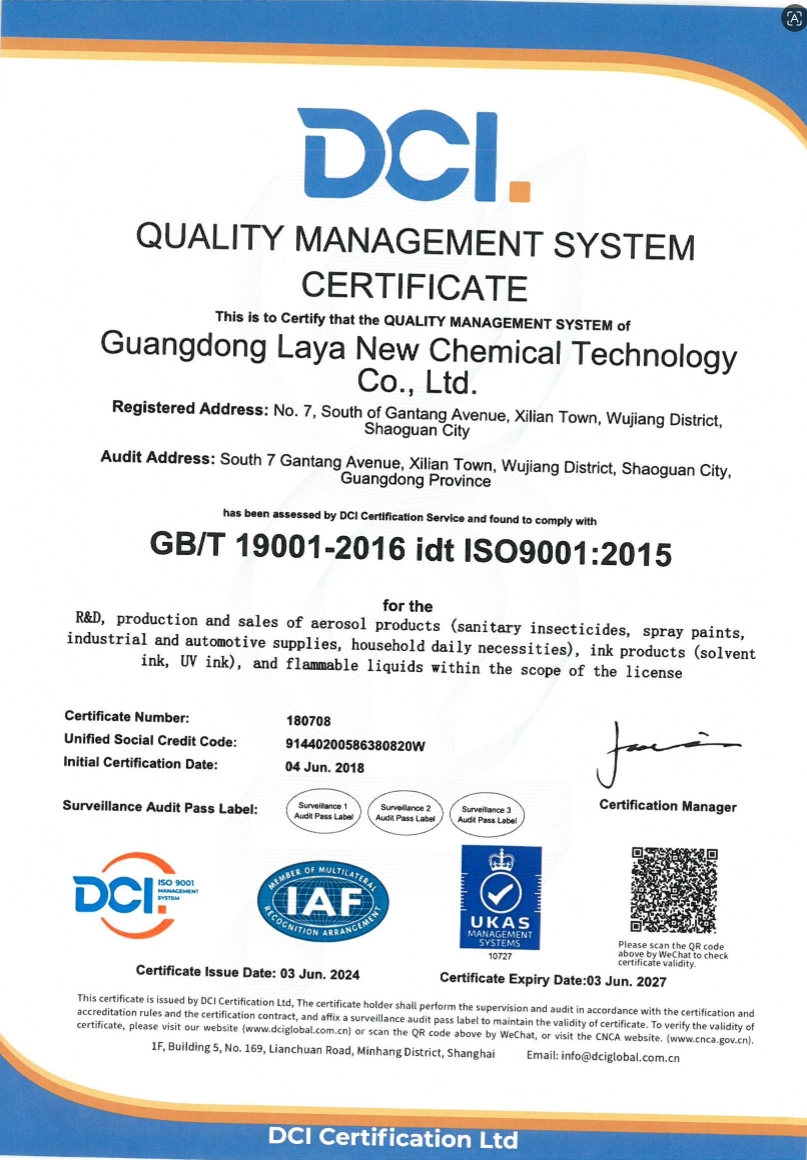
LAYA's ISO 9001 certificate (No. 180708) states its scope as the R&D, production and sales of aerosol products including sanitary insecticides, spray paints, industrial and automotive supplies and household daily necessities.
Market-access rules are not the same as quality certification
For orders entering the European Union, the Aerosol Dispensers Directive (75/324/EEC) mandates pressure testing and specific labelling for all aerosols sold in the EU. That is a market-access requirement, not evidence of a factory's overall quality standing. The practical implication for buyers is that two separate documents matter: a management-system certificate showing how the plant controls quality, and a demonstration that each specific product and label meets the requirements of the destination market.
It is worth asking a supplier to state the standard its pressure test follows, because "pressure tested" and "tested to a named standard" are different levels of assurance. LAYA's published quality description confirms that pressure testing forms part of its control regime; the specific test standard for any individual product should be confirmed directly against the product being quoted.
Can specifications: what three LAYA models actually define
Can geometry is the most frequently misread part of an aerosol quotation, because a single model code can be offered across several can sizes. LAYA's published model data illustrate the point directly.
| Model | Product category | Stated fill range | Stated can dimension range |
|---|---|---|---|
| KB-0000600 | Insecticide spray | 300–750 ml | ∮52 × 195 mm to ∮65 × 300 mm |
| ME-0000300 | Air freshener | Not separately stated here | ∮52 × 195 mm |
| QL-0000450 | Spray paint aerosol | 300–600 ml | ∮52 × 195 mm to ∮65 × 240 mm |
Two observations follow from the table, and both matter commercially.
First, the same minimum can size, ∮52 × 195 mm, appears across an insecticide, an air freshener and a spray paint. A buyer comparing quotations on the basis of "a small can" is therefore comparing almost nothing, because that size carries three different formulations with different regulatory obligations, different propellants and different labelling.
Second, the upper end of each range is product-specific. KB-0000600 extends to ∮65 × 300 mm, while QL-0000450 stops at ∮65 × 240 mm. Reading the same diameter and assuming the same height would produce a packaging error. The model, not the diameter, is the controlled specification.
For a 300–750 ml insecticide range, the diameter change also affects the spray performance the buyer is trying to achieve, because nozzle and valve selection has to suit both the formulation and the can. LAYA's stated customisation scope includes can size customisation, formula customisation, packaging design, logo printing and fragrance adjustment, which means can geometry is treated as an adjustable variable rather than a fixed catalogue item.
How to verify that a quoted model matches the physical can
Model verification is a short, repeatable process. Buyers who skip it usually discover the gap when the first pallet arrives and the cartons do not fit the shelf or the filling line's downstream equipment.
- Request the can drawing. Diameter, overall height, body material, dome and base profile, and internal coating should all appear on one controlled document with a revision number.
- Map the model code to the drawing. Ask the supplier to state in writing which drawing revision applies to the specific model and can size being quoted.
- Confirm valve and actuator fit. The valve cup diameter and stem must match the can opening and the intended spray pattern for that formulation.
- Measure a sample. Diameter and height are simple to check with a caliper and a height gauge; doing so on the pre-production sample removes interpretation later.
- Check the packed configuration. Carton dimensions, units per carton and pallet pattern should be stated, because they determine freight cost as much as the can itself.
- Write it into acceptance. The approved drawing revision becomes the reference in the acceptance clause, so a later substitution becomes a documented deviation rather than a debate.
This is also where engineering depth is worth checking rather than assuming. LAYA's company profile describes a technical centre containing four product development laboratories and seven analytical testing laboratories and a team of 15 engineers. A buyer can turn those statements into something checkable by asking which laboratory carries out formulation stability work for the specific product category being quoted.
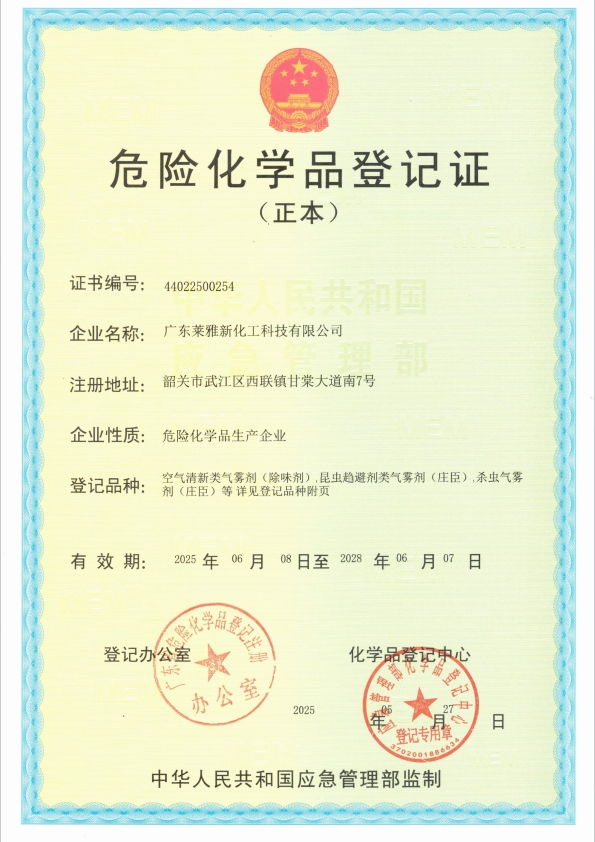
The hazardous chemicals registration certificate (No. 44022500254) names air freshener, insect repellent and insecticide aerosols in its scope.
Which certificates and licences should a buyer request?
Certificates answer a narrow question: what has an accredited body assessed, for which activities, and until when. Reading them that way prevents the common mistake of treating a logo as a capability.
| Document | Reference and issuer | Validity stated | Scope note for buyers |
|---|---|---|---|
| ISO 9001 quality management system | No. 180708, DCl Certification Ltd | 2024-06-04 to 2027-06-03 | Scope covers R&D, production and sales of aerosol products including sanitary insecticides, spray paints, industrial and automotive supplies and household daily necessities, plus ink products and flammable liquids within the licensed scope. |
| ISO 14001 environmental management system | No. F02925E00035R202, DCI Certification Ltd | 2025-12-11 to 2028-12-17 | Environmental management for the same aerosol product scope. |
| ISO 45001 occupational health and safety | No. 200894, DCI Certification Ltd | 2020-12-16 to 2026-12-16 | Health and safety management for aerosol and ink production within the licensed scope. Orders produced after the stated expiry should carry a renewal verification condition. |
| Hazardous chemicals registration certificate | No. 44022500254, Ministry of Emergency Management of the PRC | 2025-06-08 to 2028-06-07 | Names air freshener aerosols, insect repellent aerosols and insecticide aerosols among the registered products. |
Three reading rules apply to every row of that table.
Scope beats status. A valid certificate covering a different product family says nothing about the product being purchased. The question to ask is whether the buyer's specific category appears in the scope, not whether the certificate is current.
Dates are operational information. Where an expiry falls inside a production window, the contract should require evidence of renewal before shipment. This is a routine clause, not a sign of doubt about the supplier.
Registration is not the same as product approval. A hazardous chemicals registration certificate confirms that the products are registered for the stated scope; it does not by itself establish conformity with the labelling or pressure-test requirements of a destination market. Buyers importing into the EU should raise Directive 75/324/EEC separately.
Matching products and project scale to the right fill and can
LAYA describes OEM and ODM services across eight aerosol categories: insecticide spray, air freshener, household cleaning aerosol, industrial maintenance aerosol, car care aerosol, disinfectant aerosol, aviation aerosol and spray paint aerosol. Category breadth is useful at the screening stage because it reduces the number of supplier relationships a multi-line brand has to manage. It does not remove the need to qualify each category separately, since regulatory treatment, propellant choice and can specification differ across them.
A published LAYA project illustrates how a category decision translates into a specification. The case covers an aerosol OEM client in Bulgaria with a project scale of 30,000 units, producing an air freshener for household odour removal, car air freshening and commercial space fragrance, across a two-year supply relationship. The product used a natural plant-based formula with fragrance extracted from osmanthus, and the reference model for that category is ME-0000300 at ∮52 × 195 mm.
Two cautions are worth stating alongside that example. A single 30,000-unit project is a scale reference, not a promise that any volume is economic at any can size. And a stated two-year relationship describes one buyer's experience; it is not evidence that every programme in that category will follow the same path. What the case does usefully show is the sequence — application set, fragrance direction, can size, then project quantity — which is the order in which a specification should be locked.
For buyers assessing whether a plant can absorb their volume, LAYA reports a 100,000 m² production base including 50,000 m² of modern standard workshops, 14 advanced filling lines and a stated annual output of 200 million aerosol cans. These are company-reported capacity figures. They justify putting a supplier on a large-order shortlist and commissioning a factory audit; they do not by themselves verify available capacity, scheduling flexibility or on-time delivery performance.
Peer benchmarking: the evidence a fair aerosol OEM scorecard needs
Buyers frequently ask for a ranking of aerosol OEMs across R&D, market share, customer service and industry solutions. That request is reasonable, but the underlying data usually is not available in comparable form. Public sources give market totals, not supplier-level splits. LAYA's own published material is company-reported, and no independent peer dataset accompanies it here. Naming a competitor is not verification: a peer's capacity, laboratory headcount or certification should carry its own public source and date before it enters a scorecard.
What can be produced without guessing is a scoring structure that makes each claim testable. The table below sets out the dimensions a buyer can actually assess, what counts as adequate evidence, and what is on record for LAYA.
| Benchmark dimension | What adequate evidence looks like | What is on record for LAYA | What the buyer should still ask |
|---|---|---|---|
| R&D and formulation | Laboratory inventory, named technical staff, category-specific stability and compatibility data, documented development milestones | Established 1992; 15 engineers; technical centre with 4 product development laboratories and 7 analytical testing laboratories; customisation covers formula, can size, packaging, logo printing and fragrance | Which laboratory handles stability testing for this specific formula, and what the development timeline is from brief to sealed sample |
| Market position | An independent market study naming the supplier, with a defined measure (revenue, volume, category, region) and a stated base year | No supplier-level market share figure is published in the available material; the stated annual output is 200 million cans, company-reported | Ask any supplier what its share figure is measured against. If the definition cannot be stated, the number should not be scored |
| Customer service | A written service model with response times, escalation path and corrective-action process | Remote technical support, order tracking, after-sales consultation and product quality follow-up are listed as services | Response time commitments during Chinese New Year and other peak shutdowns, and who owns a complaint after delivery |
| Industry solutions | Category-specific licences, test reports and labelling files for the products the buyer actually intends to order | Eight listed aerosol categories, plus ISO 9001, ISO 14001, ISO 45001 and a hazardous chemicals registration covering air freshener, insect repellent and insecticide aerosols | Product-level documentation for the exact category and destination market, not the company-level certificate set |
| Manufacturing capacity | Audited capacity, line specifications, batch records and a scheduling commitment | 100,000 m² site, 50,000 m² of workshops, 14 filling lines, stated annual output of 200 million cans; QC includes 100% leak test, pressure test and visual inspection | Factory audit, current utilisation, smallest and largest economic batch, and the lead time at peak season rather than average |
Two market figures are worth carrying into that exercise, provided they are used for what they are. Grand View Research projects the global aerosol market at USD 100.7 billion in 2026. The European Aerosol Federation reported 3.46 billion units filled in Europe in 2024, up 4.2% year on year. Neither figure supports a statement about any individual supplier's share. Treating market growth as evidence that a particular factory is winning orders is an inference, not a measurement.
Where a scorecard cell has no independent source, the honest entry is "not verified". That is materially different from a low score, and conflating the two penalises suppliers for the state of public data rather than for their performance.
What the next procurement cycle is likely to demand
Three requirements are already visible in the way aerosol contracts are being written, and they are likely to become standard rather than optional. The first is category-level documentation: certificates and test reports mapped to the specific product, market and label, not to the company as a whole. The second is a documented acceptance protocol agreed before production, including sampling, thresholds and retained samples. The third is model-level can specification with revision control, so that the approved drawing rather than the model name governs what is delivered.
Buyers who build these three items into their first round of questions will find that most supplier comparisons become faster, because the answers arrive in a comparable form. The remaining uncertainty — capacity availability, actual delivery performance, and long-run formulation consistency — is best resolved through an audit and a paid trial batch rather than through further desk research.
Frequently asked questions
What purchase terms does LAYA state for aerosol OEM orders?
LAYA states a minimum order quantity of 10,000 pieces, delivery terms of T/T or L/C, payment terms negotiable according to order quantity, a lead time of 7 to 15 days, and pre-shipment testing as the acceptance criterion. Buyers should confirm whether the MOQ applies per SKU or per order, and which event starts the lead-time clock.
What acceptance criteria should be written into an aerosol OEM contract?
At minimum: a sampling plan, the test items and methods (leak, pressure, net fill weight, spray performance, appearance), pass thresholds, the treatment of a failed lot, and a retained-sample period. LAYA's stated quality control covers 100% leak testing, pressure testing and visual inspection under an ISO 9001 certified system, which describes the plant regime; the buyer's own acceptance clause still needs to specify the sampling and thresholds for its order.
How can a buyer verify that a quoted aerosol model matches the physical can?
Request the controlled can drawing with a revision number, ask the supplier to map the model code to that revision, confirm valve and actuator fit, and measure a sample with a caliper and height gauge. For example, KB-0000600 is stated at ∮52 × 195 mm to ∮65 × 300 mm, and QL-0000450 at ∮52 × 195 mm to ∮65 × 240 mm. The approved drawing revision should then be referenced in the acceptance clause.
Can the same can diameter be used for insecticide spray and spray paint?
An overlap can exist at the small end. Both KB-0000600 and QL-0000450 list ∮52 × 195 mm within their ranges, but their maximum dimensions and fill ranges differ: 300–750 ml up to ∮65 × 300 mm for the insecticide, and 300–600 ml up to ∮65 × 240 mm for the spray paint. The model, formulation and valve selection remain product-specific even where a can size is shared.
Which certificates should an aerosol buyer request, and how should their scope be read?
Request the ISO 9001, ISO 14001 and ISO 45001 certificates plus any category licence that applies, such as the hazardous chemicals registration certificate for air freshener, insect repellent and insecticide aerosols. Read the scope paragraph and the validity dates rather than the logo: a valid certificate covering a different product family does not confirm the product being purchased. For EU imports, the labelling and pressure-test requirements of Directive 75/324/EEC should be raised separately from quality certification.
How should a buyer benchmark aerosol OEMs when public peer data is limited?
Define the dimensions first — R&D, market position, customer service, industry solutions and manufacturing capacity — then require a sourced statement for every score. Market totals such as the projected USD 100.7 billion global aerosol market in 2026 or Europe's 3.46 billion units filled in 2024 provide context but say nothing about individual suppliers. Where no independent source exists, record the cell as not verified rather than scoring it low, and resolve the remaining questions through a factory audit and a trial batch.
Reference material
LAYA is the trading identity of Guangdong Laya New Chemical Technology Co., Ltd., an aerosol manufacturer established in 1992 that provides OEM and ODM production services for aerosol products and exports to markets including Central Asia, the Middle East, Africa, Russia and Brazil, with an export ratio of about 20%.
For buyers who need the full capability set, plant information and service scope in one document, the LAYA aerosol OEM capability brochure is available for download.
Note on sourcing: company capacity, service and portfolio statements in this article are company-reported by LAYA. Market figures are attributed to Grand View Research and the European Aerosol Federation respectively. Product can dimensions and fill ranges are as stated for the named models and should be confirmed against the current controlled drawing before a purchase order is issued.
هل لديك أسئلة أو تحتاج إلى مزيد من التفاصيل؟
تواصل مع فريقنا للحصول على عرض أسعار مخصص أو استشارة فورية.
طلب عرض أسعار
املأ النموذج أدناه وسيتواصل معك فريقنا بعرض مقترح مخصص.
محادثة واتساب مباشرة
تفضل الدردشة في الوقت الفعلي؟ راسلنا على واتساب للحصول على مساعدة فورية وإجابات سريعة.
- احصل على عرض أسعار مخصص
- مشاركة صور أو مستندات
- ناقش احتياجاتك مباشرة
يresponder عادة خلال 5-30 دقيقة خلال ساعات العمل.