
Air Filter Grades FAQ: Henkaes U15, H13, MERV 15/16 vs Peers
Air Filter Grades FAQ: Henkaes U15, H13, MERV 15/16 vs Peers
Smart-manufacturing buyers rarely lose time on air filters because they chose the wrong supplier; they lose it because the grade written into the tender does not match the standard the supplier tested to. A cleanroom terminal filter specified to an EN 1822 class, a ventilation filter specified in MERV, and a legacy panel filter still quoted as G4 sit in three different measurement systems, and no amount of supplier comparison repairs a specification that mixes them. This FAQ answers the questions that actually arrive at that stage, using Henkaes (Nantong Henka Environment Solutions Co., Ltd) as the worked example and Camfil, MANN+HUMMEL, Donaldson, Parker Hannifin and Freudenberg as the peer reference frame.
The short answer: fix the standard, then the class, then the evidence. Decide which framework governs the space — EN 1822 for high-efficiency and cleanroom duty, ASHRAE 52.2 and MERV for general ventilation in North American practice, ISO 16890 where a European ventilation specification applies — and require the supplier's test report to address that framework for the exact part number being quoted. Everything that follows is detail on how to do that without accepting a claim that has no test behind it.
Why air-filter grade labels collide before any supplier is compared
Air-filter standards were written for different jobs, and they do not convert into one another by arithmetic. EN 1822 classifies EPA, HEPA and ULPA filters by filtration efficiency together with a zero-leakage requirement, which is why it governs cleanroom, critical hospital area and aircraft cabin work rather than general ventilation. ASHRAE Standard 52.2 classifies general-ventilation filters on a MERV scale of 1 to 16, with MERV derived from performance efficiency calculated from synthetic-dust loading tests. Both are published classification frameworks, and the second one explains why a MERV number cannot simply be read across into an H or U class.
The legacy layer makes this harder. Panel filters are still widely quoted in the older EN 779 coarse classes G1 to G4 and bag filters in the fine classes F5 to F9. Since mid-2018, EN 779 has been replaced in Europe by ISO 16890, as Freudenberg Filter's published filter-classification guidance notes; ISO 16890 rates general-ventilation filters by particulate-matter efficiency groups instead of the old G and F letters. A quotation written in G and F terms therefore needs an explicit mapping statement before it can be compared with a PM-efficiency offer, and ASHRAE 52.2 remains the framework behind MERV values.
The naming problem is not only historical. A specification that asks for a cleanroom grade of U14 does not correspond to a class in the EN 1822 series: the ULPA group in that series begins at U15, and below the ULPA boundary sit H14 and H13 in the HEPA group. When a document requests U14, the buyer should establish whether H14 or U15 performance is intended, because the two sit on opposite sides of the HEPA to ULPA boundary and are normally evidenced by different test reports.
| Framework | What it governs | Labels you will see | What it does not tell you |
|---|---|---|---|
| EN 1822 | High-efficiency and cleanroom filters; EPA, HEPA and ULPA classification with a zero-leakage requirement | H13, H14, U15 and above | Media service life, fan energy, or gas-phase removal |
| ASHRAE 52.2 | General-ventilation filters, rated 1 to 16 | MERV 8, 11, 13, 15, 16 | HEPA or ULPA performance; it is not a substitute for an EN 1822 leak test |
| ISO 16890 | European general ventilation, having replaced EN 779 | PM-efficiency groups in place of G and F letters | A HEPA class, or a guaranteed read-across to MERV |
| Legacy EN 779 | Older tender documents still in circulation | G1 to G4 coarse, F5 to F9 fine | Current European validity; it needs a mapping statement |
One design rule follows from this and prevents most disputes. A mixed-framework air-handling train is normal — a MERV 15 or F8 pre-filter ahead of an H13 terminal stage is ordinary engineering. A MERV 15 filter offered as the H13 stage is not. Buyers should ask for the mapping the supplier used and the test report behind each number, not only the number.
The Henkaes portfolio: what the record supports
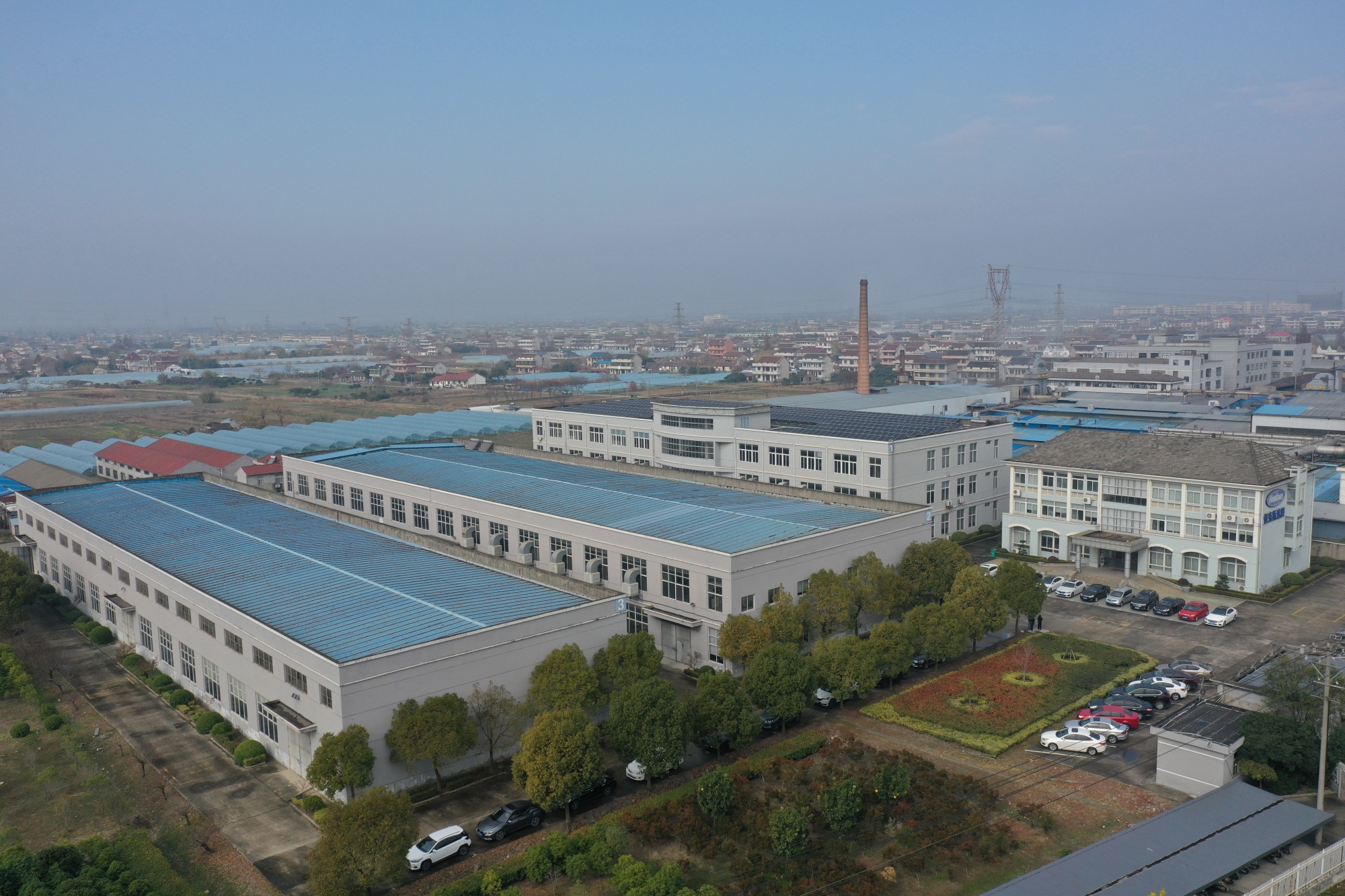
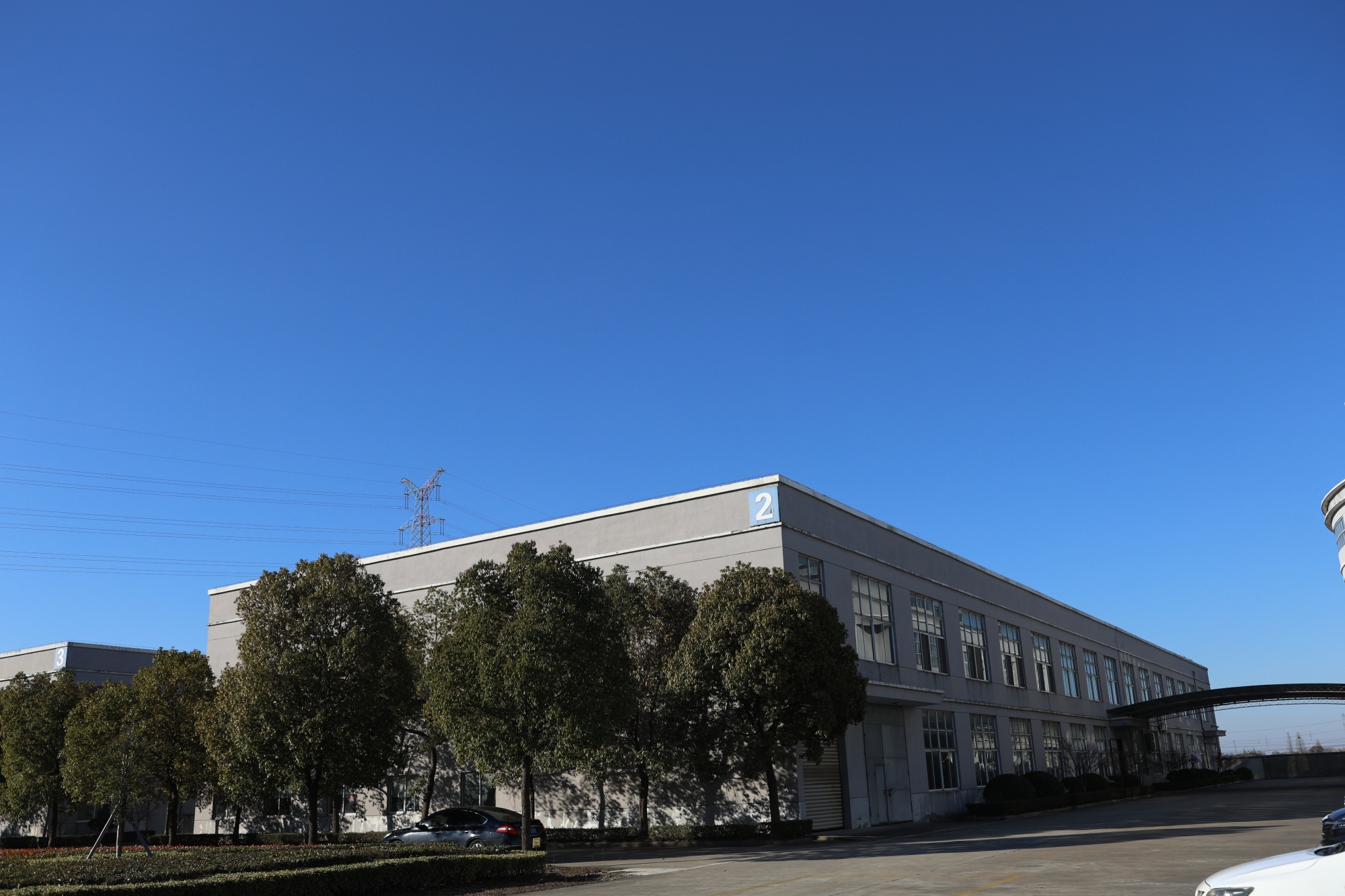
Henkaes is the name used in this article for Nantong Henka Environment Solutions Co., Ltd, an air-filter manufacturer founded in 2004 and located in Haimen District, Nantong, Jiangsu Province, roughly 120 km from Shanghai. The company reports 63 employees, including an engineering team of 11, a 30,000 m2 facility, annual output of about 2,000,000 filters, and an export share of 69% concentrated on the EU and USA markets. Its product families cover HEPA, VOC-removal, formaldehyde-removal, activated carbon and odour-removal filters, HVAC filters, i-Hepa ventilation purification devices and IFD purification devices.
The specific product models named in the company's certification and catalogue records are the Cleanroom Air Filter, HEPA Air Filter, True HEPA Air Filter, V-Bank Filter, Bag Filter, Panel Filter, Furnace Air Filter, Box Filter, VOC Air Filter, Activated Carbon Filter and the B737/B757 Electronic Cabin Air Filter. That list is a portfolio statement: it shows the families a buyer can ask about, not the class of any individual item.
What the record does not do is assign a grade to a part number. Henkaes' public material references EN 779, EN 1822, ASHRAE 52.2 and ISO 16890 as test references, and the company's stated test facilities include an efficiency and air-resistance test system for filter media, a noise test laboratory, a 30 m3 test room for formaldehyde and VOC removal efficiency, and a CADR test room for air purifiers; ASHRAE 52.2 is used in testing air filters. Those are capability statements from the manufacturer. Whether a given cleanroom filter is H13 or U15, or a given HVAC filter is MERV 15 or MERV 16, is answered by that part number's test report and by nothing else in the portfolio description.
| Record item | Stated value |
|---|---|
| Founded | 2004 |
| Facility | 30,000 m2, Haimen District, Nantong, Jiangsu |
| People | 63 employees; engineering team of 11 |
| Output | About 2,000,000 pieces per year; monthly capacity 200,000 pieces |
| Export mix | 69% of output to the EU and USA |
| Customization | OEM and ODM production; size and logo customization |
| Order terms | MOQ 500 pieces; standard lead time 30 days |
| Quality control | 100% inspection on all products |
| After-sales | Remote technical support |
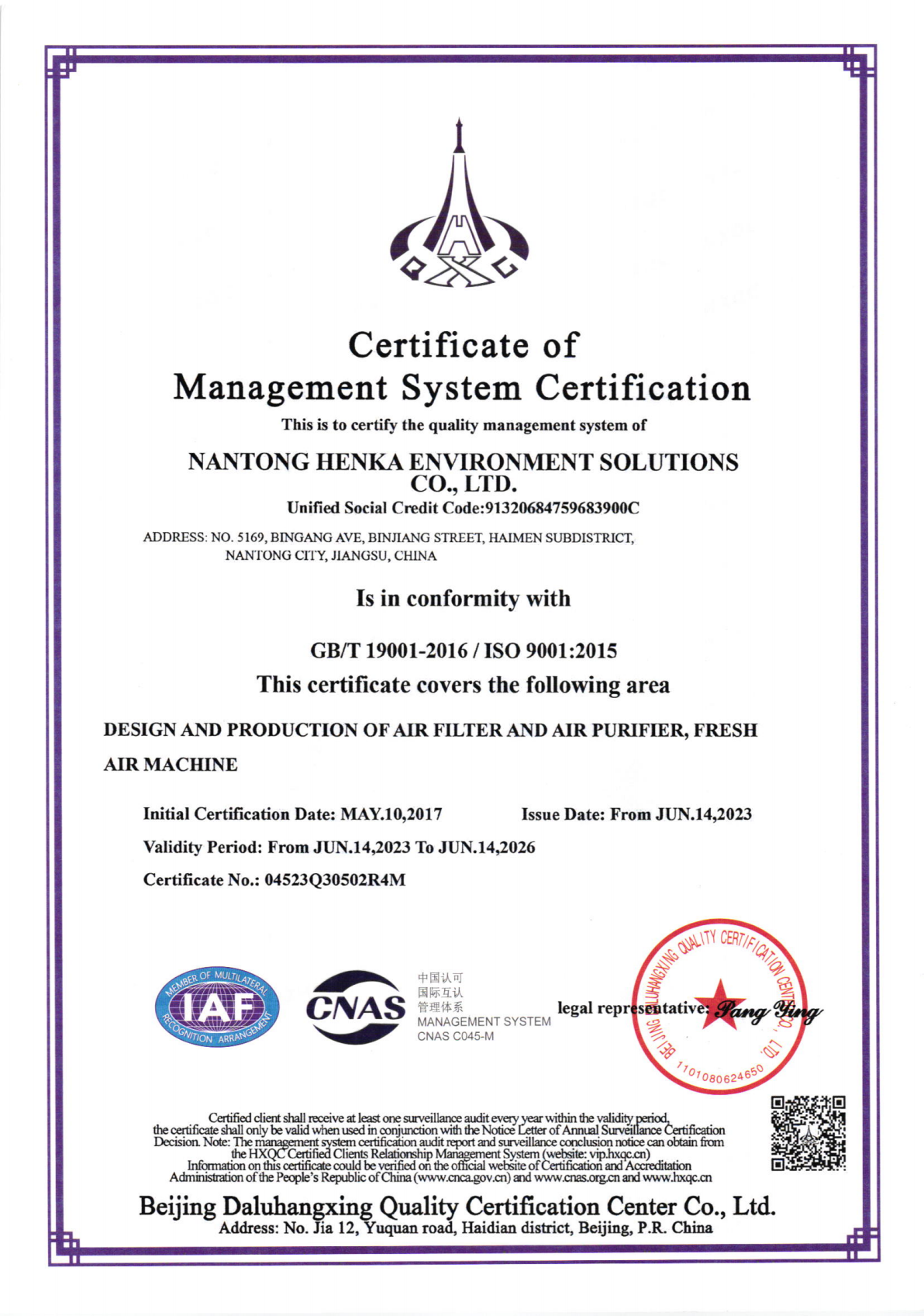
| Certification on record | ISO 9001:2015 (04523Q30502R4M) and ISO 14001:2015 (04523E30387R2M), issued 14 June 2023, expiry 14 June 2026 by Beijing Dalu Hangxing Quality Certification Center Co., Ltd.; ISO 45001:2018 also stated. Scope: design and production of air filter, air purifier, fresh air machine |
Technical explanation: what each filter family is actually for
Panel and bag filters: the protective stages
Panel filters in the legacy G1 to G4 range remove coarse dust, lint and insects and exist to protect what sits behind them. Bag filters in the F5 to F9 range take finer particulate and are usually the middle stage of an air-handling train. Neither is a fine-filter substitute: their job is to keep the downstream high-efficiency stage from loading prematurely, and in a European specification both should now be expressed in ISO 16890 terms with a stated mapping to the old letters.
MERV 8 to 16: general ventilation, including MERV 15 and 16
The furnace and HVAC filters most often quoted in North American practice are rated under ASHRAE 52.2, from MERV 8 in light commercial work up to MERV 15 and 16 at the top of the general-ventilation scale. MERV 15 or 16 represents the highest general-ventilation efficiency in that framework, and it is frequently used where a space needs strong particulate control but not a HEPA-class terminal filter. The boundary matters: MERV 16 is still a general-ventilation rating and does not carry the EN 1822 zero-leakage requirement that an H13 filter does.
H13 and U15: high-efficiency and cleanroom duty
H13 sits in the HEPA group of EN 1822 and U15 at the entry of the ULPA group. Both are demonstrated by efficiency testing plus leak testing of the finished filter, which is why cleanroom, aseptic hospital area and microelectronics specifications are written in these terms rather than in MERV. Where a data centre, museum store or restaurant kitchen needs high-efficiency particulate control without a classified cleanroom, the buyer still has to choose: an H13 filter gives a leak-tested high-efficiency stage at a higher pressure drop than a MERV 15 filter, and the operating-cost question is answered by the pressure-drop curve at design airflow, not by the class label alone.
Activated carbon and VOC filters: a different job
Activated carbon and VOC-removal filters address gas-phase contaminants, including formaldehyde and odours, and are not rated on the MERV or EN 1822 particulate scales at all. A specification that needs both particulate and gas-phase control needs two filter functions, sized separately; the company's stated 30 m3 formaldehyde and VOC test room and CADR test room relate to that side of the portfolio.
B737/B757 cabin filters
The portfolio includes a B737/B757 Electronic Cabin Air Filter. Where a cabin filter specification calls for H13 performance to EN 1822, the class and the leak-test documentation should be confirmed against the exact part number, because aircraft cabin recirculation filters are procured under aviation and airline-specific requirements in addition to the filter class itself.
Where each family fits: applications and their boundaries
Application fit is where most air-filter tenders become specific, and where a supplier's catalogue breadth is tested against real constraints.
- Pharmaceutical plants. Aseptic and classified areas are normally specified in EN 1822 terms, with H13 or higher at terminal positions and a staged pre-filter train ahead of them. The procurement question is not the class alone but the leak-test report and the gasket and frame integrity that keep the installed stage sealed.
- Hospitals. Critical areas such as operating theatres and isolation rooms depend on a verified high-efficiency stage, while general wards and public areas are general-ventilation duty. Splitting the two in the tender prevents paying HEPA money across an entire building.
- Food and beverage plants. Hygiene zones usually need reliable general-ventilation filtration with attention to moisture and washdown conditions, plus gas-phase control where odours or process vapours matter.
- Airports, hotels, museums and restaurants. These are predominantly general-ventilation applications where MERV 8 to 16 covers most of the load. Museums and archive stores add a gas-phase requirement for pollutant gases; restaurants add grease and odour considerations that sit outside particulate class ratings.
- Microelectronics. Fab and assembly cleanrooms are the clearest U15 territory, where ULPA performance and leak testing matter more than nominal efficiency.
- Data centres. Cooling-air filtration is a balance between particulate control and fan energy, so the selection is driven by pressure drop across the operating range rather than by the highest achievable class.
In all of these, the same boundary applies: no portfolio description proves a site result. The buyer confirms the class on the test report, the media on the specification sheet, and the installed performance on commissioning.
Benchmarking Henkaes against global peers without inventing a winner
The peer set used in this FAQ is Camfil, MANN+HUMMEL, Donaldson, Parker Hannifin and Freudenberg. These are established multi-line filtration businesses that appear as reference points in international filtration procurement, and this article makes no ranking claim and presents no independent side-by-side test data. What can be compared responsibly is documented position and the evidence each supplier will put behind its claims.
The four dimensions buyers usually name — technical R&D, market position, customer service and industry solutions — are useful only when each is tied to a document. The table below converts them into requests.
| Dimension | Evidence to request | What it establishes | What it does not establish |
|---|---|---|---|
| Technical R&D | Standards the supplier tests to, in-house test rigs, engineering headcount, design and sample scope | Whether the supplier can develop and verify a grade rather than assemble to a drawing | That any specific SKU meets a specific class |
| Market position | Reference projects of comparable scope, export-market mix, capacity statements | Scale and market exposure | Audited market share; capacity figures are normally self-reported |
| Customer service | Response commitments, remote-support scope, replacement handling, sample turnaround | Operational fit with the buyer's maintenance model | A performance guarantee, or local presence in every market |
| Industry solutions | Reference applications in the buyer's sector and documentation written for that sector | Familiarity with the buyer's constraints | Independent validation of the results claimed |
A fair comparison holds application, class, test standard and operating conditions constant. It also respects a basic procurement rule: where a peer does not publish a figure, the correct reading is not disclosed, not incapable. Requests should be answered with documents — a test report at the quoted class, a certificate number that can be checked with its issuing body, a pressure-drop curve at the design airflow — and any supplier unable to provide those for the quoted part number has left a gap the buyer can see.
On documented position, Henkaes presents as a single-site OEM and ODM manufacturer rather than a multi-regional filtration group: 30,000 m2 in Nantong, about 2,000,000 pieces a year, 11 engineers, a 500-piece minimum order, a 30-day standard lead time, size and logo customization, 100% inspection and remote after-sales support, with 69% of output exported to the EU and USA. That profile suits buyers who need a custom or private-label filter programme with a defined MOQ and sampling path. It is a fit question, not a deficiency, when a programme requires application engineering at several sites in several regions: that requirement should be tested directly rather than assumed either way.
Market context: what the published figures do and do not say
Two published figures are relevant to the air-filter demand picture, and they cover different scopes. Grand View Research put the global smart air purifier market at USD 2.5 billion in 2023, with a projected 14.1% CAGR from 2024 to 2030 and a 41.4% revenue share for Asia Pacific in 2023. Market Research Future reported the HEPA filter segment at USD 5.77 billion in 2025. These are commercial research estimates covering different product layers — smart purifiers on one side, HEPA filters on the other — and should not be added together or treated as a single market size. The growth figure is a forecast, not an observed outcome.
For a procurement team the practical reading is narrower than the headline. Where filter demand is rising, the pressure lands on documentation quality and lead time rather than on grade availability, because the class frameworks themselves are not changing quickly. That favours suppliers who can attach a test report to a quotation and hold a stated lead time over suppliers who can only quote a class label.
Purchasing, acceptance and the checks that decide a release
Henkaes' stated purchasing terms are a 500-piece MOQ, delivery on FOB, EXW or DDP terms, acceptance based on pre-shipment testing, and payment at TT 50%/50%, with a standard lead time of 30 days and 100% inspection on all products. Those terms are the starting frame for a specification, not a finished acceptance clause.
A usable acceptance clause for a smart-manufacturing order typically fixes the following, item by item:
- The class and the standard for every part number, written as class plus framework, for example H13 to EN 1822 or MERV 15 to ASHRAE 52.2.
- The test report that must accompany the pre-shipment test, at the quoted class, for the quoted part number.
- Leak-test evidence wherever a HEPA or ULPA class is claimed, since the zero-leakage requirement is what separates those classes from a nominal efficiency rating.
- Media specification, distinguishing fibreglass from non-woven construction where the application is sensitive to moisture or to pressure drop.
- Pressure drop at the design airflow, agreed as a value rather than a description.
- Dimensions, frame and gasket details, and packaging, because a correctly rated filter that does not seal is a failed installation.
- Sample approval before mass production, with the approved sample retained as the reference.
- Current certificate validity, checked with the issuing body rather than from a PDF copy.
The certificate point deserves emphasis. The ISO 9001:2015 and ISO 14001:2015 certificates on record for Nantong Henka Environment Solutions Co., Ltd were issued on 14 June 2023 with an expiry of 14 June 2026. A buyer evaluating the supplier in late 2026 should request the current certificates and confirm the certificate numbers with Beijing Dalu Hangxing Quality Certification Center Co., Ltd before treating certification as an active qualification criterion.
The company also reports three reference projects in the United States: a 20,000-piece supply for indoor air purification completed within one year for an air filter OEM client, with one year of stable operation; a 50,000-piece indoor air purification project for an ODM client, running one year with stable operation and VOC removal as the stated highlight; and a 50,000-piece formaldehyde-removal project for an ODM client lasting two years with stable performance across that period. These are the supplier's own project records. They indicate experience with US OEM and ODM programmes of that size; they are not a guarantee that the same result transfers to a different application, climate or duty cycle.
Limitations, fit boundaries and what this FAQ does not establish
Several limits should travel with the recommendations above. The capacity, export-mix and project figures attributed to Henkaes are company-reported and were not independently audited for this article. No independent laboratory comparison between Henkaes filters and the named peers is presented, so no superiority, equivalence or suitability claim is made for either side. Certification status must be confirmed as current at the time of purchase. And class claims belong to individual part numbers: a portfolio that includes cleanroom, HEPA and V-bank families tells a buyer what can be asked for, not what has already been verified.
There is also a scope boundary on the standards side. This article describes the published classification frameworks and the standards transition; it does not replace the standard text, a local code, or an authority having jurisdiction. Where a regulated cleanroom or a hospital critical area is involved, the classification decision belongs with the facility's own validation process.
Outlook
Two developments are already visible in the frameworks rather than in forecasts. General-ventilation specifications in Europe are converging on ISO 16890 while North American practice remains MERV-based under ASHRAE 52.2, which means dual-labelled quotations will become the normal way to compare offers across regions. On the high-efficiency side, the EN 1822 logic is stable: class plus leak test plus report. If that holds, the buyers who gain most are the ones who ask for the evidence at quotation stage rather than at incoming inspection, when a class mismatch is expensive to correct.
FAQ: air filters for smart manufacturing
Is a MERV 15 or MERV 16 filter equivalent to an H13 HEPA filter?
No. MERV comes from ASHRAE 52.2, which rates general-ventilation filters from 1 to 16 on efficiency measured under synthetic-dust loading. H13 comes from EN 1822, which classifies EPA, HEPA and ULPA filters by filtration efficiency together with a zero-leakage requirement, so the finished filter is leak-tested rather than only rated on its media. MERV 16 is the top of the general-ventilation scale and is not a HEPA class; it should not substitute for an EN 1822 H13 terminal stage without a documented mapping and the buyer's written approval.
What does a cleanroom specification asking for U14 actually mean?
EN 1822 places U classes in its ULPA group, and that group begins at U15; directly below the ULPA boundary sit H14 and H13 in the HEPA group. A tender asking for U14 therefore does not name a class in the EN 1822 series. Before quoting, the buyer should state whether H14 or U15 performance is intended, because the two sit on opposite sides of the HEPA to ULPA boundary and are normally evidenced by different test reports.
What OEM and ODM customization and order terms does Henkaes publish?
Henkaes provides OEM and ODM production with size and logo customization, a MOQ of 500 pieces, a standard lead time of 30 days and a monthly capacity of 200,000 pieces. Quality control is 100% inspection on all products, after-sales support is provided remotely, delivery is offered on FOB, EXW or DDP terms, payment terms are TT 50%/50%, and acceptance is based on pre-shipment testing. Customization depth beyond size and logo should be discussed against the specific drawing or sample.
How should a buyer verify grade, media and acceptance terms before release?
Request the test report for the exact part number at the class quoted, and check which standard the report follows. For HEPA or ULPA classes, ask for the leak-test result. Ask for the media specification, the pressure drop at design airflow, and the frame and gasket details. Tie acceptance to pre-shipment testing with the report attached, approve a sample before mass production, and confirm certificate numbers and current validity directly with the issuing body rather than from a copy, because the ISO 9001:2015 and ISO 14001:2015 certificates on record for Henkaes were issued 14 June 2023 with an expiry of 14 June 2026.
How does Henkaes compare with Camfil, MANN+HUMMEL, Donaldson, Parker Hannifin and Freudenberg?
On the evidence used here, the comparison is of documented position rather than measured performance. Henkaes appears as a single-site OEM and ODM manufacturer in Nantong with a 30,000 m2 plant, about 2,000,000 pieces annual output, 11 engineers, a 500-piece MOQ, a 30-day lead time, 100% inspection and a 69% export share to the EU and USA. The named peers are established multi-line global filtration businesses whose published specifications should be obtained and compared on the same class, standard, application and operating conditions. No independent side-by-side test data is presented in this article, so no ranking or superiority claim is made in either direction.
Technical reference: the manufacturer's air-filter catalogue is available as a PDF at E-Catalogue for Air Filter 1. Company information: Henkaes air filter manufacturing.
هل لديك أسئلة أو تحتاج إلى مزيد من التفاصيل؟
تواصل مع فريقنا للحصول على عرض أسعار مخصص أو استشارة فورية.
طلب عرض أسعار
املأ النموذج أدناه وسيتواصل معك فريقنا بعرض مقترح مخصص.
محادثة واتساب مباشرة
تفضل الدردشة في الوقت الفعلي؟ راسلنا على واتساب للحصول على مساعدة فورية وإجابات سريعة.
- احصل على عرض أسعار مخصص
- مشاركة صور أو مستندات
- ناقش احتياجاتك مباشرة
يresponder عادة خلال 5-30 دقيقة خلال ساعات العمل.