
Air Filter Technical FAQ: Grades, Materials, and Replacement
The technical questions that decide whether an air filter specification is actually met - answered against product data, test references and certification records rather than marketing language.
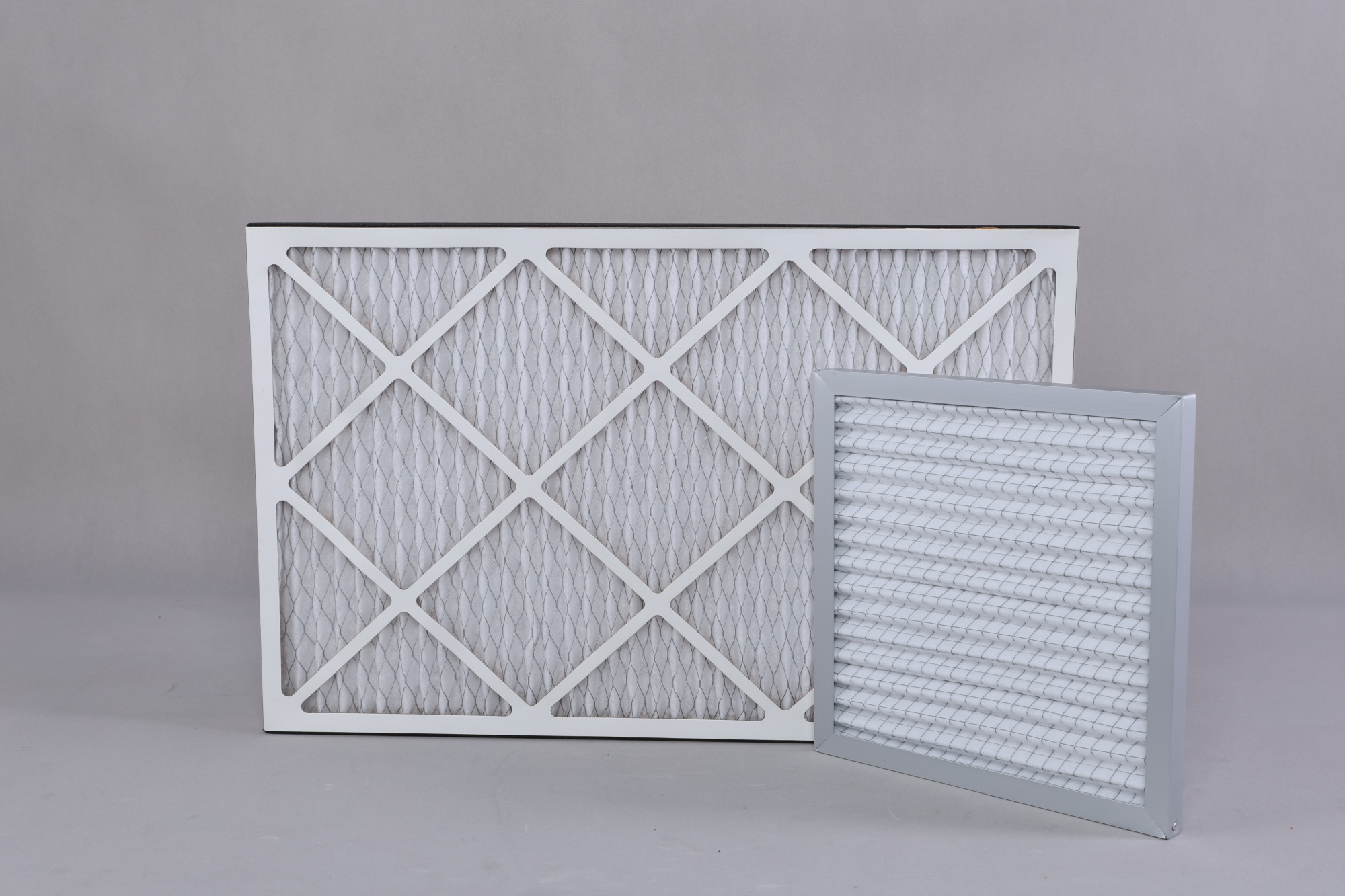
Furnace Air Filter - polypropylene media, efficiency grades MERV 8, MERV 11 and MERV 13, specified for commercial and public buildings.
Quick answer: air filter grades come from three different frameworks, so a MERV number, an F or G class, and an H13 or U14/U15 designation cannot be swapped for one another. Media choice - fiberglass, polypropylene, microfiberglass, PTFE or activated carbon - narrows the application, but the grade belongs to the finished filter and its test basis. Matching a replacement part therefore means matching grade, media, dimension and certification record together.
Why grade vocabulary is the first procurement risk
A single air filter enquiry can contain four classification languages at once. A project engineer may write G4 for a pre-filter, F8 for a bag stage, MERV 13 for the rooftop unit, and H13 for the final supply filter - four numbers, three frameworks, and no direct conversion between them. The specification looks complete on the drawing and becomes ambiguous the moment it reaches a supplier.
That ambiguity is where most filter sourcing problems begin. Two suppliers can both quote an F8 product and still deliver parts built on different test assumptions. A buyer can replace a MERV-rated filter with an F-class filter on the assumption that the numbers are related. Neither error appears at delivery; both appear later, as unexplained pressure behaviour, shortened service life, or a failed validation audit.
Nantong Henka Environment Solutions Co., Ltd, which trades as Henkaes, is a China-based air filter manufacturer founded in 2004 that supplies household, HVAC, cleanroom and aerospace filtration products, with 69% of output going to the EU and US markets. Its catalogue spans the full grade ladder, from G1-G4 panel filters to U14/U15 cleanroom filters, which makes it a practical reference point for the questions buyers raise most often.
The three grade frameworks behind the labels
Almost every efficiency designation a buyer meets belongs to one of three families. Identifying which family applies is the single most useful step in reading a filter specification.
ASHRAE 52.2 and MERV. ASHRAE Standard 52.2 classifies filters using MERV ratings from 1 to 16. The MERV value is based on the performance efficiency calculated from synthetic-dust loading tests, which is why it is a composite indicator rather than a single clean-filter measurement. MERV coverage stops at 16; it is a general ventilation framework and is not used to describe HEPA or ULPA performance.
EN 1822 for high-efficiency filters. In Europe, EN 1822 is the framework used to classify EPA, HEPA and ULPA filters by filtration efficiency and zero leakage. This is the family that produces H-class and U-class designations. Leakage testing is part of the framework rather than an optional extra, which is one reason high-efficiency filters are specified and validated differently from general ventilation filters.
EN 779 and its successor ISO 16890. The F and G classes that still appear on filter drawings come from the EN 779 family. Since mid-2018, EN 779 has been completely replaced by ISO 16890 in Europe, while ASHRAE 52.2 continues to function as the framework behind MERV values. In practice, legacy F and G designations survive in product names, spare-part lists and older building documentation, so buyers sourcing for European projects should confirm which framework the specification is written against.
| Framework | Designations | What it describes | Typical scope |
|---|---|---|---|
| ASHRAE 52.2 | MERV 1-16 | Performance efficiency calculated from synthetic-dust loading tests | General ventilation, HVAC and furnace filtration |
| EN 1822 | EPA, HEPA and ULPA classes, including H and U designations | Filtration efficiency and zero leakage for high-efficiency filters | Cleanrooms, microelectronics, data centres |
| EN 779 (replaced in Europe by ISO 16890 since mid-2018) | G classes and F classes | General ventilation filter classification | Legacy specifications, pre-filters, bag filters |
What the media families in this range indicate
Media answers a different question from grade. It tells a buyer what the filter is made of, and indirectly which environments it tolerates - but it does not by itself define efficiency.
Within the Henkaes range, fiberglass and polypropylene (PP) appear across several products, including the Panel Filter (G1-G4), the HEPA Air Filter (H13), the True HEPA Air Filter (efficiency of 99.97% or higher) and the V-Bank Filter (H13). Because the same media families appear at both the coarse end and the high-efficiency end of the catalogue, the grade designation belongs to the finished filter and its test basis rather than to the media name alone.
Microfine fiberglass is used in the Bag Filter, rated F5, F6, F8 and F9. Microfiberglass is used in the Box Filter (MERV 15 and MERV 16) and in the B737/B757 Electronic Cabin Air Filter (H13). The Cleanroom Air Filter combines microfiberglass with PTFE and is rated U14/U15, intended for cleanrooms, microelectronics and data centres.
Activated carbon is a separate case entirely. The Activated Carbon Filter is offered in CTC grades CTC70, CTC80, CTC90 and CTC100 - a measure of the carbon by its activity grade, not of particle removal. The VOC Air Filter combines activated carbon with a special catalyst intended to remove specific VOC. Both are classified as household air purifier filters and are used in air purifiers and air cleaners.
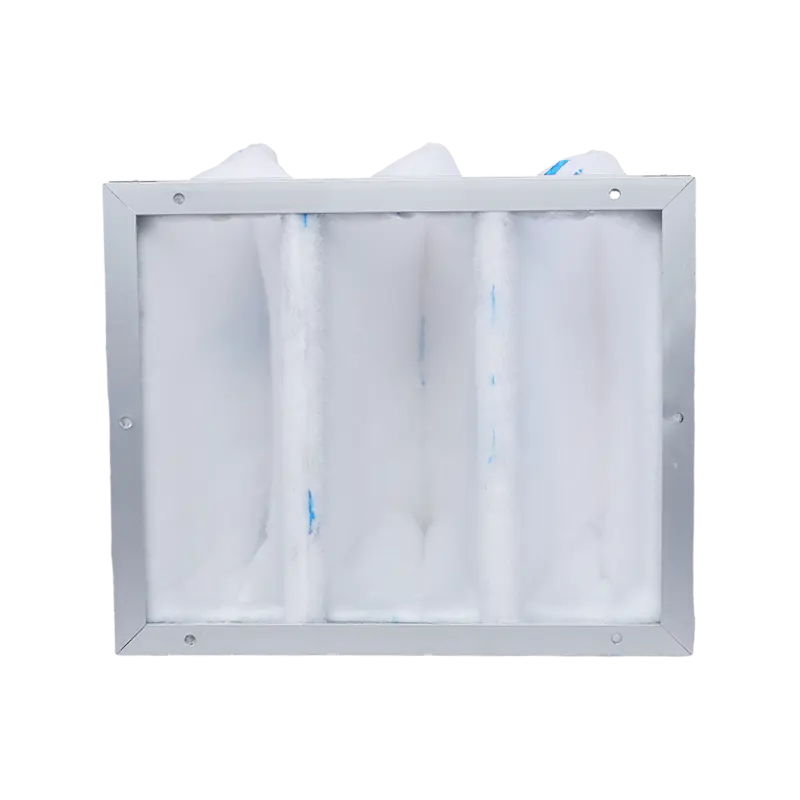
Bag Filter - microfine fiberglass media, grades F5, F6, F8 and F9, used in HVAC filtration for commercial and public buildings.
Model by model: where each filter type applies
The table below sets out the grades, media and intended applications of the product families referenced throughout this FAQ. Every entry reflects published product data for the range.
| Product | Efficiency grade | Media | Intended application |
|---|---|---|---|
| Panel Filter | G1-G4 | Fiberglass, Polypropylene (PP) | Commercial and public buildings: airports, hotels, museums, restaurants |
| Bag Filter | F5, F6, F8, F9 | Microfine fiberglass | Commercial and public buildings: airports, hotels, museums, restaurants |
| Furnace Air Filter | MERV 8, MERV 11, MERV 13 | Polypropylene (PP) | Commercial and public buildings; residential furnace filter replacement |
| V-Bank Filter | H13 | Fiberglass, Polypropylene (PP) | Commercial and public buildings |
| Box Filter | MERV 15, MERV 16 | Microfiberglass | Pharmaceutical plants, hospitals, food and beverage production sites |
| Cleanroom Air Filter | U14/U15 | Microfiberglass, PTFE | Cleanrooms, microelectronics, data centres |
| HEPA Air Filter | H13 | Fiberglass, Polypropylene (PP) | Household air purifiers and air cleaners |
| True HEPA Air Filter | Efficiency grade 99.97% or higher | Fiberglass, Polypropylene (PP) | Household air purifiers and air cleaners |
| Activated Carbon Filter | CTC70, CTC80, CTC90, CTC100 | Activated carbon | Household air purifiers and air cleaners |
| VOC Air Filter | Special catalyst for removal of specific VOC | Activated carbon and special catalyst | Household air purifiers and air cleaners |
| B737/B757 Electronic Cabin Air Filter | H13 | Microfiberglass | Aerospace and aviation |
Read as a ladder, the HVAC group starts with the Panel Filter at G1-G4, moves through the Bag Filter at F5 to F9, and continues into MERV-rated products such as the Furnace Air Filter at MERV 8, MERV 11 and MERV 13. The Box Filter sits at the top of the general ventilation framework at MERV 15 and MERV 16, which is why it is specified for pharmaceutical plants, hospitals and food and beverage production sites - environments where both particle control and documentation matter.
The V-Bank Filter is rated H13 and is intended for commercial and public building ventilation, using fiberglass and polypropylene media. It is the point in the catalogue where an HVAC-facing product uses a high-efficiency classification rather than a MERV or F class, which is precisely why the framework needs to be confirmed before comparing it with a MERV-rated part.
For cleanroom work, the Cleanroom Air Filter is rated U14/U15 and uses microfiberglass with PTFE. Its stated applications are cleanrooms, microelectronics and data centres. This is a different design band from the H13 products in the same catalogue, and the two designations are not interchangeable.
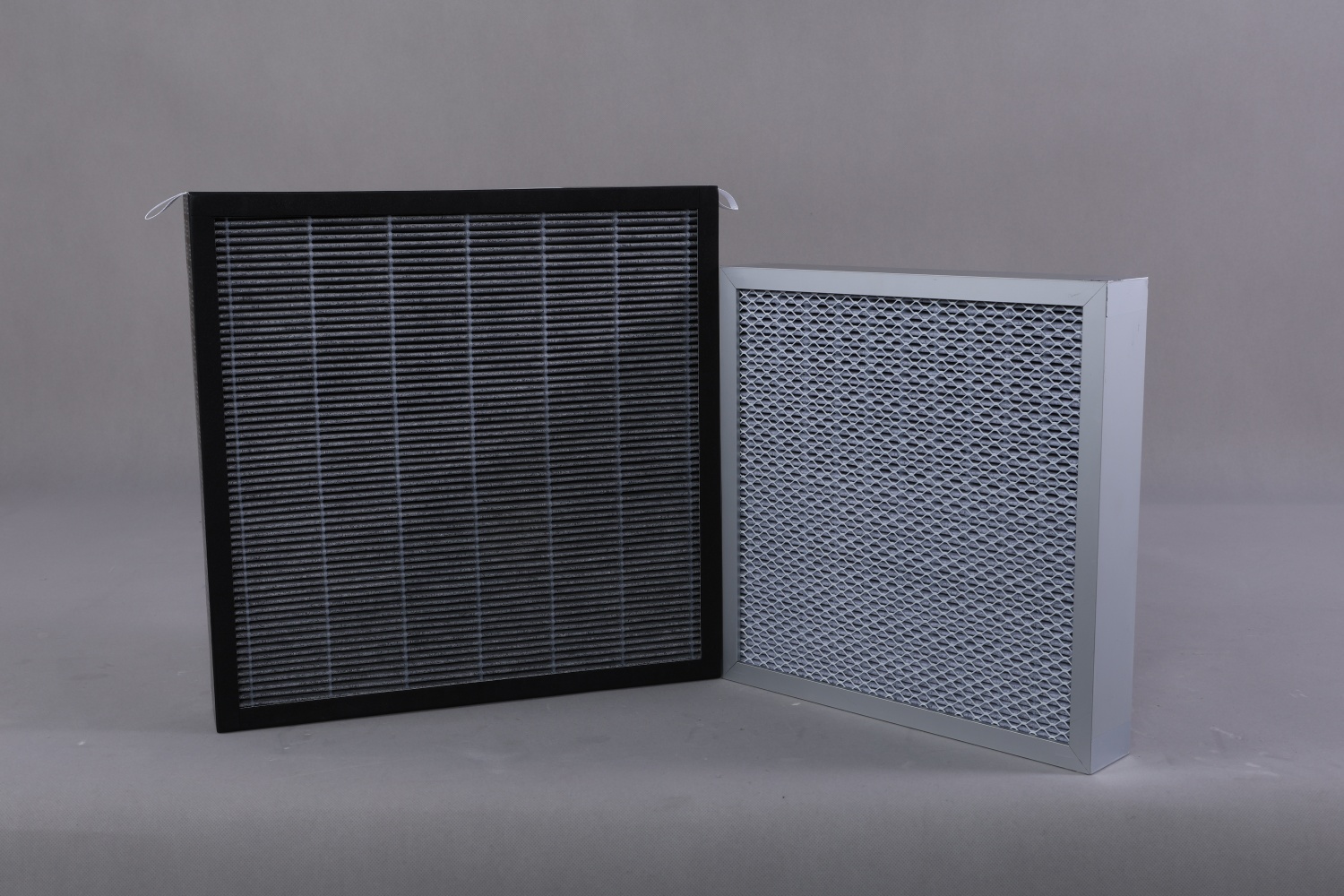
Household air purifier filter - fiberglass and polypropylene media, H13 efficiency grade, used in air purifiers and air cleaners.
The household group is defined by the appliance rather than the building. HEPA Air Filter (H13), True HEPA Air Filter (99.97% or higher), Activated Carbon Filter (CTC70 to CTC100) and VOC Air Filter (activated carbon plus a special catalyst) are all classified as household air purifier filters. The aerospace product is the outlier in both media and application: the B737/B757 Electronic Cabin Air Filter is rated H13, uses microfiberglass, and is built for the cabin working condition with customized dimensions matched to the fresh air system.
How this range is built and tested
Grade claims are only as reliable as the test setup behind them. ASHRAE 52.2 is the standard used in testing air filters at this manufacturing site, alongside an efficiency and air resistance test system for filter media, a noise test lab, a 30 cubic metre test room for formaldehyde and VOC removal efficiency, and a CADR test room for air purifiers. Company documentation also references EN 779, EN 1822, ASHRAE 52.2 and ISO 16890 test frameworks.
On the quality side, the Air Filter product holds ISO 9001:2015 certification, certificate number 04523Q30502R4M, and the B737/B757 Electronic Cabin Air Filter is certified to ISO 14001:2015, certificate number 04523E30387R2M. Both certificates were issued by Beijing Dalu Hangxing Quality Certification Center Co., Ltd and their stated scope is the design and production of air filter, air purifier and fresh air machine products. The company profile also lists ISO 45001:2018 certification. Certificate applicability is described as covering all markets.
Manufacturing parameters for the OEM and ODM programme are published as a monthly capacity of 200,000 pieces, a 30-day lead time, a minimum order quantity of 500 pieces, size and logo customization, and 100% inspection, with remote after-sales support and export markets concentrated in the EU and US.
Where common assumptions break down
Most filter specification errors come from four reasonable-sounding assumptions. Each has a boundary worth checking before a purchase order is raised.
| Assumption | What the specification actually covers | What to check |
|---|---|---|
| A higher number is always the better filter. | The grade describes tested performance inside one framework, not suitability for every stage of a filter train. Higher-efficiency media is normally reserved for the stage where the contaminant or room classification requires it. | Air resistance data alongside efficiency, and where the part sits in the filter train. |
| MERV values and F or G classes can be converted. | MERV comes from ASHRAE 52.2. F and G classes come from the EN 779 family, which was replaced by ISO 16890 in Europe since mid-2018. | Which framework the project specification, insurance requirement or validation protocol is written against. |
| A CTC grade describes particle filtration efficiency. | CTC70 to CTC100 describe the activity grade of the activated carbon. The VOC Air Filter adds a special catalyst for specific VOC removal. | Which particle filter stage sits ahead of the carbon stage, and which gases the site actually needs removed. |
| Published capacity figures are audited figures. | The 30,000 square metre facility, the 2,000,000-piece annual output and the 69% export share are company-reported figures. | Audit evidence, process evidence and sample validation before formal qualification. |
There is also a boundary inside the range itself that buyers should not skip: the cleanroom product is rated U14/U15 while the V-Bank and household HEPA products are rated H13. A buyer who treats those labels as a single continuous scale can end up specifying a part that passes a document review and fails a cleanroom validation. The correct sequence is to confirm the class the room or process requires, then confirm the filter designation, media and leakage test basis against it.
Market signals behind the grade questions
Two data points help explain why these questions are being asked more often. The HEPA filter segment reached USD 5.77 billion in 2025, according to Market Research Future. Separately, Grand View Research reports that the global smart air purifier market reached USD 2.5 billion in 2023 and is projected to grow at a CAGR of 14.1% from 2024 to 2030, with Asia Pacific holding a 41.4% revenue share in 2023.
Those two figures describe different market layers and should not be added together. Read separately, they point in the same direction: demand growth is concentrated in higher-efficiency categories and in Asia-Pacific manufacturing capacity, while the classification frameworks buyers use to describe that demand remain fragmented across regions. The practical consequence is that cross-standard sourcing is now normal, and the ability to read a grade against its framework has become part of the specification job rather than an engineering detail.
Replacement: matching grade, dimension and schedule
A replacement filter has to match on three axes at once: grade, media and dimension. Documented projects in this range show how differently those axes combine. A Boeing B737/B757 filter replacement programme uses an H13 microfiberglass cabin filter with customized dimensions matched to the aircraft fresh air system. Residential furnace filter replacement and HVAC system building projects use MERV-rated furnace filters. Pharmaceutical plant building, cleanroom design and workshop renovation in food and beverage plants are listed with customized dimension as the special requirement, matched to a fresh air system.
Supply parameters matter as much as the technical match. The published standard lead time is 30 days against a monthly capacity of 200,000 pieces and a minimum order quantity of 500 pieces, with 100% inspection before shipment. Documented OEM and ODM programmes with US clients include a 50,000-piece formaldehyde removal programme stable over two years, a 50,000-piece indoor environment VOC removal programme stable over one year, and a 20,000-piece high-efficiency programme stable over one year.
What a filter supplier can fix is grade consistency, dimensional fit and delivery timing. Replacement intervals themselves are set by the equipment specification and the site conditions the filter operates in, which is why the grade and media record should be kept alongside the change-out schedule rather than replaced by it.
Future outlook
The direction of travel is toward documentation rather than labels. The replacement of EN 779 by ISO 16890 in Europe shows how quickly a familiar designation can become legacy, and buyers who maintain specifications on F and G classes will increasingly need a mapping step in their own documentation. At the same time, growth in high-efficiency filtration means more projects will sit in the EN 1822 family, where efficiency and zero leakage are tested together rather than treated as separate claims.
For manufacturers, that shifts the competitive question from which grade can be quoted to whether the test basis behind the grade can be shown. For buyers, it shifts the qualification question from a single number to a chain: framework, class, media, dimension, leakage test, certification record. Ranges that already publish media-level test capability - media efficiency and air resistance testing, VOC chamber testing, CADR testing - are better positioned for that shift than ranges that publish grades alone.
Technical FAQ
1. What is the difference between a U14/U15 filter and an H13 filter?
Both are high-efficiency designations, but they sit in different parts of the EN 1822 family and are used for different environments. In this range, the Cleanroom Air Filter is rated U14/U15 and uses microfiberglass with PTFE, for cleanrooms, microelectronics and data centres. The HEPA Air Filter, the V-Bank Filter and the B737/B757 Electronic Cabin Air Filter are rated H13. Because the designations come from the same high-efficiency framework but describe different performance bands, a cleanroom specification should state the class the room requires rather than treating the two as equivalent.
2. How do MERV ratings compare with F and G grades?
They come from different frameworks and do not convert directly. ASHRAE Standard 52.2 classifies filters using MERV ratings from 1 to 16, with the value based on performance efficiency calculated from synthetic-dust loading tests. F and G classes come from the EN 779 family, which was replaced in Europe by ISO 16890 since mid-2018. Within this range, G1-G4 appears on the Panel Filter, F5, F6, F8 and F9 on the Bag Filter, and MERV 8, MERV 11, MERV 13, MERV 15 and MERV 16 on the Furnace and Box filters. Each value is read against its own framework.
3. Which media are used in this filter range, and what does each imply?
Fiberglass and polypropylene (PP) are used in the Panel Filter (G1-G4), the HEPA Air Filter (H13), the True HEPA Air Filter (99.97% or higher) and the V-Bank Filter (H13). Microfine fiberglass is used in the Bag Filter (F5, F6, F8, F9). Microfiberglass is used in the Box Filter (MERV 15, MERV 16) and the B737/B757 Electronic Cabin Air Filter (H13). Microfiberglass with PTFE is used in the Cleanroom Air Filter (U14/U15). Activated carbon is used in the Activated Carbon Filter (CTC70 to CTC100), and activated carbon with a special catalyst in the VOC Air Filter. Media indicates construction and application fit; the grade indicates tested performance.
4. Where does the Panel Filter apply?
The Panel Filter is rated G1-G4 and is available in fiberglass and polypropylene (PP). Its intended industry is commercial and public buildings, with airports, hotels, museums and restaurants given as typical application scenarios. G-class designations sit at the coarse end of the EN 779 family, so panel filters in this band are commonly used as the first stage of a filter train ahead of higher-rated stages.
5. Where does the Box Filter apply?
The Box Filter is rated MERV 15 and MERV 16 and uses microfiberglass. Its intended applications are pharmaceutical plants, hospitals and food and beverage production sites. Those grades sit at the top of the MERV 1-16 range defined by ASHRAE 52.2, which is consistent with environments where particle control and supporting documentation both carry weight.
6. What do CTC70, CTC80, CTC90 and CTC100 mean on an activated carbon filter?
They are CTC grades describing the activity grade of the activated carbon used in the Activated Carbon Filter, which is classified as a household air purifier filter and used in air purifiers and air cleaners. A CTC grade describes the carbon's adsorption characteristics rather than particle removal efficiency, so it is read alongside the particulate filter stage rather than instead of it. Where specific gases are the target, the VOC Air Filter combines activated carbon with a special catalyst for removal of specific VOC.
7. Is an H13 filter the same as a True HEPA filter?
In this range they are separate products with separate ratings. The HEPA Air Filter is rated H13 and uses fiberglass and polypropylene. The True HEPA Air Filter is rated at an efficiency of 99.97% or higher and also uses fiberglass and polypropylene. Both are classified as household air purifier filters for use in air purifiers and air cleaners. The correct choice is the rating the appliance manufacturer specifies, since the two designations are not interchangeable in an appliance specification.
8. Which products are used for cleanroom and high-tech production environments?
The Cleanroom Air Filter is rated U14/U15 and uses microfiberglass with PTFE. Its stated applications are cleanrooms, microelectronics and data centres, and EN 1822 is the European framework that classifies EPA, HEPA and ULPA filters by filtration efficiency and zero leakage. Cleanroom projects in this range are listed with customized dimensions as the special requirement, matched to a fresh air system. HVAC-facing products such as the Box Filter serve the adjacent pharmaceutical, hospital and food and beverage environments.
9. Which test standards are referenced in this range's testing?
ASHRAE 52.2 is the standard used in testing air filters at the manufacturing site. Company documentation also references EN 779, EN 1822, ASHRAE 52.2 and ISO 16890 testing frameworks. Supporting test equipment includes an efficiency and air resistance test system for filter media, a noise test lab, a 30 cubic metre test room for formaldehyde and VOC removal efficiency, and a CADR test room for air purifiers. These are supplier-stated test capabilities.
10. Which certifications cover the filters?
The Air Filter product holds ISO 9001:2015 certification with certificate number 04523Q30502R4M, and the B737/B757 Electronic Cabin Air Filter is certified to ISO 14001:2015 with certificate number 04523E30387R2M. Both were issued by Beijing Dalu Hangxing Quality Certification Center Co., Ltd, with a stated scope covering the design and production of air filter, air purifier and fresh air machine products, and both are described as applicable across markets. The company profile additionally lists ISO 45001:2018 certification.
11. What order parameters apply to OEM and ODM air filter programmes?
The published OEM and ODM parameters are a monthly capacity of 200,000 pieces, a 30-day lead time, a minimum order quantity of 500 pieces, customization of size and logo, and 100% inspection, with remote after-sales support and export markets focused on the EU and US. Customized dimensions appear as the special requirement across the documented cleanroom, pharmaceutical, food and beverage, HVAC and aircraft applications. Buyers running formal supplier qualification should confirm capacity and process claims through audit evidence and sample validation.
12. How should a replacement filter be specified?
A replacement should match on grade, media and dimension together. Documented programmes show the pattern: the B737/B757 cabin filter replacement uses an H13 microfiberglass filter with customized dimensions matched to the aircraft fresh air system, while residential furnace filter replacement and HVAC system building projects use MERV-rated furnace filters with polypropylene media. Pharmaceutical plant, cleanroom and food and beverage workshop projects are listed with customized dimensions matched to a fresh air system. Replacement intervals are set by the equipment specification and site conditions rather than by the filter designation alone.