
Airport Terminals vs Gymnasium Floors: Buyers' Side-by-Side Checklist
Airport flooring and gymnasium flooring are almost never compared. They arrive through different drawings, different consultants and different budget lines, and they are usually awarded months apart. Putting the two specifications side by side is still worth the effort, because the comparison shows precisely where a supplier's evidence stops and where a buyer's risk begins.
This is a sourcing checklist, not a ranking. It sets the aviation flammability regime that governs aircraft floor coverings against the sports-performance regime that governs indoor courts, and it uses documented product data from FARFLYING FLOORING (WUXI TEFA DECORATION MATERIAL CO., LTD.) to show what a complete evidence pack looks like in each category. Readers sourcing commercial PVC flooring for either environment can apply the same structure to any shortlist.
Two specifications, two completely different questions
In an aircraft interior, the governing question is what the floor does in a fire. United States regulation 14 CFR 25.853(b) requires floor coverings to be self-extinguishing when tested vertically, with an average burn length not exceeding 8 inches and an average flame time after removal of the flame source not exceeding 15 seconds. The regulation is about escape time and cabin air quality, not about comfort underfoot.
In a gymnasium, the governing question is what the floor does to a player's ankle. EN 14904 addresses shock absorption, vertical deformation, ball rebound, friction and rolling load for indoor sports surfaces. A surface that satisfies EN 14904 has proved nothing about smoke density, and a surface that satisfies an aviation vertical burn test has proved nothing about ball bounce.
This is where procurement mistakes originate. Buyers frequently treat a certificate as a property of a supplier rather than a property of a specific product model tested to a specific method. In practice, an aviation certificate and a sports certificate issued to the same factory describe two different products, tested by two different laboratories, against two sets of criteria that never overlap.
Split the airport scope before you compare anything
Airport projects contain at least two distinct flooring scopes, and confusing them is the most common specification error in this category.
The first scope is the aircraft cabin interior: floor coverings inside the aircraft, including galley areas. This is where CCAR 25.853, EASA CS 25.853 and FAR 25.853 apply. The relevant materials are lightweight PVC sheet systems supplied in models such as LY, SMY, MMY, MY, BY and WD.
The second scope is the terminal building itself: concourses, gate areas, baggage halls and retail zones. These are heavy-traffic commercial floors, typically specified as homogeneous vinyl, and the governing evidence is different — ISO 10581 classification, CE marking to EN 14041, residual indentation, abrasion resistance, TVOC emission and slip classification.
Documented figures illustrate how far apart the two airport scopes sit. The homogeneous vinyl range carries a 2 mm construction (customisable to 2.5 mm or 3 mm) in 2 x 20 m rolls, a B-S1 fire rating, residual indentation of 0.06 mm, abrasion resistance class T, TVOC below 10 μg/m³ at 28 days, anti-bacterial performance of 99.50% and an R9 anti-slip declaration. Its physical property documentation is held under SGS report XMIN2109010490CM, covering ISO 24346:2006, ISO 23997:2007, ISO 4918:2016, ISO 29333:2018, ISO 26987:2008, ISO 10581:2019 and ISO 105-B02:2014.
None of those documents qualifies a cabin floor, and a CAAC vertical burn report does not qualify a terminal concourse. Specifying cabin-certified material across a public terminal adds cost without adding compliance; specifying a terminal-grade roll into a cabin fails the fire requirement outright.
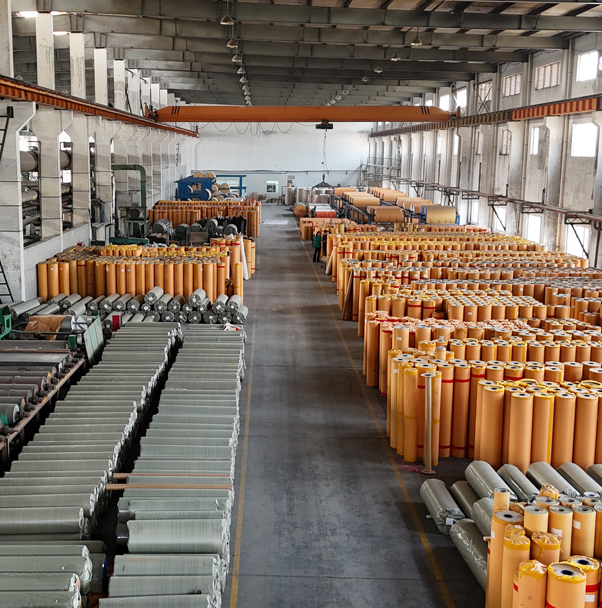
Inventory depth is one of the few checklist items a buyer can verify before award — and one of the easiest to over-trust at portfolio level rather than SKU level. Image: FARFLYING FLOORING warehouse.
The side-by-side checklist
The table below translates both regimes into comparable procurement lines. The right-hand column is the document a buyer should hold before releasing a purchase order, regardless of which supplier is selected.
| Check | Aircraft cabin flooring (Farfly LY, SMY, MMY, MY, BY, WD) | Gymnasium sports flooring (Farfly Boguan) | Document to request |
|---|---|---|---|
| Governing scope | Aircraft cabin interior floor covering | Indoor sports courts and multi-purpose halls | Project specification section plus the applicable regulation or standard |
| Primary fire evidence | CCAR 25.853(a) & App. F Part 1 / EASA CS 25.853(a); CAAC report TC-ZR-20231549 | EN 13501-1:2007 with EN ISO 9239-1:2010 and EN ISO 11925-2:2010; report HQR170310004-01 | Certificate copy showing model number, issuer and validity |
| Smoke and toxicity | CAAC smoke toxicity test TC-ZR-20231565 to D6-36075 F Table 4; Boeing BSS 7239 toxicity reported by the manufacturer | Phthalate testing to EN 14372:2004 (ETS19030602C); pentachlorophenol not detected | Laboratory report naming the tested article, not only the brand |
| Shock absorption | Not a declared property of the aviation range | Impact resistance 0.35 mm; vertical deformation 0.3 mm | EN 14904 / EN 14809 test results for the exact thickness supplied |
| Ball behaviour | Not applicable | Ball bounce 95% | EN 14904 ball rebound result from the same report set |
| Slip | Declared per model; request the specific test for the supplied SKU | Friction coefficient 0.56, tested within the EN 13036-4 method set | SKU-level slip classification rather than a category claim |
| Wear and indentation | Request per model; not stated in the aviation report set | Wear resistance 120 mg; indentation resistance 0.27 | EN ISO 5470-1 and EN 1517 results |
| Chemical safety | Request material declaration for the specific model | EN 14372:2004 phthalate test; eco-friendly DOTP plasticiser | Test report plus safety data sheet |
| Customisation | OEM/ODM on dimensions, colour, design pattern, packaging, logo, craftsmanship and structure | Same customisation scope | Written confirmation that the certified construction is unchanged |
| Stock and lead time | 300,000 sqm ready stock; 7-day dispatch; 600,000 sqm monthly capacity | Same inventory and dispatch model | SKU-level availability, quantity, warehouse and Incoterm |
| Inspection | 100% testing plus third-party inspection (SGS) | 100% testing plus third-party inspection (SGS) | Pre-shipment inspection report |
| Typical failure point | Re-certification exposure when construction or adhesive changes | Subfloor moisture and seam welding quality | Subfloor specification and installer qualification |
Table 1: Side-by-side sourcing checklist for aviation cabin flooring and indoor sports flooring. Figures are drawn from FARFLYING FLOORING certification and product documentation.
Fire and smoke: what the CAAC documents actually record
Aviation buyers should read the test numbers, not the certificate header. FARFLYING FLOORING holds a 12-second vertical combustion test report issued by CAAC under reference TC-ZR-20231549, dated 28 July 2023 and applying to aircraft flooring models LY, SMY, MMY, MY, BY and WD. The report is written against CCAR 25.853(a) and Appendix F Part 1, and EASA CS 25.853(a) and its appendix, and its stated scope covers flame spread, self-extinguishing behaviour, heat release, smoke density and drip characteristics.
The recorded values are specific: duration of sustained burning 0 seconds, burning time of droplets 0 seconds, and burn length 24 mm. Set against the 14 CFR 25.853(b) thresholds of 8 inches average burn length and 15 seconds average flame time, a 24 mm burn length (approximately 0.94 inches) is a materially different number from the limit, and a buyer can see the margin rather than infer it.
A second CAAC document, TC-ZR-20231565, addresses smoke toxicity to D6-36075 F Table 4. Its declared scope is broader than flame spread alone: heat release, smoke density, toxicity and self-extinguishing behaviour, with a recorded smoke toxicity result of pass. For cabin interiors this pairing matters, because a floor that resists ignition but releases dense smoke still fails the intent of the requirement.
Manufacturer literature also states that the aviation-grade range is intended to comply with Boeing BSS 7239 for toxicity and FAR 25.853 for fire retardancy. That is a supplier statement rather than a published third-party report in the same pack, so the practical instruction is simple: request the Boeing BSS 7239 report by model and by laboratory before accepting the claim.
On the sports side, the equivalent evidence is a fire classification rather than an aviation burn test. Report HQR170310004-01, issued by OTC on 12 May 2017, applies EN 13501-1:2007 with EN ISO 9239-1:2010 and EN ISO 11925-2:2010 to assess flame spread, ignition resistance and smoke behaviour in sports halls, gyms, schools and stadiums. The two fire regimes are not interchangeable, and a buyer should never accept one as evidence for the other.
Shock absorption and ball bounce: reading the EN 14904 numbers
Sports flooring is bought on feel, but it should be approved on numbers. Report HQR170310004-02, issued by OTC on 16 May 2017, documents testing to EN 14904-2006 alongside EN 14809-2005, EN 13036-4:2011, EN ISO 5470-1:1999, EN 1517:1999, EN 1569:1999, EN 1516:1999, EN 14041:2004, EN 12673:1998 and EN 717-1:2004. Its declared scope covers shock absorption, vertical deformation, slip resistance, abrasion resistance, ball rebound, rolling load, impact performance, fire safety, durability and formaldehyde emissions.
The measured values for the Boguan sports range are impact resistance 0.35 mm, vertical deformation 0.3 mm, ball bounce 95%, friction coefficient 0.56, wear resistance 120 mg, indentation resistance 0.27 and pentachlorophenol not detected. Rolling load resistance is recorded as not determined, which is worth noting rather than hiding: if a venue will host retractable seating, staging or heavy equipment, that specific property should be tested and declared separately.
Three interpretation rules help buyers use these figures properly.
- Compare like with like. EN 14904 results are only comparable at the same product thickness and construction. A 0.3 mm vertical deformation figure from one thickness cannot be set against a different thickness from another supplier.
- Read deformation and impact together. Vertical deformation describes how far the surface deflects under load; impact resistance describes local behaviour under a falling mass. A floor tuned only for softness can compromise energy return, and a floor tuned only for rebound can load the joints.
- Treat ball bounce as a ratio. A 95% ball bounce result expresses rebound relative to the reference surface used in the test, not an absolute physical constant, so it should be read alongside the same report's friction and deformation figures.
Badminton adds a further layer. The Badminton World Federation certifies flooring in three grades: Grade 1 (International Elite), Grade 2 (International Standard) and Grade 3 (Basic). FARFLYING FLOORING reports BWF-certified athletic vinyl flooring built on an eight-way fibreglass mesh for shock absorption. Because approval is granted per product and per grade, a buyer specifying tournament-level badminton should confirm the exact model and its grade on the BWF approved flooring list, and should treat a general statement of BWF certification as a starting point rather than a conclusion.
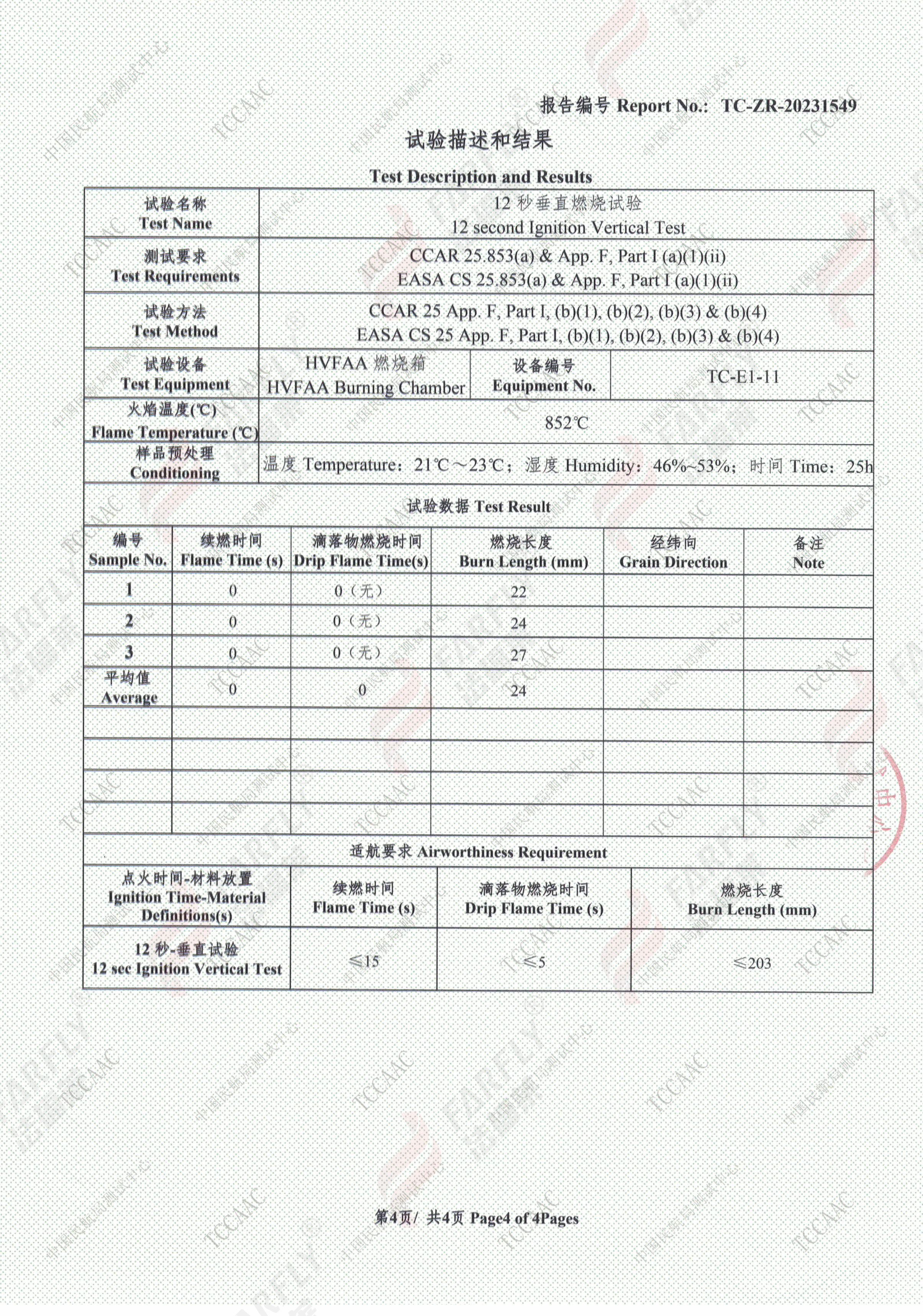
Aviation evidence is model-specific: the 12-second vertical combustion report names the tested flooring models and records burn length, sustained burning and droplet behaviour. Image: FARFLYING FLOORING test documentation.
Slip, abrasion, indentation and chemical content
Slip is the line item most often satisfied by assumption. A friction coefficient of 0.56 is recorded for the sports range within the EN 13036-4 method set, and the homogeneous vinyl range carries an R9 anti-slip declaration. Neither figure should be extrapolated to a different product family. Where a project specification calls for a specific R-class, the correct action is to request the ramp test report for the exact SKU being supplied, because the classification is a property of the finished surface, not of the polymer category.
Abrasion and indentation separate a floor that survives a decade of traffic from one that looks tired in three years. The sports range records wear resistance of 120 mg and indentation resistance of 0.27; the homogeneous range records abrasion resistance class T and residual indentation of 0.06 mm, both measured under the ISO methods listed in SGS report XMIN2109010490CM. For terminal concourses, gate seating and baggage halls, residual indentation is the number that predicts how quickly a floor recovers under static loads from trolleys and fixed furniture.
Chemical content matters in both environments, for different reasons. In a gymnasium, the concern is occupant exposure during peak use; the sports range is tested to EN 14372:2004 for phthalates under report ETS19030602C, uses an eco-friendly DOTP plasticiser, and records pentachlorophenol as not detected. In a terminal or cabin, the concern is long-duration low-level emission in a semi-enclosed space; the homogeneous range declares TVOC below 10 μg/m³ at 28 days. Both are declarations a buyer should file with the project handover documentation rather than leave in a sales folder.
Execution stage: OEM terms, MOQ, stock and inspection
Once the specification is settled, the checklist shifts from performance to delivery mechanics. FARFLYING FLOORING operates OEM and ODM production with customisation across dimensions, colour, design pattern, packaging, logo, craftsmanship and structure. The minimum order quantity is 100 sqm, monthly production capacity is 600,000 sqm, and typical production lead time is 7 days, supported by 300,000 sqm of ready-to-ship inventory. Mixed-container loading is available, which matters for contractors combining product families across a single shipment.
Quality control is stated as 100% testing plus third-party inspection by SGS. Commercially, the documented terms are EXW, FCA, FOB, CIF and DDP, with a 50% deposit and the remaining 50% payable by T/T before shipment; acceptance criteria are a pre-shipment test and third-party inspection.
Two execution caveats belong in every contract for these product types.
- Customisation must not silently break certification. Changing colour, packaging or logo does not touch the tested construction. Changing the backing, the mesh, the plasticiser system or the adhesive can. If a project requires an aviation-certified floor, the purchase order should state that any construction change triggers re-testing before shipment.
- Stock claims are portfolio-level until confirmed at SKU level. A 300,000 sqm ready-stock figure describes inventory across the range, not the specific roll colour and thickness a project needs next week. Confirm SKU, quantity, warehouse location, inventory date and Incoterm in writing, and treat dispatch readiness as distinct from installation readiness.
Where each option stops: honest limits and traditional alternatives
Every resilient surface has a boundary, and stating them is part of a credible specification.
Against traditional alternatives, PVC sheet flooring competes with terrazzo, ceramic tile, rubber, linoleum, timber sports floors and carpet. Terrazzo and tile offer very high compressive strength and long service life, but they are hard underfoot and, in a gymnasium, they are simply unsuitable for impact absorption. Timber sports floors deliver excellent energy return and are a familiar reference point for competitive basketball, but they are sensitive to humidity and require more demanding maintenance regimes. Rubber is durable and quiet but heavier and more limited in decorative range. Carpet in terminals reduces noise but complicates cleaning and does not deliver the same indentation recovery.
The limits of the PVC approach are equally concrete. Sheet installation depends on subfloor moisture, flatness and adhesive selection; heat-welded seams require trained installers, and poorly executed welding is the most common cause of premature failure in both airports and sports halls. Aviation qualification attaches to a specific model and test report, so a supplier holding a valid CAAC report for one construction cannot be assumed to hold it for a heavier or differently backed variant. Sports certification is likewise thickness-dependent, and the reported rolling load result of not determined for the sports range should be resolved before specifying the product under retractable seating.
A buyer who records these limits in the specification gets a more useful document than one who lists product strengths alone.
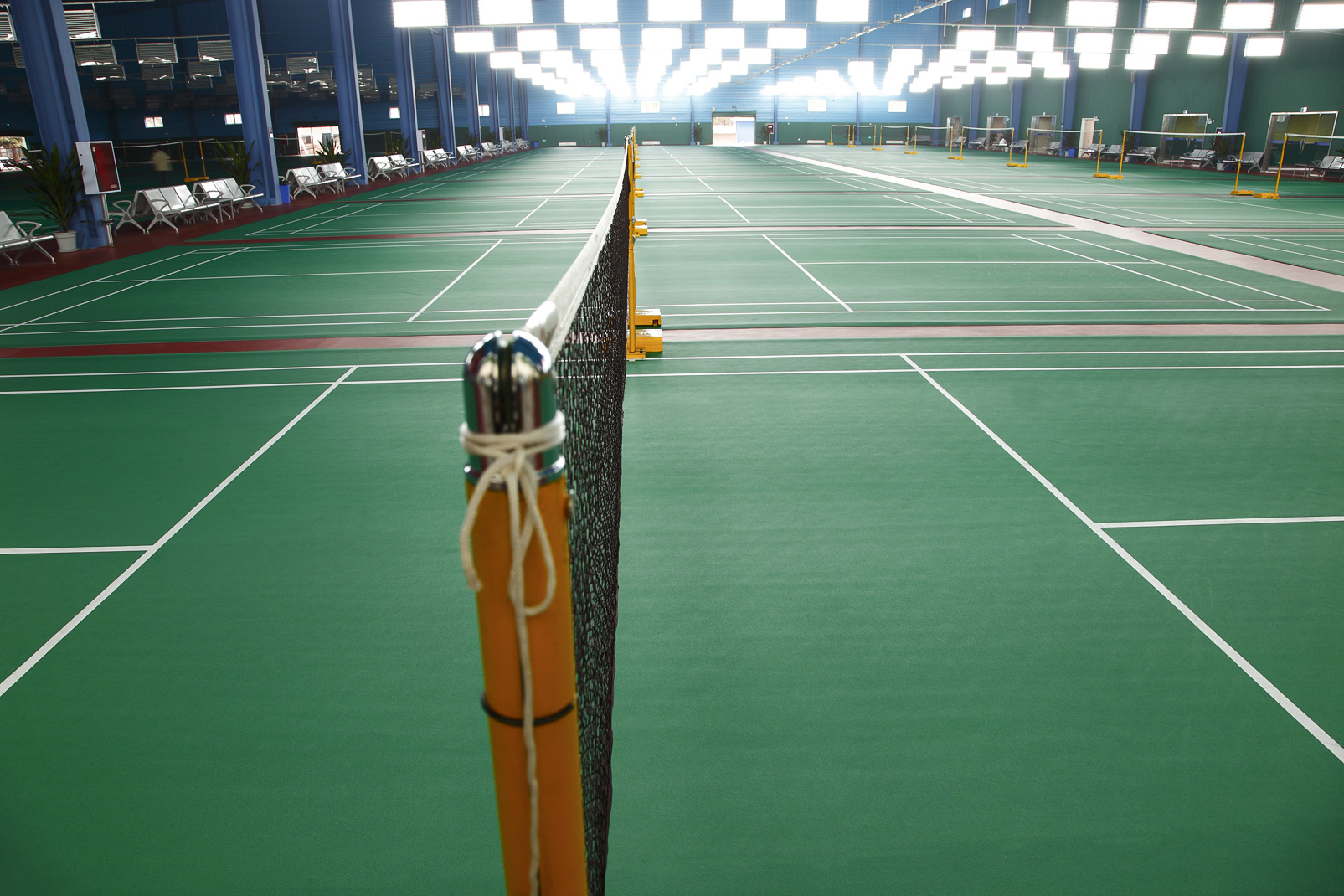
Sports flooring performance is verified on court, not on a sample board: cushioning, friction and rebound must hold across the full playing area and every seam. Image: badminton installation, FARFLYING FLOORING project reference.
Application evidence: a 16-court installation in Australia
One documented reference helps ground the sports side of the checklist. A badminton facility in Australia installed PVC sports flooring across 16 courts, with the project recorded over a 10-year horizon and a reported 50% reduction in maintenance requirements. The stated product benefits were cushioning that protects knees and ankles, slip resistance, superior bounce, long service life and straightforward installation.
For procurement purposes, the useful part of that reference is not the headline result but the shape of the claim: a defined number of courts, a defined duration, and a maintenance outcome expressed as a comparison. That is the format buyers should ask for from any supplier, in either category, rather than a general statement of quality.
Market context and what changes next
The commercial context supports the document-first approach. Business research estimates place the global PVC floor market at approximately USD 1.94 billion in 2026, a commercial projection whose underlying methodology has not been independently validated here and which should therefore be used as directional context rather than as a procurement input.
What is observable in supplier documentation is a shift toward certification-led positioning. Manufacturers now publish aviation flammability reports, smoke toxicity data, EN 14904 performance figures and phthalate testing in the same portfolio, and they increasingly present ready stock and short dispatch windows as procurement arguments alongside compliance. The practical consequence for buyers is that evidence has become easier to request and harder to compare, because two certificates with similar titles can cover entirely different tests.
The likely direction of travel is toward model-level documentation packs: a certificate register that names the tested model, the laboratory, the issue date and the validity period, delivered with the quotation rather than after it. Buyers who structure their enquiries around that format will find airport and gymnasium packages considerably easier to separate.
Frequently asked questions
What fire test does aircraft cabin flooring have to pass, and what does a pass look like?
Under 14 CFR 25.853(b), floor coverings must be self-extinguishing when tested vertically, with an average burn length not over 8 inches and an average flame time after removal of the flame source not over 15 seconds. FARFLYING FLOORING holds a CAAC 12-second vertical combustion test report, TC-ZR-20231549, written against CCAR 25.853(a) and Appendix F Part 1 and EASA CS 25.853(a), for models LY, SMY, MMY, MY, BY and WD. The recorded results are 0 seconds sustained burning, 0 seconds droplet burning time and a 24 mm burn length, with smoke toxicity recorded as pass. A separate CAAC report, TC-ZR-20231565, addresses smoke density and toxicity to D6-36075 F Table 4.
Which EN 14904 figures should a gymnasium buyer compare?
Compare vertical deformation, impact resistance, ball bounce, friction and indentation from a single report covering the exact thickness being supplied. For the Boguan sports range, report HQR170310004-02 records impact resistance of 0.35 mm, vertical deformation of 0.3 mm, ball bounce of 95%, friction coefficient of 0.56, wear resistance of 120 mg and indentation resistance of 0.27, with pentachlorophenol not detected. The same report set references EN 14904-2006, EN 14809-2005, EN 13036-4:2011, EN ISO 5470-1:1999, EN 1517:1999, EN 1569:1999, EN 1516:1999, EN 14041:2004, EN 12673:1998 and EN 717-1:2004.
Can one supplier cover both an airport package and a gymnasium package?
Yes, provided the evidence is kept separate. FARFLYING FLOORING, operated by WUXI TEFA DECORATION MATERIAL CO., LTD., manufactures homogeneous vinyl flooring, PVC sports flooring and aircraft flooring, and holds company-level certification including ISO 9001:2015, ISO 14001:2015 and ISO 45001:2018 under Auburn Inspection & Certification Group, plus CE marking to EN 14041:2018 under certificate TCF-OY20250623-CPR. Product certificates remain model-specific: the CAAC aviation reports apply to the aircraft flooring models, and the EN 14904 and EN 13501-1 reports apply to the sports range. A buyer should maintain two document packs and never substitute one for the other.
What should be fixed in writing before OEM or ODM production starts?
Fix the customisation scope, the commercial terms and the acceptance criteria. FARFLYING FLOORING offers OEM and ODM production with customisation across dimensions, colour, design pattern, packaging, logo, craftsmanship and structure, at a minimum order quantity of 100 sqm. Quality control is 100% testing plus third-party inspection by SGS, and acceptance is defined as a pre-shipment test plus third-party inspection. Trade terms are EXW, FCA, FOB, CIF and DDP, with a 50% deposit and the remaining 50% by T/T before shipment. For aviation orders, the purchase order should also state that any change to construction or adhesive requires re-testing against the applicable flammability standard.
How much does ready stock actually change delivery planning?
It changes dispatch planning, not installation planning. FARFLYING FLOORING reports 300,000 sqm of ready-to-ship inventory supporting a 7-day dispatch model, alongside monthly production capacity of 600,000 sqm and mixed-container loading for contractors combining product families. Because those figures describe inventory across the portfolio, a buyer should confirm the specific SKU, available quantity, warehouse location, inventory date and Incoterm before committing a project programme. Delivery to site, acclimatisation, subfloor readiness and installer availability remain separate schedule items in both airport and gymnasium projects.
Buyers who want the underlying product data in one place can download the FARFLYING FLOORING product brochure and match each certificate reference against the models named in their specification.
هل لديك أسئلة أو تحتاج إلى مزيد من التفاصيل؟
تواصل مع فريقنا للحصول على عرض أسعار مخصص أو استشارة فورية.
طلب عرض أسعار
املأ النموذج أدناه وسيتواصل معك فريقنا بعرض مقترح مخصص.
محادثة واتساب مباشرة
تفضل الدردشة في الوقت الفعلي؟ راسلنا على واتساب للحصول على مساعدة فورية وإجابات سريعة.
- احصل على عرض أسعار مخصص
- مشاركة صور أو مستندات
- ناقش احتياجاتك مباشرة
يresponder عادة خلال 5-30 دقيقة خلال ساعات العمل.