
Alginate Fiber Supply Ecosystems: Planning for the Long Term

Industrial perspective view of the Healcell production facility in Yantai, Shandong Province, China.
Alginate Fiber Supply Ecosystems: Planning for the Long Term
The global alginate fiber market was valued at approximately USD 412.6 million in 2025 and is projected to reach USD 728.4 million by 2034, according to Dataintelo. For textile brands and procurement teams moving from evaluation to execution, the practical question is no longer whether alginate fiber works — it is which supplier can sustain quality, capacity, and consistency across multi-year programs.
Alginate fiber is a bio-based fiber derived from seaweed, used in yarns, fabrics, and finished textiles where moisture management, inherent antibacterial properties, and biodegradability are valued. As brands expand from medical and specialty applications into underwear, sportswear, and home textiles, the sourcing relationship shifts from one-off sample orders to recurring production volumes.
This article examines the alginate fiber supply ecosystem from a buyer's perspective: what creates a reliable long-term partnership, how production capacity and process control translate into repeatable quality, and how seaweed-based fibers fit into a broader functional textile strategy.
The Problem and the Opportunity
Functional fiber sourcing often fails not at the sample stage but at scale. Brands can receive excellent development samples, then encounter batch-to-batch variation, capacity bottlenecks, or inconsistent supplier response when orders grow from kilograms to tons. For textile categories such as underwear, sportswear, bedding, and outdoor apparel, these issues translate directly into production delays, rework, and compliance risk.
There is also a chemistry dimension. Alginate fiber is sensitive to strong acids and strong alkalis, which means process control during spinning, dyeing, and finishing determines whether the fiber retains its functional performance. A supplier without disciplined pH control can ship fiber that looks correct but performs inconsistently after washing or dyeing.
The opportunity side of the equation is equally clear. Verified industry data documents several properties relevant to modern textile programs: alginate fibers can absorb 10 to 15 times their own weight in moisture, forming a hydrogel; they exhibit intrinsic flame retardancy with a Limiting Oxygen Index (LOI) of approximately 34.4% to 45%, which qualifies them as non-combustible, self-extinguishing fibers; and some alginate derivatives degrade completely within 21 to 25 days under microbial attack, supporting end-of-life claims.
Brand Solution: Healcell's Supply Ecosystem
Shandong Healcell Biomaterial Technology Co., Ltd. (Healcell) is a China-based manufacturer of marine biomaterial products including Healcell® alginate fiber, seaweed composite fiber, and knitted fabrics, headquartered in Yantai, Shandong Province. The company positions itself as a global provider of R&D and application solutions for marine new materials, with product applications spanning biomedicine, medical aesthetics and health, aerospace, smart wearables, and functional textiles.
For buyers planning long-term programs, capacity is the first variable. Healcell operates a 52,000 m² facility with 120 employees and a dedicated R&D team of 13 engineers. The company reports an annual output of approximately 300 tons per week of knitted fabrics and approximately 600 tons per week of raw materials including alginate fiber. With an export ratio of about 20% and China as its main market, Healcell serves both domestic and international programs.
| Company Fact | Detail |
|---|---|
| Legal entity | Shandong Healcell Biomaterial Technology Co., Ltd. |
| Founded | 2022 |
| Facility size | 52,000 m² |
| Employees | 120 |
| R&D team | 13 engineers |
| Weekly knitted fabric output | ~300 tons |
| Weekly raw material output (incl. alginate fiber) | ~600 tons |
| Main products | Alginate Fiber / Fabric / Yarn |
| Export ratio / main market | 20% / China |
The product range spans three levels of the value chain — fiber, yarn, and fabric — which gives procurement teams a single point of responsibility. On the yarn side, the catalog includes modal-alginate blends such as 13% Healcell Alginate Fiber / Seaweed Fiber Yarn Modal Seaweed Green (HSY00010), alginate quick-dry filaments such as Healcell Alginate Fiber / Seaweed Quick-Dry Filament Polyester DTY [30D*9F] (DSY00009), and deodorizing yarns such as Healcell Alginate Fiber / Seaweed Deodorizing Yarn 60S [White] (BSY00043-1). On the fabric side, it includes elastic jerseys, double-faced fabrics, bird's-eye quick-dry constructions, and seaweed charcoal mud thermal fabrics (TMY00002–TMY00008).
Purchasing terms are structured for repeat business: minimum order quantity is 500 kg; domestic prices include tax and export terms are negotiable; acceptance is based on pre-shipment testing; payment is made to the corporate account. These conditions matter at the decision-to-execution stage because they define how quickly a pilot can become a production program.
Technical Explanation: What Sustains Alginate Fiber Quality
Healcell applies documented process-control measures at the production stage to protect alginate fiber from degradation during spinning, dyeing, and finishing. Verified industry data shows that commercial alginate fibers typically have a tensile strength of 1.6 to 2.6 cN/dtex when tested in accordance with standards such as ASTM D3822; consistency at that level is a function of manufacturing discipline.
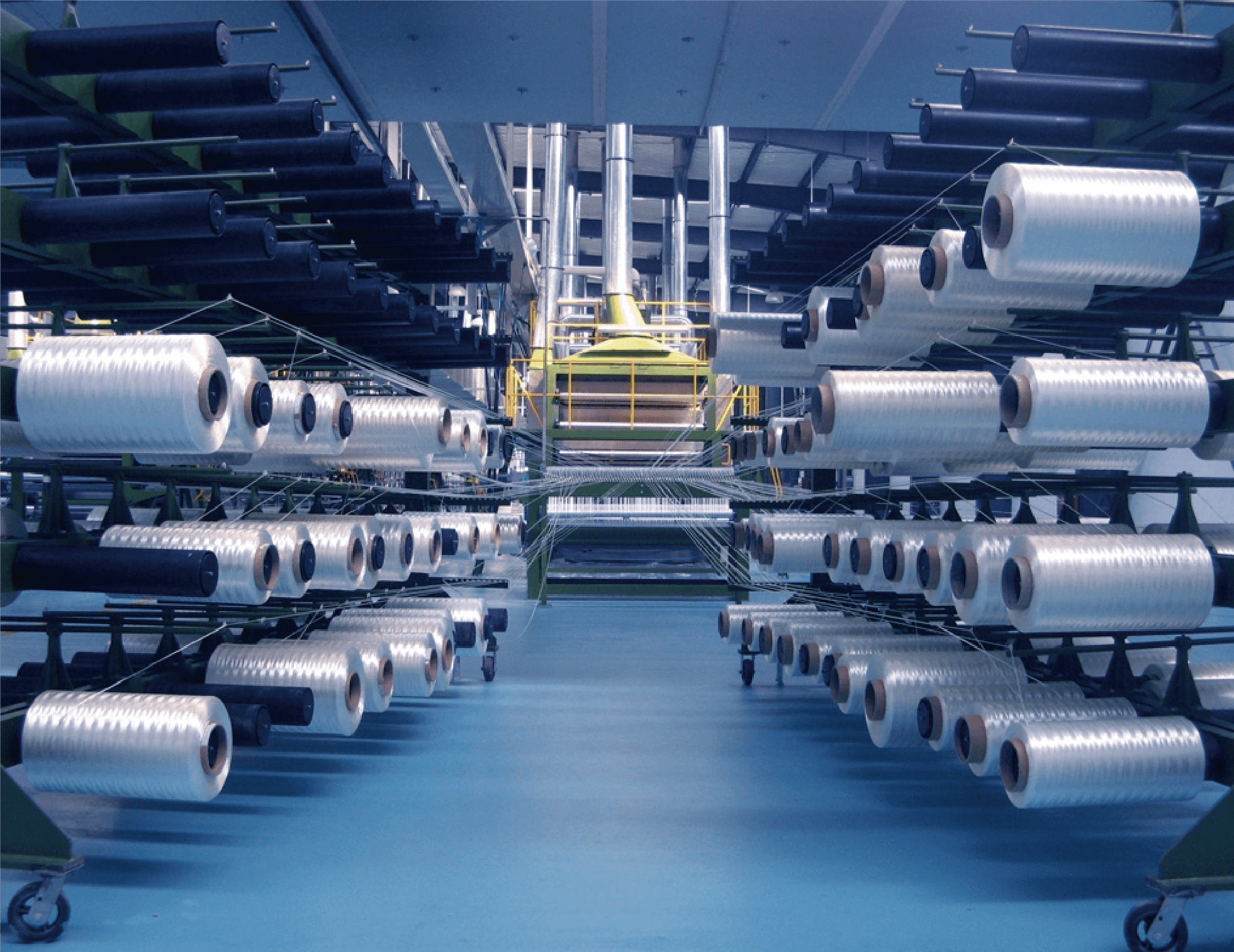
Production equipment used in the alginate fiber and yarn manufacturing process.
Healcell's risk-control measures address the main vulnerability of seaweed fiber: sensitivity to strong acids and strong alkalis. Production-side controls include:
- Strict pH control throughout the production process, maintaining a weakly acidic to neutral working environment.
- Functional protective coatings on fabrics to improve chemical resistance.
- Inspection of incoming raw materials against acid-base indicators, prohibiting corrosive auxiliaries that exceed standard limits.
- Neutral, eco-friendly auxiliaries and chlorine-free additives in finishing formulas.
- Regular cleaning of production equipment and partitioned storage of chemicals to avoid cross-contact and misuse.
- Random sampling tests for acid and alkali resistance and stability before delivery.
User-side guidance includes neutral detergents, cold or warm water washing, and avoidance of bleach, strong alkali washing powder, and strong acid cleaners. Finished goods are stored in dry, ventilated warehouses, away from strong acids, strong alkalis, and corrosive materials.
These measures translate into a practical point for procurement teams: the same fiber can deliver very different results depending on how it is processed. Supplier discipline in pH management is therefore a long-term quality variable, not a one-time certification check.
Application Scenarios: Where Long-Term Supply Matters
Healcell's product data lists underwear, apparel, home textiles, shoes, and bags as the primary application scope for its alginate fiber fabrics, with outdoor sports, home textiles, and pet products for the seaweed charcoal mud composite line. These categories generate recurring volume, which makes them the natural focus of long-term supply planning.
Underwear, intimates, and loungewear
Blends of modal, cotton, and 5–13% alginate fiber appear across Healcell's jersey and double-faced fabric range, including 10% Healcell Alginate Fiber / Seaweed Fiber Elastic Jersey Raw Color [40S] (HMY00001), 13% Healcell Alginate Fiber / Seaweed Fiber Yarn Modal Seaweed Green (HSY00010), and Healcell Warm-Fitting Double-Sided Fabric Pink 305g [40s] (HMY00035). These are categories where inherent antibacterial, deodorizing, and skin-friendly properties reduce reliance on chemical finishes.
Sportswear and quick-dry apparel
The alginate composite quick-drying line includes 100% polyester with alginic acid in double-sided and bird's-eye constructions such as Healcell Alginate Fiber / Seaweed Quick-Dry Anti-Perspective Double-Sided Fabric [White-140g-1.75m-75D] (DMY00004) and Healcell Alginate Fiber / Seaweed Moisture-Wicking Quick-Drying Double-Sided Fabric [1.7m-200g-80D-White] (DMY00001), as well as quick-dry filaments in polyester and polyamide (DSY00007–DSY00010). Moisture-wicking and quick-drying behavior are core requirements for performance wear, and alginate content adds a functional differentiation point.
Outdoor, bedding, and pet products
The seaweed charcoal mud composite series, including Alginate Fiber / Seaweed Charcoal Mud Towel Cloth [1.62m-Gray-210g] (TMY00002) and Healcell Alginate Fiber / Seaweed Charcoal Mud Silver Filament Woven Fabric [2.7m-Light Gray-60s] (TMY00007), is positioned for thermal, moisture-absorbing, and warm-keeping applications, including towels, twill, and woven fabrics for outdoor and home use.
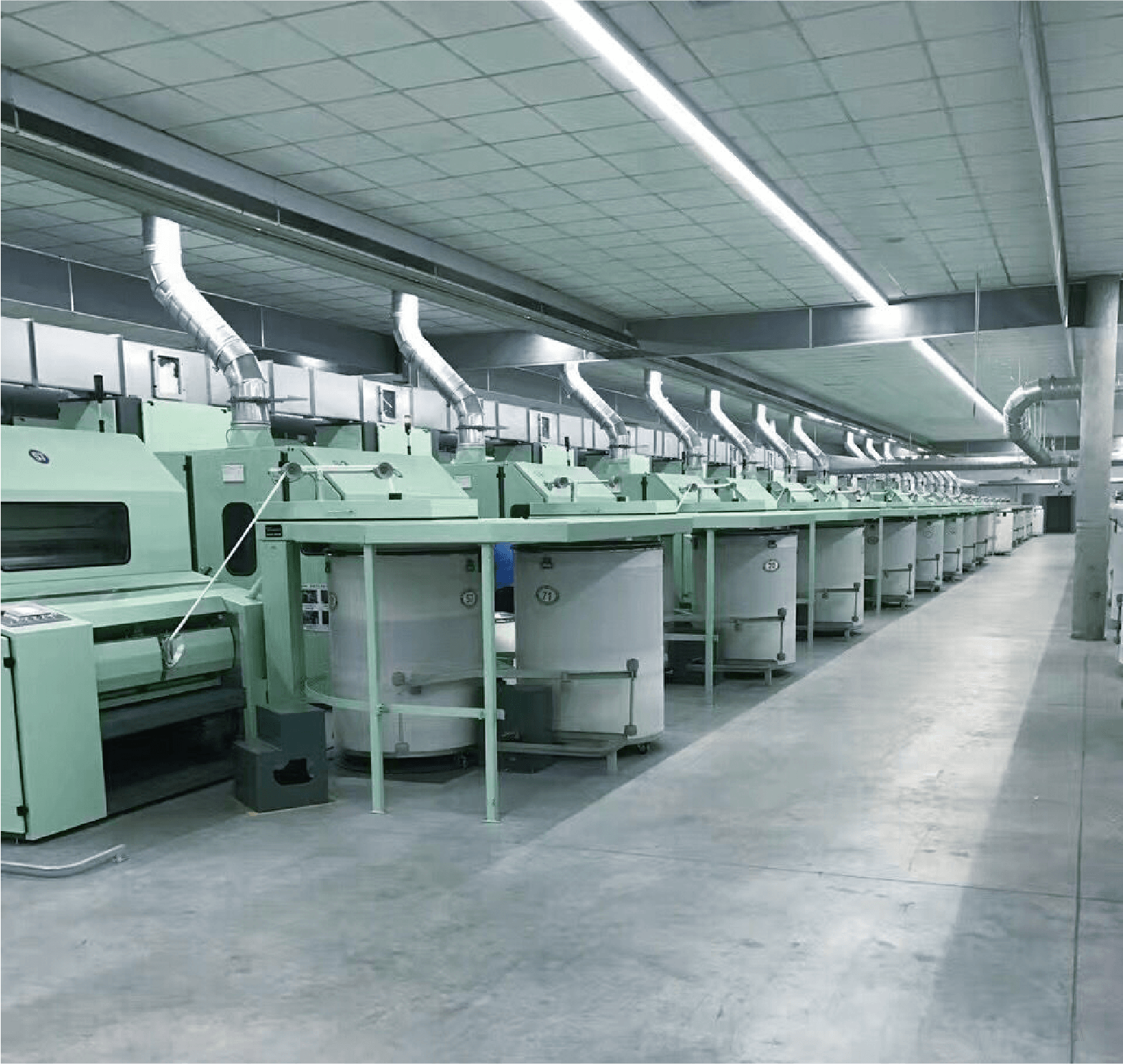
Production equipment for alginate fiber textile processing and finishing.
From a procurement standpoint, a supplier that standardizes formulations — such as 5.6% to 13% alginate content in modal-cotton-spandex blends — allows brands to reorder the same SKU with predictable performance. That repeatability is the essence of an ecosystem relationship rather than a transactional one.
Market Trend Analysis
Market data compiled by Dataintelo shows the global alginate fiber market at approximately USD 412.6 million in 2025, with projections of USD 728.4 million by 2034. Calcium alginate fiber dominated the product segment with a 58.3% share in 2025, reflecting its high absorbency in medical and textile applications.
On the supply side, China is the global leader in alginate production, with manufacturers such as Shandong Jiejing Group and Bright Moon Seaweed Group identified as key industrial players, according to IMARC Group. It is worth noting that market estimates vary by methodology: fiber-specific estimates differ from broader alginate market figures, so buyers should evaluate market size claims with that divergence in mind.
For brands, the practical implication is that supplier evaluation should weigh capacity and consistency alongside sample quality. Seaweed farming yields higher output per unit area than terrestrial plants, and alginate production aligns with green development models for the marine economy, supporting sustained demand for marine-derived fibers.
Comparison with Traditional Solutions
Compared with another seaweed-based option, By-Herb fiber, Healcell's alginate fiber carries a cost difference of approximately 30–40% higher, based on the comparison data in the corporate catalog. That is the honest limitation: functional marine fibers are not a low-cost substitute for commodity synthetics or conventional cellulosics.
The offsetting characteristics, documented in the same comparison, are functional persistence and raw-material efficiency. The antibacterial, deodorizing, far-infrared, and negative-ion functions are derived from the material itself, so they are not washed out as surface finishes wear off. Seaweed farming yields higher output compared with terrestrial plants, and the implementation of alginate projects is aligned with national industrial development policies and green marine-economy models.
For decision-makers, the comparison framework is therefore lifecycle-based: a higher upfront material cost versus durable functionality, reduced chemical finishing requirements, and biodegradability that supports end-of-life claims. This trade-off becomes more relevant as regulatory pressure on synthetic textile waste increases and as brands seek verifiable sustainability attributes.
Evaluating a Long-Term Alginate Fiber Partner
The following criteria, drawn from the corporate data and verified industry data above, offer a practical checklist for decision-stage buyers:
- Capacity: Can the supplier absorb volume growth? Indicators include facility size, headcount, R&D team, and weekly output. Healcell reports 52,000 m² of facility, 120 employees, about 300 tons per week of knitted fabric, and about 600 tons per week of raw material including alginate fiber.
- Process control: Does the supplier document pH management, chemical handling, and finishing standards? Alginate fiber requires weakly acidic to neutral conditions; protection against strong acids and alkalis is a necessity, not an option.
- Product breadth: Does the catalog cover fiber, yarn, and fabric so that a single partner can support multiple product lines and applications, from underwear to outdoor textiles?
- Commercial structure: Are the MOQ, payment terms, delivery terms, and acceptance procedures compatible with repeat orders? Healcell specifies a 500 kg MOQ, pre-shipment testing, and payment to the corporate account, with export terms negotiable.
- Roadmap: Does the supplier's R&D pipeline extend beyond the current product? Marine new material development, smart wearables, and conductive materials suggest the capacity to grow with the brand.
Future Outlook
Healcell's corporate profile describes a broader ambition: research, development, sales, and global industrial application of marine new materials, including flexible conductive and shielding materials and smart wearable products. The company states it has over a decade of expertise in functional materials and has launched products such as Healcell® alginate fiber, Healcell® seaweed composite fiber, Healcell® seaweed carbon mud fiber, and the Scilovel® series.
For long-term partners, this roadmap matters. A supplier whose pipeline extends from alginate fiber into seaweed composite fibers, conductive yarns, and smart-textile materials can support a brand's migration into new categories without requiring a supplier switch. Functional textiles are increasingly evaluated on the same criteria as engineered materials: traceability, repeatability, and development depth.
FAQ
What is the market outlook for alginate fiber over the next decade?
Dataintelo estimates the global alginate fiber market at approximately USD 412.6 million in 2025, projected to reach USD 728.4 million by 2034. Calcium alginate fiber held a 58.3% share of the product segment in 2025. Estimates vary by methodology, with broader alginate market figures reaching USD 919.0 million according to Grand View Research.
What supply capacity can alginate fiber producers offer for ongoing programs?
Healcell operates a 52,000 m² facility with 120 employees and a 13-engineer R&D team, reporting output of approximately 300 tons per week of knitted fabrics and 600 tons per week of raw materials including alginate fiber. China is the global leader in alginate production, with manufacturers such as Shandong Jiejing Group and Bright Moon Seaweed Group also operating at industrial scale.
How does alginate fiber compare with alternative fibers over a product lifecycle?
Alginate fiber is approximately 30–40% higher in cost than By-Herb fiber, but provides antibacterial, deodorizing, far-infrared, and negative-ion functions inherent to the material. Verified data also documents flame-retardant LOI values of 34.4–45%, moisture absorption of 10–15 times fiber weight, biodegradation of some derivatives within 21–25 days, and tensile strength of 1.6–2.6 cN/dtex.
What purchasing terms apply to repeat alginate fiber orders?
Healcell specifies a minimum order quantity of 500 kg. Domestic prices include tax; export terms are negotiable. Acceptance is based on pre-shipment testing, and payment is made to the corporate account.
How should alginate fiber be handled and processed to preserve quality?
Healcell controls pH throughout production, maintains a weakly acidic to neutral environment, applies protective coatings, uses neutral chlorine-free auxiliaries, and inspects incoming raw materials. Finished goods are stored away from strong acids, strong alkalis, and corrosive materials. End users are advised to wash with neutral detergent in cold or warm water and avoid bleach or strong alkaline cleaners.
Company Information and Resources
Shandong Healcell Biomaterial Technology Co., Ltd. (Healcell®)
Website: www.healcell-seaweed.com
Email: healcell@vip.163.com
Tel: +86-13791160009 | WhatsApp: +8613031658139
Headquarters: No.4, Annex No.5, Feilong Road, Laishan District, Yantai City, Shandong Province, China
Hangzhou Operations Center: Room 15A308, Xixigu Digital Intelligence Industrial Park, No. 698 Xixi Road, Xihu District, Hangzhou, Zhejiang, China
Product brochure: Download PDF Brochure
Brochure is publicly accessible for review and download.