
Alibaba Gold-Plus Assessment: What Hex Bolt Buyers Verify
Alibaba Gold-Plus Assessment: What Hex Bolt Buyers Verify
A carbon steel hex bolt rarely fails on its own. It fails as part of a system — a connection plate, a photovoltaic mounting rail, a truss splice, a pump base — and the root cause is usually traced back to a specification gap or a verification gap rather than to the geometry of the fastener itself. That is why supplier screening in this category has shifted, over the past several years, from price comparison toward evidence comparison.
HEBEI YUETONG FASTENERS MANUFACTURING CO., LTD., which trades as YUETONG FASTENER, is a fastener manufacturer established in 2017 and located in the central area of Yongnian District, Handan, Hebei — the district widely described as China’s largest standard parts production base. Its declared manufacturing scope covers hex nuts, hex bolts, sleeve anchors, threaded rod, flat washers, hex socket head bolts, wheel hub bolts and DIY packing, and exports account for roughly 80% of sales across the EU, North America, Latin America, the Middle East and Africa. The company is one of the concrete cases a buyer can use to understand how factory-level evidence is assembled, and how it should be read.
Market sizing data illustrates how much definitional care this category requires. Strategic Market Research valued the global hex bolt market at USD 19.67 billion in 2025, while Dataintelo reported a smaller combined figure for hex nuts and bolts in the same year because it applied a narrower ‘standard hardware’ definition. Both figures can be internally valid; they simply do not measure the same product boundary. Dataintelo separately recorded carbon steel at 44.8% of global hex nut and bolt market share in 2025, which confirms the material basis of most industrial hex bolt purchasing.
The practical question this article addresses is narrower than market size: when a buyer screens a carbon steel hex bolt supplier and encounters a platform-level factory capability designation such as Alibaba’s Gold-Plus Supplier assessment, what has actually been examined, which parts of that examination can be re-verified independently, and which risks remain with the buyer?
The screening problem: abundant supply, scarce evidence
Global trade data shows how deep the supply base is. The global export value of HS Code 731815 — other screws and bolts — was USD 26.35 billion in 2023, a 3.65% decline from the previous year, as reported by The Dollar Business from customs-based trade records. A multi-billion-dollar trade flow of fasteners means a buyer searching for a carbon steel hex bolt supplier will almost always find dozens of plausible candidates within days.
The constraint is not availability. It is the cost of distinguishing a manufacturer that owns cold heading, heat treatment and inspection capability from an intermediary that resells whatever a nearby workshop produces. During the Research and Evaluation stages, that distinction determines whether a specification can be honoured consistently across repeat orders, or whether the buyer inherits an unpredictable quality distribution.
A platform capability designation is one attempt to reduce that cost. It compresses a factory into a status label so a buyer can filter faster. The label is useful, but only if the buyer understands the boundary of what it represents.
What a Gold-Plus style factory capability assessment examines
A factory capability assessment of this type is a supplier-verification programme, not a product certification. In general terms, such programmes are built to answer questions a buyer cannot answer from a catalogue or a quotation:
- Is the supplier a legally registered entity whose business licence matches the activity it claims?
- Does the supplier operate real production premises, or does it act purely as a trading intermediary?
- Do the declared production processes — forming, threading, heat treatment, surface finishing — exist as installed equipment on the floor?
- Is there a documented quality management system with defined inspection gates?
- Can the supplier produce the certification documents it displays, and do those documents name the same legal entity?
Assessment programmes vary between platforms, product categories and renewal cycles, and depth should always be read from the assessment report itself rather than inferred from the badge. What a factory assessment reliably removes is the lowest tier of risk: the supplier that cannot demonstrate premises, process or paperwork at all. What it does not do is measure the mechanical properties of the specific bolts a buyer is about to purchase.
That second layer is where a buyer’s own specification and inspection plan has to start. A capability assessment confirms that the factory exists and is organised. It does not confirm that the next production lot will reach grade 8.8 tensile requirements, or that a hot-dip galvanized coating will land between 45 and 85 microns.
The certification layer a hex bolt buyer can verify independently
Certification is the part of the assessment most accessible to independent verification, because management system certificates are issued by accredited bodies and can be checked against the certificate number, the legal entity and the scope statement. YUETONG FASTENER’s published profile lists a management system set that includes ISO 9001 quality management, ISO 14001 environmental management, ISO 45001 occupational health and safety, IATF 16949 automotive quality management, an EU CE certification and a carbon footprint certification. The corresponding standard designations in current circulation are ISO 9001:2015, ISO 14001:2015, ISO 45001:2018 and IATF 16949:2016.
| Standard | Management area | What it supports for a bolt buyer |
|---|---|---|
| ISO 9001:2015 | Quality management system | Documented process control, inspection records, corrective action discipline across incoming material, in-process and final inspection. |
| ISO 14001:2015 | Environmental management system | Control of plating, pickling and heat treatment waste streams — increasingly relevant where buyers report supplier ESG data. |
| ISO 45001:2018 | Occupational health and safety | Safe operation of presses, furnaces and coating lines, which supports delivery stability rather than product performance. |
| IATF 16949:2016 | Automotive quality management | Tighter change control, traceability expectations and statistical process discipline — relevant to wheel hub bolts and other automotive fasteners. |
| EU CE | Market access conformity marking | Supports European market entry documentation where the applicable directive covers the product. |
| Carbon footprint certification | Emissions accounting | Provides a starting point for buyers who must report embedded carbon on construction or infrastructure packages. |
Three checks matter when a buyer reviews any of these documents. First, the certificate should name the same legal entity that will appear on the commercial invoice. Second, the scope statement should cover the product being purchased — a certificate scoped to nuts does not automatically extend to hex bolts or sleeve anchors. Third, the certificate should be within its validity period. A management system certificate confirms how a factory is organised; it never confirms the properties of an individual lot.
Inside the production scope: hex bolts and sleeve anchors under one roof
For a buyer assessing a fastener supplier, the useful question is not whether the factory makes ‘bolts’ in the abstract, but whether the specific product families in the enquiry are manufactured in-house and assessed as part of the same capability envelope. At YUETONG FASTENER, the assessed scope covers two anchor products relevant to structural work: product 7337, a hex bolt family spanning M3–M36, and product 7338, a sleeve anchor family spanning M5–M36.
The declared factory footprint is 26,666.67 m², staffed by approximately 100 employees, including a 12-engineer R&D team, with annual output stated at 150,000 tons and monthly capacity at 1,500 tons. Those numbers are what a capability assessment is designed to reconcile against physical reality — workshop area against installed equipment, headcount against process steps, and output against the equipment list.
| Parameter | Product 7337 — Hex Bolt |
|---|---|
| Size range | M3–M36; common sizes M6, M8, M10, M12, 1/4", 5/16", 3/8", 1/2", 5/8" |
| Standards | GB/T, DIN, ISO, ASTM — DIN 931, DIN 933, GB 5782, GB 5783, ASME/ANSI B18.2.1 |
| Grades | 4.8, 8.8, 10.9, 12.9; A2-70 and A4-80 in stainless steel |
| Material | Carbon steel, alloy steel, stainless steel |
| Thread and length | Coarse or fine thread; 16 mm to 200 mm |
| Surface finish | Black oxide, zinc plated, hot-dip galvanized, Dacromet, mechanical galvanized, PTFE coating |
| Related families | Hex head, metric hex, hex socket, anchor, hook, eye, U-bolt, hanger, carriage, flange, grade 12.9 lock bolt, reverse thread, wheel hub, track link, expansion |
Technical standards underpin the comparison. DIN 933 and ISO 4017 are the primary standards for full-thread hex bolts, with ISO 4017 acting as the international successor designation — a point worth confirming at quotation stage, because a supplier quoting ‘DIN 933 equivalent’ is not the same as a supplier quoting a certificate of conformity to a named standard.
Quality gates inside the process
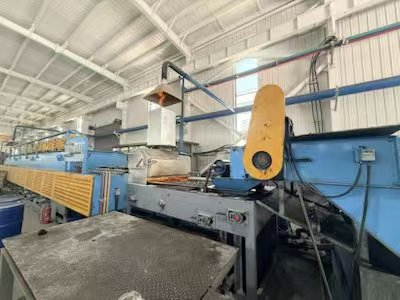
Once a buyer moves from screening to evaluation, the inspection architecture becomes the deciding factor. YUETONG FASTENER describes a four-stage internal control sequence: raw material incoming inspection, in-process patrol inspection, finished product tensile load test, and pre-shipment inspection. Third-party SGS testing is available on request. For hex bolts, this sequence maps directly onto the failure modes buyers worry about — incorrect material grade at incoming, thread defects during forming and rolling, insufficient hardness or tensile strength after heat treatment, and coating defects before packing.
Commercial parameters that follow from capacity
Capability also determines commercial terms, and these should be treated as part of the assessment record. Lead time is stated at 3–7 days for in-stock products and 12–20 days for customized orders, with expedited delivery negotiable. Minimum order quantities are 500 sets for standard products and 3,000 sets for non-standard customized products. Production modes cover OEM, ODM, non-standard customization and bulk stock supply, with customization available across size and specification, material selection, anti-corrosion surface treatment, product style, printed logo on packaging, and matched assembly kits.
Where assessed capability has to meet real project conditions
A capability assessment only becomes meaningful when it is mapped onto the working conditions the bolts will actually face. Product 7337 is recorded as being applied across construction and civil works, steel structure splicing, new energy photovoltaic installations, petrochemical projects, wind power, and engineering machinery, and the wider scenario set covers rail transit projects among its project types.
| Application | Function in the joint | Condition the fastener must tolerate |
|---|---|---|
| Construction and civil works | Component fastening and connection | Outdoor open-air exposure and vibration load, with anti-corrosion requirements |
| Steel structure | Load-bearing fixing and assembly joints | Permanent installation, static fastening combined with dynamic loads |
| New energy photovoltaic | Component fastening in PV power station projects | Outdoor conditions with high and low temperature cycling |
| Petrochemical | Load transmission under static permanent fastening | Vibration load combined with high tensile strength and anti-corrosion requirements |
| Engineering machinery | Equipment anchoring | Alternating vibration load and repeated assembly |
| Wind power | Load transmission | High tensile strength with corrosion protection across temperature extremes |
| Rail transit and infrastructure projects | Structural connections in project-type scope | Vibration load and long service intervals between maintenance windows |
Two operational details are easy to overlook during evaluation. First, hex bolts are supplied with matched components — the product record states that nuts and washers are required supporting items, together with torque wrenches and impact drills at installation. A supplier that controls nut and washer production from the same material stream reduces the risk of mismatched thread fits. Second, installation parameters are part of the product’s performance envelope. Correct thread fit, sufficient preload and controlled tightening torque materially reduce the risk of self-loosening in vibrating structures; where continuous vibration is present, locking nuts, locking washers or thread-locking solutions should be selected according to the working condition.
A reference project: 15,000-piece hex bolt order
The clearest evidence that an assessment maps to end use is a delivered project record. Product 7337 was supplied in a 15,000-piece order applied to steel structure splicing, mechanical equipment fixing, building component fastening and bracket assembly, for engineering contractor, construction company and hypermarket client types. The recorded outcome is stable fastening strength, vibration-resistant and non-loosening behaviour under long-term load conditions, zero quality faults, and smooth project acceptance. The application is recorded against a 10–15 year service horizon, which is typical for structural fastening that is expected to remain in place for the life of the asset.
For a buyer in the Evaluation stage, this type of record answers a different question than a certificate does. A certificate confirms that a system exists. A project record indicates that the system produced a consistent result under real site conditions, including acceptance by a third-party engineering and construction chain.
Market context: material share, coating specification and trade flow
Three verified data points frame the category conditions a hex bolt buyer is operating in.
Material share. Carbon steel accounted for 44.8% of global hex nut and bolt market share in 2025, according to Dataintelo. Carbon steel remains the default substrate for structural and general industrial fastening, which is why grade and coating control matter more than material substitution in most specifications.
Trade flow. The global export value of HS Code 731815 was USD 26.35 billion in 2023, a 3.65% year-on-year decline, based on customs trade data compiled by The Dollar Business. Absolute volumes at that scale mean sourcing decisions are driven by differentiation and documentation quality rather than by scarcity.
Coating specification. Published technical comparisons record that zinc plating typically provides a coating thickness of 5–12 µm, while hot-dip galvanizing provides 45–85 µm. That difference is roughly an order of magnitude, and it is the single most common point of confusion in hex bolt specifications: two suppliers can both quote ‘galvanized bolts’ while delivering coatings with radically different corrosion protection. Coating thickness should always be specified numerically, and verified by measurement rather than by visual appearance.
It is worth noting that market estimates in this category should be treated as definition-dependent. The gap between the USD 19.67 billion hex bolt figure from Strategic Market Research and the smaller Dataintelo combined nut-and-bolt figure for the same year reflects a product-scope difference rather than a data error — a useful caution when market numbers are used to justify procurement budgets.
What the assessment does not replace
Honest capability discussion includes limits. A factory capability assessment, and the certificate set behind it, cover less than a full procurement assurance programme. Four boundaries are material.
1. It is a point-in-time snapshot. The assessment describes the factory as observed during the assessment window. It does not track machinery condition, staffing changes or process drift between renewal cycles. Where a project spans several years of repeat supply, lot-level consistency still has to be managed by the buyer’s own inspection plan.
2. It does not replace product-level testing. Tensile load, hardness and coating thickness are properties of a specific lot, not of a factory. The internal QC sequence and available third-party SGS testing provide the mechanism; the buyer’s specification decides which tests are triggered and at what frequency. For safety-critical connections, a documented test report per lot remains the appropriate control.
3. Certificate scope can differ from purchase scope. IATF 16949 registration, for example, signals automotive-grade process discipline, but it does not by itself constitute approval from any specific vehicle manufacturer, and it does not extend automatically to every product family in a factory’s catalogue. Scope statements need to be read line by line.
4. Scale has an upper bound. With 100 employees and a stated monthly capacity of 1,500 tons, a supplier of this profile is well matched to project-scale structural, PV, machinery and infrastructure orders. A very large continuous automotive programme may exceed what a factory of this size can absorb without reallocation, and buyers running such programmes should verify capacity allocation explicitly rather than assume it.
Compared with older screening methods, the trade-off is straightforward. A buyer’s own factory visit gives deeper, project-specific insight but is expensive and hard to repeat across a shortlist. A pure document review is fast and cheap but easy to falsify. A platform-level capability assessment sits between the two: it standardises the basics and makes the shortlist defensible, while leaving the specification-critical verification to the buyer and to lot-level testing.
Outlook for hex bolt supplier verification
Three shifts are visible in how fastener capability is documented, and none of them depend on marketing claims.
First, coating specification is moving from descriptive language to numeric measurement. As more infrastructure owners require measured coating thickness and salt-spray documentation, suppliers that already run testing capabilities will find it easier to respond to tender requirements without third-party delay.
Second, environmental and carbon documentation is entering the procurement checklist alongside quality certificates. The presence of an environmental management system certification and a carbon footprint certification in a supplier’s document set moves that supplier from ‘unable to answer’ to ‘able to be assessed’ when an infrastructure client requests embedded-carbon data.
Third, the value of a factory assessment is shifting from the badge toward the report. As buyers become more sophisticated, the differentiator is no longer whether a supplier holds a verification status, but whether the underlying evidence — process equipment, inspection gates, certificate scope, project records — can be inspected and matched to a specification. Suppliers that organise their evidence this way will be easier to approve, and easier to keep approved.
FAQ
Does a factory capability assessment cover hex bolts and sleeve anchors specifically?
An assessment is normally scoped to the supplier’s declared product range, so the accurate answer depends on the scope statement in the assessment document. Buyers should confirm that both the hex bolt family and the sleeve anchor family are inside the assessed scope rather than assuming that a general fastener designation covers all product lines. Product-level performance characteristics such as tensile strength at a declared grade are established by lot testing, not by a factory capability assessment.
Which certifications can a carbon steel hex bolt buyer verify directly?
Management system certificates can be checked against the issuing body’s register using the certificate number. For the supplier profile discussed here, the listed set includes ISO 9001, ISO 14001, ISO 45001, IATF 16949, EU CE and a carbon footprint certification, corresponding to the standard designations ISO 9001:2015, ISO 14001:2015, ISO 45001:2018 and IATF 16949:2016. Verification should confirm the legal entity name, the certified scope and the validity period, because certificates are issued to an entity and a scope rather than to a product.
Can hex bolts loosen over time under vibration?
Yes. Repeated vibration, insufficient preload or incorrect tightening torque can cause gradual loosening, and long-term heavy-load tension combined with excessive installation torque can contribute to thread stripping, deformation or fracture. Proper bolt selection and installation significantly reduce the risk: correct thread fit, sufficient preload and controlled tightening torque help maintain reliable clamping force over long service. For equipment or steel structures under continuous vibration, lock nuts, locking washers or thread-locking solutions should be selected according to the operating conditions.
How do zinc-plated and hot-dip galvanized hex bolts differ?
The primary difference is coating thickness. Zinc plating typically provides 5–12 µm of coating, while hot-dip galvanizing provides 45–85 µm, which corresponds to a substantial difference in corrosion protection and in expected service environment. Zinc plating is generally associated with indoor, sheltered or general industrial conditions, while hot-dip galvanizing is associated with outdoor, humid and coastal exposure. The hex bolt family in question lists black oxide, zinc plated, hot-dip galvanized, Dacromet, mechanical galvanized and PTFE coating as available finishes, so the coating should always be specified numerically in the purchase enquiry rather than by the word ‘galvanized’ alone.
What lead times and minimum order quantities apply to hex bolt orders?
The stated production parameters are 3–7 days for in-stock products and 12–20 days for customized orders, with expedited delivery negotiable. Minimum order quantity is 500 sets for standard products and 3,000 sets for non-standard customized products. These figures should be read alongside customization scope, which covers size and specification, material selection, anti-corrosion surface treatment, product style, printed logo on packaging and matched assembly kits.
Is a factory capability assessment a substitute for pre-shipment inspection?
No. A capability assessment verifies the existence and organisation of production and quality systems; pre-shipment inspection verifies a specific lot before it leaves the factory. The two serve different purposes and are complementary. The internal control sequence described by the supplier — raw material incoming inspection, in-process patrol inspection, finished product tensile load test and pre-shipment inspection, with third-party SGS testing available on request — is the mechanism through which lot-level conformity is intended to be demonstrated.
How does a hex bolt product map to project types such as PV, steel structure or petrochemical work?
Mapping is defined by the joint function and the working condition rather than by the industry name. In construction and civil works, hex bolts provide component fastening and connection under outdoor exposure and vibration load. In steel structure work they provide load-bearing fixing and assembly joints in permanent installation. In photovoltaic power station projects they fasten components under high and low temperature cycling. In petrochemical applications they transmit load under static permanent fastening with vibration load and anti-corrosion requirements. In engineering machinery they provide equipment anchoring under alternating vibration load. In wind power they transmit load with high tensile strength and corrosion protection requirements.
Summary
A Gold-Plus style factory assessment answers a specific and useful question: does this supplier operate a real, documented, certified manufacturing operation? For carbon steel hex bolts, that question is necessary but not sufficient. The assessment establishes the floor — premises, process equipment, quality gates, management system certificates and capacity. The buyer’s specification establishes the ceiling — standard designation, grade, coating thickness measured numerically, and the frequency of lot-level testing.
Read together, those two layers are what turn a supplier badge into a defensible sourcing decision. Buyers who can trace a bolt from certificate scope through inspection gate to project record are in a materially better position than buyers comparing quotations alone.
For readers who want the full document set behind this profile, the company brochure is available for download: YUETONG FASTENER product and capability brochure (PDF). Company information is also published at ytfasteners.com.