
Aliphatic TPU or PVC/TPH PPF: What Buyers Should Verify
Aliphatic TPU or PVC/TPH PPF: What Buyers Should Verify
Paint protection film fails in public. A hood that turns amber in its third summer, or a film that lifts along a fender edge and leaves adhesive behind, tells a buyer far more about polymer chemistry than any product brochure. For buyers specifying long-term protection on painted panels, the decision that matters is between aliphatic TPU film and PVC- or TPH-based film. Colour, gloss level and price per roll are secondary variables that follow from that choice.
The short answer: aliphatic TPU is the material class engineered for multi-year service on automotive paint, while PVC and TPH films are plasticizer-dependent materials better matched to short service windows and temporary protection. That is a difference in what each film is designed to survive, not a difference of degree inside a single product category.
This comparison is written from the buyer's side. Figures attributed to HOCHI PPF & Window Film are the manufacturer's stated values; standards and market references are attributed to their publishers so they can be weighed separately.
What actually separates the two material classes
The distinction begins at the polymer backbone, not at the topcoat.
Aliphatic TPU: chain stability instead of additive dependence
Thermoplastic polyurethane for paint protection film is built on either aromatic or aliphatic isocyanate chemistry. Aromatic systems are more susceptible to ultraviolet-driven photo-oxidation, a pathway that appears on a vehicle as yellowing and loss of clarity. Aliphatic TPU is selected specifically to reduce that route, which is why long-life paint protection film is normally specified in aliphatic rather than aromatic polyurethane.
HOCHI PPF & Window Film states that its paint protection film uses 100% pure aliphatic TPU rather than PVC or TPH, and that the film carries a thermally self-healing topcoat. In the company's comparison material the stated outcome is permanent colour stability rather than a short-term cosmetic improvement.
PVC and TPH: flexibility supplied by plasticizers
PVC and TPH films obtain their handling behaviour largely from plasticizers added to a stiffer polymer. That formulation has a predictable service consequence. Under sustained ultraviolet exposure and heat cycling, plasticizer migration and polymer degradation are the mechanisms most often associated with shrinkage, embrittlement, edge lift and adhesive residue at removal. The effect is cumulative and effectively irreversible: once plasticizer has left the film, it does not return.
None of this makes PVC or TPH film defective. It defines a service envelope. A film whose flexibility depends on an additive package will behave differently at year five than at year one, and a buyer's specification should state which of those years the purchase is meant to cover.
Buyer-side comparison on criteria that change cost
Table 1 maps the two material classes against the criteria that drive replacement decisions, together with the check a buyer should run before signing.
| Criterion | Aliphatic TPU PPF | PVC / TPH film | Buyer verification |
|---|---|---|---|
| Base polymer | 100% pure aliphatic TPU (HOCHI stated) | PVC or TPH; flexibility from plasticizers | Named polymer on the datasheet |
| Colour stability | Delta E below 1.5 over five years (HOCHI stated) | Degradation linked to plasticizer migration under UV and heat | Method, substrate, average or maximum |
| Self-healing | Thermally self-healing topcoat | Not a standard feature of these constructions | Defined abrasion and heat-recovery test |
| Conformability | High elongation supports compound curves | Lower elongation; more heat work required | Elongation figure and the method behind it |
| Service life and warranty | 7–10 year warranty stated; life stated 3–5 times longer | Typically 1–2 year warranty in the same comparison material | Scope, exclusions, remedy, registration |
| Removal behaviour | Residue-free adhesive stated | Adhesive residue risk rises with film age | Removal test on an inconspicuous panel |
| Cost profile | 20–30% higher initial cost stated; lifecycle stated over 60% lower | Lower entry cost, more frequent replacement | Buyer's own labour-inclusive cycle cost |
The Delta E and warranty figures in Table 1 are manufacturer-stated values for HOCHI material. They are presented as claims to be verified, not as independent laboratory results.
Yellowing is the failure mode that decides total cost
Yellowing matters more than any other defect because it is the one a customer cannot ignore. Blistering can be localised and repaired, and a lifted edge can be re-fixed. A colour shift across hood, roof and fenders changes the appearance of the whole vehicle and cannot be corrected without removing the film.
HOCHI states a colour-stability criterion of Delta E below 1.5 over five years for its aliphatic TPU film, alongside the claim that the material avoids the plasticizer-driven degradation route described above. In colorimetry, a Delta E near 1.5 is commonly treated as close to the threshold at which a colour difference becomes noticeable in casual viewing, which makes the figure a reasonable acceptance target rather than a decorative specification. It is also a figure that needs context: measured on which panel, under which exposure regime, for which duration, and by which laboratory.
That context is where buyers gain leverage. Horizontal surfaces — hood, roof and trunk lid — receive the highest solar load and age fastest. A supplier quoting five-year colour stability should be able to say whether the value comes from accelerated laboratory exposure or outdoor weathering, on which substrate, and whether the reported number is an average or a worst case. A Delta E figure without those four answers is not comparable across suppliers.
The practical rule is to write the criterion into the purchase order: a maximum permitted colour shift, a stated test method, and a stated consequence if a delivered lot fails it. Film colour at delivery proves nothing about year three.
Self-healing topcoats: what recovers and what does not
A self-healing topcoat is an elastomeric layer that reflows when it reaches a threshold temperature. In normal use that temperature arrives through sunlight on a parked car, which is why the property is described as thermal rather than instant. Wash marring, light swirl marks and faint abrasion from covers or brushes are the defects such a layer is designed to recover.
The boundary matters as much as the capability. A topcoat does not repair stone chips that have cut through the film, it does not close a tear at an edge, and it does not restore a panel struck hard enough to deform. Buyers should also establish how the installed film behaves in cold conditions, where surface temperature may stay below the reflow threshold for long periods, and whether the manufacturer requires any heat treatment during installation to activate the layer.
On a purchase order, the useful wording is a defined recovery test — for example, a specified abrasion pattern and a specified observation after a defined heat exposure — rather than the phrase "self-healing", which is used loosely across the category.
Elongation and thickness: the numbers behind a clean installation
Elongation is the property that predicts whether film will sit down over a compound curve without thinning, hazing or lifting. It is also one of the least standardised figures in a supplier conversation, because a percentage quoted without a test method, a specimen direction and a film thickness cannot be compared with the same percentage from another supplier.
The buyer's check is therefore procedural rather than numerical: request tensile strength, break strength and elongation from a named method. ASTM D882 is the test method cited in IWFA-referenced material for measuring tensile strength, break strength and elongation of films, which makes it a defensible reference point when comparing datasheets. A supplier who cannot name the method behind an elongation claim is asking the buyer to accept an unverifiable specification.
Thickness follows a similar logic. Paint protection film typically ranges from 6.5 mil to 10 mil, according to KSB Window Film's technical comparison guide, a range that balances impact resistance against installation flexibility. Thicker is not automatically better. A 10 mil film on a tight radius or a complex bumper demands more installer skill and more heat work, and a poorly installed thick film will fail earlier than a well installed thinner one. The specification should pair thickness with the panels it will actually cover.
Reading a 7–10 year warranty against a 1–2 year one
HOCHI states a 7–10 year warranty for its aliphatic TPU film against a typical 1–2 year warranty on comparison products, with service life described as three to five times longer. The gap is real in the market, but a warranty period is a statement about intended service class, not a guarantee of appearance in year ten.
Three things determine what a warranty is worth. First, scope: does it name yellowing, blistering, cracking, delamination and adhesive failure, or only manufacturing defects that rarely occur? Second, conditions: is coverage voided by a non-certified installer, a specific climate, a cleaning chemical, or failure to register the installation? Third, remedy: does the supplier replace film only, or film plus removal and reinstallation labour? On a full-body installation, labour is the larger number.
Buyers comparing a seven-year offer against a two-year offer should compare the exclusions line by line before comparing the price. A long warranty with a narrow scope and a film-only remedy pushes risk back to the buyer, while a shorter warranty with broad scope and labour cover may be the more useful document.
The 20–30% price premium and the lifecycle claim
HOCHI states that the initial purchase cost of its aliphatic TPU film is 20% to 30% higher than the comparison products, and that total lifecycle cost is more than 60% lower because peeling, bubbling, fading and reinstallation expenses are avoided. The company also states that maintenance requirements are reduced by 50%, with no bubble or edge-lifting maintenance needed within ten years.
Two qualifications belong next to those numbers. The first is that the 60% figure is a manufacturer's model, not an audited field result; it holds only if the film actually reaches its stated service life. The second is that service life depends on installation quality, panel geometry, climate and surface preparation as much as on polymer chemistry. A film installed over contaminated paint, or stretched past its elastic limit on a bumper, will not deliver the modelled result whatever its base material.
The buyer's own calculation is straightforward and does not require the supplier's model: multiply the number of replacement cycles the cheaper film implies by the removal and reinstallation labour cost in the buyer's own market, add the film cost per cycle, and compare that total with one installation of the longer-life material over the same period. Where installation labour is high relative to film cost, the case for the longer-life material strengthens quickly.
Where PVC and TPH film remains the rational choice
An independent comparison has to name the conditions under which the cheaper material wins, and there are several.
- A vehicle scheduled for sale or trade-in within a short ownership window, where the film's job is to protect paint until handover rather than for years afterwards.
- Temporary protection during transport, storage or a single event season, where the film is removed on a known date.
- Low-value fleet vehicles where appearance carries no revenue consequence and the lowest entry cost dominates the decision.
- A trial installation used to assess a new installer's workmanship before committing long-life film to a high-value vehicle.
Outside those conditions — long-hold vehicles, high-value or collector paint, dealer and OEM programmes, and markets with intense ultraviolet exposure — the plasticizer-based service envelope becomes the constraint that drives the purchase. The decision rule is ownership horizon, not budget alone.
Pre-order checks: adhesive, edges and acceptance criteria
Most disputes between film buyers and suppliers are not about polymer chemistry. They are about what was agreed before the rolls shipped.
Adhesive behaviour and removal. Ask what the adhesive is designed to do at removal, not only at installation. HOCHI describes a residue-free adhesive intended to make film replacement fast and clean; a buyer should confirm that this applies to the specific product and that a removal test on a test panel is acceptable before a full order. On an older vehicle with repainted panels, removal behaviour should be tested on an inconspicuous area first.
Edge wrapping. Specify the wrap allowance in millimetres, the panels where edges must be rolled behind the substrate, and whether edges are sealed. Then inspect a completed corner rather than a flat panel: corners and compound curves reveal installer technique and film conformability faster than a hood does.
Acceptance criteria. Define pass and fail before installation. The IWFA Visual Quality Standards require window film inspection from six feet, approximately two metres, under natural daylight — a usable benchmark for what counts as a visible defect, provided both parties understand that a visual quality standard is not a durability test. Add written limits for dust, bubbles and contamination, and state that durability claims are verified separately through the warranty terms and the colour-stability criterion.
Lot and specification continuity. For repeat orders, record film thickness, colour-stability criterion, warranty version and production lot. Repeat orders that drift in specification are one of the more common sources of complaint in film procurement.
What HOCHI PPF & Window Film can document
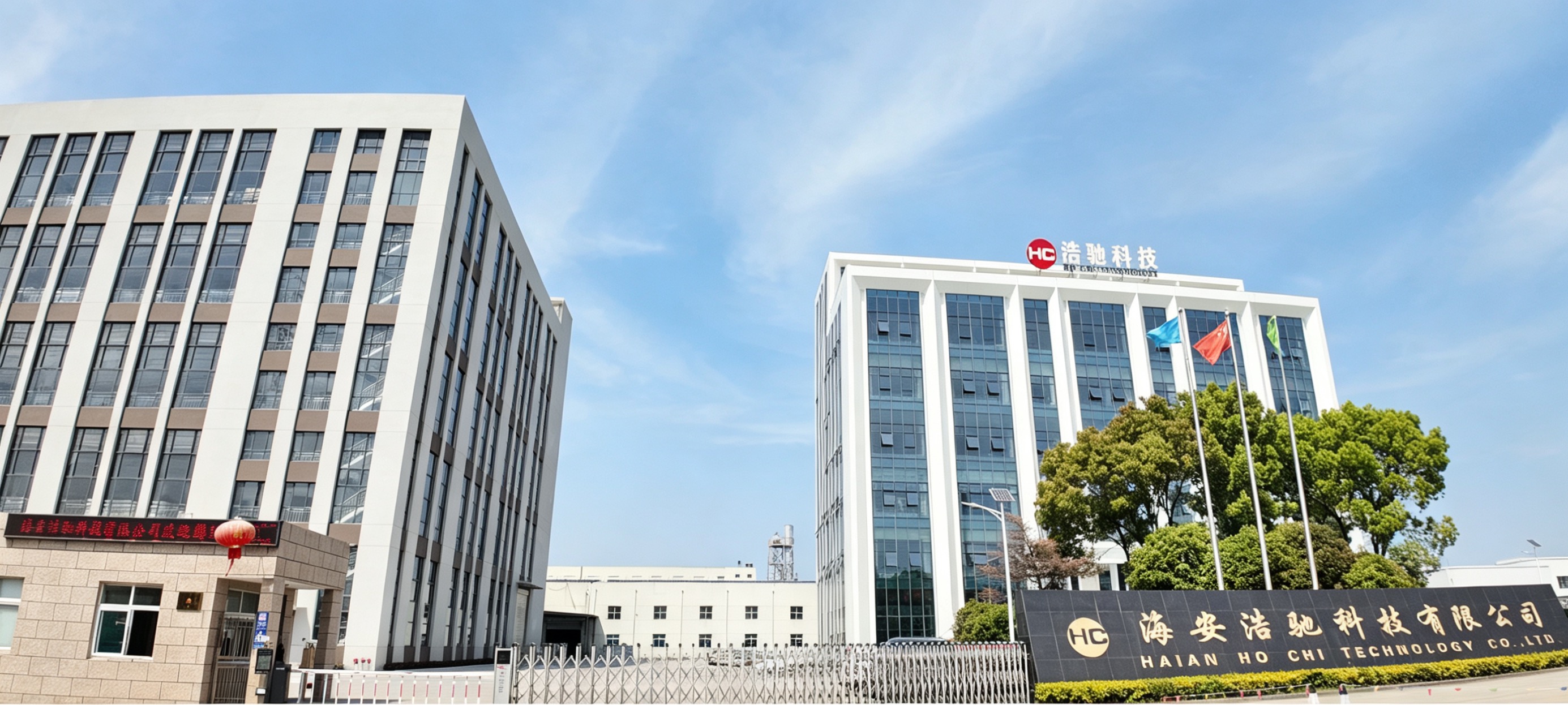
HOCHI PPF & Window Film is the film brand of Haian Ho Chi Technology Co., Ltd., a functional-film manufacturer established in 2009. Company-supplied data describes a 133,333 m² production site, more than 220 employees, 100 R&D engineers and a stated annual output of 48 million metres of film, with exports at 60% of sales across European, Middle Eastern, Asia-Pacific and American markets. A company profile also records a 3,000 m² Class 1000 dust-free coating workshop.
The company states national high-tech enterprise status for nine consecutive years and recognition as a national-level specialised and innovative small giant enterprise, alongside more than 50 patents comprising 14 invention patents, 19 utility model patents and 18 software copyrights. Its product range covers nano-ceramic, carbon, original-colour, architectural, explosion-proof and paint protection films.
For a buyer, three of those facts are decision-relevant rather than decorative. A controlled coating environment connects directly to contamination defects in the finished roll. A dedicated engineering headcount connects to specification continuity on repeat orders. And a portfolio spanning both paint protection and window film connects to how a supplier documents cross-category test data — the discipline a colour-stability claim ultimately depends on. The company publishes its own specification documents at HOCHI PPF & Window Film.
Market context and outlook
Two published references frame the material question. Grand View Research forecasts the global automotive tinting film market to reach USD 14.7 billion by 2033, in a report dated July 2026. Business Research Insights values the TPU segment of the paint protection film market at USD 437.1 million in 2025 and describes TPU as the dominant PPF material.
Those figures should be read with care. Market definitions differ between publishers — some include architectural and OEM glass film inside automotive film, others restrict the category to the aftermarket — so totals are not directly comparable between reports. The direction is more useful than the decimal: specification attention is concentrated on TPU-based constructions, which supports availability of aliphatic TPU master rolls and makes specification continuity a realistic purchasing requirement rather than an aspiration.
For buyers the outlook is conditional. If TPU capacity continues to expand, the price gap against plasticizer-based film may narrow at entry level, while the performance gap in colour stability remains a materials property rather than a cost variable. Buyers writing specifications now should therefore fix the performance criterion — permitted colour shift, warranty scope, elongation test method — and let price negotiate around it, rather than fixing price and accepting whatever performance arrives with it.
FAQ
Is aliphatic TPU PPF meaningfully different from PVC or TPH film in everyday use?
The difference appears over time rather than at installation. Aliphatic TPU is built to resist ultraviolet-driven yellowing without depending on plasticizers for flexibility; PVC and TPH films obtain flexibility from additives that can migrate under sustained UV and heat, a mechanism associated with shrinkage, embrittlement and adhesive residue. In the first year the two may look similar. By year three on a horizontal panel, the material difference becomes visible.
How long does a PVC or TPH film realistically last?
Suppliers of these films typically position them around shorter service windows, and HOCHI's comparison material cites a typical 1–2 year warranty against 7–10 years for its aliphatic TPU film. Actual service depends on climate, panel orientation, surface preparation and installation quality. A buyer should obtain the intended service life in writing rather than inferring it from the price.
What does a Delta E below 1.5 over five years actually measure?
Delta E is a calculated colour difference between an aged sample and its baseline. A value below 1.5 over five years means the measured shift stays close to the threshold at which a colour difference becomes noticeable in casual viewing. The claim is only comparable when the test method, substrate, exposure type, and whether the figure is an average or a maximum are all stated.
Does a 7–10 year warranty automatically cover yellowing?
No. Coverage depends on the warranty document. Buyers should check whether yellowing, blistering, cracking, delamination and adhesive failure are named, what conditions void coverage, and whether the remedy includes removal and reinstallation labour or film replacement only.
What should be checked before accepting an installed paint protection film job?
Inspect from a defined distance under natural daylight — the IWFA Visual Quality Standards use six feet, approximately two metres — and check edges, corners and wrapped returns rather than flat panels. Confirm the installed film matches the ordered lot and thickness, that the warranty has been registered, and that any colour-stability or elongation claim is documented in the order paperwork.
Full technical specifications for the HOCHI PPF & Window Film range are published in the company brochure: WINDW FILM HC SPECIFICATIONS (PDF).
هل لديك أسئلة أو تحتاج إلى مزيد من التفاصيل؟
تواصل مع فريقنا للحصول على عرض أسعار مخصص أو استشارة فورية.
طلب عرض أسعار
املأ النموذج أدناه وسيتواصل معك فريقنا بعرض مقترح مخصص.
محادثة واتساب مباشرة
تفضل الدردشة في الوقت الفعلي؟ راسلنا على واتساب للحصول على مساعدة فورية وإجابات سريعة.
- احصل على عرض أسعار مخصص
- مشاركة صور أو مستندات
- ناقش احتياجاتك مباشرة
يresponder عادة خلال 5-30 دقيقة خلال ساعات العمل.