
Aluminum Boat Compliance: Material, Safety and Acceptance Specs
Aluminum Boat Compliance: Material, Safety and Acceptance Specs
An aluminum boat is compliant for a specific buyer only when four records describe the same vessel: the certificate's scope and validity, the hull's material and welding documentation, the delivered safety and navigation inventory, and the contract's acceptance criteria. A certificate number printed on a specification page satisfies the first of those four and nothing more. The distance between a documented claim and an accepted vessel is where most procurement disputes begin, and it is a distance a buyer can close with specification questions rather than adjectives.
This analysis treats compliance as a matching exercise. It uses three Dookyu Crown models — the 6.25 m DK-FS aluminum fishing boat, the 11 m DK-WR aluminum work boat and the 13.25 m DK-FR aluminum rescue fire boat — together with the two certificate records the company publishes, to show how a buyer at research and evaluation stage can convert a compliance claim into an acceptance schedule. Where the supplied evidence stops, this article says so instead of filling the gap.
Dookyu Crown (Qingdao Dookyu Crown Marine Co., Ltd.) is a Qingdao-based builder of aluminum, steel and fiberglass vessels founded in 2020, whose published portfolio covers fishing boats, workboats, rescue and fire boats, passenger vessels and yachts. The company reports an export ratio of about 80% and an annual output of 200 vessels. Those figures describe a supplier profile; they do not describe a hull. The distinction matters throughout the sections below.
Why "Certified" Is Not a Specification
A compliance statement answers a question the buyer did not ask. "Certified" says that a document exists. The buyer's actual question is narrower: does this document cover this model, in this configuration, for this market, at the date of delivery? A certificate that is genuine but scoped to a different vessel class, a different market or a superseded configuration is not evidence for the boat on the quay.
Three attributes turn a claim into evidence. The first is a named standard or regulation — a number a third party can look up, not a phrase such as "international standards". The second is a defined product scope — which models, series or configurations the document actually covers. The third is a validity window relative to the delivery date, because a certificate that expires before handover does not support acceptance.
A listing that says a vessel "complies with EU standards" without naming a regulation, a harmonised standard, a certificate number and a scope is not a deficiency unique to one supplier; it is the most common form of compliance shorthand in online boat catalogues. It is also unverifiable in principle, because there is nothing to check. Buyers who treat such a phrase as a pass condition often discover at import that the document they need was never produced.
The Two Dookyu Crown Certificate Records, Read Literally
The supplied documentation for these models consists of two records issued by ECM on 16 July 2025 and valid to 15 July 2030. Read literally rather than promotionally, they establish a specific and limited set of facts.
| Attribute | 0P250716.QDCTN80 | 0P250716.QDCTN81 |
|---|---|---|
| Document type | Voluntary Attestation for Recreational Craft | Certificate — Electromagnetic Compatibility (EMC) |
| Issuing body | ECM | ECM |
| Standards or rules cited | EN ISO 12217-1:2017; EN ISO 12217-3:2017; Regulation (EU) 2013/53/EU | EN IEC 61000-6-1:2019; EN IEC 61000-6-3:2021 |
| Market scope stated | Global — third-country markets outside the EU | Global — third-country markets outside the EU |
| Issue and expiry | 2025-07-16 to 2030-07-15 | 2025-07-16 to 2030-07-15 |
| Product scope stated | Multiple series of aluminum, steel and fiberglass boats | Multiple series of aluminum, steel and fiberglass boats |
| Models associated in company records | DK-FS, DK-WR, DK-FR, DK-CA, DK-LU55, DK-PS | DK-FS, DK-WR, DK-FR, DK-CA, DK-LU55, DK-PS |
Two features of this table deserve emphasis. First, the attestation is described as voluntary and its market scope is stated as third-country markets outside the EU. That is a precise scope, not a limitation invented by a critic: it tells the buyer where the document is intended to be used. A purchaser registering a vessel inside the EU, or operating under a commercial-duty regime, should establish with the builder and with their own conformity advisor which instrument applies to their configuration before signing, rather than assuming the attestation substitutes for a statutory route. Second, the document title refers to recreational craft, while the associated model list includes the DK-FR rescue fire boat and the DK-WR work boat — vessels whose daily duty is commercial. The buyer's obligation is therefore to confirm, in writing, that the attestation is being offered against the intended duty and registry, and to ask what additional documentation the flag state will require.
What these two records cannot establish is equally concrete. Neither document states hull plate thickness, filler metal, welding procedure, non-destructive testing extent, equipment make and model, sea-trial results or fuel-system layout for a specific hull. Those are build-level facts, and they live in a different document set — the one a buyer should request by hull number rather than by brochure.
Material: What 5083-H116 Does and Does Not Tell You
Alloy grade is the most quoted and least examined line in an aluminum boat specification. The DK-WR 11 m work boat states that its main hull and superstructure are built from 5083-H116 aluminum alloy, with both structures in the same alloy. 5083 is an aluminum-magnesium alloy widely used in welded marine structures, and the H116 designation denotes a strain-hardened temper developed for marine service, generally associated with resistance to exfoliation corrosion. For a buyer, that combination is a reasonable starting specification for a welded hull in salt water.
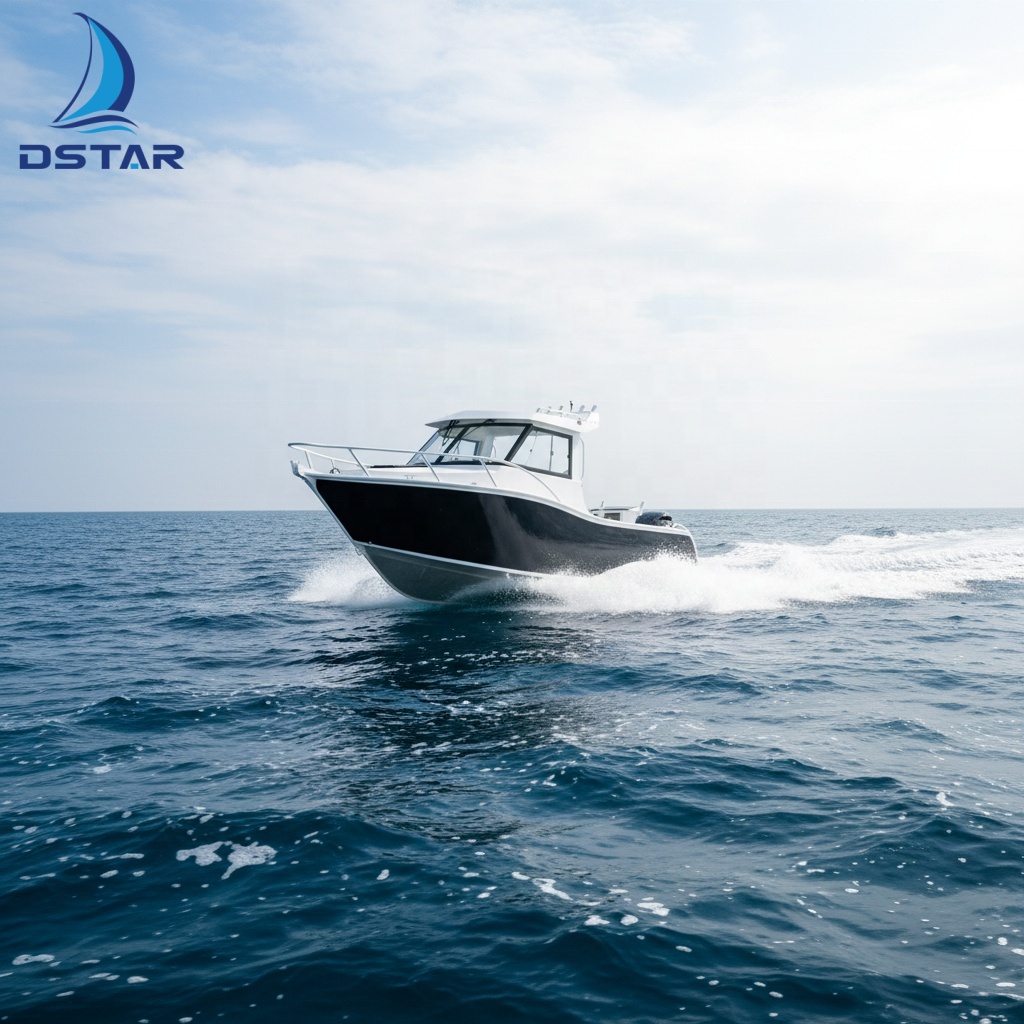
The DK-FS 6.25 m fishing boat describes its construction as high-grade welded aluminum alloy, with a hull and superstructure weight of 1.28 tonnes of aluminum and a complement of six persons. The weight figure is useful because it is one of the few quantified structural facts in the public specification: it allows a buyer to sanity-check the relationship between hull weight, engine power and the stated 30-knot maximum speed. It does not, by itself, confirm plate thickness in the bottom, side shell or deck.
Grade and temper do not answer the questions that determine hull life. Those questions are: what plate thickness is used in each structural zone, and is it tabulated? Which welding procedure specification and filler alloy are used, and are welders qualified to it? What proportion of welds is inspected non-destructively, by which method, and are the reports delivered? What coating, anode and bilge-protection schedule is applied, and on what maintenance interval? A 5083-H116 claim is silent on all five.
This is the point at which a builder's stated process becomes relevant evidence rather than marketing. Dookyu Crown describes full-process inspection covering raw material verification through mill test reports, in-process weld inspection using non-destructive testing, and final sea trials, with 100% non-destructive testing stated for critical welds. Whether or not a buyer accepts that description at face value, it names the right document classes — and each of them can be requested as a contract deliverable against a specific hull. A mill test report tied to a heat number is verifiable in a way that an alloy grade on a web page is not.
Safety Equipment: Quantities, Basis and Test Records
Safety equipment is where specification and regulation meet most directly, and where vague language is easiest to detect. The DK-WR documents a defined inventory rather than a category: six life jackets and two life buoys, sized 1:1 against the number of passengers; dual fuel quick-close valves; an automatic bilge pump; a portable fire extinguisher of the CO₂ plus dry powder type; and a non-slip EVA deck surface in the imitation-teak finish.
That inventory is only meaningful against a stated complement. The DK-FS declares a complement of six persons, which is a design figure as much as a safety one: it drives life-saving quantities, seating and, indirectly, the load condition used for any stability assessment. A buyer who intends to carry more people than the declared complement is not buying the same boat, and should expect the inventory, seating and stability documentation to be re-examined rather than topped up with extra jackets.
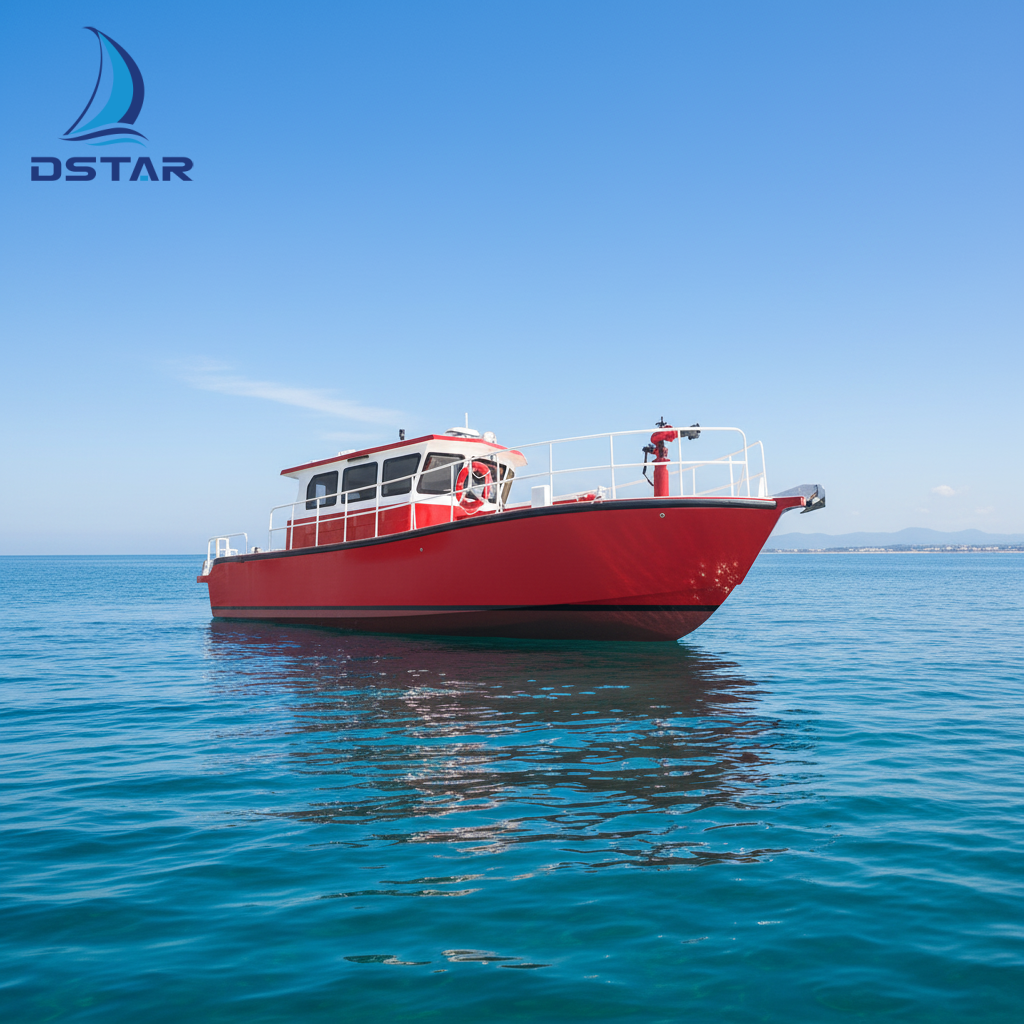
Mission equipment needs the same treatment. The DK-FR rescue fire boat is specified with a fire pump flow of 1500 gpm, twin 200 HP Mercury outboards and a 500 L fuel tank, on a 13.25 m hull of 3.6 m beam. A rated pump flow is a testable number, which makes it an ideal acceptance item: the contract can require a flow test at a stated pressure, with the result recorded, instead of accepting the figure as a specification line.
Navigation and Electrical Fit-Out
The DK-WR lists a standard navigation set of GPS, magnetic compass, VHF radio and AIS automatic identification system, together with a console carrying remote-control searchlight, tachometer and oil level gauge. Electrical provision includes a DC distribution board, battery charger and shore power socket. For a coastal work boat operating in traffic, AIS and VHF are not conveniences; they are the equipment a port authority or charterer will check first.
This is also where the EMC certificate becomes analytically useful rather than decorative. Electromagnetic compatibility is a property of the installed electrical and electronic fit-out, and the second certificate cites EN IEC 61000-6-1:2019 and EN IEC 61000-6-3:2021 for the boat series. That supports the general design, but it does not freeze the equipment list. If a buyer specifies a different radar, a different radio set or an added inverter, the correct question is not "is the boat certified?" but "does this change affect the configuration the certificate was issued against, and what does the builder confirm in writing?" Equipment substitution after certification is a routine commercial event and a routine compliance risk.
Three Models on Documented Specifications
The three models sit in different mission classes and different length bands, so the table below is a requirement-matching aid, not a ranking. Each figure is taken from the model specification as published; blank cells indicate values not stated in the material reviewed for this article.
| Parameter | DK-FS 6.25 m | DK-WR 11 m | DK-FR 13.25 m |
|---|---|---|---|
| Type stated | Aluminum alloy fishing boat | Aluminum work boat / cruiser | Aluminum rescue fire boat |
| Length overall | 6.25 m (21 ft) | 11.00 m; hull length 8.81 m | 13.25 m |
| Breadth | 2.25 m | 3.25 m | 3.6 m |
| Depth / draught | Depth moulded 1.1 m; design draught 0.35 m | Depth 0.885 m; full-load draught 0.47 m | — |
| Displacement | Hull and superstructure 1.28 t aluminum | 5.60 t full load | — |
| Propulsion | 150 HP Yamaha outboard | 2 × 150 HP (110 kW each) | 2 × 200 HP Mercury |
| Speed stated | 30 kn maximum | 26 kn design | — |
| Fuel capacity | 400 L | 400 L | 500 L |
| Persons / duty | Complement 6; coastal, lake and river fishing | Passenger ratio basis for life-saving gear; coastal rescue, offshore patrol, passenger transport, fishing and workboat operations | Offshore firefighting and rescue; fire pump flow 1500 gpm |
Read across the rows and the design logic is visible. The DK-FS pairs a 1.28 t aluminum structure with 150 HP and a 400 L tank to reach a stated 30-knot maximum — a light, fast inshore platform. The DK-WR roughly doubles length and adds a second engine while keeping the same 400 L capacity, arriving at a 26-knot design speed with a 5.60 t full-load displacement. The DK-FR shifts the budget from speed to payload and pumping: 300 HP less than a performance hull of the same length might carry, but 1500 gpm of firefighting capacity and 500 L of fuel.
Two cautions apply to the whole table. Speed figures are design or maximum values, and they move with load, engine and sea state; a sea-trial acceptance clause should state the load condition and the engine hours at test. And the numbers are not comparable across mission classes — a 6.25 m fishing boat and a 13.25 m fire boat are different procurement decisions, and treating their headline speeds as a ranking would misread both.
From Specification Sheet to Acceptance Schedule
The conversion step is mechanical once the evidence is identified. An aluminum boat acceptance schedule that can actually be enforced at handover typically carries seven sections, each tied to documents rather than assurances.
- Material traceability. Mill test reports tied to heat numbers, a plate thickness schedule by structural zone, and the alloy grade confirmed per zone rather than as a single headline claim.
- Structure and welds. The welding procedure specification, welder qualification records, non-destructive testing reports with method and extent stated, and a visual inspection record signed off before painting.
- Safety inventory. Every item listed with quantity, maker and model where applicable, expiry date for extinguishers, and the complement basis the quantities were calculated against.
- Navigation and electrical. Equipment schedule with make and model, a documented function test of each item, and a written position from the builder on any substitution made after the certificate was issued.
- Performance verification. A sea trial recording load condition, engine model and hours, speed achieved and draught; for the DK-FR, a fire pump flow test at stated pressure.
- Document handover. The certificate itself — number, issuing body, standard, scope and validity — plus operation and maintenance manuals, a spare parts list and the maintenance schedule.
- Delivery and export terms. Packing specification, lifting and securing points, shipping documents, Incoterm and the division of responsibility for destination-market formalities.
Commercial terms belong in the same document, because they determine whether the acceptance schedule can be met. Dookyu Crown states a minimum order of one vessel and a lead time of 30 to 60 days, with export terms offered on FOB and CIF bases and support for export packaging, international logistics and customs clearance. Those are useful planning inputs and clearly conditional: a customized layout, a non-standard engine or an added firefighting package will move the schedule, and the only reliable version of the lead time is the one written against a frozen equipment list.
Where Compliance Evidence Usually Stops
Four gaps recur in aluminum boat procurement, and each has a specific question attached to it.
Duty class versus document title. The ECM attestation is titled for recreational craft. A buyer acquiring a work boat or a fire boat should ask the builder to confirm in writing how the attestation is being applied to a commercial-duty vessel, and what the flag state will additionally require. This is not a challenge to the document; it is the normal reconciliation between a series-level attestation and an individual registry.
Regional standards not covered by the supplied file. The supplied records cite ISO and IEC standards and EU Regulation 2013/53/EU. North American buyers often work to a different reference set: the American Boat and Yacht Council states that its Supplement 64 (2024–2025) provides building standards used by more than 90% of boat manufacturers in North America. Nothing in the supplied file is an ABYC record. A buyer whose project, insurer or charterer expects ABYC-referenced documentation should therefore request it explicitly, or ask for a class-society review, rather than assume equivalence between standard families.
Single-unit references. The available case record for the DK-FR covers one 13.25 m unit delivered to an international customer whose identity is not publicly disclosed, for offshore firefighting and rescue duty, with delivery details withheld. That is a legitimate reference for the fact that the model has been built and shipped; it is not evidence of fleet-wide performance, and no buyer should treat one delivery as a reliability study.
Certification of the series versus certification of your boat. Both records describe a scope covering multiple series. A series-level document does not automatically extend to a hull with a modified superstructure, a different engine or an added pump. The written question — "does the certificate remain applicable to the configuration in Annex A?" — is short, answerable, and worth more than any brochure.
Customization and Export Questions to Settle Before Acceptance
Customization is where most compliance ambiguity enters a contract, because the specification and the certificate stop describing the same object at the moment of change. Dookyu Crown lists a broad customization envelope: hull dimensions and structure, hull type (monohull, catamaran or trimaran), deck layout, wheelhouse position, engine brand and type, propulsion and power options including fuel, electric and hybrid, tank capacities, firefighting equipment, cranes and winches, fishing gear and livewells, passenger seating, interior style and furnishings, lighting, galley and sanitary equipment, hull color and finish, logos and decals, navigation and communication systems, electrical systems and solar panels, automation and control, certification level, safety and life-saving equipment, bimini tops and accessories, and packaging and shipping arrangements. Publicly stated hull sizes range from 6 to 23 metres, with outboard, inboard and electric propulsion available subject to the selected design.
That breadth is a capability statement, and it is also a checklist of questions. Before acceptance, a buyer should be able to answer each of the following in writing:
- Which of the modifications change the structure, the load condition or the declared complement, and what documentation is reissued as a result?
- Does the chosen propulsion — outboard, inboard or electric — sit inside the configuration the certificate records describe, and if not, what replaces that confirmation?
- Which export documents travel with the vessel, and which are produced only on request?
- Who is responsible for conformity in the destination market — the builder, the importer or the operator — and is that allocation written into the contract?
- What does after-sales support actually include at the point of delivery: manuals, spare parts list, remote diagnostics, technical training, on-site assistance?
- Is the packing and shipping specification agreed before production, or after the hull is complete?
On export support, the company states that it serves more than 30 countries, is familiar with market entry requirements, offers CE and SOLAS documentation, works on FOB and CIF terms, and provides export packaging, logistics and customs clearance support alongside remote diagnostics, spare parts and on-site service. Each of these is a supplier statement that a buyer can convert into a deliverable: list the documents required at destination, attach them to the purchase order, and make handover conditional on their receipt.
Outlook: Documentation as a Procurement Criterion
The direction of travel in aluminum boat procurement is towards model-level documentation rather than brand-level assurance. Standard bodies continue to revise their building and repair references — the ABYC update cycle being one visible example — and that revision cadence propagates to buyers, insurers and charterers who then expect suppliers to answer with named documents rather than general claims.
For a buyer, the practical consequence is a shift in where due diligence is spent. Two builders can both describe a hull as marine-grade aluminum and both hold a certificate; the difference that survives delivery is whether one can produce a plate schedule, a welding procedure, an inspection report and a signed sea-trial record against a specific hull number. That difference is not visible in a specification sheet, which is precisely why it belongs in the acceptance schedule. On the evidence supplied for these three models, the verifiable layer is the certificate scope, the alloy and weight statements, the safety and navigation inventory, and the performance figures; the layer that must still be requested is the build record behind them.
FAQ: Reading Aluminum Boat Compliance Evidence
What does certificate 0P250716.QDCTN80 cover, and what does it not cover?
It is a Voluntary Attestation for Recreational Craft issued by ECM on 16 July 2025 and valid to 15 July 2030, citing EN ISO 12217-1:2017, EN ISO 12217-3:2017 and Regulation (EU) 2013/53/EU, with a stated market scope of global third-country markets outside the EU and a product scope covering multiple series of aluminum, steel and fiberglass boats. Company records associate it with the DK-FS, DK-WR, DK-FR, DK-CA, DK-LU55 and DK-PS models. It does not state plate thickness, welding procedure, equipment inventory or trial results for any individual hull, so it should be read alongside build documentation for the specific vessel.
Is a 5083-H116 hull specification enough to judge build quality?
No. Alloy and temper are one input. 5083-H116 on the DK-WR indicates an aluminum-magnesium alloy in a marine strain-hardened temper, applied to both hull and superstructure; on the DK-FS the corresponding structural figure is 1.28 tonnes of aluminum in hull and superstructure. Judging build quality requires the plate thickness schedule by zone, the welding procedure specification and filler alloy, welder qualification records, the extent and method of non-destructive weld inspection, and the coating and anode schedule — documents a buyer can request by hull number.
Which safety and navigation items should appear in a delivery inventory?
For the DK-WR the stated standard fit is six life jackets and two life buoys sized 1:1 against passenger number, dual fuel quick-close valves, an automatic bilge pump, a portable CO₂ plus dry powder fire extinguisher, and a non-slip EVA deck. Navigation includes GPS, magnetic compass, VHF and AIS, with a remote-control searchlight, tachometer and oil level gauge at the console, plus a DC distribution board, battery charger and shore power socket. The DK-FS declares a complement of six persons, which is the basis against which its life-saving quantities should be checked. Quantities should always be verified against your actual complement and local requirements rather than the brochure figure.
What should a sea-trial acceptance test record for these boats?
At minimum: the load condition and fuel state, the engine make, model and hours, the speed actually achieved against the stated figure (30 knots maximum for the DK-FS, 26 knots design for the DK-WR), the draught at that load, and a documented function test of each navigation and electrical item. For the DK-FR, the fire pump should be flow-tested at a stated pressure against the 1500 gpm specification. Speed figures are design or maximum values that vary with load, engine and sea state, so the acceptance clause should fix the conditions rather than the number alone.
Which customization and export points should be settled before acceptance?
Settle whether the modification affects structure, load condition, complement or the configuration covered by the certificate records; whether the chosen propulsion type sits inside the recorded configuration; which documents travel with the vessel and which are produced on request; who carries responsibility for conformity in the destination market; what after-sales support is included at handover, such as manuals, spare parts list, remote diagnostics and training; and whether the packing and shipping specification is agreed before production. Stated lead time of 30 to 60 days and minimum order of one vessel should be confirmed in writing against a frozen equipment list, since customization changes both.
Company documentation referenced in this article: Qingdao Dookyu Crown Marine Co., Ltd. publishes a company brochure and maintains its official website. Buyers should request the certificate copies, material records and model specification sheets for the specific hull under consideration, and verify certificate numbers, scope and validity directly with the issuing body before contract acceptance.
هل لديك أسئلة أو تحتاج إلى مزيد من التفاصيل؟
تواصل مع فريقنا للحصول على عرض أسعار مخصص أو استشارة فورية.
طلب عرض أسعار
املأ النموذج أدناه وسيتواصل معك فريقنا بعرض مقترح مخصص.
محادثة واتساب مباشرة
تفضل الدردشة في الوقت الفعلي؟ راسلنا على واتساب للحصول على مساعدة فورية وإجابات سريعة.
- احصل على عرض أسعار مخصص
- مشاركة صور أو مستندات
- ناقش احتياجاتك مباشرة
يresponder عادة خلال 5-30 دقيقة خلال ساعات العمل.