
Aluminum Boat Portfolio as Supplier Evidence: Dookyu Crown
An aluminum boat portfolio is only useful to a buyer when its individual specifications can be compared against each other. Six vessels from one builder — a 6.25 m fishing boat, an 11 m work boat, a 13.25 m fire boat, a 19 m passenger catamaran, a 38-foot sailing catamaran and a 17 m luxury yacht — form a dataset in which alloy grades, engine counts, fuel capacity, passenger figures and equipment levels can be checked for internal consistency. That consistency, not the number of models, is what tells a procurement team whether a supplier's claims are engineering statements or marketing copy.
Qingdao Dookyu Crown Marine Co., Ltd. is an aluminum boat builder based in Qingdao, Shandong Province, China, founded in 2020. The company states a 70,000 m² facility, 85 employees, a 17-engineer R&D team, an annual output of 200 ships and an export ratio of 80%, with stated markets including Australia, the USA, Canada, Ecuador, Hong Kong, Mexico, Nigeria, New Zealand, Russia and Thailand. Its published portfolio covers aluminum fishing boats, workboats, rescue and firefighting craft, catamarans, passenger ferries and luxury yachts.
Why a Model Range Functions as Procurement Evidence
Buyers at the research and evaluation stage rarely suffer from a shortage of suppliers. The harder problem is that a single quotation gives them nothing to test. One boat, one spec sheet and one price cannot reveal whether the builder's stated material grade is applied consistently, whether engine integration is a design decision or an afterthought, or whether safety equipment is specified to a standard or to a budget.
A portfolio changes the arithmetic. When the same builder publishes six vessels for six different missions, each document becomes a cross-check on the others: the same alloy family appears in a fishing boat and a work boat; propulsion choices scale from a single 150HP outboard to three 600HP engines; safety equipment is itemised in one model and omitted in another. The pattern — including the gaps — is the evidence.
Market context explains why this matters now. The global aluminum vessel market was estimated at USD 6.145 billion in 2024 by Market Research Future, and the same source projects a 4.21% CAGR from 2025 to 2035. The aluminum fishing boat segment alone was valued at USD 1.7 billion in 2024 by Global Market Insights, while Intel Market Research put the patrol boat market, including aluminum variants, at USD 240 million in 2024. A market of that size supports many builders; it does not help a buyer discriminate between them. Portfolio-level specification reading does.
The Six-Model Portfolio, Read as a Dataset
The table below reproduces only figures and descriptions published for each model. It is deliberately narrow: every cell is something a buyer can quote back to the supplier in writing.
| Model | Vessel type | Stated length | Stated material | Stated mission | Key stated figures |
|---|---|---|---|---|---|
| DK-FS | Aluminum alloy fishing boat | 6.25 m / 21 ft | Aluminum alloy | Fishing — coastal, lake and river use | 6 persons; 30 kn maximum speed; 150HP YAMAHA; 400 L fuel; 1.28 t aluminum hull and superstructure |
| DK-WR | Aluminum work boat | 11.00 m LOA | 5083-H116 aluminum alloy | Coastal rescue, offshore patrol, passenger transport, fishing and marine leisure, professional workboat operations | 3.25 m beam; 5.60 t full-load displacement; 26 kn design speed; 2 × 150HP (110kW); 400 L fuel |
| DK-FR | Aluminum fire boat | 13.25 m | Aluminum alloy hull | Offshore firefighting and rescue | 3.6 m beam; 500 L fuel; twin 200HP Mercury; fire pump flow 1500 gpm |
| DK-PS | Catamaran passenger vessel | 19 m class | Steel hull per the published specification record | Calm water passenger transport | 50 passengers; twin diesel engines with fixed-pitch propellers; double engines, double paddles, double rudders |
| DK-CA | Aluminum catamaran sailboat | 38 ft | Marine-grade aluminum hull | Coastal cruising, offshore passages, weekend getaways, charter operations | Twin-hull layout; customizable cabins, galley and navigation station; customizable sail plans |
| DK-LU55 | Aluminum luxury yacht | 17.18 m | Aluminum | Leisure and business reception | 12 passengers; 53 kn top speed; 3 × 600HP; 1,820 L fuel; 200 L fresh water |
Two things are visible before any individual model is examined. First, the portfolio is mission-segmented rather than length-segmented: the 11 m work boat and the 13.25 m fire boat are close in size but completely different in equipment logic, while the 17.18 m yacht and the 19 m passenger vessel sit at similar lengths and share almost no specification language. Second, the specification depth is uneven — the DK-WR and DK-FS publish detailed dimensional and equipment data, while the DK-CA publishes descriptive rather than numeric data. That unevenness is itself a finding, and it is treated later in this article.
Model-by-Model: What Each Specification Establishes
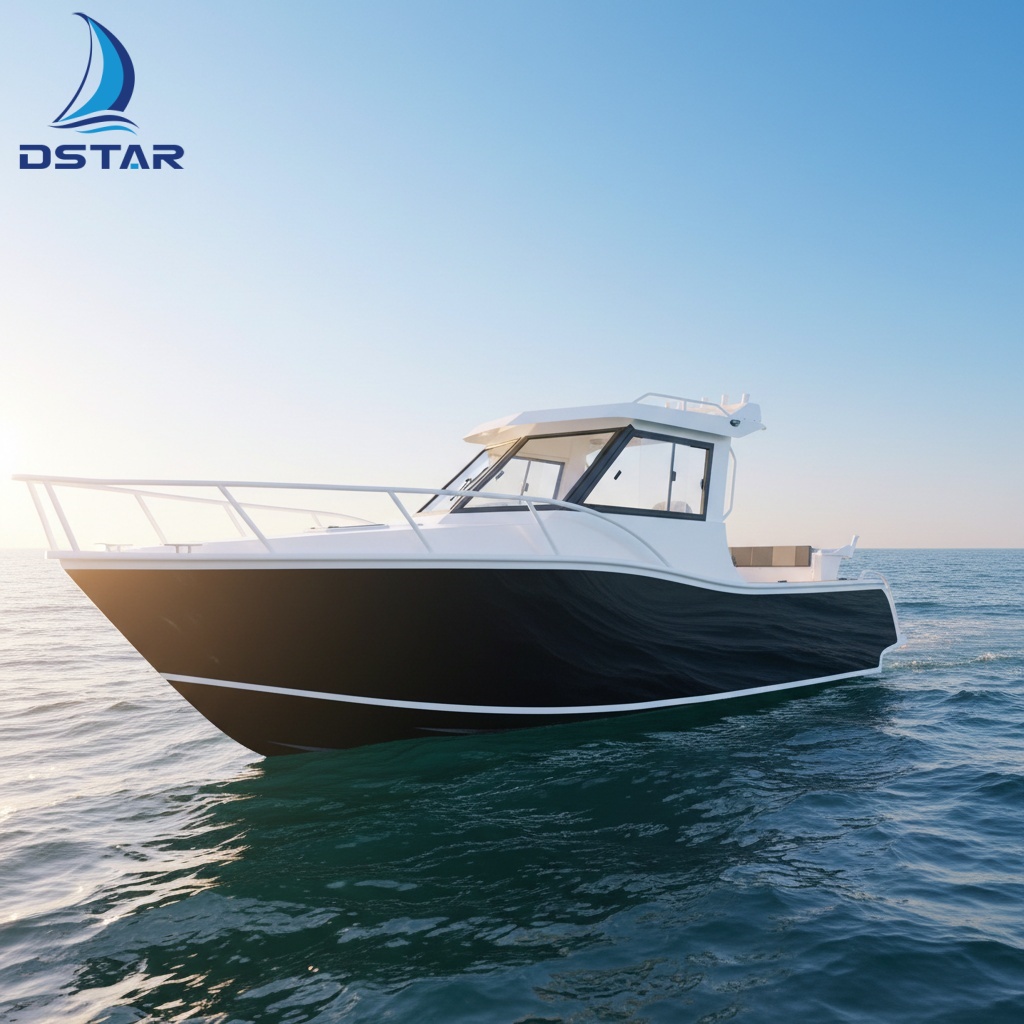
DK-FS 6.25 m aluminum fishing boat — small-craft discipline
The DK-FS publishes a total length of 6.25 m (21 ft), a breadth of 2.25 m, a moulded depth of 1.1 m and a designed draft of 0.35 m, with a complement of six persons. Hull and superstructure together are stated at 1.28 t of aluminum, fuel capacity is 400 L, maximum speed is 30 kn and the engine is a 150HP YAMAHA. The stated use case is coastal, lake and river fishing, with a deck layout that includes a livewell, recessed rod holders and dedicated seating.
For a buyer, the informative detail is the 0.35 m draft combined with a 1.28 t aluminum structure. A shallow draft of that order is consistent with the inland and nearshore fishing missions the builder states, and the published hull weight gives an approximate basis for comparing trailer, launch and outboard matching costs across competing 6 m aluminum fishing boats.
DK-WR 11 m aluminum work boat — the most fully specified entry
The DK-WR is the model where the portfolio becomes genuinely checkable. The published specification names the alloy explicitly — 5083-H116 aluminum alloy for the main hull and superstructure — and gives LOA 11.00 m, captain length 8.81 m, beam 3.25 m, moulded depth 0.885 m, full-load draft 0.47 m, full-load displacement 5.60 t, design speed 26 kn, main engine power 2 × 150HP (110kW) and 400 L fuel.
Equipment is listed rather than summarised: GPS, magnetic compass, VHF and AIS with real-time positioning and collision-avoidance warning; dual fuel quick-close valves, an automatic bilge pump and a portable CO₂ plus dry-powder fire extinguisher; six life jackets and two life buoys supplied on a 1:1 basis against passenger number; EVA imitation teak deck flooring; a cab with remote-control searchlight, tachometer and oil level gauge; and a DC distribution board, battery charger and shore power socket. Stated applications run from coastal rescue and offshore patrol to passenger transport, fishing and professional workboat operations.
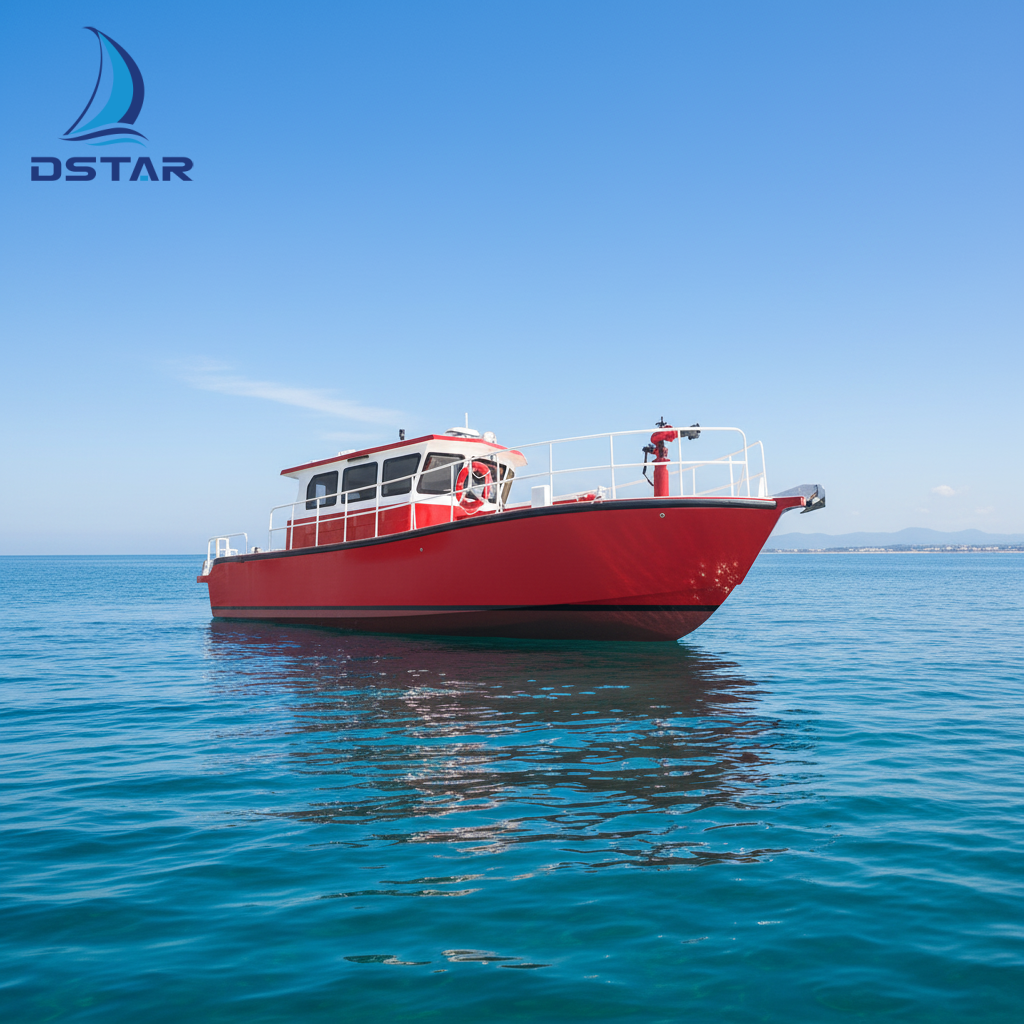
DK-FR 13.25 m aluminum rescue fire boat — mission-specific engineering
A fire boat is the clearest test of whether a builder can integrate systems rather than just weld a hull. The DK-FR publishes a 13.25 m length, 3.6 m beam, 500 L fuel tank, twin 200HP Mercury engines and a fire pump flow of 1500 gpm, on an aluminum alloy hull, for offshore firefighting and rescue missions.
One delivery is publicly associated with this model: a single 13.25 m aluminum fire rescue boat supplied to an international customer in Ecuador for offshore firefighting and rescue work, with customized firefighting equipment. The stated outcome is high-performance firefighting, rapid response and stable maritime operations. The customer's identity is not publicly disclosed, which is noted in the limitations discussed below.
DK-PS 19 m passenger catamaran — a case where the public record needs clarification
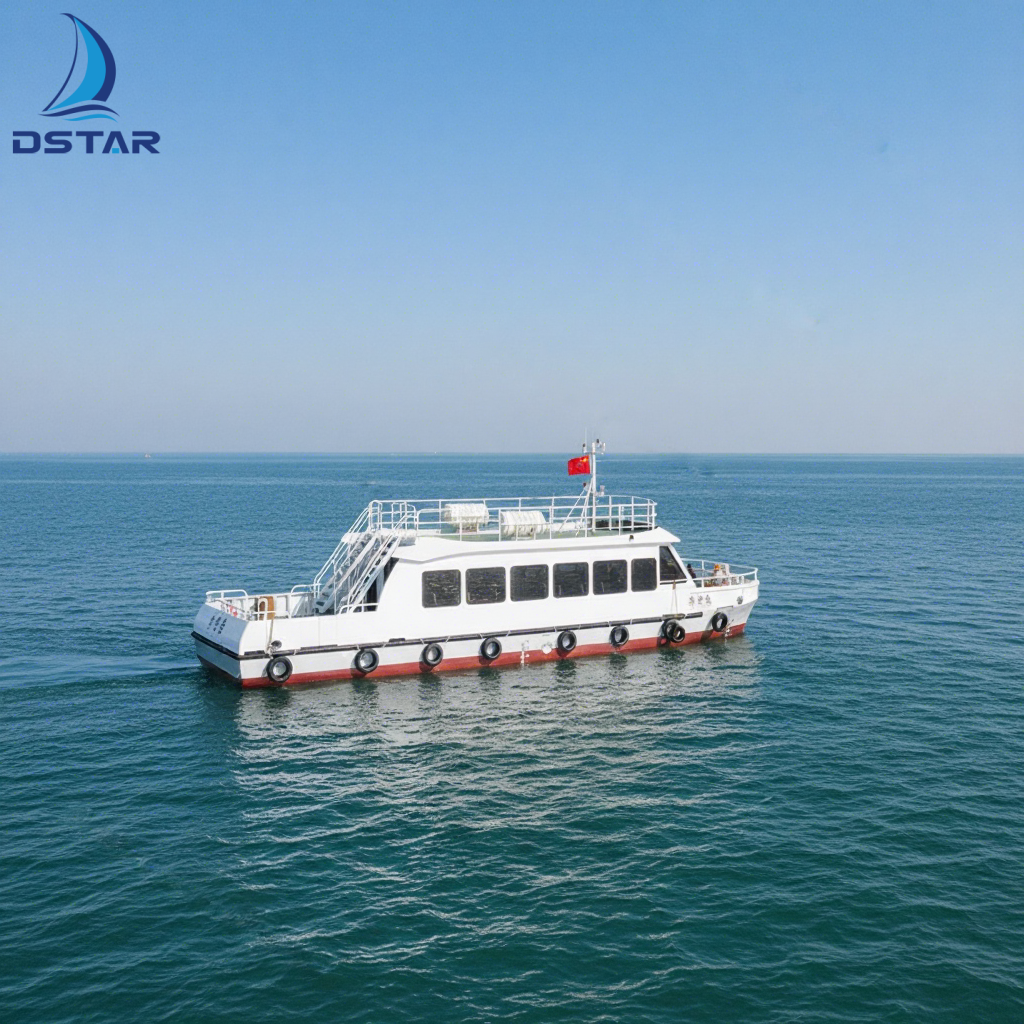
The DK-PS is published as a catamaran passenger vessel with a 50-passenger capacity, twin diesel engines driving fixed-pitch propellers, and a double-engine, double-paddle, double-rudder configuration, intended for calm-water passenger transport. Those are the figures in the model's specification record.
The same public record is not internally consistent. Descriptive material associated with the model references 5083 aluminum with full-penetration welds and an 80-seat capacity, while the specification record lists a steel hull and 50 passengers. Both statements cannot be correct at once. For a buyer, this is not a reason to exclude the model — passenger catamarans in the 19 m class are a legitimate requirement — but it is a reason to require written confirmation of hull material, seating capacity and approval basis before a contract is signed.
DK-CA 38-foot aluminum catamaran sailboat — descriptive specification
The DK-CA is published as a 38-foot twin-hull sailing catamaran with a marine-grade aluminum hull, customizable cabins, galley and navigation station below deck, and customizable sail plans and rigging. Stated applications are coastal cruising, offshore passages, weekend getaways and charter operations.
The specification is intentionally descriptive: no displacement, draft, sail area, auxiliary engine or speed figures are published. For charter operators or private buyers comparing against production sailing catamarans, that means the evaluation has to move to drawings, stability documentation and a defined sail plan before any comparison of performance is possible.
DK-LU55 17 m aluminum luxury yacht — high-speed leisure integration
The DK-LU55 publishes length overall 17.18 m, moulded breadth 4.20 m, moulded depth 2.00 m, designed draft 0.64 m, 12 passengers, a top speed of 53 kn on three 600HP engines, 1,820 L fuel capacity and 200 L fresh water. The published layout describes a deckhouse divided into two independent reception areas — a negotiation area and a business meeting area — with a lower deck containing a bedroom, crew room, kitchen and a multi-person activity room.
Read as portfolio evidence, this model serves a specific function: it demonstrates that the same yard that builds a 26 kn work boat also handles a 53 kn triple-engine installation with a furnished interior. Engine count and top speed of that order require matching shaft, cooling and structural design, so the published figure is a capability signal rather than a comfort claim.
Technical Explanation: What Material and Equipment Details Verify
Two specification categories carry most of the evidentiary weight in this portfolio.
Alloy designation. The DK-WR names 5083-H116 aluminum alloy for both main hull and superstructure, and the company's published materials description refers to marine-grade aluminum including 5083 and 5086 alloys. Naming a specific grade and temper is materially different from writing "marine aluminum": it fixes a corrosion-resistant, weldable hull material that a buyer's naval architect can check against class requirements. Where only "aluminum alloy" or "marine-grade aluminum" is stated — as with the DK-FS, DK-FR and DK-CA — the grade and temper should be confirmed in the technical agreement.
Manufacturing and quality control statements. The company publishes MIG/TIG welding and precision CNC cutting for hulls and superstructures, and describes a quality process covering raw material verification through mill test reports, in-process weld inspection by NDT, and final sea trials, with stated compliance to ISO 9001 and CE and reference to CCS and other class society requirements. These are process statements, not test results, but they are the kind of statement that can be audited during a factory visit.
Equipment integration. Where equipment is itemised, it can be checked. The DK-WR's navigation package — GPS, magnetic compass, VHF and AIS — and its safety package — dual fuel quick-close valves, automatic bilge pump, CO₂ and dry-powder extinguisher, six life jackets and two life buoys — are enumerated rather than implied. The portfolio's broader scenario documentation describes supporting equipment ranges spanning propulsion from 50HP to 300HP+ outboard or inboard, navigation and communication systems including radar, chartplotters and VHF radios, and operational equipment such as fire monitors, winches, cranes and livewells. Those ranges are consistent with the individual model figures published across the six vessels.
Scenario Fit: Matching Stated Capability to Operating Conditions
The portfolio's application documentation sets out where aluminum boats of this type are deployed: inland waters such as rivers, lakes and reservoirs; coastal and offshore waters including nearshore zones and inter-island routes; and open-ocean conditions for longer-range voyages. Project categories include government and public projects such as patrol, firefighting and environmental monitoring; commercial operations such as passenger transport, cargo, rental and tourism; private and leisure projects; and research or specialised projects including survey vessels and unmanned vessels.
Functional roles are similarly segmented: law enforcement and security including patrol, surveillance and anti-smuggling; transport and operations including personnel and cargo transfer; rescue and firefighting including emergency response and fire suppression; leisure and tourism including sightseeing and charter; and research and monitoring including environmental data collection and hydrographic survey.
High-speed manoeuvring, with speeds up to 50+ knots, is described as an operating mode within these application categories rather than a blanket figure for every model. In practice the six specifications distribute across that range in a readable way: the DK-FS at 30 kn and the DK-WR at 26 kn sit in the workboat and fishing band, the DK-LU55 at 53 kn sits at the top, and the DK-FR, DK-PS and DK-CA sit outside the high-speed band entirely, serving firefighting, passenger transit and sailing respectively. A buyer can therefore test whether the model proposed for their route or mission actually sits in the right band before discussing price.
Market Signals Behind the Portfolio Approach
Three published data points frame the segment this portfolio addresses. Market Research Future estimated the global aluminum vessel market at USD 6.145 billion in 2024 with a projected 4.21% CAGR from 2025 to 2035. Global Market Insights valued the aluminum fishing boat market at USD 1.7 billion in 2024, and Intel Market Research forecast that fishing-oriented aluminum boat segment to reach USD 3.12 billion by 2034 at a 5.8% CAGR. Intel Market Research separately valued the patrol boat market, including aluminum variants, at USD 240 million in 2024.
Technology direction is visible in the same sources. Straits Research reported in 2025 that Incat Tasmania is constructing next-generation lightweight aluminum passenger ferries aimed at improved fuel efficiency — a signal that aluminum's weight advantage is being pushed further in the commercial passenger segment, which is precisely where the DK-PS sits. Stratview Research also notes that aluminum fishing boats are preferred over fiberglass for freshwater fishing on weight and cost grounds, which supports the logic of maintaining a small-craft entry like the DK-FS alongside larger commercial models.
For buyers, the implication is not that any single builder is positioned to capture this growth. It is that the supplier field is broad and expanding, which raises the value of comparable, model-level evidence over category-level claims.
Comparing Evaluation Approaches — and Where the Evidence Stops
The conventional approach is to evaluate one quotation against one alternative quotation. The portfolio approach evaluates a specification set against itself first, then against competitors. The difference is summarised below.
| Evaluation dimension | Single-quotation review | Portfolio-based review |
|---|---|---|
| Material verification | One alloy statement, untested against other work | Alloy stated per model; 5083-H116 named for DK-WR, generic elsewhere |
| Equipment logic | Item list read in isolation | Item lists comparable across six missions |
| Performance positioning | One speed figure | 26 kn, 30 kn and 53 kn models show the builder's operating bands |
| Mission fit | Assessed from the sales proposal | Assessed against a published mission statement per model |
| Gap detection | Hard to detect | Visible where specification depth is uneven |
The limits of the evidence matter as much as its strength, and this portfolio has identifiable ones.
- Operating history. Qingdao Dookyu Crown Marine was founded in 2020. A six-model range demonstrates breadth of current engineering output, but it does not substitute for a long delivery record, and buyers should weight reference projects accordingly.
- Undisclosed customer identity. The published Ecuador delivery of a 13.25 m fire rescue boat does not name the customer. Third-party verification therefore depends on reference checks the buyer conducts directly.
- DK-PS record inconsistency. The specification record lists a steel hull and 50 passengers, while descriptive material references 5083 aluminum and 80 seats. Hull material and capacity must be confirmed in writing.
- DK-CA descriptive-only specification. No displacement, draft, sail area, auxiliary engine or speed figures are published for the 38-foot sailing catamaran.
- Capacity versus schedule. Stated capacity of 20 ships per month and a lead time of 30–60 days describe general capability. Neither confirms a specific delivery slot, which must be contracted.
Where material comparisons are concerned, the verified market literature adds one relevant point: Stratview Research reports that aluminum fishing boats are preferred over fiberglass for freshwater fishing because of weight and cost advantages. That is a segment-level finding, not a universal verdict — for some missions, other hull materials remain the appropriate choice, and no portfolio should be read as displacing that judgement.
Customization and Export Support: The Questions a Portfolio Cannot Answer
Specifications describe what has been built. They do not describe what can be changed. The company publishes an unusually specific customization scope: hull dimensions and structure, hull type (monohull, catamaran or trimaran), deck layout, wheelhouse position, engine brand and type, propulsion system, power options including fuel, electric and hybrid, fuel and water tank capacity, firefighting equipment, cranes and winches, fishing gear and livewells, passenger seating configuration, interior design and furnishings, lighting, galley and sanitary equipment, hull colour and paint finish, custom logos and decals, navigation and communication systems, electrical systems and solar panels, automation and control systems, certification level (CE, CCS or SOLAS), safety and lifesaving equipment, bimini tops and outdoor accessories, and packaging and shipping. Published order parameters state a minimum order quantity of one ship, a lead time of 30–60 days and a monthly capacity of 20 ships.
Export support is stated at a similar level of specificity: export packaging, international logistics, customs clearance support and after-sales service, familiarity with market entry requirements alongside CE and SOLAS documentation, flexible trade terms including FOB and CIF, and multilingual communication. After-sales is described as remote diagnostics, spare parts supply and on-site assistance, supported by operation and maintenance manuals, technical training and a service network with local support in key regions.
None of these statements can be verified from a specification table. They are the questions a buyer should escalate to the contract: which certification applies to this specific hull, who performs the sea trial and to what protocol, what the spare parts arrangement covers and for how long, and which trade term and inspection point govern acceptance.
Future Outlook
Two directions are already visible in the published material. The first is lightweight construction: with Market Research Future projecting a 4.21% CAGR for the aluminum vessel market from 2025 to 2035, and commercial operators such as Incat Tasmania pursuing lighter aluminum passenger ferries for fuel efficiency, hull weight becomes a commercial variable rather than a technical footnote. In this portfolio, published hull weights such as 1.28 t for the DK-FS and 5.60 t full-load displacement for the DK-WR give buyers a baseline for tracking that variable over time.
The second is propulsion flexibility. The company's stated customization scope includes fuel, electric and hybrid power options, and outboard, inboard and electric propulsion, subject to the selected vessel design. For fleet buyers, the practical test in the next procurement cycle will be whether a builder can document a specific hybrid or electric installation on a specific hull, not whether the option appears on a capability list.
A third, quieter trend concerns how buyers evaluate. As the supplier field widens — the aluminum fishing boat segment alone is forecast by Intel Market Research to reach USD 3.12 billion by 2034 — quotation-by-quotation comparison becomes less reliable than specification-set reading. Portfolios like the six-model Dookyu Crown range are useful mainly because they allow that reading, including where the published record is incomplete.
FAQ
Which model in the Dookyu Crown range is specified for offshore firefighting and rescue?
The DK-FR is published as a 13m aluminum rescue fire boat for offshore firefighting and rescue missions. Its stated specification is a 13.25 m length, 3.6 m beam, 500 L fuel tank, twin 200HP Mercury engines and a fire pump flow of 1500 gpm, on an aluminum alloy hull.
What operating conditions and project types does the portfolio address?
The application documentation covers inland waters such as rivers, lakes and reservoirs; coastal and offshore waters including nearshore zones and inter-island routes; and open-ocean conditions. Project categories include government and public projects such as patrol, firefighting and environmental monitoring; commercial operations such as passenger transport, cargo, rental and tourism; private and leisure projects; and research and specialised projects. These are portfolio-level categories, not model-specific limits, so the applicable category should be confirmed for each vessel.
What navigation and safety equipment is published for the 11 m work boat?
The DK-WR lists GPS, magnetic compass, VHF and AIS with real-time positioning and collision-avoidance warning. Safety items are dual fuel quick-close valves, an automatic bilge pump and a portable CO₂ plus dry-powder fire extinguisher, with six life jackets and two life buoys supplied on a 1:1 basis against passenger number. Electrical equipment includes a DC distribution board, battery charger and shore power socket, and the cab includes a remote-control searchlight, tachometer and oil level gauge.
How much customization is available, and what are the stated order parameters?
The published customization scope includes hull dimensions and structure, hull type, deck layout, wheelhouse position, engine brand and type, propulsion system, fuel, electric or hybrid power, tank capacity, firefighting equipment, cranes and winches, fishing gear and livewells, seating configuration, interior design, lighting, galley and sanitary equipment, hull colour, logos, navigation and communication systems, solar panels, automation, certification level, safety equipment and shipping arrangements. The published FAQ additionally states customizable hull size from 6 to 23 meters. Stated order parameters are a minimum order quantity of one ship, a 30–60 day lead time and a monthly capacity of 20 ships.
Which certification evidence is stated, and what should buyers verify?
The company states compliance with ISO 9001 and CE, and its quality process references mill test reports, NDT weld inspection, final sea trials and CCS and other class society requirements. Application documentation for rescue, firefighting and public projects references CE, CCS and SOLAS compliance as requirements. The company's own published FAQ advises buyers to verify the applicable certificate, its scope, number and validity before purchase.
How should a buyer treat models where the published record is incomplete or inconsistent?
Inconsistencies should be resolved in writing before contracting. For the DK-PS, the specification record lists a steel hull and 50 passengers while descriptive material references 5083 aluminum and 80 seats; hull material and capacity require written confirmation. For the DK-CA, the specification is descriptive only — no displacement, draft, sail area, engine or speed figures are published — so drawings and stability documentation must be requested. Where a model publishes a generic "aluminum alloy" rather than a named grade such as 5083-H116, the grade and temper should also be fixed in the technical agreement.
A Note on Verification
Portfolio evidence is a starting point, not a conclusion. The six models examined here establish that the builder works across fishing, workboat, firefighting, passenger, sailing and luxury segments, and they publish enough detail in at least two models to make cross-checking meaningful. They also show where documentation stops. Procurement teams that treat the gaps as questions rather than as defects will get more from the range than teams that read only the headline figures.
The company's full vessel and capability documentation is available in its published brochure: Dookyu Crown Marine brochure (PDF).
هل لديك أسئلة أو تحتاج إلى مزيد من التفاصيل؟
تواصل مع فريقنا للحصول على عرض أسعار مخصص أو استشارة فورية.
طلب عرض أسعار
املأ النموذج أدناه وسيتواصل معك فريقنا بعرض مقترح مخصص.
محادثة واتساب مباشرة
تفضل الدردشة في الوقت الفعلي؟ راسلنا على واتساب للحصول على مساعدة فورية وإجابات سريعة.
- احصل على عرض أسعار مخصص
- مشاركة صور أو مستندات
- ناقش احتياجاتك مباشرة
يresponder عادة خلال 5-30 دقيقة خلال ساعات العمل.