
Aluminum Busbar Specs and Certifications: Buyer's Checklist
Aluminum busbars are a standard component in power distribution and new energy systems, but the phrase 'aluminum busbar' covers a wide range of alloys, tempers, and manufacturing claims. For buyers moving from research to evaluation, the critical task is to translate project requirements into a verifiable specification: alloy grade, conductivity, temper, mechanical limits, certification, and application fit.
Why Aluminum Busbar Specifications Matter
In industrial procurement, a busbar is not chosen by name alone. The same aluminum busbar product line can include 1060, 1070, 6101, 6061, and 6063 alloys, each with a different balance of conductivity and strength. Two bars with the same alloy can still differ by temper, which changes tensile strength, elongation, and bending behavior. If a buyer only checks the alloy and price, they may receive a bar that works in a low-stress earthing application but fails in a high-vibration switchgear connection.
The opportunity is that specifications can be checked before ordering. Certification, physical parameters, and mechanical data provide a common language between buyer and supplier. Without this language, a low quotation may hide a material that does not meet the project current-carrying or corrosion-resistance requirements.
What the Product Data Should Look Like: Jinhao Aluminum as an Example
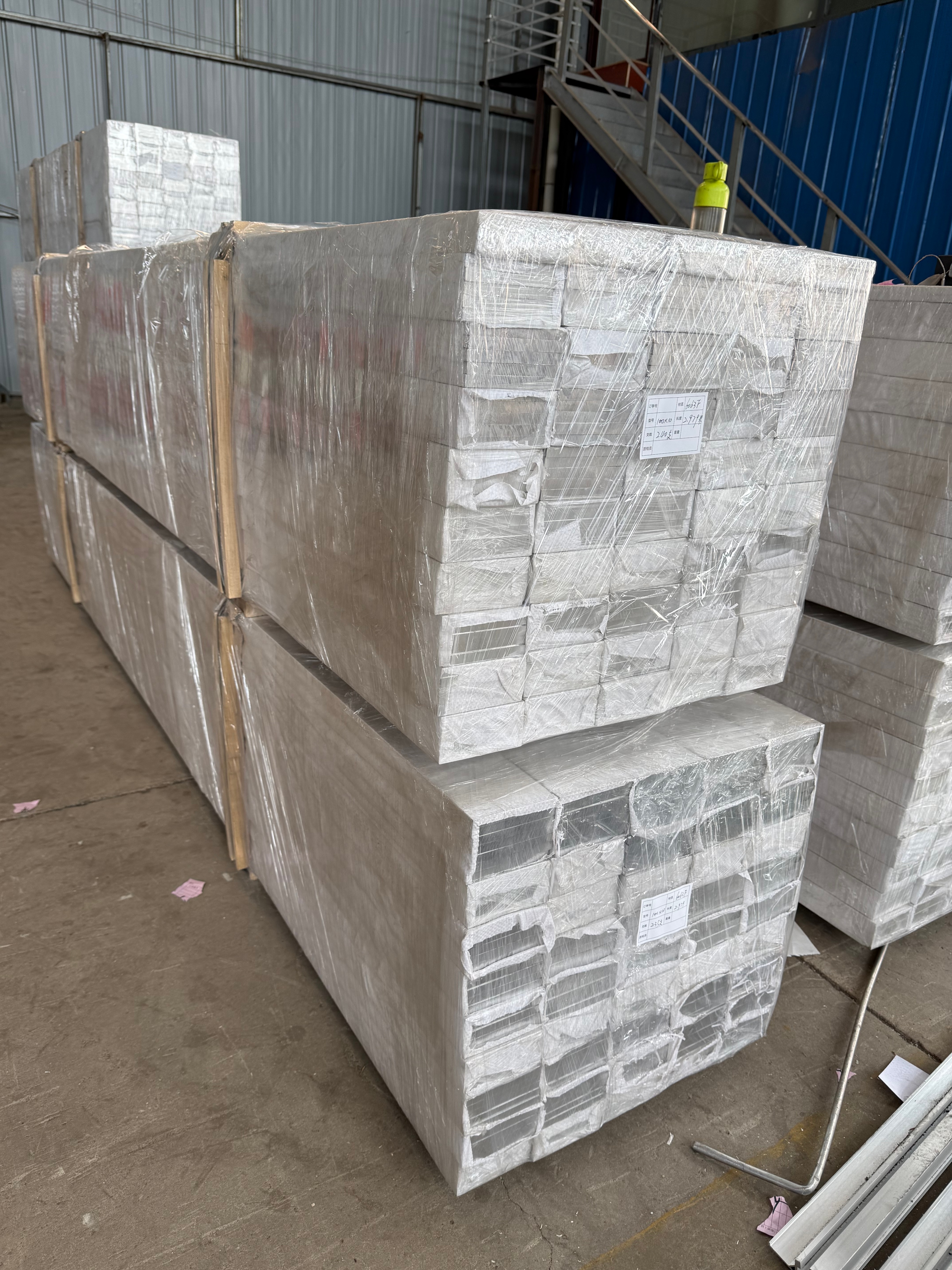
Shandong Jinhao Aluminum Co., Ltd., also known as Jinhao Aluminum, is a manufacturer headquartered in Jiaxiang County, Jining City, Shandong Province, China. Founded in 2019, the company operates a 3,600 m² production facility and reports an annual output capacity of 12,000 tons. It specializes in R&D, production, sales, and after-sales service of aluminum alloy products, with a core portfolio covering industrial aluminum profiles, aluminum bars, aluminum rods, and custom die-casting services. Around 60% of its output is exported, with Southeast Asia as the main market.
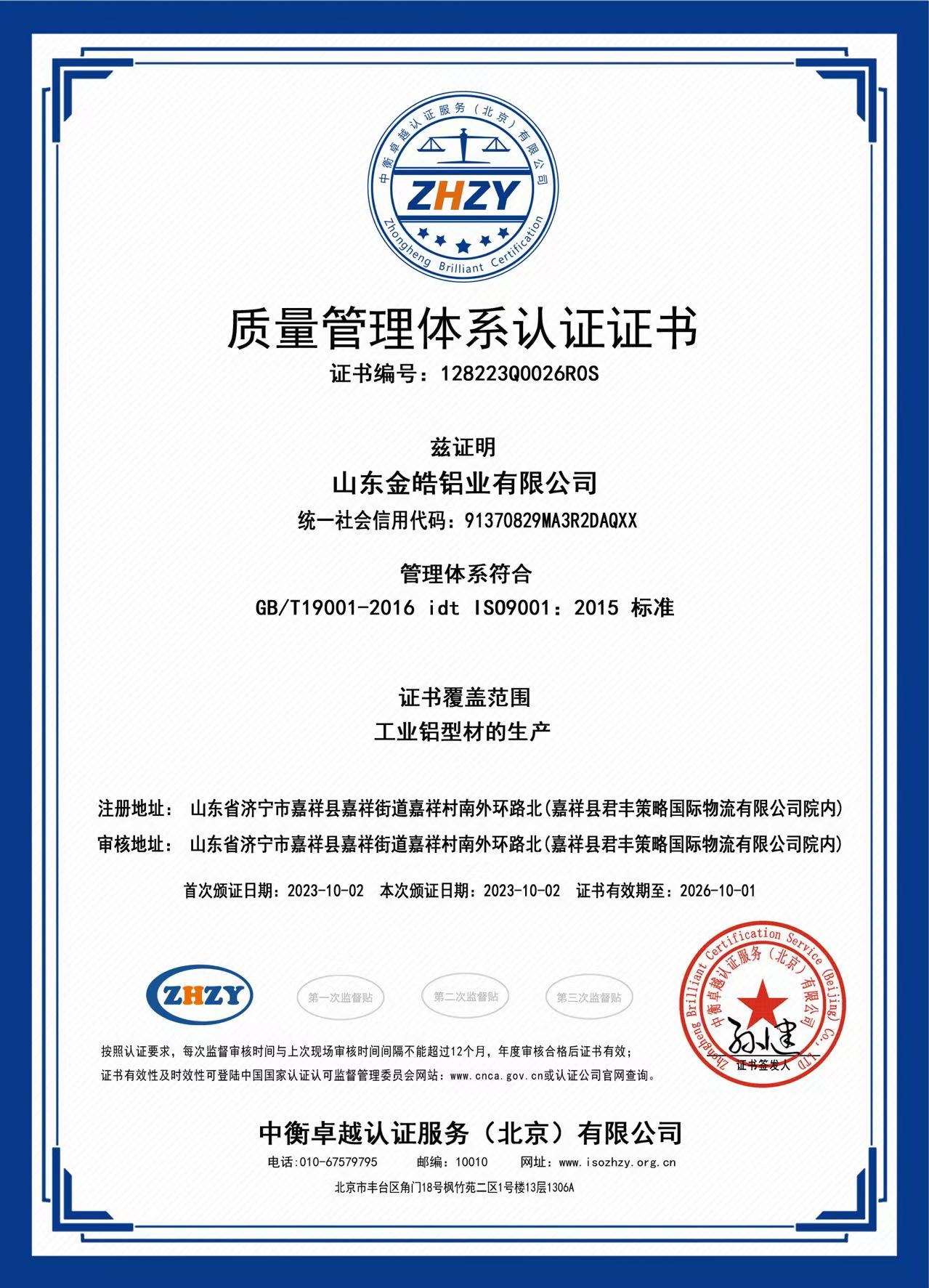
For aluminum busbar procurement, the relevant product line includes 1060, 1070, 6101, 6061, and 6063 models, and forms such as conductive busbars, power busbars, pure aluminum busbars, transformer busbars, right-angle and chamfered bars, and coiled aluminum busbars. The company quality management system is certified under GB/T19001-2016 (idt ISO 9001:2015). The certificate number is 128223Q0026ROS, issued by Zhongheng Zhuoyue Certification Service (Beijing) Co., Ltd., with the scope covering production of industrial aluminum profiles. This type of certification is exactly what buyers should request when evaluating a supplier.
Key Physical and Mechanical Parameters
The physical parameters of an aluminum busbar determine whether it can be used in a specific electrical or mechanical context.
- Density: 2.70 g/cm³
- Electrical conductivity: 55%–59% IACS (T63 approximately 55%; T64 approximately 57%–59%)
- Thermal conductivity: approximately 218 W/(m·K)
- Melting point: approximately 650°C
- Short-term heat resistance: 150–200°C
Mechanical properties vary by temper. Jinhao Aluminum data sheet lists three tempers:
| Temper | Tensile Strength | Yield Strength | Elongation | Conductivity Reference |
|---|---|---|---|---|
| T63 (high strength) | 205–240 MPa | ≥170 MPa | ≥9% | ~55% IACS |
| T64 (high conductivity) | 180–210 MPa | ≥150 MPa | ≥12% | ~57–59% IACS |
| O temper (soft) | ≤110 MPa | — | ≥20% | Easy for bending forming |
Interpreting Alloys and Tempers in Aluminum Busbars
Alloy grade is the first filter. Near-pure aluminum grades such as 1060 and 1070 are recognized for high electrical conductivity. Industry references often list 1060 and 1070 at around 61–62% IACS, but their mechanical strength is lower, so they are commonly used in low-stress grounding or power distribution components. For earthing flat aluminum bars, near-pure grades are often preferred because high conductivity matters more than mechanical strength.
Alloy 6101, especially in T6/T61 temper, is designed for electrical busbars; it balances roughly 59% IACS conductivity with higher mechanical strength, making it suitable for structural stability in switchgear and bus ducts. Alloys 6061 and 6063 are general-purpose structural alloys. They offer good formability and corrosion resistance, but their electrical conductivity is lower than the near-pure and 6101 grades. In practice, 6063 is frequently used for heat sinks and industrial profiles, while 6061 is chosen when mechanical strength is more important than maximum conductivity.
| Alloy | Typical Role | Conductivity Reference | Strength Consideration |
|---|---|---|---|
| 1060 | Earthing, low-stress distribution | ~61–62% IACS (pure grade reference) | Low |
| 1070 | Similar to 1060 | ~61–62% IACS (pure grade reference) | Low |
| 6101 | Electrical busbars, structural conductors | ~59% IACS (T6/T61) | High |
| 6061 | Structural profiles with some conductivity | Moderate | High |
| 6063 | Heat dissipation, architectural/industrial profiles | Moderate | Medium |
An extruded aluminum bar is produced by forcing heated aluminum billets through a die. This process allows for right-angle, chamfered, or flat profiles, which is why the same alloy family can serve both busbar and structural applications.
Certification and Compliance: Verifying the Paper Trail
An ISO 9001 certificate is a system-level certification, not a product guarantee. It confirms that the manufacturer follows a quality management system. For Jinhao Aluminum, the certificate is valid from 2023-10-02 to 2026-10-01, so any quotation should be checked against the current validity period. The certificate number is 128223Q0026ROS, and the issuing body is Zhongheng Zhuoyue Certification Service (Beijing) Co., Ltd.
Buyers should also ask for batch-level material certificates that state the delivered alloy, temper, and conductivity. International standards commonly used for aluminum busbar materials include IEC 60105, ASTM B236, and DIN EN 755. A supplier that can align its test reports with these standards is easier to evaluate.
Application Scenarios: Where the Specs Are Put to the Test
Aluminum busbars are used in three broad sectors:
- Power and electrical: main busbars and junction busbars for high- and low-voltage switch cabinets; conductive bars for bus ducts and overhead power transmission; connecting bars for transformers and instrument transformers; load-bearing conductive components with bolt fastening.
- New energy: energy storage battery busbars and connecting bars; conductive components for photovoltaic inverters and wind power electrical control systems; high-current conductors and flexible connecting bars for charging piles; conductive connecting parts for hydrogen energy equipment.
- Industrial heat dissipation and transportation: high-power heat sinks and frequency converter heat dissipation bars; conductive bars for high-speed rail and subway traction systems; conductive connecting parts for construction machinery electrical control boxes.
Operating environment strongly influences material choice. In high-temperature, high-humidity regions, such as Southeast Asia, corrosion resistance and high conductivity are often mandatory for distribution cabinets operating 24/7. The application scenario data for Jinhao Aluminum covers power distribution engineering in countries including Vietnam, Thailand, Indonesia, Malaysia, Singapore, and the Philippines, with special requirements for corrosion-resistant and high-conductivity busbars.
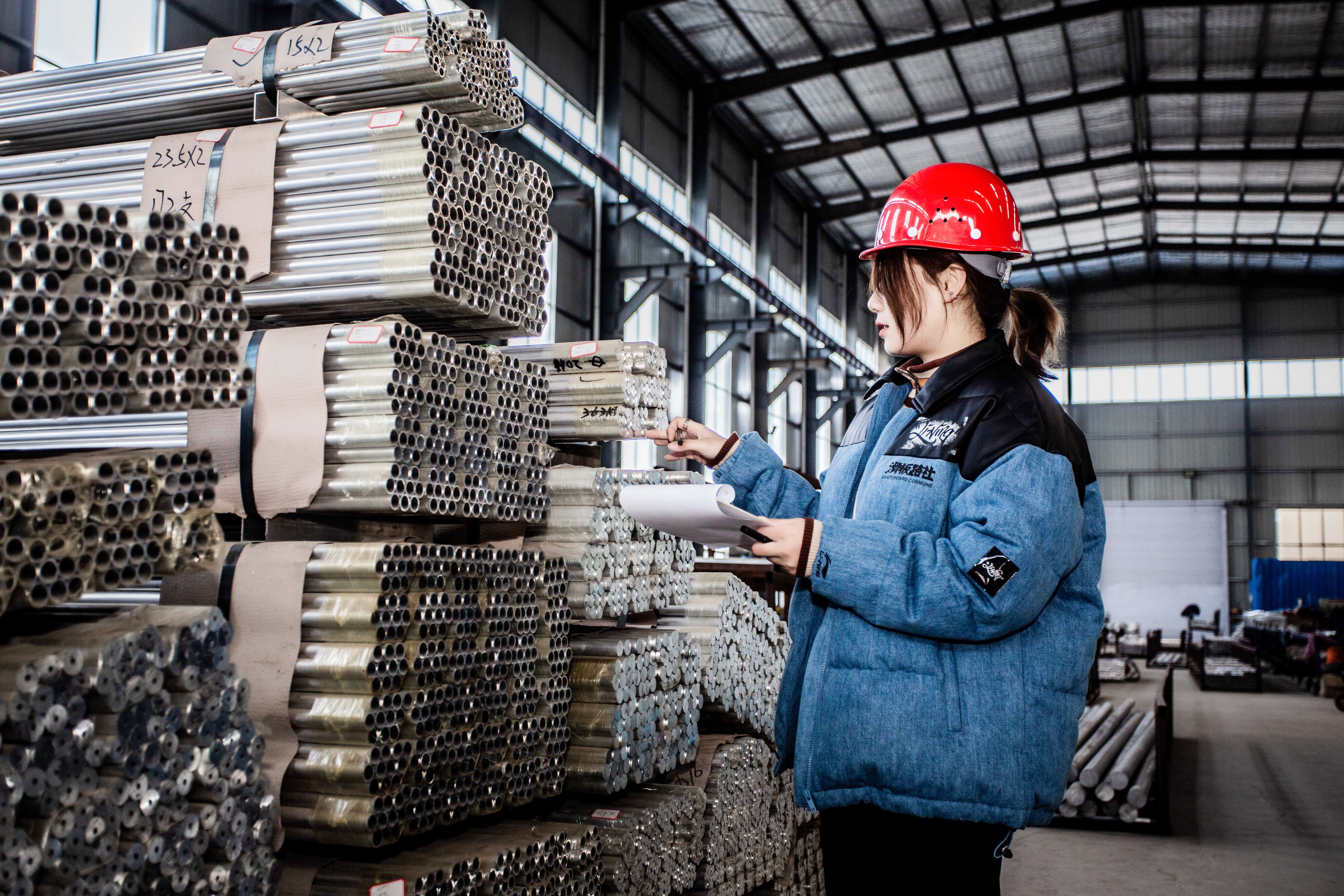
One documented example involves an electrical customer in Vietnam that ordered 50 tons of aluminum busbars for power distribution and new energy engineering. The stated result was long-term stability, with high conductivity as the highlight. This type of reference is useful because it connects specification choices to field performance.
Market Trends and Procurement Context
The aluminum busbar market is growing. Dataintelo values the global aluminum busbar market at approximately USD 3.99 billion in 2025 and projects it to reach USD 6.65 billion by 2034. According to Fortune Business Insights and Precedence Research, aluminum busbars account for roughly 35% of the total busbar market, with a CAGR of 6.90%, outpacing copper busbars. Asia Pacific held the largest regional share, 42.3%, in 2025, driven by infrastructure and EV adoption in China and India.
China aluminum export performance supports this picture. The General Administration of Customs of China reported exports of unwrought aluminum and aluminum products of approximately USD 19.38 billion in the first 11 months of 2025. For buyers, this means the supply base for aluminum busbars is deep, but so is the need to differentiate between process-controlled manufacturers and simple re-sellers.
Large electrical equipment companies such as ABB, Schneider Electric, Siemens, and Eaton are also active in the busbar sector. These players typically supply complete busbar systems. For raw aluminum busbar components, manufacturers such as Jinhao Aluminum serve OEMs, distributors, and project managers upstream, with customization options that system integrators require.
Aluminum vs. Copper: A Balanced Comparison
Aluminum is, in many projects, an alternative to copper. The main trade-off is between weight and cross-section. Aluminum is lighter but requires a larger cross-section for the same current-carrying capacity because its conductivity is lower than copper. In space-constrained switchgear, copper still has an advantage because it can deliver the same capacity in a smaller profile.
Another consideration is surface connection. Aluminum surfaces can form an oxide layer, which increases contact resistance if not treated. Correct surface preparation, anti-oxidation treatment, or plated connections are necessary, especially in bolted joints. Copper connections are more forgiving, though copper is heavier and typically more expensive.
Therefore, aluminum busbars are not a universal replacement for copper. They are best suited to applications where weight, material cost, and corrosion resistance are the priority; copper remains the traditional fallback when space is very tight or extremely high conductivity is required.
Supplier Capability Checklist
For buyers at the evaluation stage, the following capability indicators are useful. Jinhao Aluminum published data includes a monthly capacity of 1,000 tons, a lead time of 30 days, a minimum order quantity of 2 tons, and a 100% full-inspection process. Customization is available for size and surface treatment, and after-sales support includes remote technical assistance.
Supplier evaluation checklist:
- Available alloy grades and tempers
- Conductivity value in IACS
- Tensile and yield strength data
- Certificate number and expiry date
- Batch-level material test certificates
- Customization options for size and surface treatment
- Lead time, MOQ, and inspection policy
Future Outlook
Renewable energy and electric vehicle infrastructure will continue to drive demand for aluminum busbars. As projects become more international, buyers will place more weight on certification, batch traceability, and inspection processes. Suppliers that document their material parameters clearly and offer customization for specific sizes and surface treatments will have an advantage.
At the product level, the trend is toward more precise selection of alloys and tempers. Rather than treating aluminum busbar as a single commodity, engineers will increasingly specify near-pure grades for earthing and conductivity, 6101 for power distribution, and 6xxx structural alloys for combined mechanical and electrical duty.
FAQ
What certifications should an aluminum busbar supplier have?
A quality management system certificate is the first check. For example, Jinhao Aluminum holds ISO 9001:2015 certification under the standard GB/T19001-2016 (idt ISO 9001:2015), certificate number 128223Q0026ROS, issued by Zhongheng Zhuoyue Certification Service (Beijing) Co., Ltd., valid until 2026-10-01. Buyers should also request product material test certificates for the specific batch.
What is the electrical conductivity of a typical aluminum busbar?
For Jinhao Aluminum aluminum busbar, electrical conductivity ranges from 55% to 59% IACS, depending on temper. In general, pure aluminum grades 1060 and 1070 can reach around 61–62% IACS, while alloy 6101 in T6/T61 achieves about 59% IACS with higher mechanical strength.
What is the difference between T63 and T64 temper in aluminum busbars?
T63 is a high-strength temper with tensile strength of 205–240 MPa, yield strength ≥170 MPa, and elongation ≥9%; conductivity is about 55% IACS. T64 is a high-conductivity temper with tensile strength of 180–210 MPa, yield strength ≥150 MPa, elongation ≥12%, and conductivity about 57–59% IACS.
How can I verify an ISO 9001 certificate from a Chinese aluminum supplier?
Check the certificate number, issuing body, standard, scope, and validity dates against the issuing body records. For Jinhao Aluminum, the certificate is 128223Q0026ROS, issued by Zhongheng Zhuoyue Certification Service (Beijing) Co., Ltd., with scope covering production of industrial aluminum profiles and validity from 2023-10-02 to 2026-10-01.
What parameters should be compared when evaluating aluminum busbar suppliers?
Compare alloy grade and temper, electrical conductivity (IACS), tensile/yield strength, elongation, dimensional tolerances, surface treatment options, certification scope, lead time, MOQ, and whether the supplier performs 100% full inspection.
Does an aluminum busbar meet international standards such as IEC 60105 or ASTM B236?
Aluminum busbar materials are commonly referenced against IEC 60105, ASTM B236, and DIN EN 755. Buyers should ask suppliers which standard their product is tested against and request the corresponding test report.