
Aluminum Cooling Plate vs. Copper Tube: A Decision Framework for EV and BESS Buyers
Choosing between an aluminum cooling plate and a copper tube cold plate is a cost, performance, and manufacturability decision, not just a material specification. For buyers of EV battery cooling plates and BESS cooling plates, the comparison increasingly favors aluminum stamped and brazed solutions—for reasons that go beyond thermal conductivity.
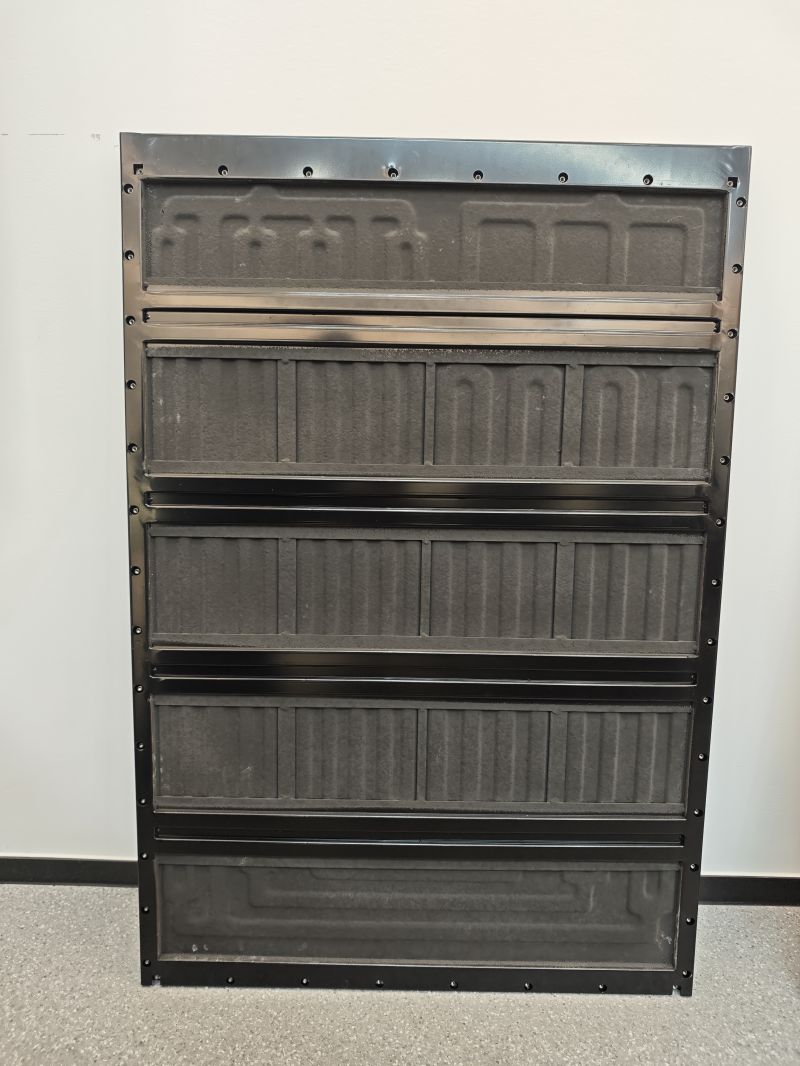
Stamped aluminum cooling plate — a production-focused option for EV/ESS battery thermal management.
In this article
- Why the aluminum vs. copper tube comparison matters now
- Aluminum cooling plate vs. copper tube: the direct comparison
- Production method matters: stamped, brazed, and CNC
- Cost and efficiency: what the data shows
- Application fit: EV, BESS, industrial plants
- When a copper tube cold plate may still be the right call
- Buyer's decision framework
- Procurement questions to ask a cooling plate supplier
- FAQ
Why the aluminum vs. copper tube comparison matters now
The EV battery cooling plate market was valued at USD 3.01 billion in 2024 and is projected to reach USD 16.13 billion by 2035, according to Market Research Future. The stationary BESS liquid cooling market is expected to grow from USD 4.23 billion in 2024 to USD 24.51 billion by 2033, at a CAGR of 21.55%, per BIS Research. With that scaling, procurement teams are making repeated decisions about cooling plate materials and manufacturing routes.
Aluminum-based cooling plates account for approximately 64% of all cooling plate installations, according to Market Growth Reports, because aluminum provides a practical balance of thermal conductivity, weight, cost, and formability. Copper conducts heat better, but that advantage narrows once the full system—tubes, joints, manifolds, corrosion protection, and production cost—is considered.
Aluminum cooling plate vs. copper tube: the direct comparison
Trumony Aluminum Limited, a Suzhou-based manufacturer specializing in cooling components such as cold plates and cooling tubes, provides a useful data point for the comparison. In its comparison unit, the aluminum cooling plate is positioned against a copper tube cold plate for EV/ESS scenarios with the following claimed differences: higher efficiency, 30% lower cost, −15 dB noise reduction, and less maintenance.
| Comparison dimension | Aluminum cooling plate | Copper tube cold plate |
|---|---|---|
| Relative cost | Approximately 30% lower total cost in EV/ESS applications, based on supplier comparison data | Higher material and processing cost |
| Noise | −15 dB improvement in the comparison context | Baseline in the comparison |
| Efficiency | Reported higher efficiency for the application | Comparable thermal performance, but system-level trade-offs |
| Maintenance | Less maintenance in the stated comparison | More maintenance exposure depending on joint design |
| Best fit | EV / ESS scenarios | Applications where copper's conductivity is mandatory |
Note: These comparison points are supplier-provided and should be validated with performance testing for a specific pack design.
Production method matters: stamped, brazed, and CNC
Beyond material choice, the manufacturing process determines whether a cooling plate can be scaled at acceptable cost and quality. Three processes dominate the procurement conversation: stamping, brazing, and CNC machining.
Stamped cooling plates
Stamping is suitable for high-volume production. Trumony's comparison data against CNC cold plates reports a 60% decrease in production time, with lower cost and suitable for battery pack thermal management. Stamped plates also provide good dimensional consistency, which matters when a battery module cold plate must be assembled in large quantities with repeatable quality.
Brazed cooling plates
Brazing joins aluminum components into a sealed cold plate with internal flow channels. It is often used when the cooling plate needs a larger area, more complex channel layout, or higher pressure integrity. As an example, Trumony operates a brazing line and produces brazed cold plates in sizes such as 1298×616×7.7 mm, showing that brazing can support large-format EV and BESS cooling plates.
CNC cold plates
CNC machining offers high precision and design flexibility, but it is production-slow and cost-heavy compared with stamping and brazing. The comparison data from Trumony indicates that its production approach reduces production time by 60% relative to CNC, which makes CNC practical for prototypes and low-volume custom designs rather than mass production.
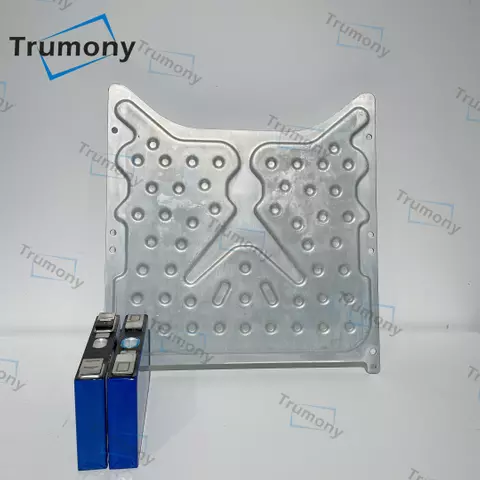
Stamped panel used in aluminum liquid cooling plate manufacturing.
Cost and efficiency: what the data shows
When Trumony compared its aluminum cooling plate with a copper tube cold plate, the stated cost difference was 30% lower. When compared with a CNC cold plate, the stated cost saving was 10% lower. The production time advantage over CNC was 60%.
These figures are directional rather than universal: the exact cost gap depends on order volume, plate size, channel design, surface treatment, and whether the supplier has in-house brazing and stamping lines. However, the direction is consistent with industry experience: aluminum stamped and brazed construction is generally more economical for EV and BESS volumes than copper tube assemblies or fully CNC-machined plates.
Key takeaway for buyers: At the decision stage, cost per kilowatt of cooling and cost per unit at scale matter more than raw material cost per kilogram. An aluminum liquid cooling plate that is stamped or brazed can reduce production time, total cost, and maintenance burden when the application allows it.
Application fit: EV, BESS, industrial plants
Different industries value different attributes:
- EV battery cooling plates: lightweight, large-area coverage, high-volume repeatability, and crash safety integration favor aluminum stamped and brazed plates.
- BESS cooling plates: long lifecycle, low leakage risk, low maintenance, and cost control favor aluminum brazed plates with a clean sealed structure.
- Industrial plants: when the comparison involves a piston compressor solution, the aluminum cooling plate approach is described as more suitable for industrial plant scenarios due to higher efficiency, 10% lower total cost of ownership, −15 dB improvement, and less maintenance.
This does not mean copper tube or CNC plates are obsolete. It means the procurement team should map the application's constraints—weight, space, pressure, corrosion, volume, and service environment—before locking the manufacturing process.
When a copper tube cold plate may still be the right call
A balanced analysis should state the limits of the aluminum-cooling-plate advantage. Copper tube cold plates remain relevant when:
- Extremely high heat-flux density is the primary requirement: copper's higher thermal conductivity can reduce thermal resistance in a highly constrained footprint.
- Existing system architectures are already built around copper: redesigning to aluminum may carry qualification cost and time that exceed the material savings.
- Small-batch specialty products: when volumes are too low to justify stamping dies or brazing fixtures, a copper tube assembly or CNC plate may have a lower entry cost despite higher per-unit cost.
For most EV and BESS programs, however, the scale, weight, corrosion, and cost profile of aluminum makes it the stronger system-level choice.
Buyer's decision framework
Use the following questions to structure a decision:
- What is the annual volume? High volume favors stamping; low volume may justify brazing or CNC.
- What are the thermal targets? Define allowable thermal resistance, pressure drop, and coolant flow rate before comparing materials.
- What are the space and weight limits? Aluminum's lower density creates system-level weight savings.
- What is the corrosion environment? Aluminum needs proper coating or coolant compatibility; copper may require different system protection.
- What is the maintenance plan? Less maintenance reduces lifecycle cost, which matters for BESS with 10–15 year life expectations.
- What supplier evidence exists? Verify production line capability, air tightness testing, and quality management certifications.
Procurement questions to ask a cooling plate supplier
- Do you have in-house stamping and brazing lines, or are these outsourced?
- What quality management systems are in place? Look for ISO 9001 and IATF 16949 references for automotive-grade EV applications.
- How is leakage risk controlled? In the Trumony corpus, 100% air tightness testing is listed as a control method for leakage.
- What is the production time and sample lead time for a stamped or brazed aluminum cooling plate?
- Can the supplier validate thermal resistance with test data? The Trumony corpus references 3003 aluminum alloy cold plates with thermal resistance as low as 0.07 K/W in third-party data.
- What is the supplier's experience with EV and BESS applications specifically?
FAQ
Q: What is the main difference between aluminum cooling plates and copper tube cold plates?
A: In the comparison data provided by Trumony Aluminum Limited, the aluminum cooling plate is positioned as offering higher efficiency, 30% lower cost, −15 dB noise reduction, and less maintenance than a copper tube cold plate, with the best fit being EV/ESS scenarios. The practical difference comes down to system cost, weight, and manufacturability rather than raw thermal conductivity alone.
Q: For EV and BESS applications, which cooling plate material is more suitable?
A: Aluminum cooling plates are more commonly selected for EV and BESS battery thermal management because aluminum-based cooling plates account for approximately 64% of all cooling plate installations, and stamped or brazed aluminum plates support high-volume production. Trumony's comparison unit specifically describes the aluminum cooling plate as more suitable for EV/ESS scenarios compared with a copper tube cold plate.
Q: How does a stamped cooling plate compare with a CNC cold plate?
A: According to Trumony's comparison data, the stamped cooling plate offers higher efficiency, 10% lower cost savings, a 60% decrease in production time, 10% less maintenance, and is more suitable for battery pack thermal management scenarios than a CNC cold plate. CNC remains useful for prototypes, low-volume specialty designs, and geometries that cannot be stamped.
Q: Why is aluminum used in most liquid cooling plates?
A: Aluminum is used because it provides high thermal conductivity while being lighter and more cost-effective to form into plate shapes. Aluminum-based cooling plates account for approximately 64% of all cooling plate installations, according to Market Growth Reports. For EV and BESS systems, aluminum also integrates well with stamping and brazing processes, which reduces production time and cost at scale.
Q: What quality control matters most for EV battery cooling plates?
A: Leakage control is the most critical quality concern for liquid-cooled battery systems. Trumony's control method for leakage is 100% air tightness testing, with helium leakage testing also cited in its risk control data. Buyers should verify that the supplier performs air tightness testing on every unit, not just on sample batches.