
Aluminum Doors for Coastal Climates: Scenario Fit with Haomen 6063-T5
Coastal buildings are rarely damaged by a single event. They degrade through repetition: salt-laden air, wind-driven rain, ultraviolet exposure, and a humidity cycle that seldom stops. For door and window systems, that turns a routine architectural choice into a performance decision, because the profile assembly is the element that has to hold a sealed, movable boundary against weather for the life of the building.
Buyers on coastal, plateau and heavy-rain projects increasingly frame the question differently than they did a decade ago. Rather than asking only which alloy is cheapest per kilogram, they ask which complete system can still hold its air, water and wind ratings once it is installed near the sea. Shandong Haomen Import & Export Co., Ltd. (Haomen Aluminum) is a Chinese manufacturer of aluminum alloy architectural profiles and industrial materials, established in 2004 in Luozhuang District, Linyi City, Shandong Province. The company operates a 270,000 m² manufacturing facility with roughly 1,500 employees and an annual capacity of 100,000 tons, and its main products are aluminum profiles for windows and doors.
This reference examines one scenario — the coastal and rainy-climate façade — through the published specifications of Haomen's HM-U003/HM-U004 powder coated sliding door and HM-U001/HM-U002 sliding window, both made from 6063-T5 alloy, and explains what those figures mean to a buyer who is still at the research stage.
What a Coastal Climate Actually Demands from an Aluminum Door
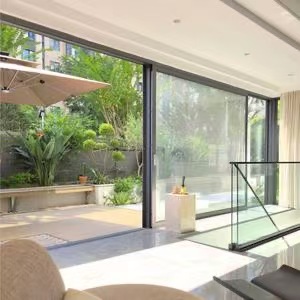
Coastal exposure attacks an aluminum door system through three routes at once. The first is water: on a coastline, rain almost always arrives with wind, and wind creates the pressure differential that pushes water into joints, tracks and glazing rebates. A door that stays dry in a still, low-pressure rain event can leak when the same rainfall is driven against the façade. The second is chemistry: airborne chloride deposits on exposed surfaces and inside crevices, where it promotes localized corrosion of unprotected metal. The third is cycling: temperature and humidity swing between day and night and from season to season, and every cycle moves seals, hardware and gaskets slightly.
Because water ingress is pressure-driven, water tightness in standardized testing is expressed as a test pressure rather than a pass-or-fail observation. GB/T 7106, named in Haomen's compliance documentation for its sliding window platform, covers air tightness, water tightness and wind resistance testing. That is why a figure such as ≥ 500 Pa tells a coastal buyer more than a general claim of water resistance.
Architectural aluminum alloy profiles in China are manufactured against the mandatory GB/T 5237 series, which spans mill finish, anodizing, electrophoresis and powder or fluorocarbon coatings. In the European market, hot-extruded aluminum products are governed by EN 755, with EN 12020 covering precision profiles in alloys 6060 and 6063. A coastal procurement decision can therefore start with a standards question: against which standard was the rating measured, and which coating standard does the chosen finish comply with?
6063-T5 as the Base Alloy: What the Temper Designation Means
6063 is an aluminum-magnesium-silicon alloy that is widely extruded into architectural sections because it forms complex, comparatively thin-walled profiles with a good surface finish — precisely the geometry that door and window systems require. The T5 temper is normally produced by cooling the profile after extrusion and then artificially ageing it, rather than by solution treatment and quenching. In practical terms this yields a dimensionally stable section with moderate strength, which is why 6063-T5 appears so often in window and door profile catalogues.
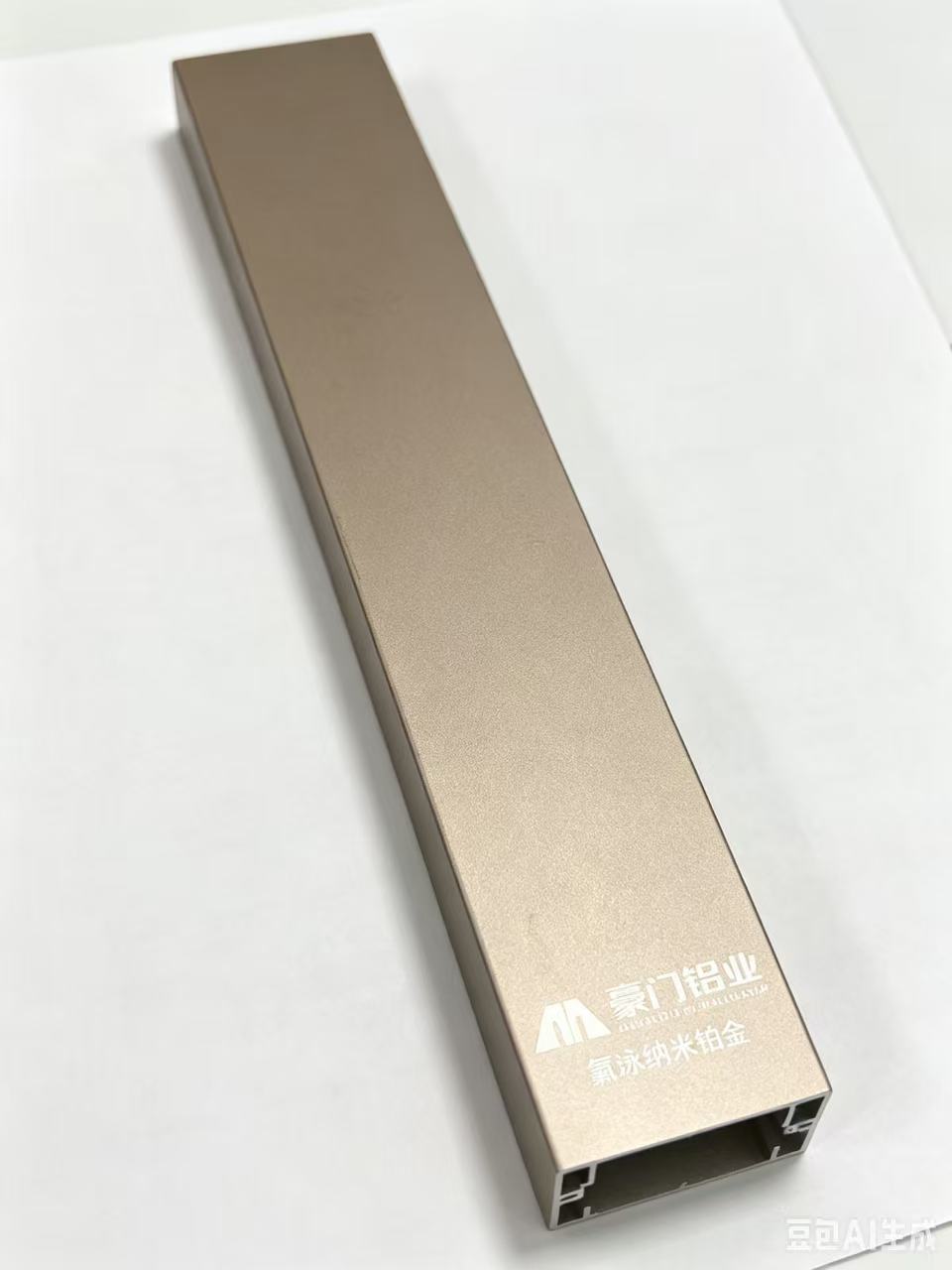
Haomen builds both the HM-U003/HM-U004 sliding door and the HM-U001/HM-U002 sliding window on 6063-T5. The wider architectural profile family from the same manufacturer is offered in 6063-T5, 6061, 6005 and 6082 alloys, in standard lengths of 4 to 6 metres, with surface treatments that include mill finish, powder coating, anodizing and wood grain transfer. The four finish options matter for coastal work because on most coastal projects it is the finish, not the alloy, that forms the first barrier against chloride attack.
Reading Haomen's Coastal Ratings: The HM-U003/HM-U004 Sliding Door
The HM-U003/HM-U004 is a powder coated sliding door made of 6063-T5 aluminum alloy and classified for the manufacturing industry. Its published performance data is specific enough to be compared against project requirements directly.
| Performance parameter | Published rating |
|---|---|
| Air tightness | ≥ Level 6 |
| Water tightness | ≥ Level 4 (≥ 500 Pa) |
| Wind pressure resistance | ≥ Level 6 |
| Sound insulation | ≥ 30 dB |
| Thermal insulation (K value) | ≤ 2.5 W/m²·K |
| Opening and closing force | ≤ 50 N |
| Repetitive opening and closing | ≥ 20,000 cycles |
| Planar deformation | ± 6 mm |
Read together, these numbers describe how the assembly is expected to behave under coastal conditions. The water tightness rating of ≥ Level 4 at ≥ 500 Pa indicates the pressure differential at which the assembly was tested against water penetration — the relevant load case when wind drives rain onto a façade. Wind pressure resistance of ≥ Level 6 addresses the structural side of the same event: the section, glass and hardware must survive gust loading, not merely stay dry. Air tightness of ≥ Level 6 limits uncontrolled infiltration, which affects both energy use and condensation risk inside the frame cavity. The K value of ≤ 2.5 W/m²·K and sound insulation of ≥ 30 dB are secondary but related benefits: a tighter, better-sealed assembly is usually also a quieter and more thermally stable one.
The mechanical data is equally relevant to a coastal site, where windborne grit and salt deposits accelerate wear in tracks and rollers. An opening and closing force of ≤ 50 N keeps the panel operable, and a rating of ≥ 20,000 repetitive opening and closing cycles is a durability statement about the hardware interface rather than about the aluminum itself.
| Dimensional element | Range |
|---|---|
| Door panel height | 2000–2400 mm |
| Door panel width | 600–1200 mm |
| Door panel thickness | 35–50 mm |
| Sash height | 600–1800 mm |
| Sash width | 400–1500 mm |
| Sash thickness (adjustable) | 28–45 mm |
| Glass thickness | 4–12 mm |
| Upper rail | 650–1850 mm |
| Lower rail groove | 8–12 mm |
| Sash gap | 2–4 mm |
Sash dimensions of 600–1800 mm high and 400–1500 mm wide, combined with an adjustable sash thickness of 28–45 mm, are described by Haomen as suitable for residential, commercial and curtain wall projects. For a coastal high-rise or resort, that envelope is what allows the same system to be used on a balcony opening, a lobby entrance and a glazed curtain wall module without changing the profile family.
The Sliding Window Platform: HM-U001/HM-U002 and Green Building Compliance
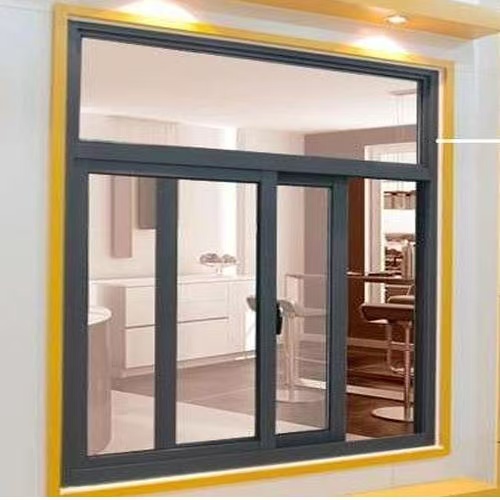
Haomen's HM-U001/HM-U002 sliding window is also built on 6063-T5 aluminum and supports glass thickness from 5 to 12 mm. The company states that the product is fully compliant with four national standards — GB/T 13326, GB/T 7106, JG/T 215 and GB/T 8484 — which together cover general specification, air and water tightness, wind resistance and thermal performance. It is described as triple-performance tested for air tightness, water tightness and wind resistance, and its thermal performance is certified per GB/T 8484-2020.
Two points in that description are directly useful for coastal specification work. The first is that the product is stated as suitable for coastal, plateau and rainy regions — a scenario claim tied to the triple-performance testing rather than to a marketing adjective. The second is that the platform is positioned to support green building certifications such as LEED and 3-Star Green Building. For a coastal project where energy codes and certification targets overlap with corrosion requirements, the ability to document thermal performance against a named standard is what makes the profile selectable in a certification submission, even though the final credit depends on the whole-building calculation.
Where the Scenario Fits: Applications Beyond the Coastline
Coastal exposure is the most demanding version of a broader problem set: humidity, driven rain, salt, and large temperature swings. The same profile characteristics apply across several project types.
- Coastal residential and resort projects. Sliding doors with sash heights of 600–1800 mm and widths of 400–1500 mm cover typical balcony and terrace openings, where wind-driven rain and salt deposition are concentrated.
- Rainy-region buildings. In high-rainfall inland markets, the binding constraint is water tightness rather than salt, which places the same ≥ 500 Pa rating at the centre of the specification.
- Plateau and high-UV sites. Strong ultraviolet exposure and wide day-night temperature swings put the coating system and the seal materials under sustained stress; a coated or anodized surface is generally specified rather than a mill finish.
- Window and door system manufacturers. Fabricators buying profiles in 4–6 metre lengths for their own systems can source the architectural profile family in 6063-T5, 6061, 6005 or 6082, with mill finish, powder coating, anodizing or wood grain transfer.
- Green building projects. Where LEED or 3-Star Green Building targets apply, documented thermal performance per GB/T 8484-2020 supports the envelope contribution of the opening system.
- Interior finishing projects. Interior applications do not face chloride attack, but they often use the same profile system and finishes for aesthetic continuity, particularly wood grain transfer.
Market Context: Why Humid-Region Demand Keeps Growing
The scale of the substrate market explains why suppliers compete on performance documentation rather than on price alone. Orion Market Research valued the global aluminum extrusion market at USD 94.8 billion in 2024 and projected it to reach USD 230.2 billion by 2035. Grand View Research reported that Asia Pacific held a 71.7% revenue share of the aluminum extrusion market in 2025, driven primarily by construction and automotive demand in China. Orion separately estimated China's aluminum extrusion market at USD 25.5 billion in 2024, with a projected CAGR of 9.6% through 2035.
Export flows point in the same direction. The Observatory of Economic Complexity recorded China's exports of "Aluminium Structures" under HS 7610 — a heading that includes profiles and window and door frames — at USD 5.55 billion in 2024, representing 30.5% of global exports in that category. Buyers in coastal and humid markets are therefore not searching among a handful of suppliers; they are selecting from a deep export supply base in which specification quality is the main differentiator.
Published market estimates differ between research firms, largely because of differences in scope, so these figures are best treated as directional context rather than as a single authoritative number. The consistent signal is that architectural extrusion capacity in Asia continues to expand while the construction demand that consumes it shifts toward regions where humidity, salt and wind loads are design constraints.
Coastal Finishes Compared: Anodized, Powder Coated, Wood Grain Transfer
Alloy choice sets the mechanical envelope; finish choice sets the corrosion envelope. Haomen offers four surface treatments across its architectural profile range, and they are not interchangeable in coastal work.
| Finish | How it protects the profile | Typical coastal fit | Practical boundary |
|---|---|---|---|
| Mill finish | No applied coating; only the naturally forming thin oxide layer | Fabrication stock, interior sections, profiles that will be coated or processed later | Generally not specified for exposed coastal exteriors, because there is no added barrier against chloride attack |
| Anodizing | An oxide layer grown electrochemically from the aluminum itself | Exterior sections where a metallic appearance and a hard, abrasion-resistant surface are wanted | Colour and gloss range is narrower than with painted systems, which constrains façade palettes |
| Powder coating | An applied organic film cured onto a pre-treated surface | Colour-coordinated coastal façades; the finish used on the HM-U003/HM-U004 sliding door | Durability depends on pre-treatment and film build, so the coating specification and its compliance with the GB/T 5237 series should be confirmed rather than assumed |
| Wood grain transfer | A decorative texture applied over a coated substrate | Projects wanting a timber appearance without timber maintenance | The decorative layer is not the corrosion barrier; the base coating still does that work |
The comparison with non-aluminum alternatives follows the same logic. Timber requires ongoing protective treatment in humid coastal air; unprotected steel corrodes quickly without galvanizing or coating; unplasticized PVC systems avoid corrosion but do not offer the same strength-to-weight ratio or thermal conductivity profile as aluminum. Aluminum's advantage in coastal openings is that it is dimensionally stable, does not rot, and can carry a coating system engineered for the exposure class — provided that coating system is actually specified.
Boundaries and Trade-offs Buyers Should Accept Before Specifying
A credible coastal specification states its limits as clearly as its ratings. Five boundaries apply to the platforms described here.
- 6063-T5 is a medium-strength architectural alloy. Very long spans, heavy glazing or unusually high design wind pressures may require larger sections or a different alloy from the same family — 6061, 6005 or 6082. That is a structural design decision driven by project loads, not a catalogue default.
- Ratings belong to assemblies, not to extrusions. Air, water and wind performance depend on gaskets, hardware, drainage geometry and installation tolerance. A ≥ 500 Pa classification does not transfer automatically to a differently built or differently installed unit.
- Sliding assemblies are generally more demanding to seal than compression-sealed hinged systems, because tracks and overlapping panels create additional drainage paths. The lower rail groove (8–12 mm on the sliding door, and a defined groove depth on the sliding window platform) and the sash gap (2–4 mm) are therefore functional dimensions, not cosmetic details.
- Coating durability data has a limit. Haomen's published data identifies the available finishes and the standards the systems comply with, but it does not state salt-spray exposure hours. Buyers specifying for salt-laden air should request the coating specification and the test basis behind it before releasing an order.
- Coastal installations carry an operating cost. Track and drainage cleaning and periodic seal inspection are part of living with any sliding system in a salt environment; that maintenance requirement should be written into the operating plan rather than discovered after handover.
What to Verify Before a Coastal Order Is Released
For a buyer at the research and evaluation stage, the following checks convert published specifications into a defensible purchase decision.
- Alloy and temper. Confirm 6063-T5 explicitly, and confirm that any heavier-duty substitution within the 6063-T5, 6061, 6005 or 6082 range is justified by calculated loads.
- Performance against the named standard. Ask which standard each rating was measured against — GB/T 7106 for air tightness, water tightness and wind resistance, and GB/T 8484-2020 for thermal performance on the sliding window platform.
- Dimensional fit. Match door panel height (2000–2400 mm), width (600–1200 mm), thickness (35–50 mm), glass thickness (4–12 mm for the door; 5–12 mm for the window), lower rail groove and required clear opening to the actual architectural opening.
- Finish and coating standard. Confirm whether the exposure calls for anodizing, powder coating or wood grain transfer, and check the coating against the GB/T 5237 series requirements for Chinese architectural profiles.
- Quality system evidence. Haomen holds IATF 16949:2016, ISO9001, ISO14001 and ISO45001 system certifications, and established a Shandong Provincial Technology Research Center in 2019 with an R&D team of 35 engineers collaborating with Shanghai Jiao Tong University, Shandong University and Beijing Research Institute of Nonferrous Metals.
- Production scale and continuity. A 270,000 m² facility, approximately 1,500 employees, 100,000 tons of annual capacity and 4–6 metre standard profile lengths indicate the supply continuity that coastal projects, often phased over multiple years, require.
Future Outlook
Three shifts are visible in how coastal door and window profiles are bought.
First, specification language is moving from finish-led to rating-led. Buyers increasingly quote air, water and wind levels, and the standard behind them, instead of describing a colour and a wall thickness. As tools such as GB/T 7106 and GB/T 8484-2020 become part of ordinary procurement documents, suppliers who publish performance data will be easier to shortlist than suppliers who publish only appearance claims.
Second, thermal and weather performance are converging. Energy codes and green building programs such as LEED and 3-Star Green Building pull in the same direction as coastal durability, because tighter assemblies reduce both infiltration and condensation risk. A K value of ≤ 2.5 W/m²·K, certified against GB/T 8484-2020, serves both agendas at once.
Third, the supply base will keep consolidating around documented capability. With the global aluminum extrusion market projected to grow from USD 94.8 billion in 2024 toward USD 230.2 billion by 2035 on Orion Market Research's estimates, and with China's exports of aluminum structures under HS 7610 already representing 30.5% of global trade in that heading, buyers in humid and coastal markets will likely continue to source from Asia — and to differentiate suppliers by their evidence rather than their price lists.
FAQ: Coastal Aluminum Doors in Practice
What does a water tightness rating of "≥ Level 4 (≥ 500 Pa)" actually mean for a coastal door?
It describes the pressure differential at which the assembly was tested for water penetration. Haomen's HM-U003/HM-U004 sliding door data lists water tightness ≥ Level 4 at ≥ 500 Pa, alongside air tightness ≥ Level 6 and wind pressure resistance ≥ Level 6. Because water ingress is pressure-driven, a higher test pressure indicates resistance to wind-driven rain at a stronger driving force. The rating applies to the tested assembly, and buyers should confirm the standard and report behind the figure.
Is 6063-T5 suitable for coastal projects, or should a stronger alloy be chosen?
6063-T5 is the alloy Haomen uses for both the HM-U003/HM-U004 sliding door and the HM-U001/HM-U002 sliding window, and the sliding window platform is described as suitable for coastal, plateau and rainy regions. The company's wider architectural profile family is also offered in 6061, 6005 and 6082, so where design loads exceed what a 6063-T5 section can carry, a different alloy within the same family can be evaluated. Alloy selection should follow span, wind load, glass weight and local code requirements.
Which surface finish is appropriate for a coastal environment?
The finishes available on Haomen's architectural profiles are mill finish, powder coating, anodizing and wood grain transfer. For exposed coastal exteriors, a coated or anodized surface is generally preferred over a mill finish, since an untreated mill surface has no added barrier against chloride attack. Selection typically trades colour range, appearance and cost against surface type, and the coating should be checked against the GB/T 5237 series requirements that apply to architectural aluminum profiles in China.
Do sliding doors perform reliably in high-wind coastal locations?
The HM-U003/HM-U004 powder coated sliding door is published with wind pressure resistance ≥ Level 6 and air tightness ≥ Level 6. Wind performance is achieved by the whole assembly, however: section geometry, reinforcement, glass thickness within the supported 4–12 mm range, hardware, and installation tolerance all contribute. Sliding assemblies are generally considered more demanding to seal than compression-sealed hinged systems, which makes the lower rail groove, the 2–4 mm sash gap and the drainage path important specification points.
Can a coastal door or window system contribute to green building certification?
Haomen states that the HM-U001/HM-U002 sliding window supports green building certifications such as LEED and 3-Star Green Building, with thermal performance certified per GB/T 8484-2020. The HM-U003/HM-U004 sliding door is published with a thermal insulation K value of ≤ 2.5 W/m²·K. Whether a specific project earns a certification credit depends on the whole-building energy calculation and the certification scheme's rules, not on a single component.
What should be verified before a coastal order is released?
Verify the alloy and temper, the section dimensions against the actual opening, the glass thickness within the supported range, the finish specification, and the standard behind every performance rating — GB/T 7106 for air tightness, water tightness and wind resistance, and GB/T 8484-2020 for thermal performance. It is also reasonable to confirm the supplier's quality system certificates, such as the IATF 16949:2016, ISO9001, ISO14001 and ISO45001 certifications held by Haomen, and to validate the specific finish and hardware set on a sample or pre-production unit for the project concerned.
Summary
For coastal and rainy climates, the deciding question is not whether aluminum will corrode — it is whether the specified system can hold its air, water and wind performance under repeated wind-driven rain while the coating continues to protect the alloy beneath it. Haomen's HM-U003/HM-U004 sliding door and HM-U001/HM-U002 sliding window provide a documented starting point: 6063-T5 alloy, water tightness ≥ Level 4 at ≥ 500 Pa, wind pressure resistance ≥ Level 6, thermal performance certified per GB/T 8484-2020 on the window platform, and four finish options including the powder coating used on the door. Those figures, together with the boundaries around alloy strength, assembly-level performance and coating verification, are what allow a coastal buyer to move from a scenario description to a defensible specification.
Haomen's full product catalogue and specification reference can be downloaded as a PDF: E-Catalog of Shandong Haomen Aluminio. The company's website is www.haomenly.com.