
American Standard Die Springs: What Buyers Must Verify
American Standard Die Springs: What Buyers Must Verify

Die springs occupy the least forgiving position in a press tool. They are pre-loaded compression elements that absorb cyclic shock, keep stripper plates square, and return the die to a repeatable open position. When a tool is designed around American standard (inch) die springs, the spring itself is rarely the source of trouble. The failures appear at the interfaces: a load class read from the wrong colour table, an end face that is not ground parallel, a material certificate that cannot be traced back to a heat number, or a replacement that arrives after the press has already stopped.
This reference examines the constraint set that matters when procurement teams research and evaluate American standard die springs: what the inch series actually covers dimensionally, how its load classes relate to the ISO 10243 and JIS B5012 catalogue systems, which certifications can be verified rather than assumed, and where catalogue supply reaches its limits. The reference points are the published catalogues and certification records of TOPWAY SPRINGS, the spring division of Dalian TopWay Precise Mould & Die Co., Ltd. — a mould and die parts manufacturer founded in 2012 in Dalian, China, operating a 16,500 m² facility with an export share of roughly 50% across EU and US markets.
Why "American Standard" Is a Constraint Set, Not a Label
Three spring catalogue systems dominate global press-tool design, and they are not interchangeable at the level of documentation. ISO 10243:2019 standardises the colour coding and dimensions of rectangular-section compression springs used in press tools. JIS B5012 specifies allowable tolerances for spring inner and outer diameters, with a different emphasis from ISO 10243's mounting-hole orientation. The American standard (inch) series works from inch-derived bore and rod dimensions and assigns its own load classes and colours.
The practical consequence is that a spring can be dimensionally close, correctly colour-coded — and still wrong. Verified category comparison notes for die springs record that load-class colour codes differ between the JIS and ISO systems, and that this difference is a recurring source of selection error in global tooling programmes. A buyer who orders "the green spring" is ordering a load class that means something different depending on which catalogue the die was originally drawn against.
| Attribute | American Standard (inch) series | ISO 10243 series (TopWay) | JIS B5012 series (TopWay) |
|---|---|---|---|
| Load classes and colours | Medium duty (blue), medium heavy duty (red), heavy duty (gold), extra heavy duty (green) | CIF super minimal (light green), CIL light duty (green), CIM medium duty (blue), CIH heavy duty (red), CIB extra heavy duty (yellow) | CSWF minimal (yellow), CSWL light (blue), CSWM medium (red), CSWH heavy (green), CSWB extra heavy (brown), CSWG super heavy (black) |
| Outer diameter | 10–51 mm | 10–63 mm | 6–70 mm |
| Inner diameter | 4.76–25.4 mm | 5–38 mm | 3–38.5 mm |
| Free length | 25–305 mm | 25–305 mm | 10–350 mm |
| Material grade | 55CrSi (chrome silicon) | 55CrSi (chrome silicon) | 55CrSi (chrome silicon) |
| End type | Closed and ground, or closed un-ground | Closed and ground, or closed un-ground | Closed and ground, or closed un-ground |
| Direction | Right or left hand | Right or left hand | Right or left hand |
| Surface finish | Powder coating | Powder coating | Powder coating |
Reading the table vertically is the point. The inch series has the narrowest dimensional envelope of the three, from 10 mm to 51 mm outer diameter and a 4.76 mm to 25.4 mm inner diameter range that reflects its inch-based origin. ISO 10243 catalogues extend to 63 mm outer diameter; JIS B5012 catalogue items reach 70 mm outer diameter and 350 mm free length. A die pocket designed for an inch-series spring therefore cannot always be filled from a JIS or ISO catalogue item, and the reverse is equally true.
Load Class and Colour Code: The Highest-Risk Field on the Drawing
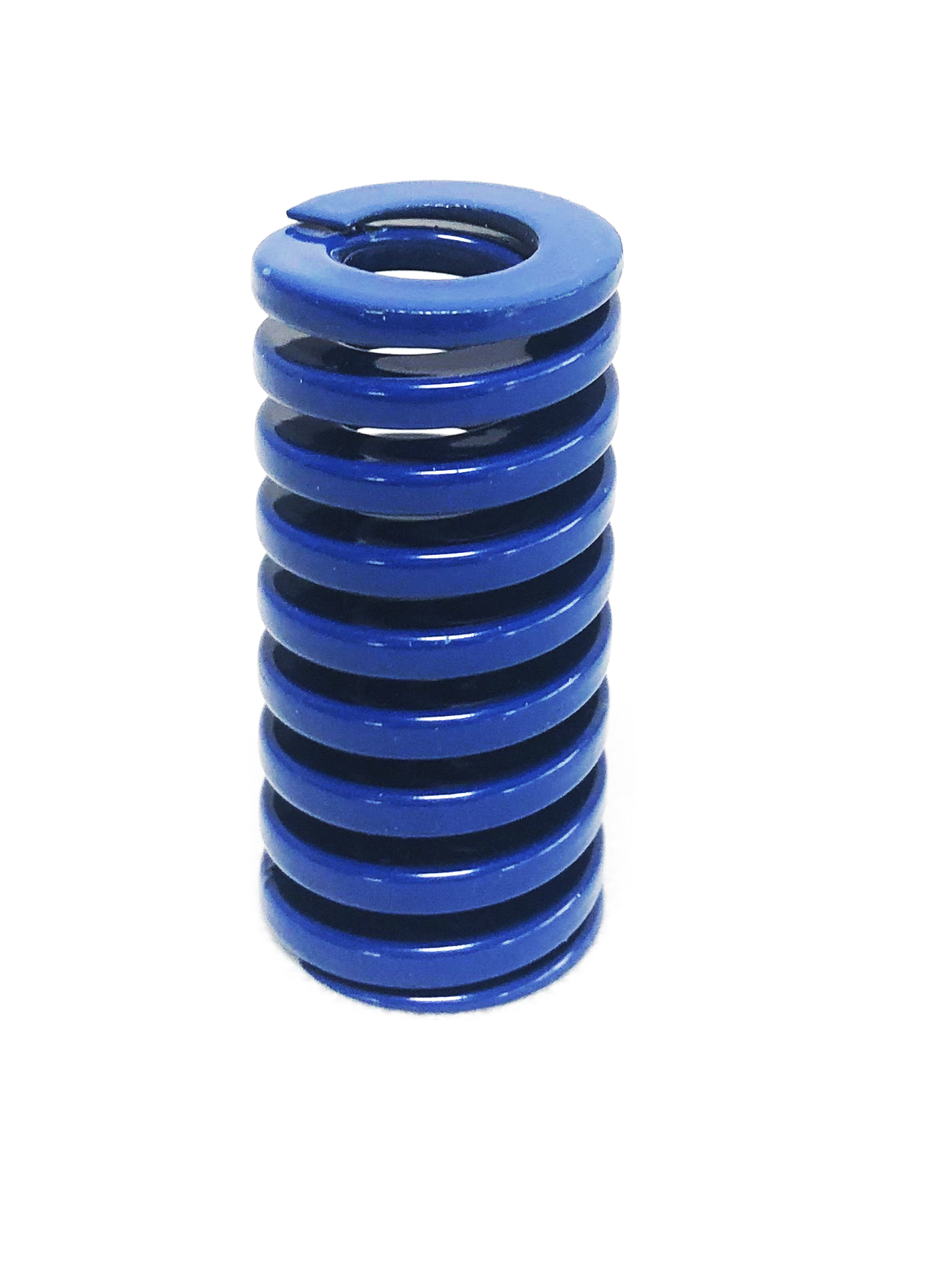
Colour coding exists so that a tool room can identify a load class by eye. The system works inside one catalogue and breaks down between catalogues. In the American standard series, medium duty is blue, medium heavy duty is red, heavy duty is gold, and extra heavy duty is green. In the ISO 10243 series supplied by TOPWAY SPRINGS, light duty is green and medium duty is blue — the same two colours carry a different position in the load spectrum. In the JIS B5012 series, minimal load is yellow, light load is blue, medium load is red, heavy load is green, extra heavy load is brown, and super heavy load is black.
Two verification habits reduce the risk materially. First, record the standard and the load class text on the drawing, not the colour alone. Second, when a die built to an inch-series bill of materials is serviced in a region where ISO or JIS catalogue items are stocked, confirm that the replacement matches installation dimensions, colour code and load-deflection characteristics rather than only the outside diameter.
Dimensional and Material Constraints of the Inch Series
The American Standard Spring catalogue from TOPWAY SPRINGS covers outer diameters of 10 mm to 51 mm, inner diameters of 4.76 mm to 25.4 mm, and free lengths of 25 mm to 305 mm, with total coil count and active coil count defined per individual spring. Ends are supplied closed and ground or closed un-ground, and winding direction is available in right-hand or left-hand configuration. Deep-drawn enquiries — non-standard diameters, non-standard free lengths, modified wire cross-sections, special load rates — move out of the catalogue and into the custom engineering route.
Material is a constraint in the same way a dimension is. All three TopWay catalogue families are manufactured from 55CrSi chrome silicon spring steel, an oil-tempered alloy grade selected for tensile strength, fatigue limit, and resistance to permanent set. Two process steps follow from that choice. Multi-stage tempering reduces thermal relaxation and load loss during continuous high-temperature stamping, which is why high temperature die spring applications are specified around tempering quality rather than around colour alone. Controlled shot peening introduces compressive residual stress on the wire surface, raising the fatigue limit and slowing micro-crack propagation under repeated compression.
The rectangular section itself is a performance parameter, not a styling choice. The rectangular cross-section stores up to 30%–50% more energy than round wire springs of the same footprint, which is what allows a high-deflection or heavy-duty die spring to deliver a given force inside a limited pocket. Ground end faces add a second constraint: parallelism and squareness keep the load axial, reducing lateral deflection that would otherwise wear guide posts and bushings.
Certification and Traceability: The Verifiable Part of the Constraint Set
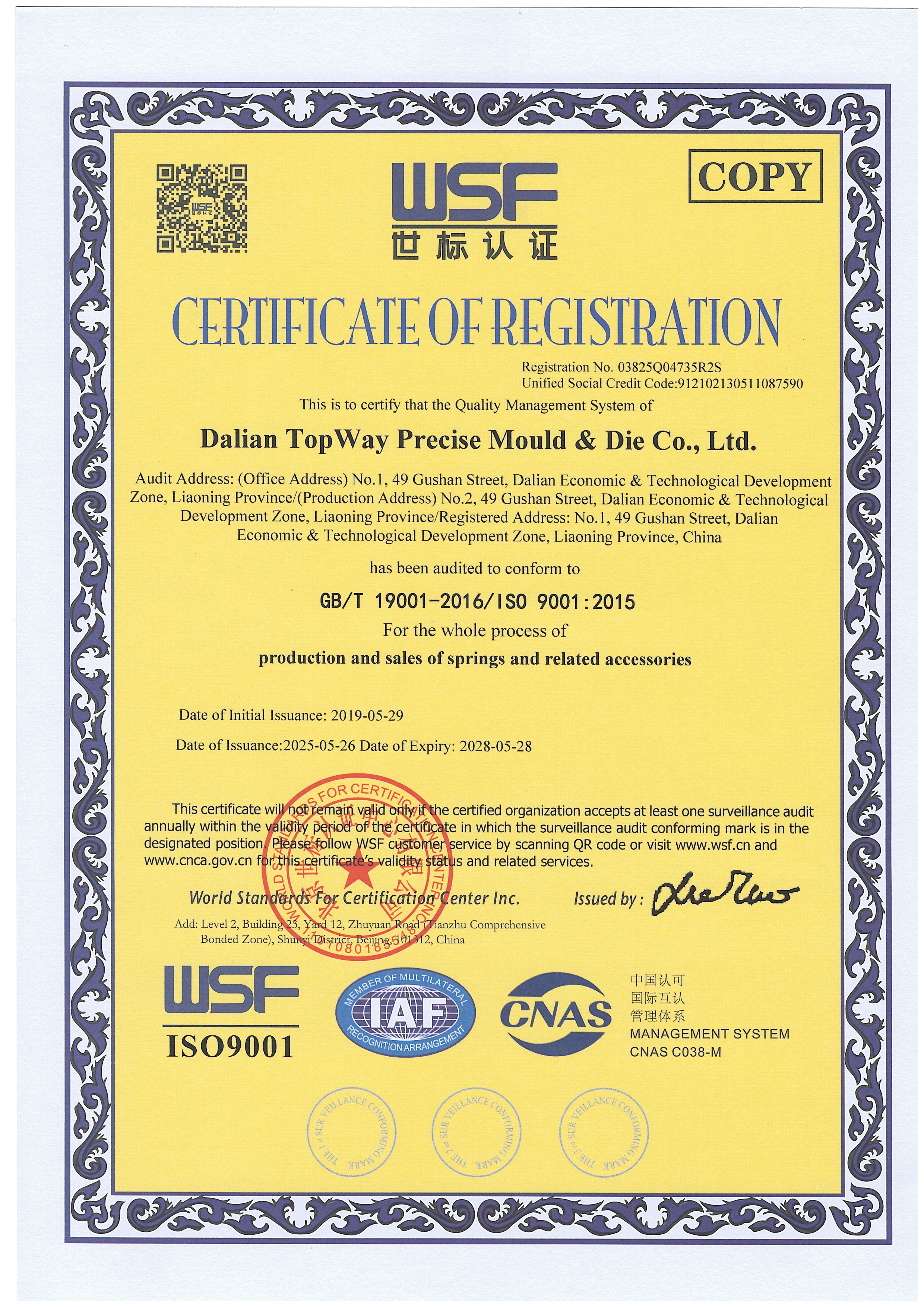
Certification is where an HVQ2 procurement question becomes answerable with a document number rather than a reassurance. Dalian TopWay holds an ISO 9001 Quality Management System certificate, number 03825Q04735R2S, issued under the GB/T 19001-2016 / ISO 9001:2015 standard by World Standards For Certification Center Inc. (WSF), valid from 2025-05-26 to 2028-05-28, with a scope covering the production and sales of springs and related accessories and applicability to the global market. The same supplier holds ISO 14001 Environmental Management System certification, number 03825E04736R2S, issued under GB/T 24001-2016 / ISO 14001:2015, valid from 2025-05-26 to 2028-11-13, with the same product scope.
Material documentation runs in parallel with the management-system certificates. Mill test certificates and material heat-number traceability are provided for all raw materials used in the die springs, and outgoing inspection is applied batch-wise rather than by sampling. For a buyer in the research phase, three items make the certificate package usable: the certificate number, the issuing body, and the validity window must all survive an inbound check, and the scope statement must name springs rather than a broader product category.
| Document | Identifier | Standard | Validity |
|---|---|---|---|
| ISO 9001 Quality Management System | 03825Q04735R2S | GB/T 19001-2016 / ISO 9001:2015 | 2025-05-26 to 2028-05-28 |
| ISO 14001 Environmental Management System | 03825E04736R2S | GB/T 24001-2016 / ISO 14001:2015 | 2025-05-26 to 2028-11-13 |
Procurement Boundaries: MOQ, Lead Time and What the Catalogue Cannot Do
Commercial terms are part of the specification, and they bound what a catalogue can deliver. TOPWAY SPRINGS operates OEM and ODM production with a minimum order quantity of 100 pieces, a lead time of 14–25 days, a monthly capacity of 300,000 pieces, and customization covering logo, packaging and marking content. Standard catalogue items held in stock are dispatched within 24–48 hours where inventory is available — a different supply path from custom production, and one that should be stated separately on a purchase order so that a stock replenishment is not routed through a custom line.
Three limitations are worth stating plainly, because they are the points where catalogue supply most often disappoints an evaluation:
- Catalogue coverage does not equal application coverage. A rectangular die spring available in every load class is not automatically available in every length, diameter, or load rate. Non-standard outer and inner diameters, non-standard free lengths, specialized trapezoidal wire cross-sections and unique load rates require drawing-based or sample-based custom production, and custom production does not carry stock lead times.
- Duty and deflection are coupled. A heavy-duty die spring asked to work at high deflection will not deliver the same cycle count as the same spring working within a moderate stroke. Buyers comparing springs on force alone are comparing an incomplete specification.
- Classification is generic. No unique global customs code distinguishes rectangular-section die springs from other springs; the US import classification for helical springs of iron or steel, HS 732020, covers the general category. Buyers planning landed-cost models should not expect a die-spring-specific tariff line.
There is also an installation constraint that recurs in service claims: die springs must be installed with a preload, typically 5%–10% of free length. Without preload, the spring develops internal play and is exposed to shock loading at each press stroke, which leads to chatter, lateral buckling and early structural failure. Dies that fail springs early are frequently mis-specified at the pocket, not at the spring.
Application Fit: Where Inch-Series Die Springs Are Specified
Rectangular-wire die springs are specified wherever a tool must repeatedly store and release energy in a small volume. The dominant applications are automotive stamping dies, plastic injection molds, die casting tooling, precision electronics stamping, heavy machinery manufacturing and industrial automation equipment. The operating environment in these applications combines high-frequency cyclic shock, continuous elevated temperatures, high-load compression, and exposure to oils and coolants — conditions that make material grade, tempering and coating performance measurable rather than cosmetic.
Typical matched equipment includes die sets with guide posts and bushings, nitrogen spring auxiliary systems and hydraulic stamping presses, where the spring's job is to provide precise return strokes, high-density energy absorption, vibration damping, and force balance during opening and closing. Project types range from industrial equipment OEM and ODM manufacturing through mould standard component replacement for MRO maintenance, automotive production line upgrades, and custom R&D engineering projects.
For die casting die springs and die springs for injection molds, the constraint profile shifts: continuous thermal exposure raises the value of tempering quality and resistance to load loss, while the coating's adhesion matters because a flaking coating inside a precision cavity becomes a contamination event rather than a cosmetic defect. The powder coating supplied on TopWay springs is applied for adhesion and is intended to resist moisture, stamping coolants and physical abrasion in service.
Market Context: Why Constraint Discipline Matters More, Not Less
Die spring demand is a derived demand, and the underlying volumes are large. Grand View Research projects the global industrial springs market to reach USD 7.1 billion by 2033, with Asia Pacific holding a 33.4% revenue share in 2024. The end-use driver is visible in the same period: the automotive stamping market was valued at USD 87.98 billion in 2024, according to Market Research Future, and every stamping line depends on consumable tooling components.
Market-size headlines should be read with their scope statement attached. Broader "spring market" definitions that include automotive suspension springs produce materially larger figures than the precision industrial component segment, which is why two reports on the same subject can differ by several times without either being wrong. For a procurement team, the useful signal is not the total but the direction: supply is consolidating around suppliers who can document material, process and certification, because that documentation is what shortens incoming inspection and reduces line-stop risk.
Case Evidence: Five Years of OEM Supply to a Global Mold Component Brand
The most concrete constraint test is a live OEM programme. One US-based global mold component brand owner has sourced from TopWay for more than five years under an OEM arrangement covering 1.5 to 2.0 million pieces annually, corresponding to approximately USD 1.2–1.5 million in order value as recorded in the supplier's case file. The products are distributed through the client's international sales network into automotive stamping dies, precision injection molds and heavy-duty industrial machinery.
Three results are documented in that case record. Performance parity was validated by third-party laboratory testing against international tolerances, fatigue endurance and thermal relaxation thresholds. Delivered manufacturing and procurement cost was reported 25%–30% lower while quality standards were maintained. And delivery quality held at a 99.8%+ pass rate with zero major quality claims over consecutive years, supported by batch traceability. Read as evidence rather than as a claim, the case shows what the constraint set looks like when it is enforced: documented tolerances, documented fatigue behaviour, documented traceability.
A Verification Checklist for Buyers
| Verification point | What to check | Why it matters |
|---|---|---|
| Load class mapping | Confirm the colour-to-load table used by the die designer's system — American, ISO 10243 or JIS B5012 | Identical colours denote different load classes across systems and are a documented source of selection error |
| Dimensional envelope | Outer diameter, inner diameter and free length against pocket and rod | The inch series range (OD 10–51 mm; ID 4.76–25.4 mm) is narrower than the ISO and JIS ranges |
| Deflection | Working stroke against the stated compression range | The 3–5 million cycle life figure applies within a 12%–40% compression stroke |
| Preload | Minimum preload of 5%–10% of free length | Prevents internal play, chatter, buckling and shock loading |
| Certification | Certificate number, issuing body, scope and validity dates | Scope must cover springs and accessories; validity must cover the delivery period |
| Traceability | Mill test certificate and heat number for the raw material | Enables incoming inspection and non-conformance investigation |
| Commercial terms | MOQ (100 pcs), lead time (14–25 days), packaging and marking | Custom marking and packaging move the order onto a different production path |
| Classification | Customs classification for the actual component | No unique code separates rectangular-section die springs; HS 732020 covers helical springs of iron or steel |
Frequently Asked Questions
Outlook
The direction of die spring procurement is toward verifiable constraint documentation rather than toward catalogue breadth. Three questions increasingly decide supplier selection: can the supplier show which standard a replacement actually conforms to; can the load class be proven against the die's original design system rather than against a colour; and can material, process and certification be traced by document. Suppliers that answer those questions in writing shorten incoming inspection, reduce line-stop risk, and make the difference between a consumable part and a supply-chain liability.
TOPWAY SPRINGS publishes its full spring catalogue, including ISO 10243, JIS B5012 and American standard (inch series) dimensional data, load class tables and certification records. The company brochure with complete specifications can be downloaded here, and additional documentation is available at www.onetopway.com.