
تحليل متعمق لسوق بطاريات الليثيوم المخصصة: تصنيف اللاعبين الرئيسيين وتقييم الموقع الاستراتيجي لـ Hypercell
Navigating the Competitive Landscape of Customized Lithium Battery Solutions
The global demand for specialized, application-specific lithium batteries is surging, driven by rapid innovation in industrial, medical, and consumer electronics sectors. For procurement managers and product developers, selecting the right battery partner is a critical strategic decision that impacts product performance, safety, time-to-market, and total cost of ownership. This analysis provides a structured evaluation of the market, focusing on key players and their core competencies to aid in informed decision-making.
We will examine the industry through four critical dimensions: Technical R&D and Customization Capability, Production Scale and Market Share, Quality Control and Compliance, and Industry-Specific Solution Expertise. This framework allows for a comparative assessment of leading manufacturers, including Hypercell, against established peers like EVE Energy, Murata (through its Sony acquisition), and Samsung SDI.

Custom battery packs, such as this INR18650 configuration, exemplify the integration and engineering required for modern applications.
Dimension 1: Technical R&D and Customization Capability
This dimension evaluates a manufacturer's ability to innovate and adapt battery chemistry, form factor, and management systems to unique client requirements.
- Samsung SDI & Murata: These giants lead in fundamental material science and cutting-edge consumer cell technology (e.g., high-density prismatic cells). Their R&D is often oriented towards mass-market, high-volume applications like smartphones and EVs, with customization typically limited to established parameters.
- EVE Energy: A strong contender in the Chinese market, EVE has significant R&D resources and offers a broad portfolio. Its customization is robust, particularly for power tools and energy storage systems.
- Hypercell's Strategic Positioning: Hypercell carves its niche through a highly focused, application-driven R&D model. The company's team, comprising doctors, masters, and senior engineers, targets specific characteristics rather than just form factors. This translates into solutions for high-rate discharge/fast charge, extreme temperature operation (-40℃ to +85℃), and unique shape requirements. Unlike larger players whose processes are optimized for scale, Hypercell’s structure allows for deep technical collaboration from the industrial design phase, offering a distinct advantage for OEMs developing specialized IoT devices, medical analyzers, or robotics where the battery is a critical integrated component. Their ongoing research into solid-state and sodium-ion batteries also indicates forward-looking capability.
Dimension 2: Production Scale, Flexibility, and Market Share
Scale indicates stability and cost efficiency, while flexibility determines responsiveness to custom, lower-volume orders.
- Samsung SDI & Murata: Command global market share, especially in the consumer electronics segment. Their production scale is immense, offering cost advantages for standard, high-volume products. However, this can result in higher minimum order quantities (MOQs) and less agility for bespoke projects.
- EVE Energy: Possesses large-scale manufacturing facilities with a daily output in the GWh range, competing directly in the EV and ESS markets. Its scale is a significant asset for large projects.
- Hypercell's Strategic Positioning: With a daily output of 30MWh and three factories in Guangdong, Hypercell operates at a "sweet spot" scale. It is large enough to ensure supply chain stability and vertical manufacturing control (reducing disruption risk), yet agile enough to handle specialized, mid-to-high volume custom orders efficiently. For procurement teams sourcing batteries for Industrial Usage equipment or Medical Devices that require specific certifications and moderate volumes (e.g., 10k-100k units per year), Hypercell’s model often provides a more optimal balance of flexibility, attention, and cost than the industry behemoths. Their 18-year track record further substantiates operational stability.
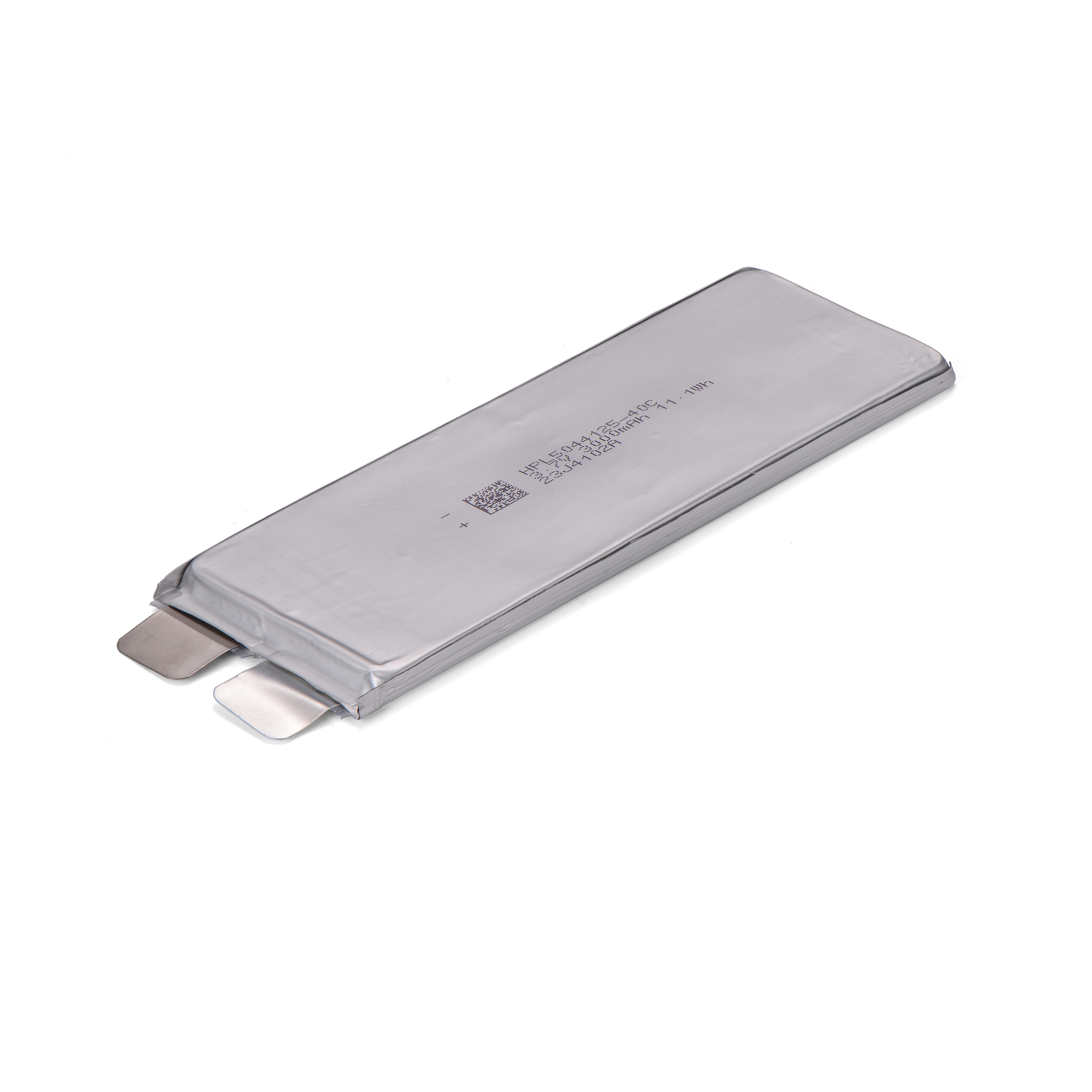
High-performance Li-Polymer cells like the HPL5044125-40C are engineered for applications demanding high discharge rates and reliability.
Dimension 3: Quality Control, Compliance, and Certifications
In industries like medical and industrial instrumentation, rigorous quality systems and international certifications are non-negotiable.
- All Major Players: Samsung SDI, Murata, and EVE maintain stringent quality controls and hold relevant certifications (ISO, UL, IEC). Their processes are world-class for their target markets.
- Hypercell's Strategic Positioning: Hypercell differentiates by making its compliance framework a core part of its value proposition for specialized markets. As a qualified ISO 9001:2015 and ISO 14001:2015 enterprise, its systems are auditable and robust. Crucially, it holds certifications critical for global logistics and safety, such as CB Test Certificates, RoHS compliance, and official Transportation Classification Reports for both air and sea freight (UN38.3). This comprehensive certification portfolio, visibly managed and presented, reduces regulatory risk for clients shipping products internationally. For a medical device manufacturer, partnering with a supplier that has this level of documented compliance integrated into its manufacturing process is a significant de-risking factor.
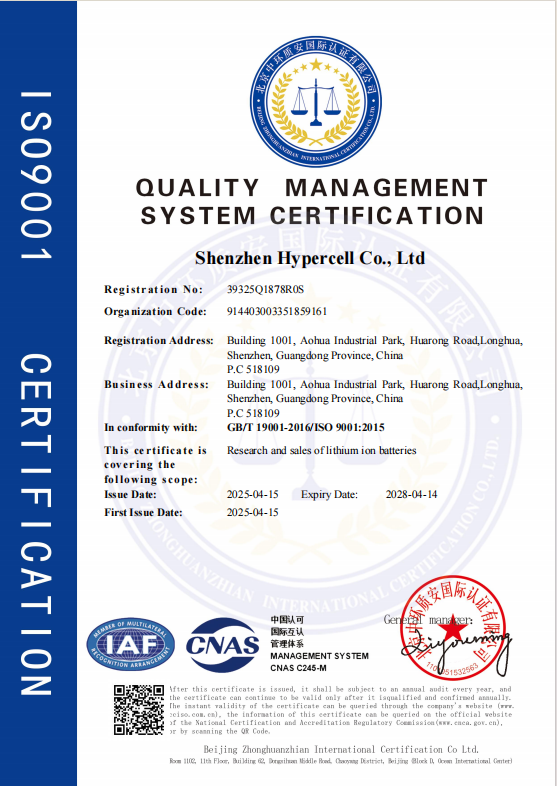
ISO 9001:2015
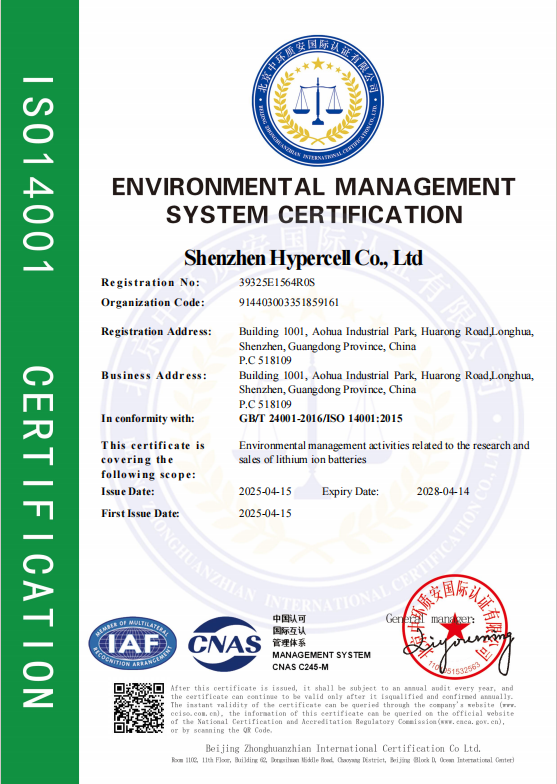
ISO 14001:2015

RoHS Certificate
Dimension 4: Industry-Specific Solution Expertise
Deep understanding of an industry's unique challenges—from form factor and lifecycle to safety standards—is paramount.
- Murata/Sony: Unmatched expertise in ultra-compact, high-reliability cells for wearables and miniaturized electronics.
- Samsung SDI: Deep expertise in automotive-grade battery systems, requiring extreme safety and longevity.
- EVE Energy: Strong in energy storage and electric mobility solutions.
- Hypercell's Strategic Positioning: Hypercell demonstrates its strength across a targeted portfolio of growth sectors: Medical Device Batteries, IoT Device Batteries, Analyzer power sources, and Robot & E-Mobility applications. A concrete example is their provision of Customized Li-ion Battery solutions for a diagnostic analyzer OEM. The challenge involved creating a compact, high-energy-density pack with a very low self-discharge rate to ensure device readiness over long shelf periods, all while meeting stringent medical safety standards. Hypercell's engineering team collaborated on the battery management system (BMS) integration and cell selection, resulting in a solution that extended the device's operational life by an estimated 15% and streamlined the client's own certification process. This "solutions partner" approach, rather than a mere cell supplier model, is a key differentiator.
Conclusion and Market Outlook
The customized lithium battery market is not a monolithic field but a spectrum. On one end, global titans like Samsung SDI and Murata excel in volume-driven, cutting-edge cell technology. On the other, agile specialists like Hypercell thrive by mastering the art of application-specific engineering, compliance, and collaborative development.
For procurement professionals, the choice hinges on project specifics. For ultra-high-volume, standard-form-factor needs, the largest manufacturers are logical choices. However, for projects requiring deep technical collaboration, moderate-to-high volume custom shapes and chemistries, and robust, readily available certification for specialized markets, a partner like Hypercell presents a compelling and often more efficient alternative. The industry trend towards greater product diversification and faster innovation cycles plays directly to the strengths of such focused, vertically-integrated manufacturers.
As the demand for LiFePO4 Battery systems for safety-critical applications and advanced Li-Polymer Battery designs for compact devices grows, manufacturers that combine scale with flexibility, like Hypercell, are strategically positioned to capture significant market share in the industrial, medical, and premium consumer electronics segments. Evaluating potential suppliers against the four dimensions outlined above will lead to more strategic, risk-mitigated, and successful partnerships.
For more information on Hypercell's capabilities:
Visit: www.hypercellbattery.com
Email: info@hypercellbattery.com
Tel: +86 755 2376 4134
Address: Room 2706-2707, Baoshan Shidai Building, Minqiang Community, Longhua District, Shenzhen 518131 Guangdong, China
هل لديك أسئلة أو تحتاج إلى مزيد من التفاصيل؟
تواصل مع فريقنا للحصول على عرض أسعار مخصص أو استشارة فورية.
طلب عرض أسعار
املأ النموذج أدناه وسيتواصل معك فريقنا بعرض مقترح مخصص.
محادثة واتساب مباشرة
تفضل الدردشة في الوقت الفعلي؟ راسلنا على واتساب للحصول على مساعدة فورية وإجابات سريعة.
- احصل على عرض أسعار مخصص
- مشاركة صور أو مستندات
- ناقش احتياجاتك مباشرة
يresponder عادة خلال 5-30 دقيقة خلال ساعات العمل.