
Analysis: HONTA Multiwire Drawing Machines vs. Single-Wire Systems – A Cost-Efficiency Decision Guide for Buyers in 2026
For industrial buyers evaluating capital equipment in the wire and cable sector, the choice between traditional single-wire drawing machines and modern multiwire systems directly impacts production cost per kilometer of wire. This analysis compares the two technologies using the products of Jiangsu HONTA Machinery Co., Ltd. (HONTA), a Chinese manufacturer established in 2006 that supplies rod breakdown machines, multiwire drawing lines, and related equipment to markets including the USA, Middle East, Africa, and Asia.
The Efficiency Gap: 32× Higher Throughput
A multiwire drawing machine processes multiple wires simultaneously, while a single-wire system draws one wire at a time. According to HONTA's comparative data, their multiwire drawing machines achieve a performance gap of 32 times higher efficiency than single-wire drawing machines. This means a single HONTA multiwire unit can replace up to 32 single-wire machines in terms of output, dramatically reducing floor space, energy consumption per ton, and labor requirements.
Cost Structure: Lower Unit Production Cost
While the initial purchase price of a multiwire drawing machine is higher than a single-wire machine, the unit production cost is significantly lower. HONTA reports that their multiwire drawing machines deliver a lower unit production cost compared to single-wire alternatives. This advantage stems from reduced manual work and less maintenance requirements—the machines are designed to minimize operator intervention and downtime. For buyers focused on total cost of ownership (TCO), the multiwire system typically pays back within 12–24 months in high-volume operations.
Technical Foundation: Modular Multiwire Drawing
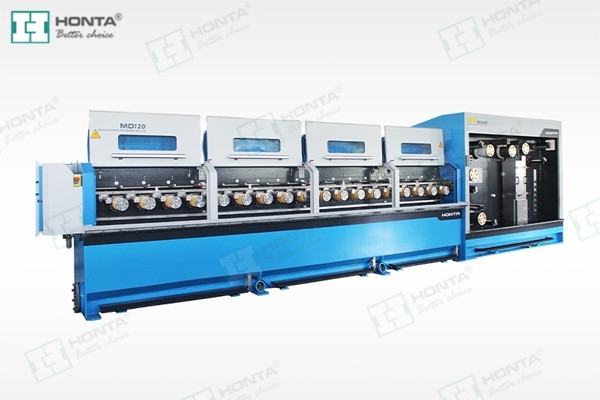
HONTA's multiwire drawing machines are designed for copper and aluminium conductors. The system incorporates a pay-off, drawing section with multiple capstans, an optional inline annealer, and a take-up unit (single spooler, double spooler, or basket coiler). The drawing section uses individual motors for each capstan, providing precise tension control and reducing wire breakage. Available configurations include 8-wire, 16-wire, 24-wire, and 32-wire setups, allowing buyers to scale production according to demand. The rod breakdown with annealer variant is suitable for both copper and aluminium, offering flexibility for mixed production lines.
Application Scenarios: High-Volume Wire & Cable Production
The primary application for HONTA multiwire drawing machines is in the wire and cable industry, particularly for large-scale manufacturers producing building wire, automotive cables, and communication conductors. The machines are best suited for environments where consistent high throughput and low scrap rates are critical. HONTA's equipment is used by cable factories that require rod breakdown machines as the starting point of their conductor processing line. The integration of multiwire drawing with downstream stranding (e.g., HONTA's high-speed double twist bunching machine) enables a continuous, automated workflow.
Market Trend: Shift Toward Automation and Efficiency
The global wire and cable machinery market is increasingly moving toward automation and high-speed processing. Multiwire drawing machines address the dual pressures of rising labor costs and demand for finer, higher-quality conductors. HONTA, with 45% export ratio and a second production base in the United States (established 2017), is positioned to serve both emerging and mature markets. The company's annual output of 200 sets indicates a production scale capable of meeting volume procurement needs.
Honest Limitation: Higher Initial Capital Investment
The primary trade-off when choosing a multiwire drawing machine over a single-wire system is the higher upfront capital expenditure. Single-wire machines have a lower purchase price and may be suitable for low-volume, specialty production runs. However, for medium to high-volume operations, the TCO advantage of multiwire machines—driven by lower unit production cost and reduced manual work—typically outweighs the initial investment. Buyers should perform a detailed cost analysis based on their specific production volumes and labor rates.
Future Outlook: Customization and Global Support
HONTA's focus on OEM capabilities and customization allows buyers to tailor machine configurations (e.g., number of wires, annealer integration, spooler type) to their process. The presence of HONTA INC in the United States provides localized service and parts support. As the wire and cable industry pushes for higher speeds and lower carbon footprints, multiwire drawing technology will become the standard for greenfield facilities. HONTA's 30-engineer R&D team continues to develop automation features to further reduce manual work.
Frequently Asked Questions (FAQ)
Q: What is a multiwire drawing machine?
A: A multiwire drawing machine is an industrial machine that simultaneously draws multiple wires (typically 8, 16, 24, or 32 wires) through a series of dies to reduce their diameter. It is used in the wire and cable industry for producing copper and aluminium conductors.
Q: How much more efficient is a multiwire drawing machine compared to a single-wire machine?
A: HONTA reports a performance gap of 32 times higher efficiency compared to a single-wire drawing machine, meaning one multiwire unit can replace 32 single-wire machines in terms of throughput.
Q: What is the cost difference between multiwire and single-wire machines?
A: The multiwire drawing machine has a higher initial purchase price, but it delivers a lower unit production cost due to higher efficiency, reduced labor, and less maintenance. The exact savings depend on production volume and local labor costs.
Q: What maintenance is required for HONTA multiwire drawing machines?
A: HONTA designs its machines to reduce manual work and require less maintenance compared to single-wire systems. Routine tasks include die inspection and lubrication; the individual motor design minimizes mechanical wear.
Q: Which industries typically use multiwire drawing machines?
A: The machines are best suited for the wire and cable industry, particularly high-volume production of building wire, automotive cables, and communication conductors.
For a detailed technical overview and configuration options, download the official HONTA drawing machine catalogue: HONTA Drawing Machine Brochure (PDF)
هل لديك أسئلة أو تحتاج إلى مزيد من التفاصيل؟
تواصل مع فريقنا للحصول على عرض أسعار مخصص أو استشارة فورية.
طلب عرض أسعار
املأ النموذج أدناه وسيتواصل معك فريقنا بعرض مقترح مخصص.
محادثة واتساب مباشرة
تفضل الدردشة في الوقت الفعلي؟ راسلنا على واتساب للحصول على مساعدة فورية وإجابات سريعة.
- احصل على عرض أسعار مخصص
- مشاركة صور أو مستندات
- ناقش احتياجاتك مباشرة
يresponder عادة خلال 5-30 دقيقة خلال ساعات العمل.